A strong pool accessories list is not about adding more products. It is about selecting the right equipment to protect water quality, improve safety, reduce maintenance pressure, and preserve the finish of a premium pool over time. For villa owners, developers, hospitality operators, and facility managers, the difference between a pool that looks impressive for a season and one that performs year after year usually comes down to the accessories behind the surface.
In high-value residential and commercial settings, accessories are not secondary purchases. They are part of the operating system of the pool. The right combination supports cleaner water, more stable circulation, lower downtime, better swimmer comfort, and a sharper visual result. The wrong combination creates recurring service issues, uneven performance, and unnecessary replacement costs.
What should be on a pool accessories list?
The most effective pool accessories list includes the categories that directly affect day-to-day operation: cleaning tools, water treatment support, safety products, lighting, circulation fittings, heating and cooling support, and practical surround equipment. Which items matter most depends on the size of the pool, whether the property is residential or commercial, and how often the pool is used.
A private villa pool may prioritize elegant lighting, easy cleaning access, and child safety. A hotel or residential tower is more likely to require durable commercial-grade fittings, stronger sanitation control, reliable testing systems, and accessories that can withstand heavy use. That is why specification matters. Premium pools need accessories matched to the project, not a generic shopping cart.
Core cleaning accessories that protect performance
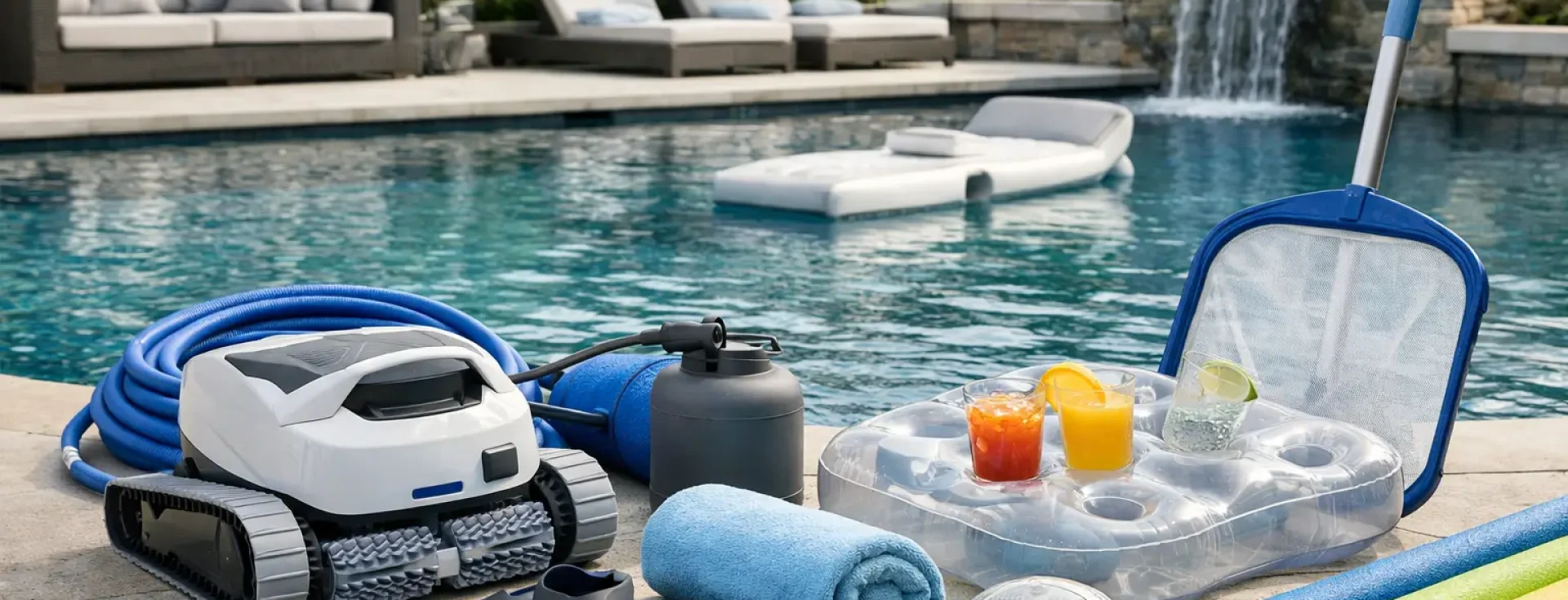
Clean water starts with circulation and filtration, but visible cleanliness depends on accessories that handle the daily burden. Leaf skimmers, wall brushes, vacuum heads, telescopic poles, and flexible hoses remain essential even on highly automated systems. They help remove surface debris, prevent algae buildup on pool walls, and support routine maintenance before small issues turn into water clarity problems.
For larger pools or properties with landscaping, manual tools alone may not be enough. Automatic pool cleaners and suction or pressure-based cleaning accessories can reduce labor and improve consistency. The trade-off is cost and compatibility. Not every cleaner suits every pool finish, hydraulic setup, or debris profile. A pool surrounded by palms and fine dust needs different cleaning support than an indoor lap pool with controlled conditions.
Premium operators usually benefit from choosing durable, commercial-quality cleaning accessories rather than low-cost replacements. Lower-grade tools tend to fail at connection points, wear faster under UV exposure, and create recurring purchasing cycles that add up quickly.
Water treatment and testing accessories
If there is one category that should never be treated as optional, it is water treatment support. Test kits, digital water testing systems, chemical feeders, dosing equipment, and disinfection accessories all contribute to stable water balance. Without them, even a well-designed pool can develop sanitation issues, eye irritation complaints, scaling, corrosion, or cloudy water.
A basic residential setup may only need dependable manual testing and standard chemical handling accessories. A more advanced pool, especially in hospitality or commercial use, often benefits from automated dosing and more precise monitoring. The reason is simple: bather load changes water demand quickly, and manual correction is rarely as consistent as controlled dosing.
There is also a visual and financial angle. Poor water balance can damage tile lines, stainless steel components, pumps, heaters, and decorative finishes. In premium environments, repair costs and reputational costs are both higher. Water testing accessories are not just maintenance tools. They are asset protection tools.
Safety accessories for residential and commercial pools
Safety products deserve a fixed place on any serious pool accessories list. This includes life rings, rescue hooks, depth markers, anti-slip accessories, handrails, ladders, safety signage, and in some settings, pool covers or child-protection barriers. The exact mix depends on the property type and applicable standards.
For family homes, the priority is often preventing accidental access and supporting safe entry and exit. For hotels, clubs, schools, and managed communities, visibility, compliance, and emergency readiness become even more important. A polished pool area should never overlook safety basics in favor of appearance.
The best safety accessories are those that combine durability with clear functionality. Corrosion resistance matters in harsh climate conditions. So does installation quality. A premium handrail or ladder that is poorly fitted becomes a liability instead of an advantage.
Lighting accessories that shape the pool environment
Lighting changes how a pool performs after sunset, but it also affects safety, mood, and perceived value. Underwater lights, niche fittings, transformers, controllers, and color-programmable systems all play a role in the finished result. In luxury homes and commercial properties, lighting is often one of the most visible indicators of quality.
That said, the best lighting choices are not always the most dramatic ones. Some projects call for clean white illumination that enhances water clarity and architectural lines. Others benefit from programmable color effects for entertainment or hospitality settings. It depends on the purpose of the space and the surrounding design language.
LED systems are the standard choice for most modern projects because they offer energy efficiency, long life, and better control. But performance still depends on proper housing, waterproof integrity, and electrical compatibility. Premium aesthetics require premium technical execution.
Circulation, fittings, and hidden accessories
Many of the most important pool accessories are the least visible. Inlet fittings, main drains, skimmers, vacuum points, grating, valves, nozzles, and connection hardware all influence water movement and maintenance efficiency. If these components are underspecified, even the best pumps and filters may not deliver the expected result.
This is especially relevant for commercial pools and large residential installations where circulation dead spots can lead to poor chemical distribution and debris accumulation. Decorative pools and fountain-integrated designs also demand precise fittings to preserve both performance and appearance.
For buyers focused on long-term reliability, material quality matters here. UV resistance, chemical resistance, pressure tolerance, and compatibility with the overall system should take priority over short-term savings. Hidden accessories are often where future maintenance costs begin.
Comfort accessories that improve the user experience
A premium pool should feel as good as it looks. Heat pumps, heat-cool systems, water features, return fittings designed for better flow comfort, and selected surround accessories all shape the user experience. In warm climates, temperature control is not only about heating. Cooling can be just as valuable for comfort during peak summer periods.
This is where project goals matter. A private plunge pool, a rooftop leisure pool, and a hospitality pool deck will not have the same comfort priorities. Some clients want year-round swimming usability. Others want visual elegance and a controlled water environment that supports guest satisfaction.
Accessories in this category should be chosen with the operating profile in mind. Overspending on features that will rarely be used makes little sense. Underspecifying them for a high-expectation property can be just as costly.
How to build the right pool accessories list for your property
The right approach is to build the list around function first, then refine it around finish and brand level. Start with the essentials that affect water quality, circulation, cleaning, and safety. Then evaluate lighting, comfort systems, and aesthetic upgrades based on how the pool will actually be used.
For residential projects, this often means balancing elegance with simplicity. Homeowners usually want dependable equipment that does not complicate maintenance. For commercial buyers and developers, the conversation is different. Durability, standardization, serviceability, and stock availability often matter as much as visual appeal.
Working with a supplier that understands both equipment and technical execution makes the process more efficient. Accessories are rarely standalone decisions. They interact with the pool shell, hydraulic design, filtration setup, electrical planning, and maintenance strategy. That is why experienced guidance adds value long before installation begins.
Aquatic Pools and Fountains serves this need by combining premium product availability with technical support for both residential and commercial projects, which is often what separates a well-equipped pool from one that constantly needs correction.
Why premium buyers should avoid generic accessory selection
A generic pool accessories list may look complete on paper, but it often ignores the realities of climate, usage intensity, finish quality, and maintenance expectations. Premium pools require precision. The accessories should suit the project scale, align with the system design, and support a long operating life.
This is particularly true in demanding environments where heat, dust, heavy occupancy, or design complexity place more pressure on the equipment. Choosing stronger components at the start usually saves time, protects appearance, and reduces service disruption later.
The best accessory plan is not the longest one. It is the one that makes the entire pool system cleaner, safer, more efficient, and easier to maintain without compromising the design standard of the property.
If you are reviewing options for a new installation or upgrading an existing pool, start with the accessories that carry the most operational weight. When those choices are right, the water looks better, the space performs better, and the investment holds its value far more effectively.