
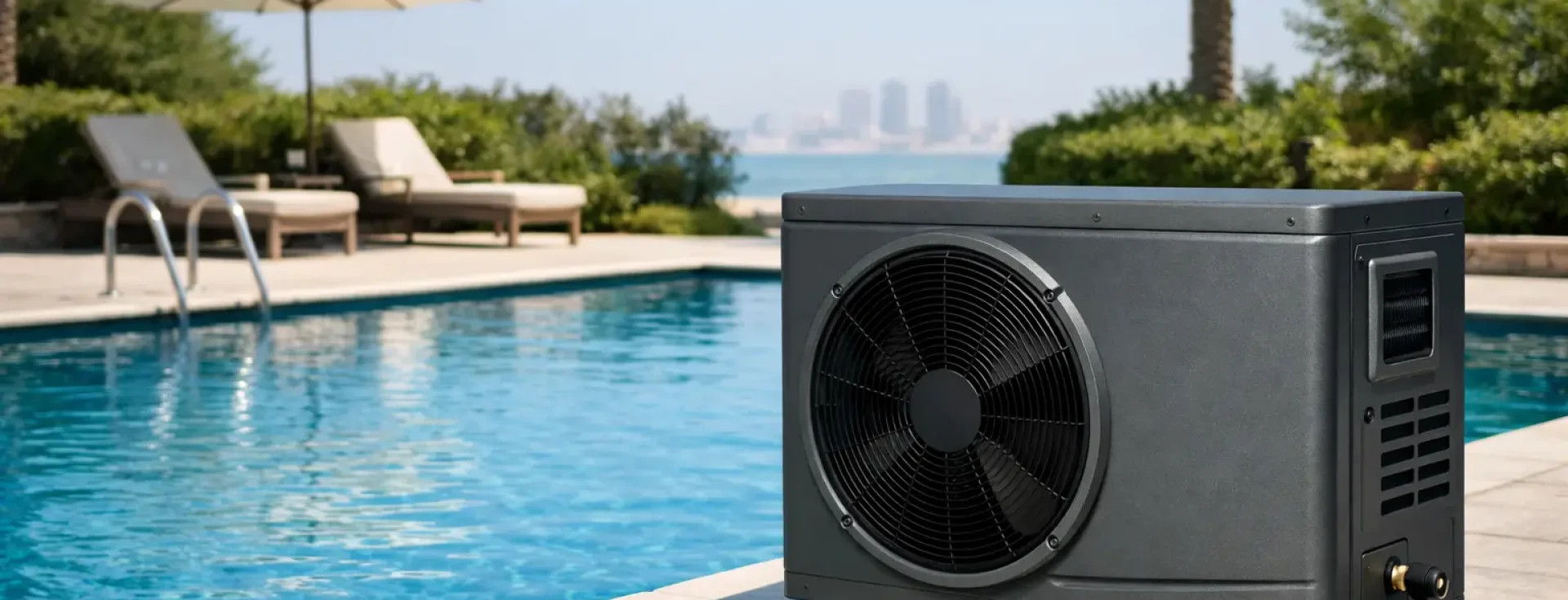
A pool that looks exceptional but is too warm in August or too cool on a winter evening is not delivering its full value. This pool heat pump review looks beyond headline capacity figures to assess what matters for villas, hotels, residential towers, and commercial properties in the UAE: dependable water temperature, operating efficiency, acoustic comfort, and long-term serviceability.
For premium installations, a heat pump should not be treated as an add-on. It is a central part of the pool environment. The correct unit extends the usable season, protects guest comfort, and gives property owners greater control over an amenity that represents a substantial investment.
Pool Heat Pump Review: What a Premium Unit Must Deliver
A pool heat pump transfers heat from ambient air into the pool water rather than generating all heat directly through an electrical element. This principle makes it markedly more efficient than conventional electric resistance heating in suitable conditions. In the UAE, where ambient temperatures are often favorable, that efficiency can make heat pumps an excellent choice for residential and commercial pools.
The best units also reverse the refrigeration cycle to cool the water. This heat-cool capability is particularly relevant in Dubai and across the UAE. During the hottest months, pool water can rise above the temperature many swimmers find comfortable. A properly selected heat-cool pump can help maintain a more refreshing and consistent swimming experience.
However, performance is never defined by a brochure figure alone. Capacity changes with air temperature, humidity, water temperature, wind exposure, and whether the pool is covered. A unit rated under ideal test conditions may need more time to heat a large, exposed pool on a cooler evening. This is why professional sizing matters more than simply selecting the highest kilowatt rating available.
Efficiency: Look at COP, but Read the Conditions
Coefficient of Performance, or COP, indicates how much heat a unit can provide for each unit of electrical energy consumed. A COP of 5, for example, means the heat pump produces five units of heat for one unit of electricity under the stated test conditions. Higher COP figures are attractive, but they should be compared only when the test conditions are equivalent.
For a property owner, the more useful question is how the unit will perform at the temperatures and operating hours expected on site. A pool used mainly after sunset, a shaded indoor pool, and an outdoor pool exposed to strong wind will each have different heating demands. A technical review should account for these real operating factors rather than relying on a single maximum COP claim.
Variable-speed inverter technology is a strong advantage in premium heat pumps. Instead of repeatedly switching fully on and off, an inverter compressor can adjust output as the pool approaches its target temperature. The result is typically quieter operation, steadier water temperature, and lower energy use during maintenance operation. For villas with outdoor entertaining areas and hotels where guest comfort is paramount, this quieter performance is a meaningful benefit.
Heating and Cooling Capacity Must Match the Pool
Capacity selection begins with pool volume, but volume is only the starting point. A 20,000-gallon pool with a thermal cover has very different requirements from an identical-volume pool exposed to open air, night wind, and frequent use. Surface area, location, desired temperature, operating schedule, and circulation system all affect the calculation.
Oversizing is not automatically the answer. An excessively large fixed-output unit can cycle more frequently and may add unnecessary upfront cost. Undersizing is more problematic: it can run for extended periods without achieving the desired temperature, especially when the weather changes or the pool is heavily used. The right specification balances recovery speed, energy consumption, and the client’s expectations.
For commercial projects, capacity planning must also allow for bather load. Hotels, health clubs, and apartment developments can experience sudden demand peaks. Warm water is lost when swimmers enter and leave the pool, while filtration and water-treatment schedules may impose additional operational constraints. Commercial heat pump selection should be coordinated with the complete hydraulic and mechanical design, not handled in isolation.
The Features That Separate Strong Equipment from Average Equipment
Premium pool heat pumps are defined by more than compressor capacity. The following features have a direct effect on performance, durability, and ownership experience:
- Titanium heat exchangers resist corrosion in treated pool water and are particularly valuable for saltwater pools.
- Inverter compressors and fans allow the unit to modulate output, supporting quieter and more economical operation.
- Heat-cool operation gives UAE pool owners valuable control during both cooler and very hot periods.
- Low-noise engineering matters for villas, rooftops, hotel courtyards, and pools close to guest rooms or neighboring properties.
- Smart controls and remote monitoring simplify temperature management and help service teams identify operational issues quickly.
- Durable cabinets and weather protection are essential in outdoor environments exposed to heat, dust, humidity, and coastal conditions.
Not every project requires every premium feature. A private pool used occasionally may prioritize simple, reliable controls and quiet performance. A luxury hotel, meanwhile, may require centralized monitoring, multiple units for redundancy, and more detailed operating control. The correct equipment should reflect the property’s usage profile, not just its size.
Installation Quality Determines Real-World Results
Even the most capable heat pump can underperform if it is installed without proper planning. Airflow is critical. The unit needs adequate clearance around its air intake and discharge so it can exchange heat efficiently. Positioning it too close to a wall, planting, enclosure, or other equipment can restrict airflow and reduce output.
The hydraulic connection must be equally precise. Water flow through the heat pump must remain within the manufacturer’s recommended range. Too little flow can trigger protection alarms or limit heat transfer, while excessive flow may create unnecessary pressure and noise. A bypass arrangement gives technicians the ability to fine-tune water flow and simplify maintenance.
Electrical design should be completed by qualified professionals and coordinated with the equipment’s starting current, cable run, protection requirements, and local regulations. Drainage is also often overlooked. During heating operation, a heat pump produces condensate. This is normal, but it must be directed properly to avoid wet surfaces or confusion with a leak.
For high-value properties, equipment location deserves careful consideration. The unit should be accessible for service, visually discreet where possible, and far enough from bedrooms, terraces, and social spaces to preserve acoustic comfort. At the same time, placing it too far from the pool can increase pipe runs and heat loss. Good design resolves these competing requirements early.
Operating Costs: The Pool Cover Is Part of the System
A heat pump’s operating cost depends less on its nameplate alone than on how the pool is managed. Heat loss occurs primarily at the water surface through evaporation. A quality pool cover can significantly reduce this loss, particularly overnight, and it is often the most practical companion investment to a heating system.
Owners seeking economical operation should set a realistic water temperature and maintain it rather than allowing large temperature swings. Constantly reheating a pool from a low temperature usually consumes more energy than controlled maintenance. Filtration schedules should also provide sufficient circulation time for the heat pump to operate effectively.
In the UAE, cooling mode needs the same disciplined approach. Cooling an uncovered pool during the peak heat of the day can be demanding. Running the system during more favorable hours, using appropriate shading where design allows, and selecting sufficient cooling capacity all contribute to better results.
Maintenance and Service Considerations
Heat pumps are reliable when specified correctly and maintained consistently. Routine checks should include cleaning the evaporator coil, inspecting airflow paths, verifying water flow, checking electrical connections, and reviewing the unit for alarms or unusual noise. Dust accumulation is a practical concern in the region and can restrict airflow if neglected.
Water balance also affects equipment life. Although titanium heat exchangers offer excellent resistance, pool chemistry should always be maintained within recommended ranges. Extremely aggressive water, poor circulation, or untreated scaling can create avoidable problems elsewhere in the hydraulic system.
For commercial facilities, planned maintenance is preferable to reactive repair. A service team that understands pumps, filters, disinfection equipment, automation, and heat-cool systems can assess the complete installation rather than treating each component as separate equipment. This integrated approach is especially valuable when pool comfort, energy use, and water quality must all remain consistent.
Is a Pool Heat Pump the Right Choice?
For most UAE villa pools, hospitality pools, and managed residential amenities, a quality heat-cool pump is a compelling solution. It offers efficient heating when temperatures drop, useful cooling during extreme heat, and a more refined ownership experience than basic heating equipment. It is particularly well suited to owners who value predictable comfort and lower long-term operating costs.
There are exceptions. Small pools with very limited seasonal use may not justify a premium installation. Indoor pools may require a broader humidity-control strategy alongside water heating. Projects with unusual electrical limitations, severe space restrictions, or highly specialized temperature requirements need a tailored technical assessment.
Aquatic Pools and Fountains approaches heat pump selection as part of the complete pool system, considering equipment capacity, hydraulics, location, controls, and ongoing maintenance requirements. The most effective choice is not simply the largest model on the specification sheet. It is the unit designed around the way your property will actually use its pool, so every swim feels intentional rather than weather-dependent.