A pool cover is one of the few upgrades that protects several investments at once: water quality, operating costs, equipment life, and guest safety. This pool cover review looks beyond basic material descriptions to help villa owners, developers, hotels, and facility managers select the right cover for the way their pool is actually used.
For premium properties in Dubai and across the UAE, the decision is rarely as simple as choosing the least expensive option. Intense sun, airborne dust, frequent use, strong evaporation, and high visual expectations place real demands on every component around the pool. The right cover should improve daily operation without compromising the appearance or access expected from a high-quality aquatic installation.
Pool Cover Review: What Separates a Good Cover From the Right One
Every pool cover creates a barrier, but the purpose of that barrier changes by product type. A cover designed mainly to reduce evaporation will not provide meaningful child safety. A heavy-duty safety cover may be highly secure but less convenient for a pool used several times a day. An automatic system delivers exceptional convenience, yet it requires careful engineering during installation and dependable service support over time.
The most effective selection begins with four questions: Is safety the primary concern? How often is the pool used? Is heat retention or cooling cost control a priority? And can the pool deck accommodate tracks, a recessed mechanism, or a storage reel?
For a private villa, the answer may center on protecting children and reducing maintenance between weekend use. For a hotel, residential tower, or corporate property, the cover must also support staff efficiency, appearance, predictable maintenance, and the demands of a larger water surface. Cover performance is therefore as much an operational decision as a product decision.
Automatic Pool Covers: Premium Convenience With Planning
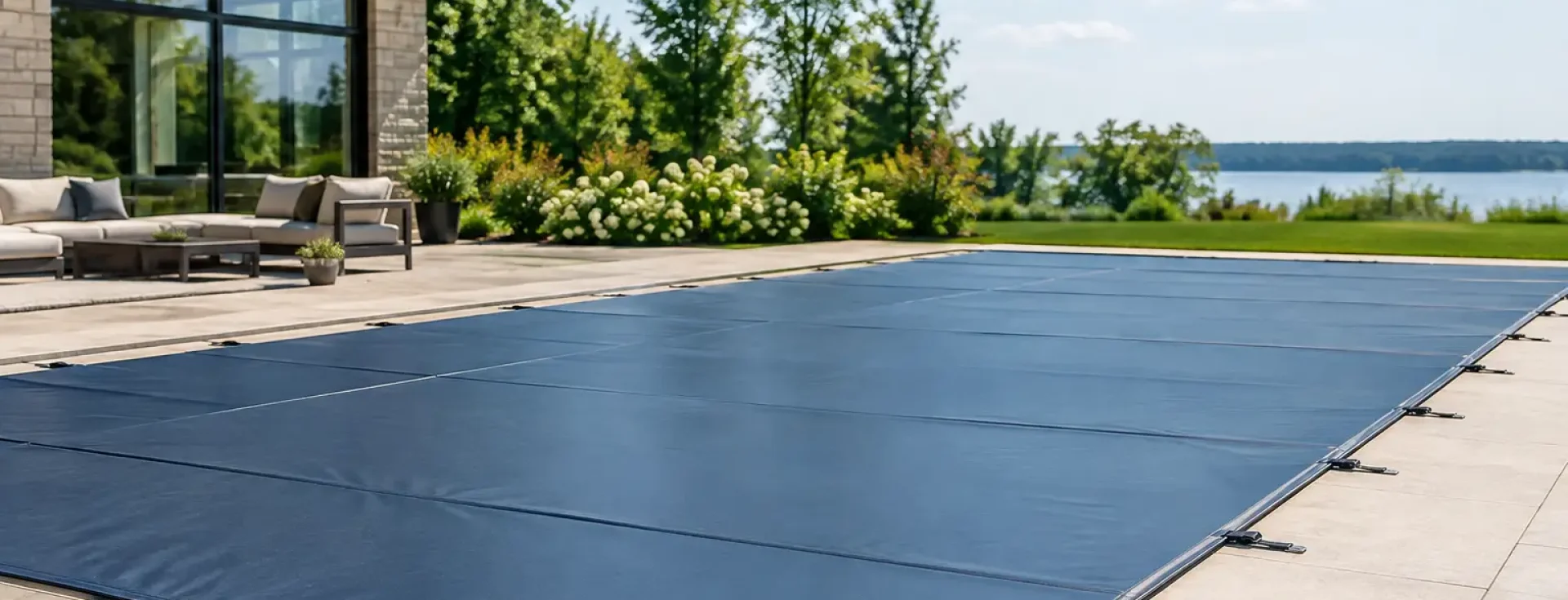
Automatic pool covers are often the preferred option for luxury residential and commercial projects because they can be opened or closed at the push of a button. When specified correctly, they offer a clean, integrated result and make it far more likely that the cover will be used consistently. That matters because even the best cover offers no value when it remains stored away.
These systems use a motorized mechanism to move the cover across the pool surface, typically through recessed or surface-mounted tracks. Recessed installations can create a particularly refined finish, with the cover mechanism concealed below the deck or within a purpose-built housing. This approach is especially suitable for new builds and major renovations where dimensions, drainage, access panels, and structural details can be coordinated early.
The trade-off is cost and technical complexity. The mechanism must be sized for the pool shape and cover weight, while the electrical supply, drainage, track alignment, and service access need professional attention. For pools with freeform shapes, raised spa sections, or extensive water features, a custom assessment is essential. A poorly planned automatic cover can become difficult to operate and expensive to correct.
Not every automatic cover should be treated as a safety cover. Buyers should confirm the product’s stated safety rating, load capacity, locking arrangement, and suitability for the local installation. A premium appearance is valuable, but safety performance must be verified rather than assumed.
Safety Covers: The Strongest Choice for Controlled Access
A safety cover is designed to prevent accidental entry into the water when properly installed and secured. It is a serious consideration for family homes, holiday villas, schools, shared residential facilities, and any property where children or unauthorized visitors may approach the pool outside supervised hours.
Mesh safety covers allow rainwater to pass through while keeping leaves and larger debris out. Solid safety covers block more light and debris, which may reduce algae growth during extended closures, but they require a managed drainage solution so water does not accumulate on top. Both styles rely on secure anchors, correct tension, and strong perimeter support.
The visual and practical compromise is that manual safety covers take time to install and remove. On a large commercial pool, that process may require more than one staff member. They also need careful measuring around ladders, handrails, walls, and irregular corners. Still, where dependable physical protection is the top priority, a properly engineered safety cover remains difficult to surpass.
Solar and Thermal Covers: Efficient Water Management
Solar and thermal covers are designed mainly to slow evaporation and retain heat. In hot, dry climates, evaporation can be a substantial source of water loss and chemical demand. By limiting exposure to moving air, these covers help preserve water temperature and reduce the need for frequent top-ups.
A solar cover can also capture solar energy, which may be useful during cooler months or overnight periods when the pool loses heat. For temperature-controlled pools, thermal blankets can support heat pumps and heaters by reducing heat loss between use periods. The resulting savings depend on the pool’s location, operating schedule, wind exposure, water temperature, and whether the pool is heated or cooled.
These covers are lightweight and practical, particularly when paired with a storage reel. However, they are not a substitute for safety protection. Their material can be damaged by harsh handling, chemical imbalance, and prolonged UV exposure, so premium-grade material and disciplined water chemistry are important. For hospitality pools with continuous guest use, they may be more useful overnight than during the day.
Winter and Debris Covers: Useful Beyond Cold Climates
The term “winter cover” can be misleading in the UAE. A pool may remain operational throughout the year, yet there are still periods of reduced use, travel, renovation, or property vacancy when full debris protection is required. Dust, leaves, insects, and construction residue can quickly affect water clarity and place added strain on filtration equipment.
A durable debris cover is particularly useful for seasonal residences, landscaped villa pools, and sites near active construction. It reduces the cleaning burden and helps prevent organic debris from breaking down in the water. However, it should not be chosen solely by thickness. Attachment method, drainage, UV resistance, and edge reinforcement determine whether the cover remains dependable after repeated exposure to sun and handling.
For pools that will be closed for an extended period, cover selection should be combined with a maintenance plan. Water balance, circulation intervals, chemical treatment, and periodic inspections remain necessary. A cover reduces exposure; it does not eliminate the need for professional pool care.
Material, Fit, and Installation Matter More Than Marketing Claims
A cover performs only as well as its fit and support system. Gaps around the edge allow debris and heat loss, while poor tension can cause sagging, water accumulation, and premature wear. This is why measured, pool-specific solutions are preferable to generic covers for high-value installations.
Look closely at UV stability, seam construction, reinforced edges, anchor quality, track materials, and warranty terms. For automatic covers, ask how the motor is protected from water and dust, what happens during a power interruption, and how technicians access the mechanism for routine service. For manual covers, confirm whether a reel, storage area, and handling procedure are included in the project scope.
Aesthetic integration also deserves attention. Cover boxes, recessed channels, visible anchors, and reels should complement the pool surround rather than look like an afterthought. On luxury projects, the best technical solution is one that protects the pool while preserving the clean lines of the landscape, deck, and water feature.
Choosing the Right Cover for Your Property
An automatic cover is often the strongest long-term choice where convenience, presentation, and frequent use are priorities. A certified safety cover is better suited to properties where secure restricted access is non-negotiable. Solar and thermal covers are practical for managing evaporation and energy use, while debris covers serve pools that face dust, landscaping debris, or periods of closure.
Aquatic Pools and Fountains can help evaluate pool dimensions, usage patterns, surrounding finishes, and technical requirements before specifying a cover solution. This approach avoids a common mistake: buying a cover for a general pool category rather than for the specific conditions of the property.
The right pool cover should feel like part of the installation, not an inconvenience added afterward. When the material, mechanism, and installation method are selected with care, the pool stays cleaner, safer, more efficient, and ready to make the impression the property deserves.