
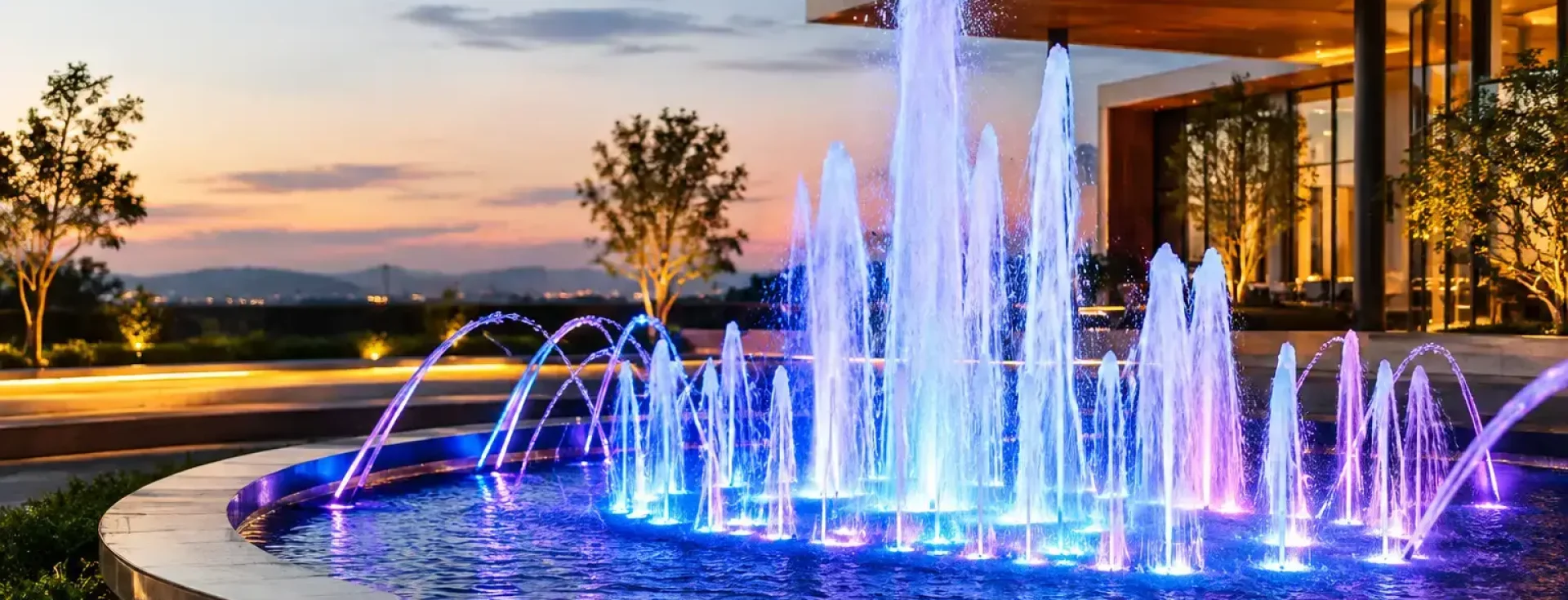
A fountain can look impressive in daylight and disappear completely after sunset – unless its lighting is designed as part of the feature, not added afterward. The strongest LED fountain lighting trends are moving beyond simple color changes toward precise beam control, durable underwater components, and lighting scenes that support the architecture of a villa, hotel, residential tower, or commercial destination.
For premium properties, the objective is not to use the most lights or the brightest colors. It is to create a controlled visual statement that remains elegant, energy-efficient, and dependable in demanding outdoor conditions. In Dubai and across the UAE, that also means selecting equipment built for heat, dust, high-use environments, and regular maintenance access.
LED Fountain Lighting Trends Shaping Premium Spaces
Architectural white remains the foundation
Dynamic RGB lighting attracts attention, but refined white light continues to be the foundation of premium fountain design. Warm white around 2700K to 3000K can complement stone finishes, landscaped villas, hospitality terraces, and traditional architectural materials. Neutral white, often around 4000K, delivers a cleaner appearance for contemporary commercial facades and modern water walls.
The key trend is intentional color temperature rather than a one-size-fits-all fixture choice. A cool white light may make clear water appear crisp, but it can feel harsh against beige paving or warm cladding. Conversely, warm white creates a welcoming effect but may reduce the sharp, sculptural impact of stainless-steel nozzles and tall laminar arcs. The right choice depends on the surface palette, sightlines, and the intended atmosphere after dark.
White light also offers an operational advantage. It is timeless, easier to standardize across a large property, and appropriate every night of the year. Many high-end projects use white as the standard operating scene, reserving color for events, seasonal programming, and brand moments.
RGBW is replacing basic RGB for better light quality
RGB fixtures can create an extensive range of colors, but mixed red, green, and blue light does not always produce a convincing white. RGBW technology adds a dedicated white LED, giving fountain owners stronger white-light performance alongside programmable color effects.
This is a practical upgrade for properties that need both restraint and flexibility. A hotel entrance fountain might operate in warm white during normal service, shift to a subtle corporate color for an event, and use coordinated scenes for public holidays. A residential community may choose calm blues and aquas for evening ambiance without making the water feature look like an entertainment display.
Fixture quality matters more than the number of available colors. Premium LED units should provide even color mixing, stable output, accurate dimming, and reliable sealing. Poor-quality fixtures often reveal individual colored points, produce inconsistent tones, or lose brightness prematurely. These issues are particularly noticeable in shallow basins, clear water, and fountains viewed at close range.
Layered lighting creates depth, not glare
One of the most effective current approaches is layered fountain lighting. Rather than aiming every fixture directly upward, designers combine underwater illumination, nozzle lighting, perimeter accents, and controlled illumination of surrounding landscape or walls. Each layer has a different role.
Underwater lights reveal the body of the water and the base of the fountain. Nozzle lights define moving jets and create drama. Perimeter lighting can establish the shape of the basin, while nearby architectural lighting provides visual context. When these elements are balanced, the fountain feels integrated into the property rather than isolated in a pool of brightness.
The trade-off is that more layers require more planning. Excessive lighting creates glare, reflections that hide the water pattern, and unnecessary maintenance points. The best result is often achieved with fewer, correctly positioned fixtures using the appropriate beam angle and output. A narrow beam can emphasize a tall jet; a wider beam may better suit a bubbling feature or a broad spillway.
Intelligent controls are now an expected feature
Lighting controls have become central to LED fountain lighting trends because they improve both presentation and operating efficiency. Timers, dimming schedules, programmable scenes, and remote control capability allow a property to manage the fountain according to real use.
For a villa, this may be as simple as warm white lighting that activates at sunset and turns off at a set hour. For a hotel, mixed-use development, or corporate property, a more advanced system can coordinate lighting scenes with fountain pumps, music, events, and façade illumination. Separate lighting zones are especially valuable in large installations, allowing the central feature, side jets, and water wall to operate independently.
Control systems should be specified for the project, not selected purely for their app features. A facility manager may need a durable centralized controller with clearly labeled zones and override controls. A homeowner may prefer straightforward smartphone control. In either case, the system should remain practical when staff changes, Wi-Fi is interrupted, or maintenance is required.
Energy efficiency is being evaluated as part of total ownership
LED lighting already uses significantly less power than older halogen systems, but premium clients are looking beyond energy consumption alone. The real measure is total cost of ownership: fixture life, driver quality, cable protection, accessibility, heat management, water chemistry resistance, and the time required to replace components.
A low-cost underwater light can become an expensive choice if it fails repeatedly or requires draining a basin to access it. Quality fountain lighting should be selected with appropriate ingress protection, corrosion-resistant housing, reliable cable glands, and compatibility with the fountain’s water treatment program. Salt exposure, high chlorine levels, mineral content, and chemical dosing can all affect equipment longevity.
For commercial properties, specifying serviceable components and accessible junction points is as important as selecting attractive fixtures. This protects the visual standard of the installation long after handover.
Designing for Water Movement and Viewing Distance
Light does not behave the same way in every fountain. A still reflecting pool, a high-velocity jet fountain, a cascade wall, and a fog feature each require a different lighting strategy. Water movement breaks and reflects light, while water depth and surface texture affect how much illumination reaches the viewer.
Tall jets generally benefit from focused beams positioned to catch the water column without sending glare toward guests or drivers. Cascades often look better when grazed from above or below, revealing texture across the falling sheet. For shallow decorative basins, low-output fixtures may be sufficient, particularly where nearby architectural lighting already contributes ambient brightness.
Viewing distance should guide fixture output and placement. A fountain at a hotel porte cochere is frequently viewed from vehicles and across a wide entry forecourt. Its lighting must read clearly from afar. A courtyard fountain in a private villa is experienced at close range, where light quality, glare control, and concealment of equipment become more important.
Reliability Must Lead the Specification
The visual result is only as strong as the installation behind it. In premium aquatic environments, lighting selection should account for voltage drop, transformer capacity, cable routing, junction-box protection, grounding, bonding, and compatibility with pumps and automation. These technical details are not optional additions. They determine whether a system performs consistently and can be safely maintained.
Professional installation is particularly valuable when fountain lighting is integrated with water treatment, variable-speed pumps, interactive controls, or existing landscape systems. It avoids common failures such as uneven brightness across fixtures, water intrusion at connections, overloaded power supplies, and inaccessible components behind finished stonework.
At Aquatic Pools and Fountains, the right lighting solution begins with how the fountain is built, used, and maintained – not with a catalog color chart. Global-brand equipment, correct fixture placement, and trained technical support provide a stronger foundation for villas, hospitality venues, residential developments, and commercial landmarks.
Choosing the Right Direction for Your Project
The most successful lighting scheme usually has a clear hierarchy. Decide what the fountain should communicate every evening: calm luxury, an arrival statement, a branded commercial moment, or an active event feature. Then select color capability, beam angles, controls, and service access to support that purpose.
For most premium projects, a restrained white-light scene combined with RGBW flexibility provides the best long-term balance. It keeps the feature elegant on ordinary nights while allowing the property to create a more expressive experience when the occasion calls for it. A well-specified LED system should make the water look exceptional without making the technology itself the center of attention.