
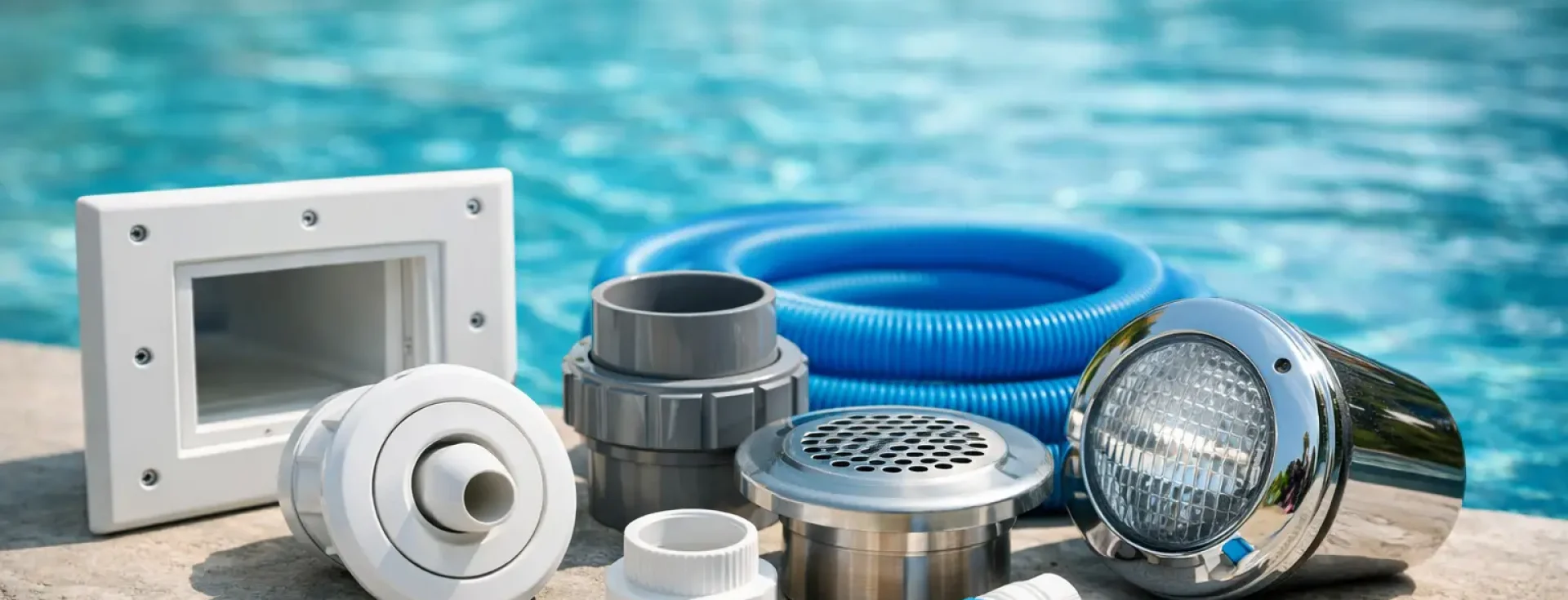
A premium pool can look flawless on the surface and still underperform if the smaller components behind it are poorly selected. That is why pool fitting accessories deserve far more attention than they usually get. These details control water movement, support safety, protect equipment, and shape the finished appearance of the pool far more than many property owners expect.
For villa owners, developers, and facility teams, the difference is rarely about adding more accessories. It is about choosing the right fittings for the pool design, hydraulic demands, finish quality, and long-term maintenance plan. In high-end residential and commercial projects, that decision has a direct impact on durability, visual consistency, and service reliability.
Why pool fitting accessories matter more than they seem
Pool fitting accessories sit at the point where design meets operation. Inlets, outlets, drains, skimmers, vacuum points, return fittings, and related connection components are not decorative extras. They help determine circulation efficiency, water clarity, cleaning effectiveness, and user safety.
A well-designed pool system depends on balance. If the main pump and filter are high quality but the fittings are undersized, incorrectly placed, or made from inferior materials, the whole system can suffer. Water may circulate unevenly. Dead zones can develop. Cleaning becomes less effective. Wear on core equipment can increase over time.
This is especially relevant in the UAE, where pools often operate under demanding conditions. Heat, heavy usage, chemical exposure, and long operating hours all put pressure on the system. In that environment, accessory quality is not a minor specification. It is part of the foundation of a dependable installation.
The core types of pool fitting accessories
When clients ask for pool fitting accessories, they are often referring to a broad category rather than one product line. In practice, these accessories include several functional groups, each serving a distinct role in performance and finish quality.
Return inlets and suction fittings
Return inlets direct filtered water back into the pool and help create effective circulation patterns. Their placement matters. In a compact residential pool, fewer well-positioned returns may be enough. In a larger overflow pool or a commercial installation, the circulation strategy is more complex and requires closer hydraulic planning.
Suction fittings, including vacuum points and wall suction components, support cleaning and water movement. These must be selected with safety and flow requirements in mind. In the wrong configuration, they can reduce efficiency or create service complications later.
Main drains, grates, and skimmers
Main drains contribute to circulation and help remove heavier debris from the lower section of the pool. Their covers and grates must meet performance and safety expectations while also resisting corrosion and chemical wear.
Skimmers are equally important in pools that do not use overflow systems. A premium skimmer should do more than collect floating debris. It should fit cleanly into the pool structure, maintain reliable operation, and support straightforward maintenance access for service teams.
Eyeballs, nozzles, and directional fittings
These smaller accessories often make a major difference. Adjustable directional fittings help control water flow patterns and improve circulation in problem areas. They are particularly useful where pool geometry creates corners or sections with weaker movement.
This is where expert specification matters. Two pools of similar size may require different nozzle arrangements depending on shape, bather load, and surrounding equipment design.
Connection fittings and finishing components
Unions, adapters, wall fittings, flanges, and sealing components are less visible but equally important. Poor-quality connection fittings can lead to leaks, service disruption, or premature replacement. In luxury installations, finishing components also need to match the visual standard of the project. Clean lines, proper alignment, and material consistency all contribute to a better result.
What to look for when selecting pool fitting accessories
The right choice depends on more than catalog availability. High-performing accessories should be evaluated against material quality, compatibility, hydraulic design, and installation standards.
Material is the first checkpoint. Components used in swimming pools must withstand water treatment chemicals, sun exposure, temperature variation, and regular operation without cracking, fading, or degrading. High-grade plastics and corrosion-resistant materials are often the standard, but not every product performs at the same level.
Compatibility comes next. Accessories should work properly with the selected filtration system, pump capacity, pipe dimensions, and pool construction method. A fitting that works well in one system may be a poor match in another. This is where experienced technical guidance saves time and cost.
The finish also matters. In premium residential and commercial settings, accessories must complement the pool interior rather than interrupt it. Visible fittings should feel integrated, not improvised. White, stainless, and specialty finishes each have their place, but the right choice depends on the pool style and operational environment.
Residential vs commercial requirements
Not all pool fitting accessories should be chosen by the same standard. A private villa pool and a hospitality pool face very different demands.
In residential projects, owners often prioritize appearance alongside performance. They want fittings that disappear into the design, support efficient circulation, and require minimal maintenance. Quiet operation, elegant finish quality, and a clean visual outcome usually carry significant weight.
In commercial projects, durability and serviceability become even more critical. Hotels, residential towers, fitness facilities, and shared amenities need accessories that can handle heavier usage and frequent maintenance cycles. Access for inspection, consistency in water turnover, and compliance with broader safety requirements are more important in these environments.
There is overlap, of course. Many luxury residential buyers now expect commercial-grade reliability, while premium hospitality spaces demand residential-level aesthetics. That is why specification should always be project-specific rather than based on simple category assumptions.
Common mistakes that create long-term problems
The most expensive mistake is usually not the product cost. It is choosing accessories that are technically unsuitable and then paying for correction later.
One common issue is treating fittings as interchangeable. They are not. Small dimensional differences, flow characteristics, or material limitations can affect installation and long-term performance.
Another issue is underestimating placement. Even a high-quality return inlet or skimmer can perform poorly if installed in the wrong position. This can lead to circulation gaps, debris buildup, and extra strain on cleaning systems.
The third mistake is buying for initial price rather than lifecycle value. Lower-cost accessories may seem attractive during procurement, especially on large projects. But if they discolor, become brittle, leak, or require early replacement, the real cost rises quickly. For premium pools, reliability is usually the more economical decision.
Why professional specification makes the difference
Pool fitting accessories are best selected as part of the full hydraulic and construction plan, not as an afterthought. That approach reduces installation conflicts, improves performance, and supports cleaner finishing on site.
An experienced supplier looks beyond the product itself. They assess pool type, structural details, usage patterns, finish materials, and system requirements before recommending a fitting package. That level of planning is particularly valuable in custom projects, overflow systems, spa integrations, and larger commercial developments where accessory coordination affects several trades at once.
This is where a full-scope partner adds real value. Aquatic Pools and Fountains supports clients not only with product availability, but also with technical guidance, branded equipment options, and installation-focused recommendations that suit both luxury residential and demanding commercial environments.
A better standard for pool fitting accessories
The best pool fitting accessories do not call attention to themselves. They simply perform, year after year, while preserving the appearance and operating quality of the pool. That takes the right material, the right design, and the right specification from the start.
For property owners and project teams aiming for a premium result, accessories should be chosen with the same care given to pumps, filters, lighting, and surface finishes. Small components shape big outcomes. When they are selected correctly, the pool looks better, runs better, and stays easier to maintain over the long term.
If you are planning a new pool, upgrading an existing system, or sourcing for a large-scale development, the smartest move is to treat fittings as performance-critical infrastructure. That is how refined aquatic spaces keep their standard long after handover.