
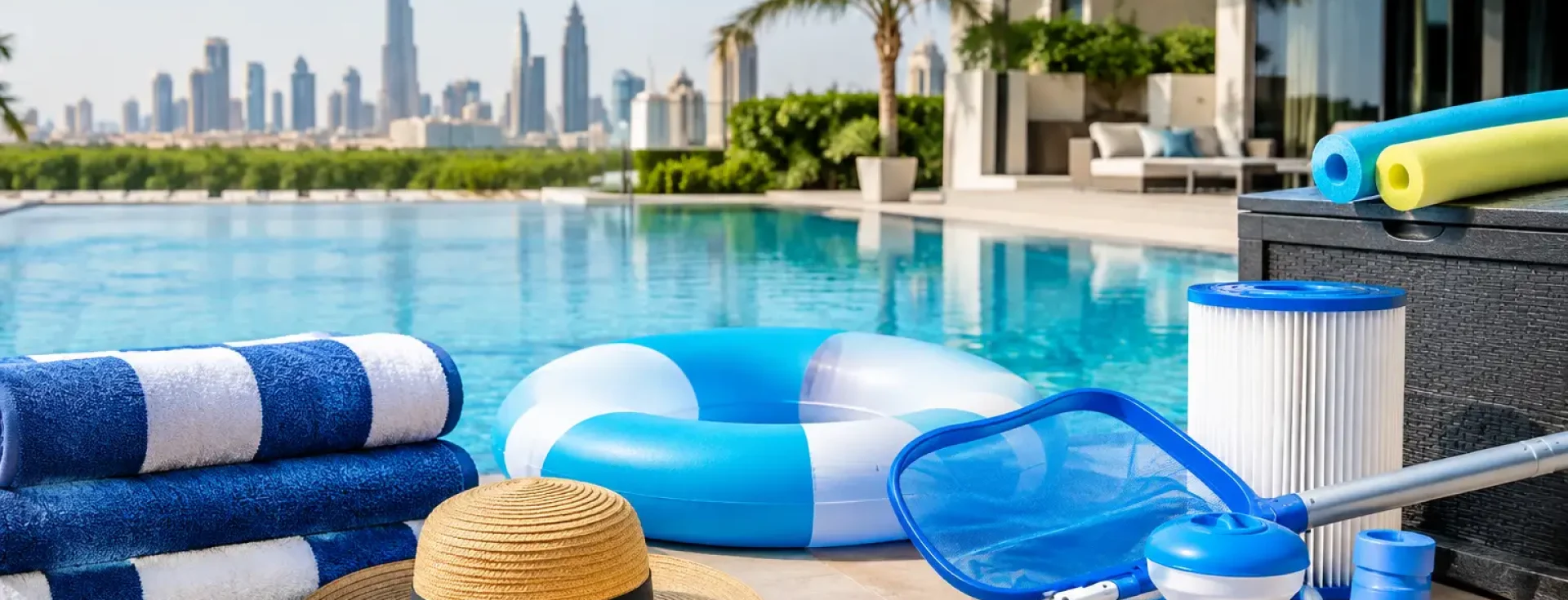
A luxury villa pool should look effortless from the terrace, but that result depends on equipment working hard behind the scenes. This essential villa pool accessories list focuses on the components that protect water quality, improve safety, simplify upkeep, and give the pool area the polished finish expected in premium UAE properties.
The right selection is not simply a matter of adding more products. A compact plunge pool, a family leisure pool, and a high-use hospitality-style villa pool have different circulation, lighting, and safety demands. Heat, airborne dust, high bather loads, and frequent outdoor entertaining should all influence the specification.
Essential Villa Pool Accessories List: Start With Water Quality
Clear water is the visible sign of a properly equipped pool, but clarity alone is not a measure of hygiene. Reliable circulation, filtration, and treatment accessories must operate as one system. Choosing premium, correctly sized equipment reduces avoidable service calls and protects the finishes, fittings, and comfort of everyone using the pool.
Circulation pump and filtration equipment
A high-performance pool pump is the foundation of daily water movement. It pulls water through skimmers and main drains, sends it to the filter, and returns treated water through inlet fittings. For villas, variable-speed pumps are often a strong choice because they can deliver quieter operation and lower energy use when the pool does not require full-speed circulation.
The pump must be matched to the pool volume, pipework, water features, and filter capacity. Oversizing can create unnecessary noise and energy consumption, while undersizing may leave dead zones where debris and contaminants collect. A professional flow calculation is especially valuable when a pool includes a spa, overflow edge, waterfall, or fountain feature.
A quality sand, glass media, or cartridge filter captures fine debris before it returns to the pool. Glass media can provide excellent filtration performance and may require less frequent backwashing than traditional sand, while cartridge filters can suit some compact installations where water conservation is a priority. The best option depends on the pool design, local service routine, and available plant-room space.
Automatic disinfection and chemical control
Manual chemical dosing can be appropriate for small pools with attentive owners, but it leaves too much room for inconsistency in a busy villa. Salt chlorinators, automatic chlorine dosing systems, pH controllers, and UV or ozone disinfection systems create a more stable treatment process.
A salt chlorinator is popular for its softer-feeling water and reduced need to handle packaged chlorine. It still produces chlorine, however, and requires correct salt levels, cell inspection, and balanced water chemistry. UV and ozone systems add another layer of disinfection support, but they do not replace the need for a residual sanitizer in the pool water.
For premium residential and commercial-standard properties, automated pH and sanitizer control offers a practical advantage: chemistry is adjusted according to measured conditions rather than guesswork. This helps reduce eye irritation, surface damage, and the sharp chemical odor often associated with poorly balanced water.
Water testing tools and essential chemicals
Even automated systems require verification. A dependable digital test kit or photometer provides accurate readings for sanitizer, pH, alkalinity, calcium hardness, and stabilizer levels. Test strips offer a quick indication, but they are best used as a convenience tool rather than the sole basis for chemical decisions.
Keep correctly labeled chemicals in a cool, dry, ventilated storage area away from children, ignition sources, and incompatible products. The core treatment stock generally includes sanitizer, pH increaser or reducer, alkalinity balancer, calcium treatment, shock treatment, and algaecide when required. Products should be selected for the specific treatment system, not bought as a generic package.
Cleaning Accessories That Protect the Finish
Desert dust, landscaping debris, sunscreen residue, and heavy weekend use can quickly affect the appearance of a villa pool. Cleaning accessories are not secondary purchases. They prevent buildup that can stain tile lines, strain the filtration system, and make water treatment less efficient.
A well-equipped cleaning set includes:
- A telescopic pole, leaf net, and surface skimmer for fast removal of leaves and floating debris.
- A pool brush suited to the surface, such as nylon for vinyl and delicate finishes or stainless steel options for more durable plaster surfaces.
- A manual vacuum head and hose for targeted cleaning in steps, corners, and areas a robot may miss.
- A robotic pool cleaner for regular floor and wall cleaning with less manual effort.
- A tile-line brush or dedicated cleaner to remove oils, mineral deposits, and sunscreen marks before they become difficult to treat.
Robotic cleaners are particularly valuable for large villas and properties with frequent guest use. They reduce the burden on staff and can improve cleaning consistency. Still, a robot is not a substitute for brushing, water testing, or periodic professional inspection. Pools with intricate steps, sharp angles, or negative edges may need a model selected specifically for those geometries.
Safety Equipment Is Part of a Premium Pool Design
Safety accessories should be specified early, not added only after an incident or inspection concern. A refined pool environment can remain visually open while providing effective protection for children, guests, and maintenance personnel.
A compliant safety cover is one of the most valuable additions for family villas. It limits unauthorized access, reduces evaporation, keeps debris out, and can support heat retention. The correct cover depends on the pool shape and intended use. Lightweight floating covers offer efficiency benefits but are not safety barriers, whereas engineered safety covers are designed for a higher level of protection.
Additional safety equipment should include anti-entrapment drain covers, clearly visible depth markers where appropriate, sturdy handrails for steps, and a reachable rescue pole or ring buoy. If young children live in or visit the property, removable pool fencing and self-closing gates deserve serious consideration. These measures should complement supervision, never replace it.
For shared villa compounds, developer-managed homes, and hospitality residences, safety signage and emergency equipment should be maintained as carefully as decorative finishes. Sun exposure can degrade plastic components, fade markings, and weaken poorly specified materials over time.
Lighting, Heating, and Comfort Accessories
After sunset, lighting determines whether the pool feels like a feature or an unusable dark surface. LED underwater lights provide energy-efficient illumination and can be specified in warm white or color-changing options to suit the architecture. Quality fixtures, properly sealed niches, and professionally installed low-voltage connections are essential for both appearance and electrical safety.
Warm white lighting often complements stone, wood, and contemporary villa landscaping more naturally than constantly changing colors. Color systems can be effective for entertaining, but they should be controlled simply and used with restraint. The goal is to highlight water movement and pool contours, not overwhelm the outdoor setting.
In the UAE, a heat-cool pump can extend comfortable swimming beyond the hottest months and help manage water temperature during intense summer conditions. A pool that becomes uncomfortably warm may encourage algae growth and reduce user comfort. Heat-cool equipment should be sized around pool volume, desired temperature range, ambient conditions, and operating hours.
Pool covers also support comfort and operating efficiency by reducing evaporation, heat loss, and chemical consumption. For homeowners who value an unobstructed terrace, automated cover systems can be integrated discreetly into the pool design, although they require careful planning during construction or renovation.
Surround Equipment for a Complete Villa Pool Area
The area around the water deserves the same attention as the pool itself. Outdoor showers reduce the amount of dust, oils, and sunscreen entering the water. Storage reels keep hoses and covers organized. Durable drainage grates, non-slip deck finishes, and high-quality ladder or rail fittings make everyday use more comfortable and safer.
For villas with fountain elements, water blades, bubblers, or cascade features, install the appropriate valves, dedicated pump controls, and service access from the beginning. Decorative water features can elevate the visual impact of a property, but poorly planned hydraulics create noise, splash, and maintenance complications. Premium components should be selected for corrosion resistance and ease of future servicing.
Smart control panels are another worthwhile accessory for owners who travel frequently or manage several properties. Depending on the system, they can schedule pumps and lights, adjust heating, monitor treatment equipment, and flag operating issues. Convenience is valuable, but professional commissioning remains essential so automated schedules support proper circulation and treatment.
Specify for the Pool You Have, Not the Pool You Imagine
The most effective accessory plan balances visual expectations with operational reality. A quiet variable-speed pump, dependable filter, automated dosing, quality cleaner, safety cover, tested lighting, and correctly selected comfort equipment will deliver far more value than decorative additions chosen without technical planning.
Aquatic Pools and Fountains supports villa owners, developers, and facility teams with premium equipment selection, installation expertise, and maintenance guidance tailored to each pool environment. The right accessories should make ownership feel more refined, not more demanding. Start with the systems that protect water, people, and equipment, then add the finishing details that make every swim feel exceptional.