
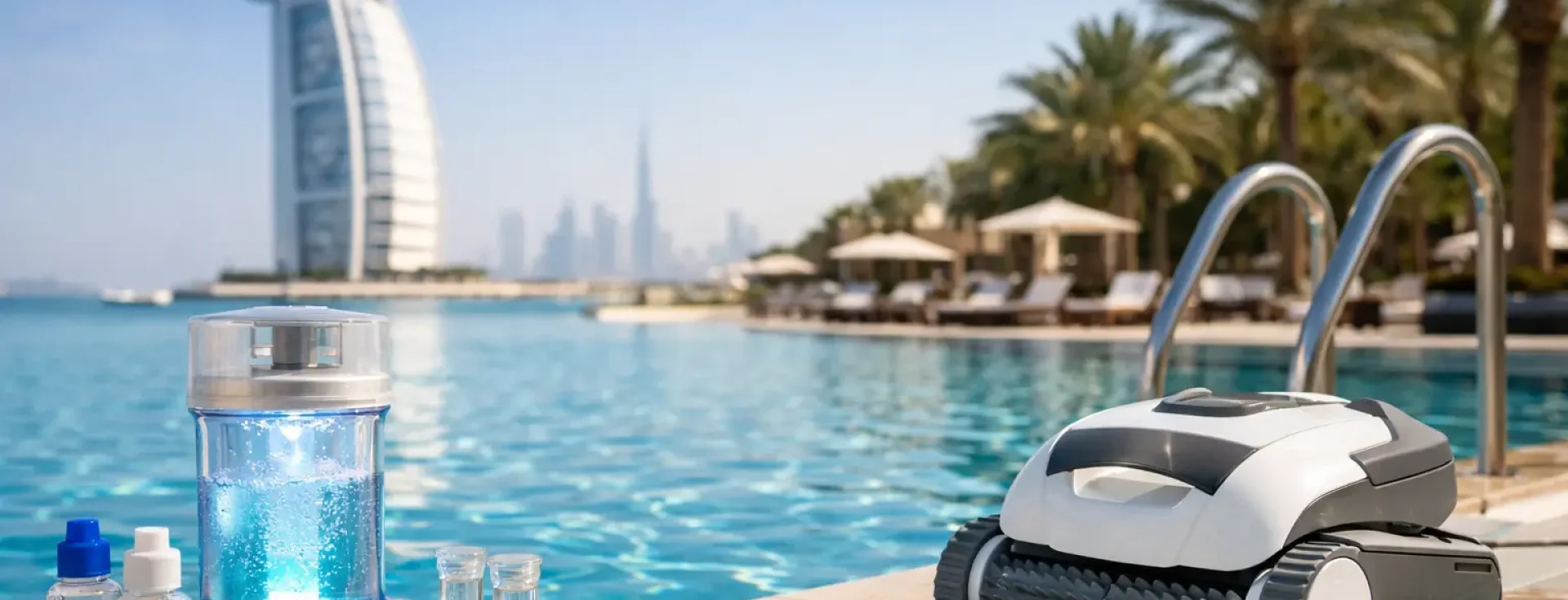
A clear, comfortable pool is no longer judged only by how it looks under the lights. For villa owners, hospitality operators, and facility managers, the future of pool sanitization is about delivering consistently safe water with less chemical odor, fewer manual corrections, and better control over operating costs. In the UAE, where high temperatures, heavy pool use, dust, and evaporation can quickly affect water balance, that shift has real operational value.
The direction is not toward a chemical-free pool. Effective sanitation still requires a dependable residual disinfectant in most applications. Instead, modern systems are designed to reduce unnecessary chemical demand, improve oxidation, and give operators accurate information before a water-quality issue becomes a guest complaint or maintenance emergency.
The Future of Pool Sanitization Is Layered
The strongest pool sanitation strategy does not rely on one device to solve every water-quality challenge. It combines circulation, filtration, primary disinfection, supplemental treatment, and regular testing into one coordinated system. This layered approach is especially valuable for premium pools, where water clarity, comfort, and reliability are expected every day.
Chlorine remains a practical and widely accepted primary sanitizer because it provides a residual level of protection throughout the pool. However, chlorine alone must manage every contaminant introduced by swimmers, windborne debris, cosmetics, and organic matter. That workload can lead to chloramines, the compounds often responsible for a sharp pool smell, eye irritation, and reduced water comfort.
Future-focused installations use secondary treatment technologies to reduce that burden. Ultraviolet systems, ozone generators, and carefully engineered salt chlorination can each improve results, but they perform differently and must be selected for the pool’s size, bather load, hydraulic design, and intended use.
UV treatment for improved water comfort
UV systems expose circulating water to ultraviolet light inside a treatment chamber. The process helps break down chloramines and can inactivate a broad range of microorganisms as water passes through the unit. For hotel pools, residential towers, schools, and high-use amenity facilities, UV can support a noticeably fresher pool environment with reduced combined-chlorine concerns.
UV does not leave a sanitizer residual in the pool itself. For that reason, it works alongside chlorine or another approved residual disinfectant rather than replacing it. Correct flow rate, lamp condition, chamber cleanliness, and professional sizing are essential. An undersized UV unit or a system installed without regard to actual circulation performance will not deliver the expected benefit.
Ozone for oxidation support
Ozone is a powerful oxidizer generated on site and injected into the circulation system. It can help treat organic contaminants and improve water clarity, particularly when combined with effective filtration and contact time. In premium residential pools and selected commercial applications, ozone can reduce the amount of conventional chemical correction needed to maintain polished water quality.
Its trade-off is technical complexity. Ozone must be safely generated, properly injected, and managed so it does not reach swimmers at undesirable levels. It is best treated as part of a professionally designed equipment package, not as an add-on selected only by pool volume. For projects where aesthetics and low-odor water matter, the investment can be justified. For a lightly used private pool, a high-quality salt system and automation may be the more practical choice.
Salt Chlorination Is Becoming More Refined
Saltwater pools are often described as chlorine-free, but that is inaccurate. A salt chlorinator uses dissolved salt to generate chlorine on site. The advantage is steadier sanitizer production, reduced handling of packaged chlorine, and water that many swimmers find more comfortable when properly balanced.
The next generation of salt systems offers more than simple output control. Better units can communicate with automation platforms, adjust production based on operating schedules, and provide diagnostic alerts when the cell needs cleaning or the water chemistry is outside an efficient range. This is useful in the UAE, where intense sunlight and warm water can increase chlorine demand and accelerate scale formation on equipment.
Salt chlorination still requires disciplined water management. pH, total alkalinity, calcium hardness, cyanuric acid, and salinity must stay within suitable ranges. In hard-water areas, scale control is particularly important for protecting the salt cell, heater or heat-cool pump, and circulation equipment. The right system reduces daily intervention, but it does not eliminate professional maintenance.
Smart Automation Turns Data Into Better Decisions
Automation is likely to have the greatest day-to-day impact on the future of pool sanitization. Instead of relying solely on occasional manual readings, connected controllers can track pH, oxidation-reduction potential, temperature, flow, and in some cases free chlorine. The system can then signal when dosing is required or operate compatible dosing equipment within programmed limits.
For facility managers responsible for multiple pools, this creates a more controlled maintenance environment. Trends become visible: sanitizer demand may rise during a holiday period, pH may drift after heavy rainfall or top-up water additions, or a recurring flow issue may indicate a filter or pump concern. Acting on those signals early is less disruptive than responding after the water turns cloudy.
Automation should not be confused with set-and-forget operation. Sensors require calibration, probes need cleaning, and chemical feed equipment must be inspected by qualified technicians. The value lies in consistency and visibility, supported by manual verification and a clear service schedule.
Remote oversight for premium properties
Remote monitoring is particularly relevant to villas that are vacant for part of the year, large residential communities, and hospitality sites where water presentation affects the property experience. Authorized operators can review key readings, adjust approved settings, and schedule service before guests or residents are affected.
This also supports a more efficient maintenance model. Rather than making routine adjustments based on guesswork, service teams can arrive with a clearer understanding of the system condition. For commercial operators, documented readings and service history can also support internal compliance procedures and quality assurance.
Filtration and Hydraulics Still Set the Standard
No sanitizer can compensate for poor circulation. The future of sanitation is closely tied to filtration performance, pump sizing, return placement, skimmer operation, and turnover time. Water must reach the treatment equipment, and treated water must circulate effectively through the entire pool.
Variable-speed pumps are an important part of this development. They allow operators to match flow rates to filtration, heating, cleaning, and sanitation requirements instead of running at one high speed all day. When selected and programmed correctly, they can reduce energy use while maintaining the circulation needed for reliable water quality.
Filtration choices also matter. A well-sized sand, glass media, cartridge, or regenerative media filter removes suspended particles that can cloud water and shield contaminants from disinfection. The best option depends on the project, available plant-room space, water source, maintenance capability, and bather load. A luxury villa and a busy hotel pool should not be designed around the same assumptions.
What Property Owners Should Prioritize Now
The most effective upgrade begins with an assessment of the complete pool system, not a single product category. Existing circulation capacity, filter condition, chemical storage, electrical supply, plumbing layout, control compatibility, and actual pool use all influence the right recommendation.
For a private villa pool, the priority may be salt chlorination, automated pH control, and dependable filtration for simple daily ownership. For a hotel, club, or residential development, UV or ozone may be added to a commercial-grade dosing and monitoring system to manage higher bather loads and protect the guest experience. Decorative pools and fountains require a separate approach, since water chemistry must also consider equipment finishes, spray patterns, and public exposure.
Aquatic Pools and Fountains supports this level of planning with premium equipment, technical guidance, installation capability, and ongoing maintenance support for UAE residential and commercial properties. Selecting global-brand components is valuable, but correct integration, commissioning, and service are what turn those components into a dependable water-treatment system.
The best sanitation investment is the one that keeps water safe, clear, and comfortable while fitting the property’s real operating demands. Start with accurate testing and sound hydraulics, then build the right treatment combination around them. That is how a pool remains an elegant asset rather than a recurring maintenance concern.