
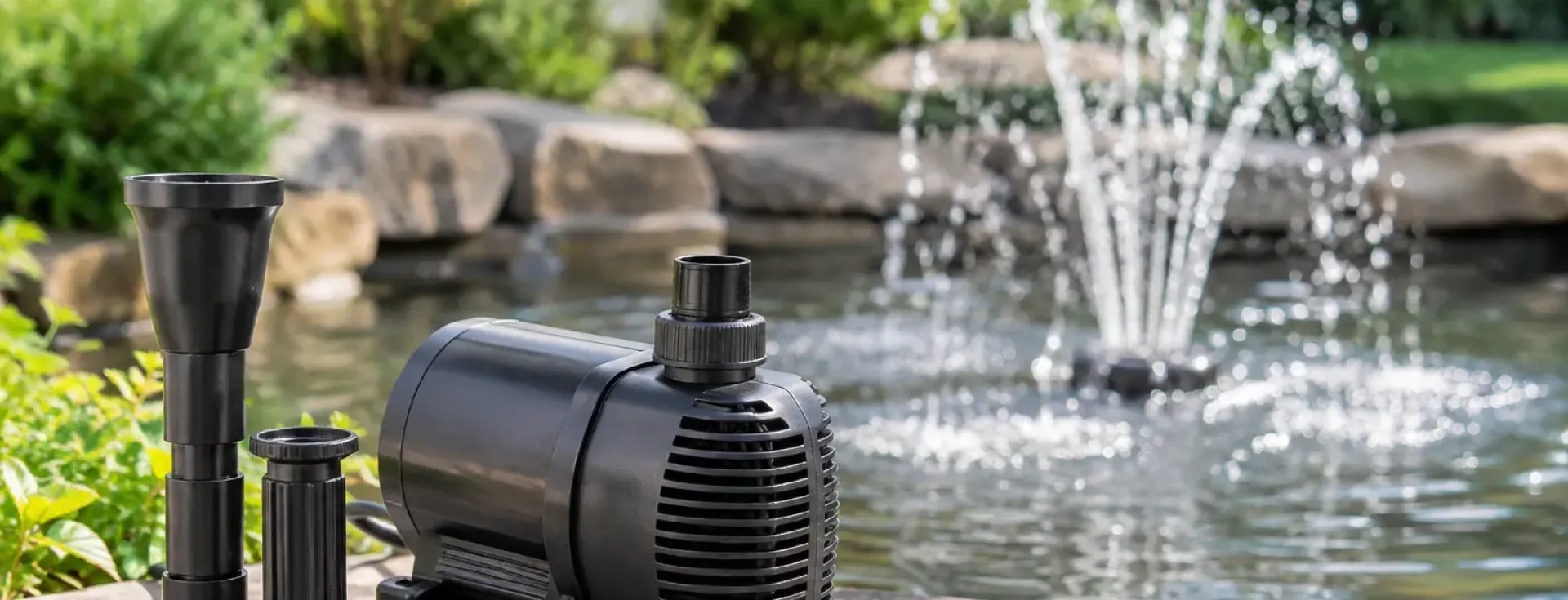
A fountain can look effortless while its pump works under demanding conditions every hour of the day. Knowing how to choose fountain pump equipment correctly is what separates a refined, consistent water display from weak jets, uneven cascades, excessive noise, and avoidable maintenance costs. For villas, hotels, towers, and commercial landscapes, the right pump must support both the intended visual effect and the long-term requirements of the installation.
Start With the Fountain Effect You Want
A fountain pump should be selected for the water feature, not simply for the size of its basin. A small bubbling urn, a wall spillway, a formal tiered fountain, and a high-visibility hotel entrance display all require very different flow characteristics.
Begin with the desired movement of water. Gentle bubbling and low cascade features need controlled, moderate flow. Sheet waterfalls and wide spillways need enough volume to create an unbroken, even curtain of water. Jet nozzles need pressure as well as flow to reach the specified height and maintain a clean pattern. A pump that is too small will leave the feature looking underpowered. A pump that is too large can cause splash-out, excessive sound, wasted energy, and premature wear on pipework and fittings.
For a premium installation, appearance should be measured rather than estimated. The width of a spillway, the number and type of nozzles, the target jet height, and the effect of wind exposure all influence the final pump specification.
How to Choose a Fountain Pump by Flow Rate
Flow rate is the amount of water a pump moves within a set time, usually measured in gallons per hour or gallons per minute. It is the starting point for any fountain pump selection, but it is not the only figure that matters.
A broad waterfall requires flow across the full width of the outlet. If one section receives less water than another, the result is a broken sheet rather than a polished visual finish. Multiple jets also require the total flow demand to be calculated across every active nozzle, with appropriate allowance for valves and distribution losses.
Manufacturers publish flow charts for their pumps. These charts show how much water the unit can deliver at different operating conditions. Do not choose a model based only on its maximum advertised flow rate. That figure is normally measured with minimal resistance, not in a completed fountain system with vertical lift, bends, valves, filters, and pipe runs.
A professionally specified system also allows for adjustment. A slightly oversized pump paired with the correct flow-control valve or variable-speed control can offer more flexibility than a pump operating continuously at its absolute limit. However, oversizing without a proper hydraulic design is not a premium solution. It can create unnecessary operating expense and place strain on the feature.
Calculate Total Dynamic Head, Not Just Vertical Height
The most common selection mistake is looking only at how high the water must travel. Vertical lift matters, but total dynamic head is the more accurate measure of what the pump must overcome.
Total dynamic head combines the vertical height between the water level and the outlet with friction losses created by pipe length, pipe diameter, elbows, tees, valves, filters, and fittings. Narrow pipework increases resistance. Long runs from a plant room to a feature can also reduce the available flow more than expected.
For example, a pump may need to raise water only six feet to a fountain nozzle, but the actual demand will be higher if the system includes a long pipe run, several directional fittings, a filter, and a control valve. Select the pump using the flow rate required at the calculated total dynamic head. This is the point where the pump curve, rather than the label on the box, becomes essential.
For larger villa landscapes, hotel courtyards, and public-facing water features, hydraulic calculations should be reviewed before equipment is ordered. Correct sizing protects the visual quality of the fountain and avoids costly changes after stonework, tiling, or landscaping is complete.
Pipe Size Has a Direct Effect on Performance
Pipe sizing is part of pump selection. Undersized pipe restricts water movement and can force the pump to work harder. It may also increase water noise within the lines and make it difficult to balance multiple outlets.
Where the design includes several nozzles or waterfall points, the distribution manifold should be sized to provide consistent delivery. Individual control valves can then be used to fine-tune each outlet during commissioning. This level of adjustment is especially valuable in formal fountains, where symmetrical water patterns are part of the design standard.
Select the Right Pump Type for the Installation
Submersible fountain pumps are installed below the water surface, making them a practical choice for compact ornamental fountains, pondless features, and smaller residential installations. They can be discreet, relatively straightforward to install, and effective when the pump remains accessible for cleaning and servicing.
External pumps are typically preferred for larger or more demanding systems. Installed in a dedicated equipment area, they are suitable for higher flow requirements, longer pipe runs, multiple water effects, and applications where technicians need easy access for inspection and maintenance. Commercial fountains, hotel features, and complex residential installations often benefit from an external pump configuration.
The right choice depends on the design, available plant space, service access, sound expectations, and operating schedule. An external pump may require more planning at the beginning, but it can provide better long-term serviceability for a high-value feature. A submersible option may be ideal where simplicity and concealment matter most.
Consider Water Quality, Filtration, and Materials
Fountain water carries leaves, dust, sand, landscape debris, and mineral deposits. In Dubai and across the UAE, heat, evaporation, and dust exposure can make water management more demanding. A pump should not be expected to compensate for inadequate filtration or poor basin maintenance.
Choose a system with a suitable pre-filter or intake screen to reduce debris entering the pump. Larger installations may need dedicated filtration, strainers, balancing tanks, automatic fill controls, and water treatment equipment. These components help preserve water clarity and reduce the risk of blocked nozzles or damaged impellers.
Materials also matter. Pumps, fittings, and electrical components should be selected for continuous water exposure and the chemistry used in the feature. If the fountain operates with treated water, confirm that seals, housings, and internal components are compatible. Premium equipment is not simply about the initial finish. It is about maintaining dependable performance through years of operation.
Account for Energy Use, Noise, and Operating Hours
A fountain at a private residence may run for a few hours each evening. A lobby, hotel entrance, retail complex, or residential tower may operate its feature for much longer periods. Operating hours should influence both pump selection and control strategy.
Energy-efficient pumps and variable-speed options can reduce consumption when full display output is not required. Timers, programmable controllers, and automation can schedule operation around occupancy, events, or cooler evening periods. For prominent commercial properties, these controls also allow the fountain to be coordinated with lighting and other landscape elements.
Noise deserves equal attention. A pump that sounds acceptable in a distant plant room may be disruptive beside a patio, reception area, or outdoor dining space. Pump location, vibration isolation, pipe support, and enclosure design all contribute to a quieter installation. The sound of falling water should be a design feature, not an attempt to hide mechanical noise.
Do Not Overlook Electrical Safety and Service Access
A fountain pump is electrical equipment operating close to water, so safety requirements must be addressed from the outset. Use properly rated equipment, protected circuits, appropriate grounding, and professional installation practices. Outdoor equipment must also be suitable for the environmental conditions of its location.
Service access is equally important. Pumps need periodic inspection, intake cleaning, and maintenance. A beautifully finished fountain becomes difficult to own if technicians must remove stonework or drain the entire basin to reach a basic service point. Access panels, isolation valves, unions, and adequate plant-room clearance make routine work faster and help protect the investment.
Get a Pump Specification, Not a Guess
For a simple decorative feature, a pump can often be selected from the feature dimensions, nozzle details, and pipe layout. For luxury villas, hospitality properties, developments, and multi-effect fountains, a full specification is the better approach. It should identify the required flow, total dynamic head, pump type, electrical load, pipe sizes, filtration needs, control equipment, and maintenance access.
Aquatic Pools and Fountains supports clients with premium fountain equipment, technical guidance, installation planning, and maintenance solutions for residential and commercial projects. Selecting from quality equipment with the right hydraulic design provides a stronger result than choosing a pump based on price or maximum flow alone.
The best fountain pump is the one that makes the water feature look precisely as intended while remaining quiet, efficient, accessible, and dependable long after the first impression.