
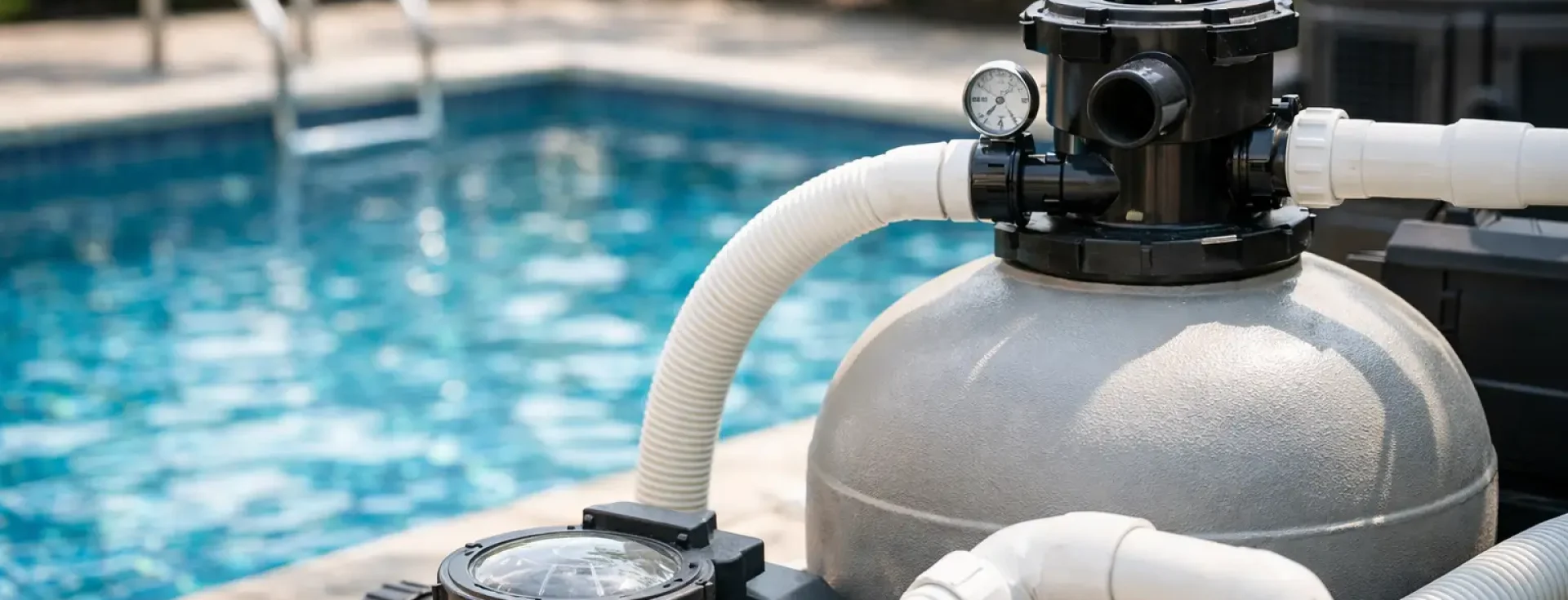
A premium pool can have the finest tile, lighting, and circulation equipment, yet still lose its clarity if the filter is undersized. Knowing how to size pool filter equipment correctly protects water quality, reduces pressure on the pump, and helps a pool maintain the polished appearance expected at a villa, hotel, residential tower, or commercial property.
Filter sizing is not a matter of choosing the largest tank available. It is a technical decision based on pool volume, desired turnover time, pump flow, plumbing design, bather load, and the filter media selected. A correctly sized system provides consistent circulation without excessive resistance, frequent cleaning, or unnecessary energy consumption.
Start With the Pool’s Total Water Volume
The first step is calculating how many gallons the pool holds. This figure determines the amount of water that must pass through the filtration system during each turnover cycle.
For a rectangular pool, multiply length by width by average depth, then multiply the result by 7.48 to convert cubic feet to gallons. For example, a pool measuring 40 feet long, 20 feet wide, and 5 feet deep has a volume of approximately 29,920 gallons:
`40 × 20 × 5 × 7.48 = 29,920 gallons`
For freeform, kidney-shaped, or highly customized pools, volume calculations require closer attention. Divide the pool into simpler sections where possible, calculate each area, and combine the results. Infinity edges, attached spas, surge tanks, balance tanks, and water features may also add meaningful water volume to the overall system.
For luxury and commercial installations, precise volume measurement matters. An estimate that is substantially low can result in equipment that is unable to keep up during high use, especially in Dubai and wider UAE conditions where heat, dust, sunscreen, and frequent bathing can place added demand on filtration.
Set the Required Turnover Rate
Turnover rate is the time needed for the circulation system to move the entire pool volume through the filter once. It is the central calculation when deciding how to size a pool filter and pump combination.
A typical residential pool often uses an 8-hour turnover target. A pool with a 30,000-gallon capacity, for example, needs a theoretical flow rate of 3,750 gallons per hour, or roughly 62.5 gallons per minute.
`30,000 gallons ÷ 8 hours = 3,750 gallons per hour`
`3,750 ÷ 60 = 62.5 gallons per minute`
Commercial pools, hospitality pools, and heavily used shared facilities may need faster turnover in line with local regulations, project specifications, and operating conditions. A 6-hour turnover means the same 30,000-gallon pool requires 83.3 gallons per minute. High bather loads, children’s pools, warm-water pools, and pools with demanding aesthetic standards can justify a more conservative design.
A faster turnover is not always better. It can increase energy use, elevate filter pressure, and create excessive velocity through pipes or equipment if the system is not engineered as a complete package. The right target balances water quality, operating cost, hydraulic capacity, and applicable requirements.
Match Filter Capacity to Actual System Flow
After determining the required flow rate, select a filter with a rated flow capacity comfortably above it. This is where many installations go wrong. A filter should not be selected only because its connection size matches the pump or because it is marketed for a certain pool size.
Every filter has a maximum recommended flow rate. That rating must exceed the flow that the pump will deliver at the system’s real total dynamic head. Total dynamic head includes resistance created by pipes, valves, bends, heaters, chlorinators, water features, elevation changes, and the filter itself.
A pump may be advertised with a high flow rating, but it will deliver less water when connected to a long pipe run, multiple fittings, a heat pump, a salt system, or decorative water features. Conversely, an oversized variable-speed pump may push more water than a small filter can efficiently handle if it is programmed incorrectly.
As a practical standard, choose filtration capacity with a margin above the calculated design flow. This gives the system room to perform as the filter collects debris and pressure rises between cleaning cycles. It also supports future additions such as solar heating, automation, spa circulation, or a water feature.
Choose the Right Filter Type Before Final Sizing
Filter area and flow capacity vary by filter type. The best option depends on the desired water finish, maintenance preference, available plant-room space, and the level of debris the pool receives.
Sand and Glass Media Filters
Sand filters are widely used because they are durable, straightforward to operate, and well suited to residential and commercial pools. Glass media filters offer similar operation while often providing finer filtration and efficient backwashing when matched with the proper media grade and system design.
For these filters, the vessel diameter and filtration rate are key. A larger tank provides more media surface area, lower resistance, and longer intervals between backwashing. In premium installations, selecting a slightly larger media filter is often a better long-term decision than working at the upper edge of its rated capacity.
Media filters require sufficient backwash flow. This must be confirmed during design because an undersized pump may not clean the media effectively, while excessive flow can disturb or waste filter media.
Cartridge Filters
Cartridge filters use pleated elements with a large filtration surface area. They can deliver excellent water clarity with low pressure loss and do not require backwashing, which makes them attractive where water conservation is a priority.
Cartridge filter sizing is based largely on total square footage of filter area. More area generally means slower loading, lower pressure, and less frequent cleaning. They are a strong choice for villas and properties where water use is carefully managed, but cartridges must be removed and cleaned thoroughly rather than backwashed.
Diatomaceous Earth Filters
Diatomaceous earth, or DE, filters provide exceptionally fine filtration and can create a highly polished water appearance. They are often specified where superior clarity is the priority. However, they require more careful servicing and proper handling of the filter media, making professional maintenance especially valuable for larger or high-visibility installations.
Do Not Size the Filter Smaller Than the Pump
The pump and filter are a working pair. An oversized pump combined with a small filter can create high operating pressure, poor filtration performance, short cleaning intervals, and unnecessary wear on equipment. Water may move quickly, but speed alone does not mean the water is being filtered effectively.
The opposite problem is also common. A large filter paired with a pump that cannot achieve the required turnover rate will not maintain adequate circulation. Stagnant zones, weak skimmer action, and uneven chemical distribution can follow.
Variable-speed pumps offer more flexibility because they can be programmed around the pool’s actual hydraulic needs. They can run at lower speeds for routine filtration, then increase for vacuuming, water features, heating, or backwashing. Even so, the filter must be sized for the highest intended operating flow, not only the pump’s lowest daily speed.
Account for Features, Usage, and Local Conditions
A pool is rarely just a pool. Spillover spas, infinity edges, fountains, deck jets, waterfalls, in-floor cleaning systems, and decorative features affect circulation demand. Some features have dedicated pumps, while others share the main filtration system. The design must identify which flows operate simultaneously.
Usage also changes the calculation. A private villa pool used by a family on weekends has different needs than a hotel pool receiving consistent guest traffic. Leaves, fine dust, landscaping, nearby construction, and strong sun exposure can increase the frequency of cleaning and chemical demand.
For commercial properties, filtration sizing should also consider peak occupancy, operating hours, local authority requirements, and redundancy planning. A facility that cannot afford downtime may benefit from multiple filters or parallel filtration arrangements, allowing maintenance without taking the entire pool out of service.
Signs Your Existing Pool Filter Is Too Small
An undersized filter often reveals itself through operating problems rather than an obvious equipment failure. Frequent backwashing or cartridge cleaning, persistently high filter pressure, cloudy water after normal use, weak return flow, and difficulty recovering after a dust event are all warning signs.
Chemical use can also rise when filtration is inadequate. Sanitizers work best when water is circulating properly and suspended particles are being removed efficiently. Adding more chemicals may temporarily mask the issue, but it does not correct a system that lacks sufficient filter capacity.
Before replacing equipment, confirm that the pump basket, skimmers, suction lines, valves, and filter media are in good condition. A blockage, air leak, worn multiport valve, damaged cartridge, or aging media can imitate the symptoms of incorrect sizing.
Professional Sizing Delivers Better Long-Term Value
The most reliable filter selection comes from reviewing the full hydraulic system rather than calculating pool volume alone. Pipe diameter, equipment location, elevation, pump curve, feature loads, filter media, and maintenance access all influence the final specification.
For a premium residential or commercial project, a correctly sized filter is an investment in lower maintenance pressure, dependable equipment life, and water that remains clear when the property is being enjoyed or presented at its best. Aquatic Pools and Fountains can assess these technical details and recommend filtration equipment designed around the actual demands of the installation.
Choose capacity for the pool you operate, not merely the pool you see on a plan. A filter with the right margin will quietly protect the water quality, efficiency, and elegance of the entire aquatic environment for years to come.