
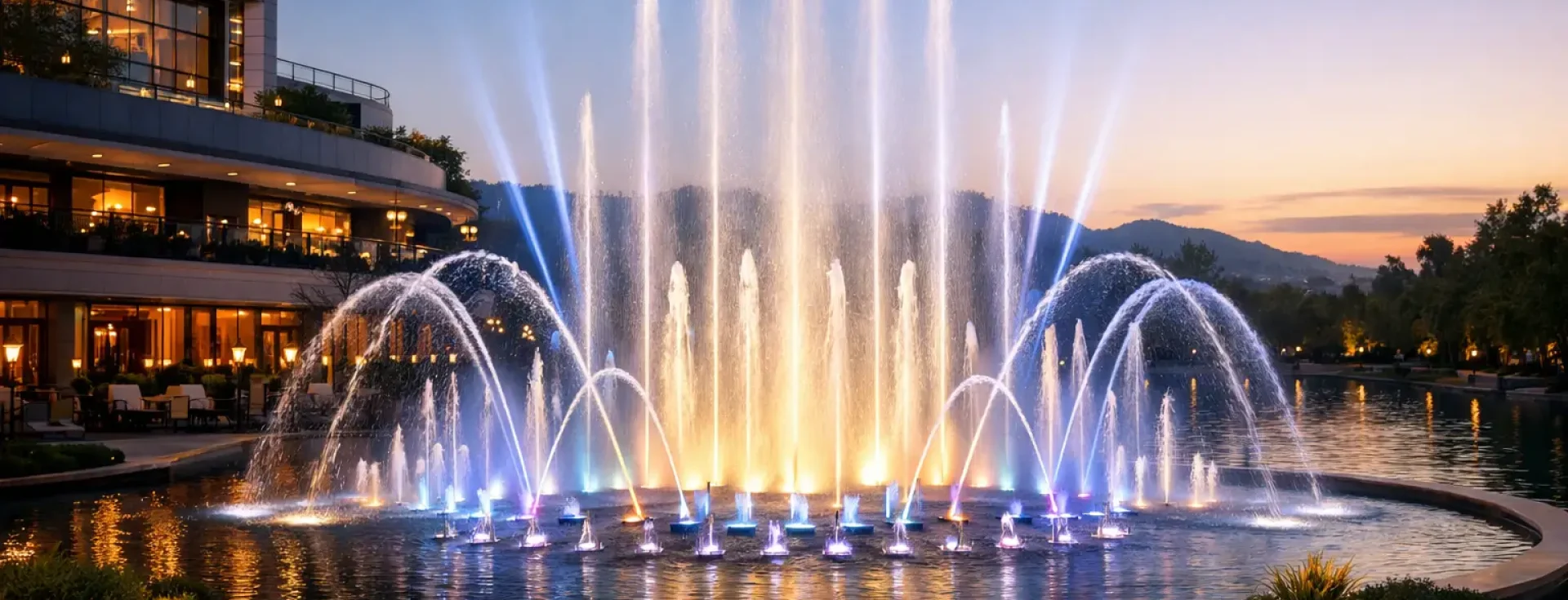
A well-executed music fountain changes how a space is experienced the moment the show begins. Water rises on cue, lighting shifts with precision, and sound gives the installation rhythm and presence. For luxury villas, hospitality venues, commercial developments, and public-facing properties, this is not just a decorative feature. It is a high-visibility asset that shapes first impressions, strengthens identity, and gives people a reason to stop, watch, and remember the setting.
In premium projects, the difference between a striking fountain and a disappointing one is rarely the idea itself. It comes down to engineering, equipment quality, programming accuracy, and long-term service support. A music fountain must do more than look impressive on opening day. It needs to perform consistently in demanding conditions, maintain visual clarity, and operate safely and efficiently over time.
What makes a music fountain work
A music fountain combines three systems into one coordinated performance – water movement, lighting control, and audio synchronization. The water effects are produced through pumps, nozzles, valves, and piping layouts designed to create specific patterns, heights, and textures. Lighting is layered into the fountain to highlight movement, define timing, and maintain visual impact after dark. Audio and control software then connect these elements so that each sequence responds to musical timing with accuracy.
That sounds straightforward, but the execution is highly technical. Water does not behave the same way in every environment. Wind exposure, basin dimensions, pump sizing, nozzle placement, and water quality all affect the final result. A design that looks impressive in a concept sketch may perform poorly if the hydraulic calculations and control logic are not developed correctly.
This is why serious fountain projects require more than product supply alone. They need technical planning, suitable equipment selection, and experienced installation teams that understand both aesthetics and system performance.
Why premium properties invest in music fountain features
For many property owners and developers, the appeal begins with visual prestige. A music fountain creates motion, sound, and light in a way that static landscape elements cannot. It turns an entrance plaza, courtyard, hotel frontage, or villa garden into a destination point.
There is also a practical commercial argument. In hospitality and commercial real estate, memorable environments support brand value. Guests photograph them. Visitors gather around them. Developers use them to reinforce a premium positioning. In residential settings, they elevate the atmosphere of the property and create a more tailored outdoor experience.
That said, not every site needs a large choreographed show fountain. In some cases, a more compact synchronized fountain delivers stronger results because it matches the scale and use of the property. The best decision is usually not the biggest option. It is the one that suits the location, audience, and operating expectations.
Music fountain design starts with the site
Before selecting jets, lights, or controllers, the project needs a clear site assessment. This is where many costly mistakes are avoided. The available footprint, viewing angles, ambient noise, drainage, electrical access, and surrounding architecture all influence the design.
A hotel entrance may require a fountain that performs beautifully from multiple arrival points without overpowering guest movement. A private villa may prioritize elegance, sound balance, and controlled spray patterns that do not affect adjacent finishes or seating areas. A commercial plaza may need a stronger visual program that holds attention across a larger open space.
Wind is one of the most underestimated factors. In exposed areas, very tall jet effects may lose shape, drift beyond the basin, or create unnecessary water loss. In these settings, designers often need to balance ambition with operational reality. Lower-profile effects, programmable variation, and wind-responsive controls can preserve the visual experience while protecting efficiency.
Core equipment behind a reliable music fountain
The visual performance of a fountain depends on hardware that can hold its accuracy over years of use. Pumps must be sized for pressure, flow, and sequence demands. Nozzles must be selected for the exact effect required, whether that is a vertical jet, fan pattern, mist effect, or dynamic burst. Underwater lighting must deliver strong output, dependable sealing, and consistent color performance.
Control systems are equally important. The choreography of a music fountain relies on well-integrated automation that can manage timing, speed variation, lighting scenes, and playback transitions without lag or instability. Poor controls create flat performances and recurring maintenance issues. Strong controls allow the installation to run repeatable shows while still giving operators flexibility to update sequences.
Water treatment should never be treated as an afterthought. Clean, balanced water protects equipment, preserves nozzle clarity, and keeps the display visually refined. In premium installations, filtration, disinfection, and water testing systems directly support appearance and service life.
The balance between aesthetics and maintenance
A fountain that is spectacular in theory but difficult to maintain quickly becomes a liability. This is especially true in hospitality, multi-property developments, and high-traffic commercial locations where downtime is visible and costly.
Good design considers service access from the beginning. Pump rooms, valve assemblies, lighting connections, and control panels should be positioned for practical maintenance. Basin finishes should be selected not only for appearance, but also for cleanability and durability. If a fountain requires excessive shutdown time for routine servicing, the owner will feel that burden very quickly.
There is always a trade-off between complexity and operational simplicity. More advanced show effects can create a stronger impression, but they also increase the number of moving parts, programming layers, and maintenance points. That does not mean complexity should be avoided. It means the design should match the operator’s capacity, budget, and performance priorities.
Where lighting and sound create the difference
Many fountain installations have water movement, but far fewer deliver a polished sensory experience. Lighting and sound are often what separate a basic feature from a premium one.
Lighting should not simply make the water visible. It should shape the show. Beam angles, color sequencing, brightness levels, and fixture placement all affect how cleanly the choreography reads at night. Harsh or poorly positioned lighting can flatten the display. Well-planned underwater lighting adds depth, contrast, and definition.
Audio also requires careful planning. The sound system must suit the environment, audience distance, and surrounding uses. A residential setting may call for controlled coverage and a more refined listening experience. A public or hospitality setting may need broader projection and stronger integration with the show program. Volume alone is not the answer. Clarity and balance matter more.
Why installation quality matters as much as product quality
Even world-class components can underperform if installation standards are weak. A music fountain depends on exact alignment, proper cable protection, hydraulic accuracy, waterproofing integrity, and reliable commissioning. The final tuning stage is particularly important because it adjusts the system from technical completion to actual performance quality.
Commissioning is where sequences are refined, pressure is balanced, lighting scenes are calibrated, and synchronization is tested under real conditions. It is also where practical issues are often identified, such as splash behavior, timing corrections, or visibility adjustments. Skipping this stage or treating it as routine usually leads to disappointing results.
For that reason, many clients prefer a full-scope partner rather than separate product suppliers and contractors. When design support, equipment sourcing, installation, and maintenance are coordinated, the project is far easier to control from both a quality and accountability standpoint.
Choosing a music fountain partner
Selecting a supplier or project partner for a fountain installation should go beyond catalogs and visuals. Clients should look for technical depth, product availability, proven installation capability, and after-sales support. These systems are not static ornaments. They are performance-based installations that require dependable service.
A strong partner will help define the right scale of project, recommend suitable branded equipment, and identify risks before they become expensive site problems. They will also understand the demands of premium residential and commercial environments, where finish quality, reliability, and presentation standards are high.
This is where companies such as Aquatic Pools and Fountains add real value. When a client needs more than hardware – when they need guidance, engineering support, installation precision, and ongoing maintenance – the quality of the partner becomes part of the final product.
Is a music fountain the right fit for every project?
Not always, and that is worth stating clearly. Some spaces benefit more from a quieter architectural fountain, a reflection feature, or a simpler illuminated display. If the site cannot support audio properly, if maintenance resources are limited, or if the visual context calls for restraint, a less complex feature may be the smarter investment.
But when the location, audience, and design ambition align, a music fountain can deliver exceptional value. It brings movement to architecture, adds identity to a property, and creates a premium visual experience that static elements rarely achieve.
The right fountain should feel effortless to the viewer even though it is highly engineered behind the scenes. That is the standard worth aiming for – not just a showpiece, but a dependable performance feature built to match the quality of the property around it.