
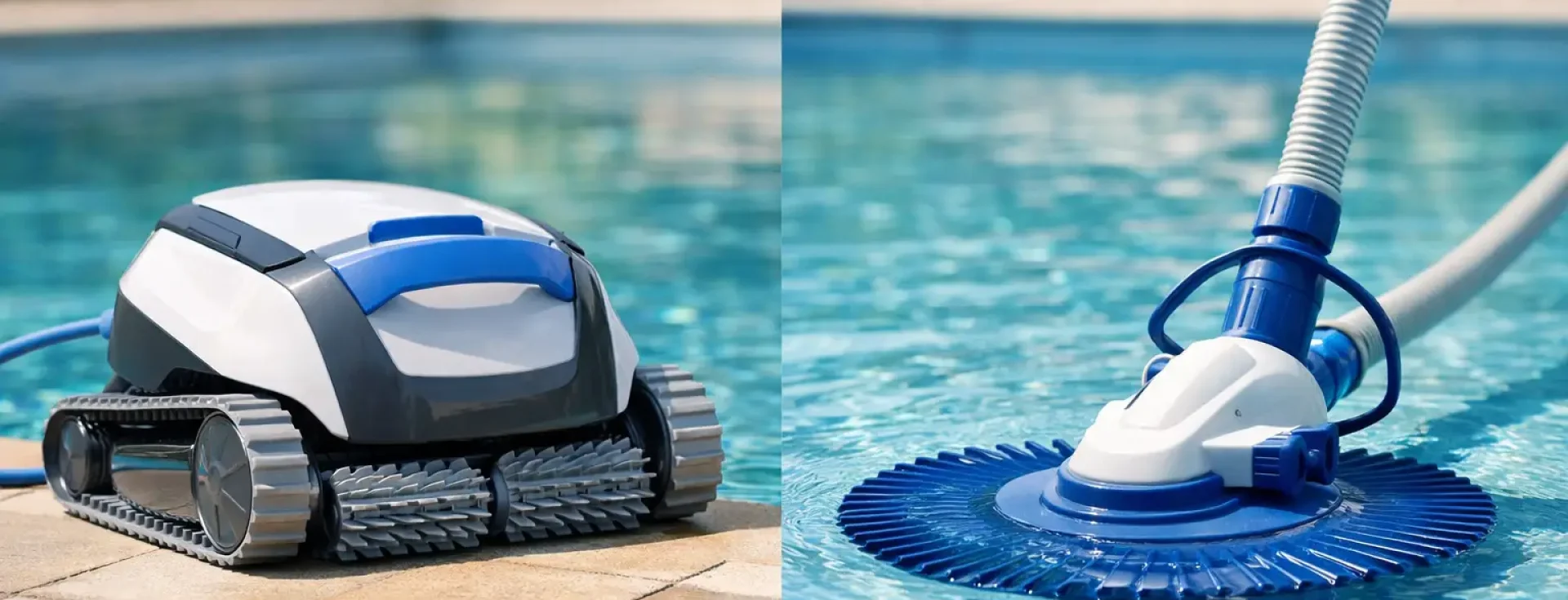
Fine sand after a windy afternoon, leaves around landscaped villas, and heavy bather use all create a cleaning demand that basic circulation alone cannot solve. The robotic cleaner vs suction decision directly affects water clarity, operating costs, and the workload placed on your pool equipment. For premium residential and commercial pools, the right choice depends on more than the purchase price.
A suction cleaner is a proven, economical option when the pool’s pump, plumbing, and filtration system are correctly sized. A robotic cleaner offers independent cleaning power, dedicated filtration, and more predictable coverage. Both can keep a pool presentable. Their real differences appear in performance, maintenance planning, and long-term system efficiency.
Robotic Cleaner vs Suction: The Core Difference
A suction-side cleaner connects to a skimmer line or dedicated suction port. It moves through the pool using the suction created by the main circulation pump. Debris collected by the cleaner travels through the hose and into the pool’s existing filter basket, pump basket, and filter.
A robotic cleaner operates independently from the pool circulation system. It uses a low-voltage power supply, an internal motor, and its own filter basket or cartridge. The unit draws in water, captures debris, and returns filtered water to the pool without sending that debris through the pump or main filter.
This distinction matters for every installation. A suction cleaner relies on the hydraulic condition of the pool. A robotic cleaner relies on its own motor, drive system, and programmed cleaning cycle. One uses infrastructure already installed; the other reduces dependence on it.
Why a Robotic Cleaner Is Often the Premium Choice
For villa pools, hospitality properties, and high-visibility amenities, robotic cleaners are often selected for their cleaning precision and operational independence. Premium models can scrub the floor, climb walls, and clean the waterline, where sunscreen residue, dust, and airborne contaminants tend to accumulate. That level of coverage is difficult for many suction-side cleaners to match.
Robotic units also place less cleaning load on the pool’s main filtration equipment. In Dubai and across the UAE, fine dust can enter outdoor pools quickly. When a suction cleaner collects this material, it ultimately reaches the primary filter. This can increase the need for backwashing, cartridge cleaning, or filter servicing. A robotic cleaner captures a significant share of debris in its own removable filter, helping preserve the performance of the main pump and filtration system.
Energy use can be another advantage. A robotic cleaner does not require the main circulation pump to run at a higher speed simply to create enough suction for cleaning. For a property using a variable-speed pump, this can support a more efficient daily operating schedule. The exact savings depend on pump size, electricity rates, cleaning frequency, and the existing filtration design, but the operational benefit is clear: cleaning can occur without making the whole pool system work harder.
Robotic cleaners are particularly valuable when the pool has complex geometry, benches, steps, tiled finishes, or a prominent waterline. Their navigation is not flawless in every pool, and a unit must be correctly matched to the pool size and surface. Still, a well-selected robotic cleaner provides consistent, professional-looking results with minimal interference to circulation equipment.
What Robotic Cleaner Owners Need to Consider
A robotic cleaner has a higher upfront cost than most suction models. It also requires basic care: emptying the filter after use, rinsing the basket or cartridges, checking brushes and tracks, and storing the unit appropriately when not in operation. These are straightforward tasks, but they should not be overlooked.
Not every robotic cleaner is designed for every surface or depth. Large commercial pools may require a heavy-duty model with a longer cable, higher debris capacity, and a duty cycle suited to frequent use. A lightweight residential unit may be excellent for a compact villa pool but insufficient for a hotel pool deck with continuous guest traffic.
When a Suction Cleaner Makes Good Sense
A suction cleaner remains a practical solution for many pools. It has fewer electronic components, a lower entry cost, and a simple operating principle. For a smaller residential pool with a reliable pump, a properly balanced circulation system, and manageable debris levels, it can provide dependable day-to-day cleaning.
It is also a sensible option where a property owner wants a cleaner that can remain connected for longer periods. Once the hose length, flow rate, and cleaner movement are correctly adjusted, the unit can work as part of the regular filtration schedule. There is no separate power supply to position and no internal robotic filter to empty after each cycle.
For straightforward pool layouts, this simplicity has value. A suction cleaner can be effective at removing settled debris from the floor, especially when the pool is used moderately and the surrounding environment is controlled. It is a cost-conscious choice, not an inferior one by default.
The trade-off is that a suction cleaner depends on consistent hydraulic performance. A partially blocked skimmer basket, worn hose, air leak, dirty filter, weak pump, or incorrect valve setting can reduce cleaner movement immediately. It may also struggle with walls, steps, sharp corners, and waterline cleaning. The pool’s filtration system must carry both circulation and debris collection duties, which can increase maintenance demand over time.
The Hidden Cost of Using Pool Suction
The purchase price of a suction cleaner can be attractive, but it should be assessed as part of the full pool system. If the cleaner requires the circulation pump to run longer or at a higher speed, energy consumption may increase. More debris passing through the pump and filter may also mean more frequent cleaning, backwashing, and service attention.
This does not mean suction cleaners are expensive to own. It means the installation must be evaluated correctly. A high-quality suction cleaner paired with the right pump, filter, valves, and plumbing can be reliable for years. A cleaner added to an underperforming system will expose problems that were already present.
Choosing for Villas, Hotels, and Commercial Properties
For a luxury villa, the decision usually comes down to convenience and finish quality. A robotic cleaner is often the stronger investment for owners who want clean floors, walls, and waterlines without adding strain to the circulation system. It also offers flexibility when cleaning is needed outside the normal pump schedule.
For apartment communities and hotels, cleaning frequency and visual standards carry greater weight. Pools may be used daily, inspected regularly, and expected to look immaculate before guests arrive. A commercial-grade robotic cleaner can support maintenance teams by handling routine debris removal efficiently. However, it should complement a professional maintenance plan, not replace water testing, brushing, vacuuming of difficult areas, or filter servicing.
For facilities with multiple pools, a suction cleaner may still be appropriate for secondary pools, smaller water bodies, or applications with a dedicated high-capacity filtration system. The best approach is often a tailored equipment plan rather than choosing one method for every pool on the property.
Key Questions Before You Buy
Start with the pool itself. Consider its dimensions, depth profile, surface finish, steps, ledges, and waterline exposure. Then assess the debris load. A pool surrounded by mature landscaping or exposed to frequent windblown sand has very different cleaning requirements from an enclosed indoor pool.
Next, examine the existing equipment. If the pump and filter are already working near capacity, adding a suction cleaner may not be the most efficient route. If the hydraulic system is strong, simple, and well maintained, a suction cleaner may offer excellent value. Also consider who will operate the cleaner. A robotic unit asks for regular filter emptying, while a suction cleaner asks for periodic hose, valve, and filter checks.
Finally, think about the standard you need to maintain. If your pool is part of a luxury property, hospitality venue, or corporate facility, presentation is a daily requirement. Equipment should be selected for reliability under real operating conditions, not only for its lowest initial cost.
Aquatic Pools and Fountains helps property owners, developers, and facility teams match cleaning equipment to the pool’s design, filtration capacity, and maintenance objectives. The right recommendation considers the complete system, from pumps and filters to cleaning access and long-term service requirements.
A cleaner should make pool ownership easier, not create a new maintenance concern. Choose suction when your pool has the hydraulic capacity and your priorities favor straightforward value. Choose robotic when independent filtration, broader surface coverage, and premium cleaning control are the priority. A proper equipment assessment before purchase will protect both your pool’s appearance and the performance of the system behind it.