
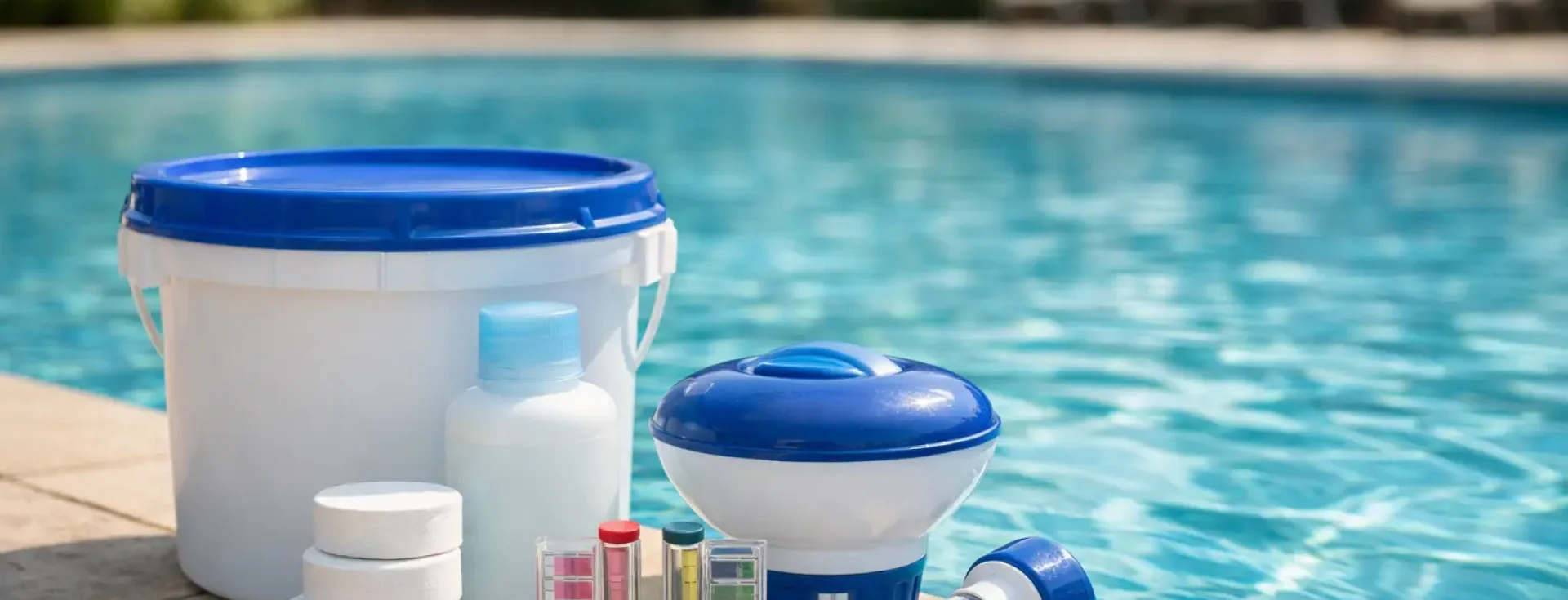
A pool can look perfectly blue in the morning and become cloudy, irritating, or visibly algae-prone within days when its water balance drifts. In Dubai and across the UAE, intense sun, high temperatures, dust, heavy bather use, and naturally hard source water place extra demands on swimming pool chemicals. The right treatment program protects more than appearance. It supports swimmer comfort, preserves premium finishes, and helps pumps, filters, heaters, and disinfection equipment operate as designed.
For luxury villas, hospitality properties, residential towers, and commercial facilities, chemical care should never be treated as a generic weekly task. It is a controlled water-management process based on testing, correct dosing, circulation, and the needs of the specific installation.
The Role of Swimming Pool Chemicals
Every pool requires a dependable sanitizer, balanced water chemistry, and a method for removing contaminants introduced by swimmers, weather, and the surrounding environment. These objectives work together. A sanitizer cannot perform efficiently in poorly balanced water, and even excellent chemical treatment cannot compensate for inadequate circulation or a neglected filter.
A professional chemical program is designed to maintain clean, clear water while protecting the pool shell, tile, grout, metal fixtures, and mechanical equipment. The best approach depends on pool size, finish, bather load, disinfection system, water source, and whether the property is residential or commercial.
Sanitizers control bacteria and organic contamination
Chlorine remains the most widely used sanitizer because it is effective, proven, and suitable for a broad range of pool applications. It may be introduced as liquid chlorine, granular products, tablets, or through an automated dosing system. The ideal delivery method depends on the pool’s equipment configuration and maintenance schedule.
Saltwater pools also rely on chlorine. A salt chlorinator generates chlorine from dissolved salt, offering convenient on-site production and often a more consistent daily residual. It still requires routine monitoring of pH, stabilizer, salt concentration, and chlorine output. A salt system is not a chemical-free pool.
Bromine is sometimes selected for warm-water environments such as spas, although it is less common for large outdoor pools. Commercial properties may also use supplementary systems such as UV or ozone. These systems can reduce sanitizer demand, but they do not eliminate the need for a measured chemical residual in the water.
pH and alkalinity protect comfort and equipment
pH measures whether water is acidic or alkaline. For most swimming pools, a pH range of approximately 7.2 to 7.6 provides effective sanitizer performance and a comfortable swimming experience. When pH rises too high, chlorine becomes less effective and scale formation can accelerate. When it falls too low, water may become corrosive, potentially affecting metal components, grout, surfaces, and equipment seals.
Total alkalinity acts as a buffer for pH. If alkalinity is too low, pH can swing rapidly after chemical additions, rain, or heavy use. If it is too high, pH becomes difficult to lower and cloudy water or calcium deposits may follow. Maintaining both readings within their recommended ranges creates stable water that is easier to manage and more forgiving between service visits.
Calcium hardness needs attention in the UAE
Calcium hardness is particularly relevant where fill water contains substantial mineral content. Water that is too hard can leave scale on tile lines, heat exchangers, salt cells, and filtration equipment. Scale does not only affect the visual finish of a premium pool. It can restrict flow, reduce heat-transfer efficiency, and shorten the service life of valuable equipment.
Water with insufficient calcium can be aggressive, especially in plaster or cement-based finishes. The correct target varies by surface type and water temperature, so it should be established as part of the pool’s full saturation balance rather than adjusted in isolation. This is one area where professional testing and equipment knowledge add significant long-term value.
Chemicals for Clarity and Algae Prevention
Cloudy water is often blamed on a lack of chlorine, but that is only one possible cause. Fine dust, oils, cosmetics, dead algae, poor filtration, imbalanced pH, and insufficient circulation can all reduce clarity. The correct remedy begins with testing rather than adding multiple products at once.
Shock treatments are used to oxidize accumulated organic waste and restore sanitizer effectiveness. They are especially useful after high bather loads, a sandstorm, visible algae, or an extended period without proper maintenance. The product type and dosage should match the sanitizer system and the pool’s volume. Over-shocking can waste chemicals, affect water balance, and require longer waiting periods before swimming.
Algaecides can be useful as a preventive support product, particularly in warm outdoor pools with strong sunlight exposure. They should not replace sanitation, circulation, or brushing. If algae is already established, the pool generally needs a structured treatment process that includes brushing affected surfaces, correcting water balance, applying the appropriate sanitizer treatment, and cleaning or backwashing the filter.
Clarifiers and flocculants address suspended particles, but they serve different purposes. A clarifier helps the filter capture very fine particles over time. A flocculant causes particles to settle so they can be vacuumed to waste. Using the wrong product, or using too much, may create additional cloudiness or place unnecessary strain on the filtration system. These treatments are best chosen after identifying the cause of the problem.
Testing Is the Foundation of Reliable Treatment
Premium pool care is based on measured readings, not visual judgment alone. Water should be checked frequently for free chlorine, pH, total alkalinity, and other parameters relevant to the installation, including cyanuric acid, calcium hardness, total dissolved solids, and salt level where applicable.
For a private pool with stable use, routine testing several times per week may be appropriate. Hotels, residential communities, schools, and high-traffic facilities need more frequent checks and documented chemical control. Hot weather increases chlorine consumption, while frequent use introduces sweat, sunscreen, body oils, and other contaminants that change the water chemistry quickly.
Digital testing systems and professional photometers provide more dependable information than basic strips alone, particularly when diagnosing persistent issues. A complete test result allows technicians to correct the actual imbalance in the proper sequence. For example, adjusting alkalinity before pH often produces a more stable result than repeatedly chasing pH readings.
Safe Handling and Storage Matter
Pool chemicals are effective because they are reactive products. They must be stored in a dry, cool, well-ventilated location, away from direct heat, moisture, sunlight, fuels, and incompatible materials. Original labeled containers should remain closed when not in use, and chemicals should never be transferred into unmarked containers.
Never mix chemicals together, even if they are both chlorine products. Never add water to chemical products. Instead, follow the product instructions exactly, use clean dedicated measuring tools, and add chemicals separately with the circulation system operating where required. Acid and chlorine products must be kept apart, as accidental mixing can create hazardous fumes.
For commercial properties, controlled access, staff training, personal protective equipment, and clear dosing procedures are essential. Automated dosing can improve consistency, but it must be calibrated, inspected, and supported by manual testing. Automation is a control tool, not a replacement for technical oversight.
Selecting the Right Program for Your Pool
There is no single chemical package that suits every pool. A compact villa pool with low bather load may benefit from a straightforward sanitizer and balance routine, while a hotel pool requires higher monitoring frequency, precise records, and stronger control of bather-related contamination. An infinity-edge pool, heated pool, saltwater installation, or pool with natural stone finishes may also have distinct operating requirements.
The quality of the chemicals matters as much as the treatment schedule. Reliable products with consistent concentration make dosing more predictable and reduce the risk of unwanted residues or unstable readings. Equally, chemical treatment must be matched to the pump capacity, filter media, circulation time, and disinfection equipment already installed.
Aquatic Pools and Fountains supports property owners and facility teams with premium chemical solutions, water testing systems, and technical guidance that align with the demands of high-performance aquatic installations. This integrated approach helps ensure that every product supports the wider system rather than creating a short-term fix.
Clear water is the visible result, but the real standard is controlled water that protects people, surfaces, and equipment day after day. Start with accurate testing, make measured adjustments, and give your pool the same level of technical care expected from the rest of a premium property.