
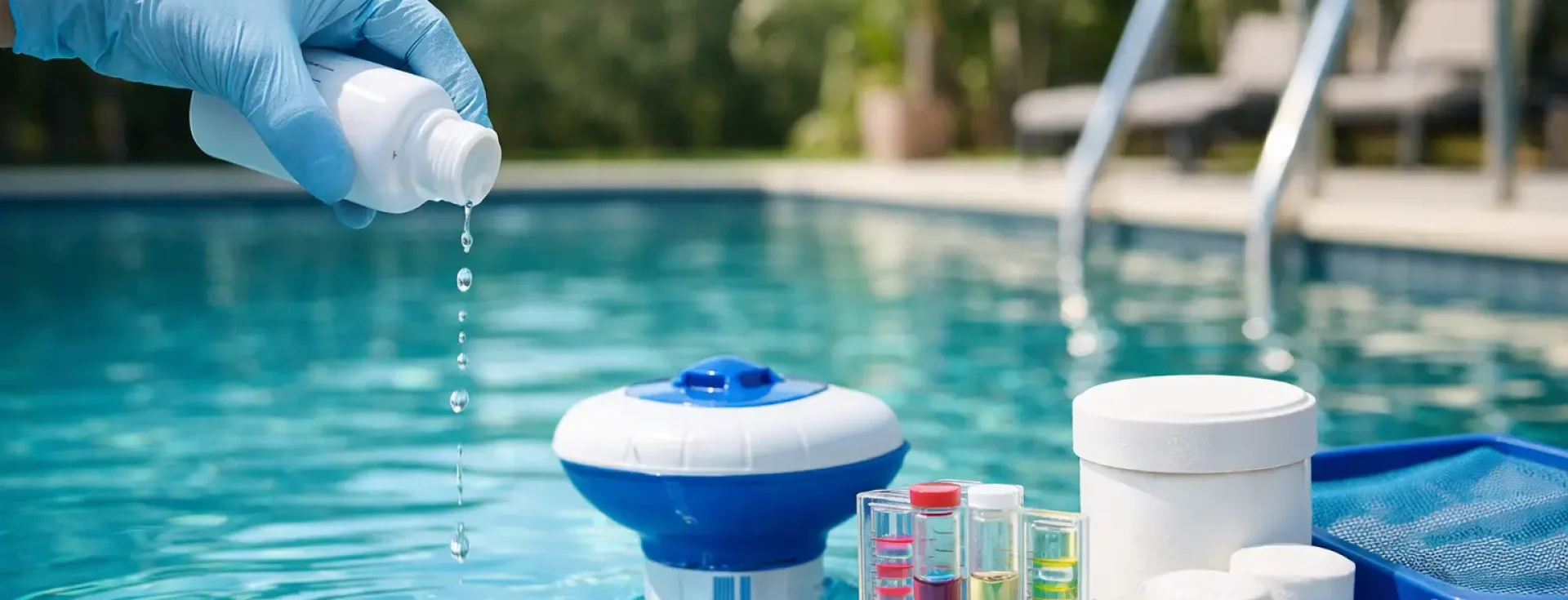
A pool can look perfectly blue and still be unsuitable for swimming. In Dubai and across the UAE, intense sun, high water temperatures, windblown dust, frequent use, and sunscreen residue place constant pressure on water quality. Knowing how to sanitize pool water means controlling microorganisms without creating harsh odors, eye irritation, cloudy water, or premature wear on premium pool equipment.
Effective sanitation is not a matter of adding chlorine whenever the water looks dull. It is a coordinated routine of selecting the right sanitizer, balancing the water around it, circulating every gallon through the filtration system, and testing often enough to correct small changes before they become expensive problems.
What Pool Sanitizing Actually Does
A pool sanitizer destroys or controls bacteria, algae, viruses, and other contaminants introduced by swimmers, debris, rain, and the surrounding environment. Chlorine remains the most widely used primary sanitizer because it is effective, accessible, and suitable for residential pools, hospitality facilities, and larger commercial installations.
However, sanitizer performance depends on water balance. If pH is too high, chlorine becomes less effective. If stabilizer is excessive, chlorine may test at an acceptable level while working too slowly. If circulation is poor, treated water never reaches every part of the pool. This is why a premium pool system should be treated as an integrated water-management system, not a collection of separate chemicals and equipment.
Sanitizing also differs from shocking. Daily or routine sanitization maintains a protective residual in the water. Shocking is a higher-dose treatment used to oxidize swimmer waste and restore water quality after heavy bather loads, algae risk, storms, or a drop in chlorine performance.
How to Sanitize Pool Water Step by Step
Start by testing the water before adding anything. A dependable test kit or digital water testing system should measure free chlorine, combined chlorine, pH, total alkalinity, cyanuric acid, calcium hardness, and total dissolved solids where appropriate. For commercial pools and high-use villa pools, documented testing gives facility teams a clearer basis for maintenance decisions.
For a standard chlorine pool, maintain free chlorine at a level appropriate for the pool’s stabilizer level and local operating conditions. Many residential pools operate well around 1 to 3 ppm of free chlorine, though warmer weather, heavy use, and elevated cyanuric acid can require a different target. Combined chlorine should remain low. A rising combined chlorine reading often indicates that the pool needs oxidation or shock treatment.
Next, adjust pH into the recommended range, typically 7.2 to 7.8. Most operators aim near 7.4 to 7.6 for swimmer comfort and effective chlorine activity. High pH can contribute to scaling, cloudy water, and reduced sanitizer efficiency. Low pH can be corrosive to surfaces, fittings, heaters, and metal components.
Then add the sanitizer according to the product label and the actual pool volume. Never estimate pool volume casually, especially for custom villas, overflow pools, spas, fountains, or commercial pools with unusual shapes. Under-dosing leaves water exposed to contamination. Repeated over-dosing can damage finishes and create an unpleasant swimming experience.
Allow the circulation system to run after dosing. The pump should move water through the filter long enough to achieve proper turnover for the pool size and bather load. In the UAE’s hot climate, many pools benefit from extended daily circulation periods, particularly during peak summer use. A variable-speed pump can provide efficient continuous or near-continuous circulation at lower speeds, while higher speeds support vacuuming, water features, and rapid mixing after chemical treatment.
Choose the Right Sanitizing System
The best sanitizing method depends on pool size, finish, user load, maintenance expectations, and whether the project is residential or commercial. The objective is not to select the most fashionable system. It is to install a reliable solution that can consistently maintain safe water.
Chlorine Tablets, Granules, and Liquid Chlorine
Traditional chlorine systems are proven and flexible. Tablets provide gradual dosing, while granules or liquid chlorine can raise free chlorine more quickly. Tablets are convenient but commonly contain cyanuric acid, also called stabilizer. In outdoor pools, stabilizer protects chlorine from sunlight. Yet it can accumulate over time, especially when tablets are used as the only chlorine source.
This is the trade-off: too little stabilizer allows sunlight to consume chlorine rapidly; too much can reduce chlorine’s sanitizing speed. Regular testing and partial water replacement, when needed, prevent this issue from being overlooked.
Liquid chlorine does not add stabilizer and is often a practical choice for frequent correction or commercial operations. It requires suitable storage, measured dosing, and safe handling. Granular chlorine offers flexibility but must be selected carefully because different formulations affect calcium hardness and pH differently.
Salt Chlorine Generators
A saltwater pool still uses chlorine. The difference is that a salt chlorine generator produces chlorine from dissolved salt as water passes through the cell. This creates a steady sanitizer supply and can reduce the need for manual daily dosing.
Salt systems are popular in premium residential pools because they support consistent water quality and a more refined ownership experience. They still require testing, cell inspection, pH control, and correct salt concentration. In hot climates, calcium scale can form on generator cells more quickly when water balance is neglected, reducing output and shortening equipment life.
UV and Ozone Systems
Ultraviolet and ozone systems can improve water quality by helping destroy microorganisms and oxidize contaminants as water passes through the treatment chamber. They are especially valuable in high-end residential projects, hotels, wellness facilities, and commercial environments where odor control and water clarity matter.
These systems are secondary treatment technologies, not a reason to eliminate the primary sanitizer residual from the pool. Water can become contaminated after it leaves the UV chamber or ozone contact area. A measured chlorine or bromine residual remains necessary to protect the entire pool basin.
Bromine for Spas and Specialized Applications
Bromine performs well in warm water and is often used in spas. It is generally less common for large outdoor pools because it can be more costly and requires a different management approach. For a heated spa connected to a pool, the treatment strategy should account for the separate water temperature, bather load, and chemical demand.
Filtration and Circulation Protect the Sanitizer Investment
Sanitizer cannot compensate for a dirty filter, a failing pump, blocked skimmer baskets, or poor return-jet positioning. Filtration removes suspended debris that consumes chemicals and clouds water. Circulation distributes sanitizer, prevents stagnant zones, and carries contaminants to the filter.
Clean skimmer and pump baskets regularly, and service the filter according to its type and pressure readings. Sand filters require periodic backwashing, cartridge filters need cleaning, and glass-media systems require correctly managed backwash cycles. Over-cleaning can be as counterproductive as neglect in some systems, because a lightly loaded filter bed may capture fine particles more effectively than a freshly stripped one.
Inspect return fittings as well. Water should circulate across the surface and through deeper areas, not simply spin in one corner. Steps, tanning ledges, dead-end channels, and decorative pool features may need special attention in custom installations.
When to Shock the Pool
Shock treatment is appropriate when water is cloudy, algae begins to appear, combined chlorine rises, the pool has experienced unusually heavy use, or an event such as a dust storm has introduced significant organic material. It may also be needed after a long period of low circulation or when a pool is reopened.
Use the correct shock product for the pool chemistry and follow the specified dosage. Run the pump, brush surfaces to dislodge developing algae, and do not allow swimmers back into the pool until testing confirms that sanitizer and pH levels are safe. Avoid treating shock as a substitute for a consistent daily sanitation routine. Repeated emergency corrections usually point to an underlying circulation, filtration, dosing, or balancing issue.
A Practical Testing Schedule
Residential pools should generally be checked at least two to three times per week, with more frequent testing during very hot weather or heavy use. A pool at a hotel, residential tower, school, gym, or commercial property needs more frequent monitoring and should follow applicable local health requirements and site operating procedures.
Test free chlorine and pH most often. Check alkalinity, stabilizer, calcium hardness, and salt level on a regular planned schedule, as these values change more gradually but strongly affect long-term equipment protection. Record results instead of relying on memory. Trends reveal whether a pool is consuming chlorine unusually fast, drifting upward in pH, or accumulating stabilizer before the issue becomes visible.
Safe, elegant water is maintained through precision, not guesswork. For pools that demand high performance in demanding UAE conditions, Aquatic Pools and Fountains can help align the sanitizer, testing equipment, circulation system, and maintenance plan with the standards your property requires.