A luxury pool is only as dependable as the equipment behind its finish. When property owners, consultants, and facility teams ask for AstralPool pool equipments, they are usually looking for more than a recognizable name. They need a coordinated system that protects water quality, reduces avoidable downtime, and performs confidently through demanding UAE operating conditions.
For villas, hotels, residential towers, and commercial facilities, the right specification starts with the pool’s actual use. A quiet private pool has different circulation needs from a high-bather-load hotel pool. An overflow pool requires a different hydraulic approach than a compact skimmer pool. Equipment should never be selected as isolated components. Pumps, filters, disinfection, heating, controls, fittings, and lighting must work together as one engineered environment.
Why AstralPool Pool Equipment Fits Premium Projects
AstralPool is widely specified for pool systems because its equipment range supports the core functions that determine long-term pool performance: water movement, filtration, sanitation, temperature management, and visual presentation. For a premium installation, that breadth matters. It enables a more consistent specification across the plant room and pool surround, while allowing each component to be matched to the project requirement.
The strongest reason to select established equipment is not branding alone. It is the ability to make informed technical decisions around flow rates, pressure loss, electrical demand, service access, and replacement planning. A pump that is oversized can waste energy and create unnecessary noise. A filter that is undersized can struggle to maintain clear water under heavy use. A disinfection system must suit the pool volume, swimmer load, and maintenance program rather than being chosen on capacity claims alone.
For high-value properties, dependable equipment also protects the overall guest or resident experience. Clear water, balanced temperature, effective circulation, and properly illuminated finishes are expected. When a pool system falls short, the issue is visible immediately.
Build the System Around Hydraulics First
The plant room is where premium pool performance is won or lost. Before choosing individual products, a qualified supplier should assess pool volume, turnover requirements, pipe sizes, suction and return points, water features, pool type, and anticipated usage. These details determine the flow the system must deliver and the resistance it must overcome.
Pumps That Match the Duty
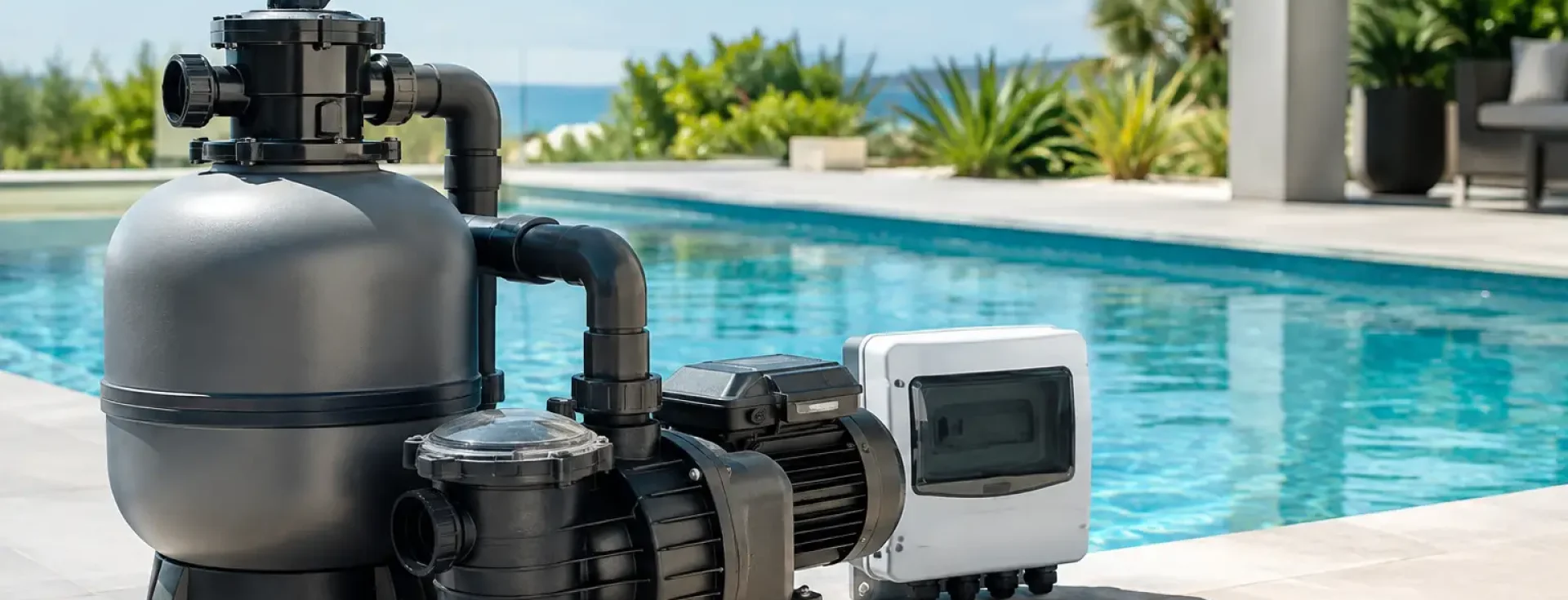
A circulation pump should be selected for its duty point, not simply its horsepower. The right unit must provide the required flow at the actual total dynamic head of the system. Pipe runs, bends, valves, filters, heaters, chlorinators, and water features all add resistance. Ignoring that resistance can leave a pool with weak circulation even when the pump appears powerful on paper.
For residential pools, energy efficiency and quiet operation are often central priorities. Variable-speed pumps can be a strong option where the system benefits from lower-speed daily circulation and higher-speed operation for vacuuming, backwashing, or features. For commercial pools, continuous operating demands, redundancy, and maintenance accessibility may take precedence. The correct choice depends on the duty cycle and the consequences of downtime.
Filtration That Maintains Clarity
Filters provide the physical barrier that removes suspended debris and supports effective sanitation. Sand filters remain a practical choice for many residential and commercial pools because they are durable, familiar to service teams, and suitable for consistent operation. Glass media can improve filtration performance in many applications, although it should be evaluated alongside the filtration vessel, hydraulic design, and cleaning routine.
Cartridge filtration can suit selected projects where water conservation and simplified servicing are priorities, but cartridges require disciplined cleaning and replacement. The decision is not about one technology being universally better. It is about aligning the filter type with available plant room space, water use targets, bather load, and maintenance capability.
Water Treatment Requires More Than Chlorine
A properly filtered pool still needs accurate disinfection and balanced water chemistry. Chemical dosing, salt chlorination, ultraviolet systems, ozone solutions, and automated controllers can each play a role in a modern water-treatment strategy. The appropriate setup depends on pool use, local operating requirements, owner preferences, and the level of daily supervision available.
Automated dosing systems are particularly valuable for properties that expect stable water quality with less manual intervention. They can monitor and control key parameters when specified, calibrated, and maintained correctly. Automation improves consistency, but it does not eliminate the need for professional testing and routine inspection. Sensors need calibration, chemical tanks require safe handling, and system settings must be checked against real water conditions.
For hospitality and high-traffic facilities, secondary disinfection may support a more resilient sanitation strategy. It can also help improve the swimmer experience by reducing certain byproducts when the system is properly designed. However, secondary treatment is not a replacement for appropriate filtration, circulation, residual disinfectant, or sound maintenance practices.
Heating, Cooling, and Lighting Complete the Experience
Pool comfort in the UAE is not limited to heating. Heat-cool pumps allow property owners and operators to manage water temperature through changing seasonal conditions, making pools more enjoyable across a wider part of the year. Correct sizing is essential. An undersized unit may run continuously without achieving the desired temperature, while an oversized unit can add unnecessary capital cost.
The pool shell, insulation, surface area, wind exposure, operating hours, and desired temperature all affect the calculation. Pool covers can significantly reduce evaporation and heat loss, especially for facilities that close overnight. For larger commercial projects, heat recovery and centralized energy strategies may deserve consideration alongside standalone heat-cool equipment.
Lighting deserves the same attention as water treatment because it defines the pool after sunset. Quality underwater LED lights can enhance tile color, highlight architectural edges, and support a safer evening environment. The design should account for beam angle, fixture placement, glare, cable routing, niche compatibility, and access for future service. A beautiful pool should not require disruptive renovation to replace a failed light.
Fittings and Surround Equipment Are Critical Details
Premium specifications often fail at the small components. Main drains, skimmers, return inlets, vacuum points, grilles, ladders, handrails, valves, and pipe fittings must be compatible with the hydraulic design and suited to the finish standard of the project. These elements affect safety, water movement, serviceability, and visual consistency.
For overflow pools, grating and balance-tank arrangements require particular care. The system must manage surge volume, maintain stable water levels, and provide practical access for cleaning and inspection. In luxury villas, the visual line of an infinity edge may lead the design conversation, but the balance tank and plant room determine whether that edge performs as intended.
Surround equipment should also reflect how people will use the space. Commercial and hospitality pools may require clearly planned depth markers, safety signage, accessible entry solutions, and durable deck equipment. Residential clients may prioritize minimal visual intrusion, integrated covers, and finishes that complement landscaping or interior architecture. Both approaches benefit from early coordination between the pool specialist, architect, MEP team, and landscape contractor.
Professional Installation Protects the Investment
Even best-in-class AstralPool pool equipment cannot compensate for poor installation. Incorrect pipe sizing, weak electrical connections, inadequate drainage, restricted ventilation, or limited service clearance can shorten equipment life and complicate every maintenance visit that follows.
A professional installation should include pressure testing, proper valve labeling, electrical protection, commissioning, flow verification, and operator guidance. For commercial properties, maintenance documentation and handover procedures are especially valuable because pool responsibility may move between multiple teams over the asset’s life.
Aquatic Pools and Fountains supports premium residential and commercial projects with product availability, technical guidance, installation support, and ongoing maintenance planning. That full-scope approach helps clients avoid the common mistake of treating equipment procurement as separate from system performance.
Plan for Service Before the Pool Opens
The best time to consider maintenance is before construction finishes. Leave clear service access around pumps, filters, dosing equipment, heaters, and control panels. Specify isolation valves where components may need removal. Ensure the plant room has suitable drainage, ventilation, and lighting. These practical decisions make inspections faster and reduce disruption when service is required.
A pool is a visible expression of a property’s standards, but its reliability is built in the details no guest sees. Specify the equipment as a complete system, install it with precision, and give it the maintenance support it deserves. The result is water that looks exceptional and a pool environment that continues to perform long after the handover.