
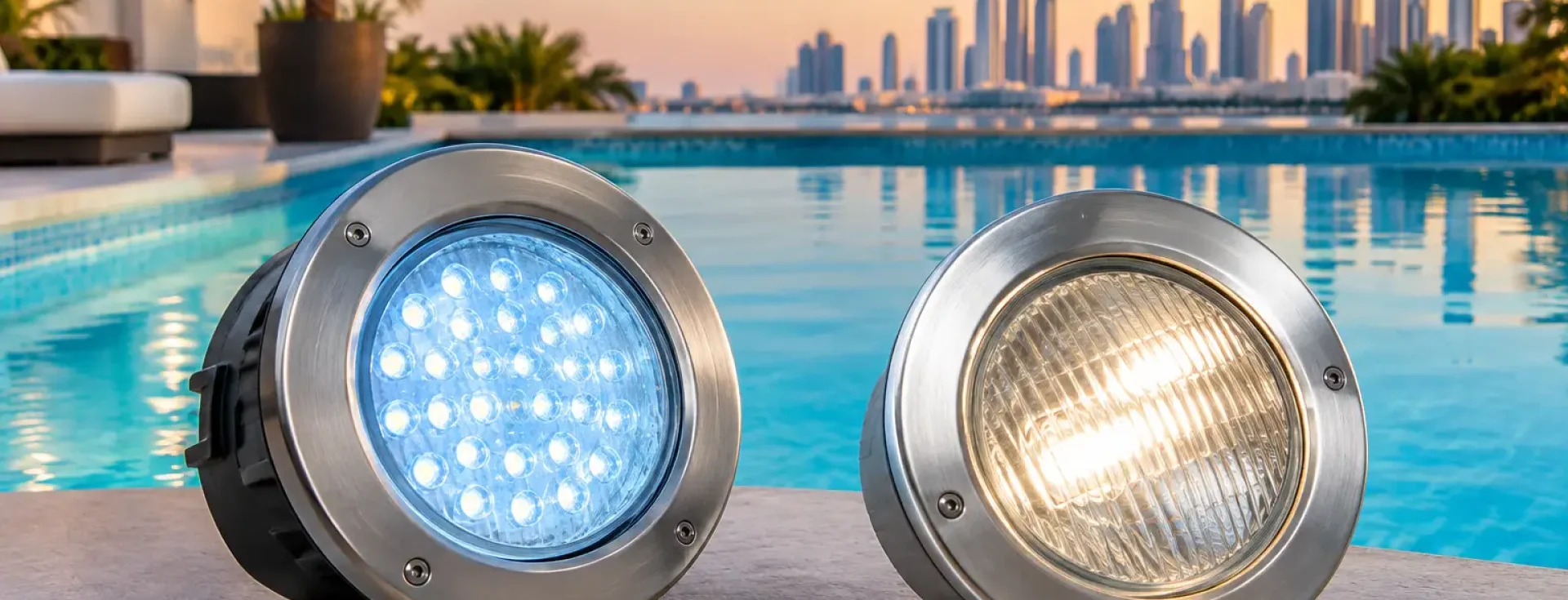
A pool light is not a minor finishing detail. At night, it defines whether a villa pool feels refined and inviting or unevenly lit and dated. For property owners and project teams comparing LED versus halogen pool lights, the better choice depends on more than the initial fixture price. Energy demand, visual effect, wiring compatibility, maintenance access, and the expected operating schedule all matter.
For most new premium pool installations in Dubai and across the UAE, LED lighting is the stronger long-term specification. Halogen still has a place in certain replacement projects, particularly where an existing system must be retained or a very specific warm-light effect is required. The right decision starts with a clear assessment of the installation, rather than selecting a lamp based on wattage alone.
LED Versus Halogen Pool Lights: The Core Difference
Halogen pool lights create illumination by heating a tungsten filament inside a halogen gas-filled bulb. They deliver a familiar warm white glow and have been widely used in swimming pools for decades. Their technology is straightforward, but much of the electricity they consume becomes heat rather than visible light.
LED pool lights use light-emitting diodes to produce illumination more efficiently. A quality LED fixture can provide powerful, even light while operating at far lower wattage than a comparable halogen unit. Many premium models also provide selectable white temperatures or RGB and RGBW color programs, allowing one pool to shift from a clean architectural white to a controlled color scene for entertaining or hospitality events.
The distinction is particularly relevant in properties where lighting operates for long evening hours. A single residential pool may have only a few fixtures, while a hotel, residential tower, or large landscape project can have dozens. The operating-cost difference becomes more meaningful as the installation grows.
Energy Use and Operating Cost
LED lighting is typically the clear winner on efficiency. A halogen pool lamp may use 100 watts, 300 watts, or more depending on its size and output. An LED pool light designed for comparable pool illumination can often operate on a fraction of that power.
This is not simply an energy-saving calculation. Lower electrical demand also reduces heat within the fixture and places less ongoing load on the lighting circuit. In the UAE, where pools are frequently used and illuminated throughout much of the year, that efficiency supports a more economical operating profile over the life of the installation.
The purchase cost of LED equipment is generally higher than basic halogen lighting. However, the initial price should be viewed alongside expected runtime, lamp replacement requirements, access costs, and the performance standard expected from the property. For a luxury villa or commercial asset, choosing a low-cost lamp that requires frequent intervention can be more expensive over time than specifying a reliable LED system from the outset.
Brightness Is Not Just About Wattage
A common mistake is comparing pool lights only by watts. Wattage measures power consumption, not the quality or amount of useful light reaching the water. Lumens, beam distribution, fixture positioning, pool surface finish, water clarity, and depth all affect the final appearance.
Halogen lights can create an appealing, intense warm center of illumination. But their beam may appear more concentrated, and a poorly planned layout can leave darker areas around steps, benches, tanning ledges, or deep ends. LED fixtures are available in carefully engineered beam patterns that can provide broader, more consistent coverage across the pool shell.
For premium projects, lighting design should consider how the pool looks from key viewing areas. A pool seen from an indoor living room, terrace, hotel restaurant, or upper-floor balcony needs balanced illumination without harsh glare. Light placement must also account for swimmers. Fixtures should normally be positioned so that people looking toward the main seating or access areas are not staring directly into the beam.
Color, Mood, and Architectural Control
This is where LED systems offer a major advantage. Standard white LED lights are available in different color temperatures, from warmer tones suited to traditional stone finishes to cooler, cleaner whites that complement modern tile and contemporary architecture. RGB and RGBW fixtures add controlled color capability without changing lamps.
For residential properties, color lighting can turn the pool into a feature for gatherings while retaining a practical white mode for daily use. In hotels, restaurants, and commercial settings, programmable lighting can support event ambience, seasonal presentations, or a consistent property identity.
Halogen systems are usually limited to a warm white output. Colored lenses may be available for some fittings, but they do not offer the flexibility, control, or refined color mixing of a quality LED system. If dynamic lighting is part of the design brief, LED is the practical choice.
That said, color should be used with restraint. The strongest aquatic lighting schemes often rely on balanced white light for everyday elegance, with color reserved for selected occasions. Bright, uncontrolled color effects can distract from premium mosaic, natural stone, and landscape finishes rather than enhance them.
Service Life, Heat, and Maintenance
Halogen bulbs have a significantly shorter operating life than quality LED pool lights. They also generate considerable heat. While pool lights are designed to operate submerged, heat remains relevant during servicing, accidental operation outside the water, and overall component stress.
LED fixtures run cooler and usually require fewer lamp changes. This is particularly valuable where access is difficult, where pools are heavily scheduled, or where shutdowns disrupt residents and guests. Less frequent replacement also means fewer occasions to open a sealed lighting assembly, reducing the opportunity for installation errors.
However, not every LED product delivers the same durability. In a pool environment, the fixture must withstand moisture, heat, chemical exposure, and electrical demands. A premium installation requires properly rated underwater equipment, dependable seals, compatible cables, and professional installation. Low-grade LED lamps may offer an attractive upfront price but can suffer from premature driver failure, inconsistent color, water ingress, or poor replacement support.
Water balance also matters. Excessive chlorine levels, incorrect pH, and unsuitable chemical practices can affect fittings, seals, and stainless-steel components over time. Good pool maintenance protects lighting equipment as well as pumps, filters, and finishes.
Retrofit Considerations for Existing Pools
Replacing halogen with LED is often possible, but it is not always a simple bulb swap. The existing niche, face ring, cable length, transformer, junction box, and voltage must be checked before selecting a replacement.
Many older halogen systems operate on low-voltage transformers. An LED replacement may need a transformer specifically suited to LED loads. Using an incompatible transformer can lead to flickering, reduced output, poor dimming behavior, or early failure. For color-changing LED systems, the controller and communication method must also be planned correctly.
The condition of the existing fixture is equally important. If a niche, gasket, cable, or conduit has deteriorated, replacing only the lamp may postpone a larger problem rather than solve it. In some cases, a complete fixture upgrade is the more dependable route, especially for commercial pools where safety, appearance, and service continuity are non-negotiable.
Electrical work around a pool should always be handled by qualified technicians. Proper grounding, bonding, sealed connections, appropriate circuit protection, and compliance with local project requirements are fundamental to a safe installation.
When Halogen Still Makes Sense
LED is not automatically the right answer for every project. Halogen can remain a reasonable option when an existing installation requires a like-for-like replacement, when budget constraints are immediate, or when a client specifically prefers its distinctive warm glow and accepts the higher energy and replacement requirements.
It may also suit short-term applications where a major lighting renovation is already planned. Even then, the availability of compatible components should be considered. Selecting a system with dependable future service support is often more valuable than saving on one replacement lamp today.
For new pools, major renovations, luxury villas, hospitality facilities, and properties with frequent nighttime use, halogen is increasingly difficult to justify as the primary lighting specification. LED delivers more design control, lower operating demand, and a service profile better suited to premium aquatic environments.
Choosing the Right Pool Lighting System
The best lighting decision should be based on the pool’s dimensions, finish, depth profile, electrical infrastructure, usage pattern, and desired nighttime character. A compact tiled plunge pool needs a different approach from a large overflow pool, a lap pool, or a resort water feature. Fountain lighting introduces further considerations, including nozzle placement, water movement, viewing distance, and synchronized effects.
Aquatic Pools and Fountains helps property owners, developers, and facility teams select pool and fountain lighting that aligns with both the design intent and the technical realities of the site. From fixture selection and compatibility checks to installation support and ongoing maintenance, the objective is a lighting system that performs beautifully long after handover.
Before replacing a single lamp or specifying a new system, evaluate the complete installation. The most successful pool lighting is not simply bright. It is efficient, properly engineered, easy to maintain, and designed to make the water look exceptional every evening.