A hotel pool that looks perfect at 8 a.m. can be under pressure by noon. Heavy swimmer loads, heat, windblown debris, and strict hygiene expectations leave very little room for equipment failure. That is why commercial pool maintenance equipment is not a minor purchasing decision. For hospitality operators, facility managers, developers, and property owners, it directly affects water quality, operating cost, guest experience, and asset value.
Commercial pools demand a different standard than residential systems. They run longer, serve more users, and face tighter performance expectations every day. Equipment in these settings must handle continuous circulation, reliable filtration, accurate dosing, and consistent cleaning without becoming a maintenance burden itself. When the right system is specified from the start, the pool stays clearer, safer, and easier to manage.
What commercial pool maintenance equipment really includes
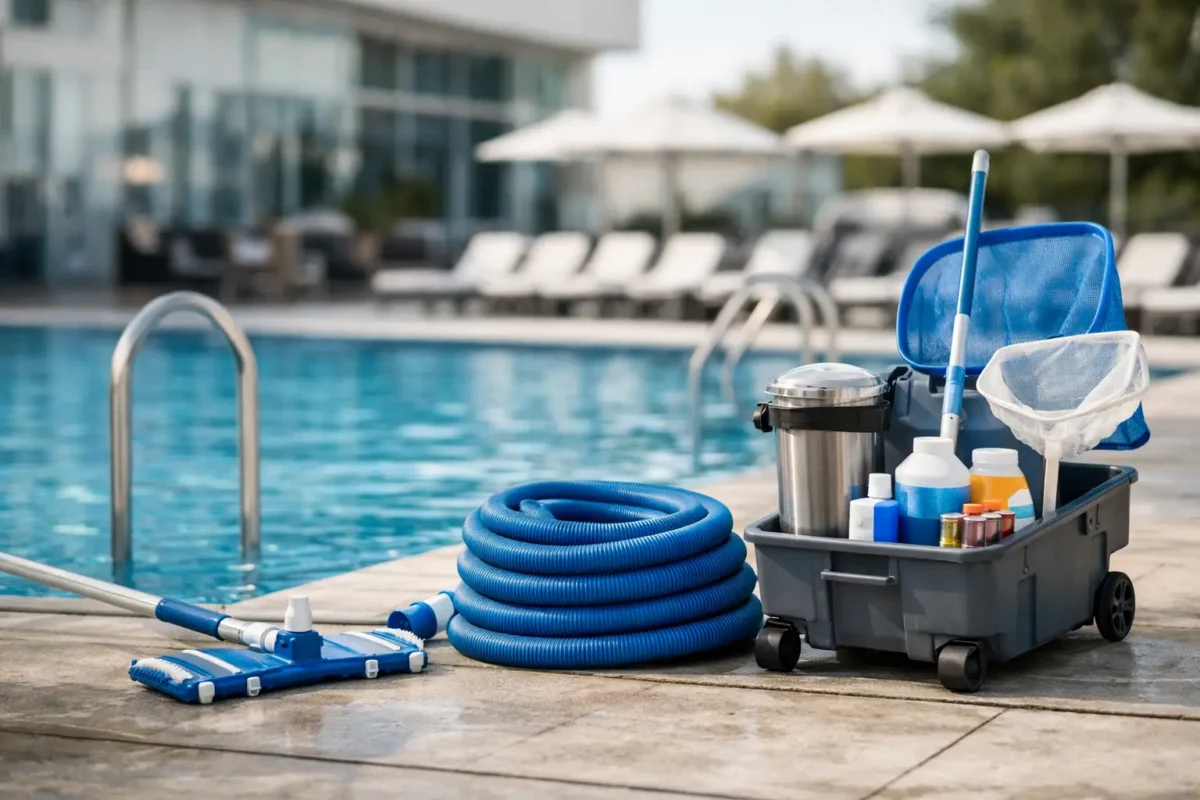
Many buyers think first about vacuums or cleaning tools, but the category is much broader. Commercial pool maintenance equipment includes pumps, filters, disinfection systems, chemical dosing units, water testing systems, automatic cleaners, skimmers, strainers, UV or supplementary sanitation components, and the supporting fittings that keep everything working together.
In premium properties, the equipment room is where performance is won or lost. A strong finish, attractive lighting, and elegant decking matter, but poor circulation or unstable chemistry will quickly overshadow every design feature. The most successful commercial installations are built around dependable mechanical and water treatment systems that can perform under daily pressure.
Start with circulation and filtration
If the circulation system is undersized, every other maintenance task becomes harder. Pumps need to move water efficiently enough to support turnover requirements without driving energy consumption too high. In a commercial setting, this balance matters. Oversizing can waste power, but undersizing often creates more expensive problems through poor water movement, uneven chemical distribution, and stressed filtration.
Filters are just as critical. The right filter depends on bather load, operating hours, water features, and the level of clarity the property expects. Sand filters remain a common choice for durability and straightforward maintenance. Media filters can offer improved fine-particle capture, while cartridge and other specialized solutions may suit selected applications. There is no single best answer for every site. A resort pool, a residential tower amenity pool, and a therapy pool may all require different filtration strategies.
For commercial buyers, the key question is not simply which filter is popular. It is which filter can maintain water clarity consistently while fitting the maintenance capacity of the site team. Backwash demand, service intervals, replacement cost, and hydraulic compatibility all need to be considered together.
Disinfection systems are where reliability matters most
A commercial pool cannot rely on inconsistent manual treatment. Water chemistry must stay controlled throughout operating hours, especially in facilities with changing swimmer loads. That is why high-quality disinfection and dosing systems are central to any serious commercial pool maintenance equipment plan.
Automatic chemical dosing helps maintain stable sanitizer and pH levels with far greater accuracy than manual intervention alone. This protects bathers, reduces chemical waste, and helps prevent the swings that lead to irritation, cloudy water, or premature wear on finishes and equipment. In high-end facilities, precision is not a luxury. It is part of protecting the property’s reputation.
Supplementary systems such as UV or advanced disinfection technologies can also strengthen performance, particularly in heavily used pools where water quality expectations are high. These systems do not replace the core sanitation process, but they can support better overall treatment when integrated correctly. The right setup depends on pool usage, local requirements, and the operator’s maintenance goals.
Cleaning equipment should match the pool’s operating reality
Cleaning is where many facilities underinvest. A commercial pool may look manageable on paper, yet daily debris load can vary dramatically depending on landscaping, foot traffic, weather exposure, and surrounding construction activity. Choosing cleaning tools without factoring in these conditions often leads to wasted labor and inconsistent results.
Automatic pool cleaners can reduce manual effort and improve cleaning frequency, especially in larger basins or properties that need presentable water at all times. Manual vacuums, brushes, leaf tools, and telescopic equipment still have an important role, especially around steps, corners, overflow edges, and detail areas where automated systems may miss buildup.
The best approach is usually a combination. Automation handles routine floor coverage, while manual tools support targeted cleaning and visual finishing. For busy hotels, residential communities, and commercial leisure spaces, that blend often produces the most reliable result.
Water testing systems protect both safety and efficiency
Without accurate testing, maintenance becomes guesswork. Commercial water conditions can shift quickly, particularly during peak occupancy periods. Reliable water testing systems allow operators to respond before small imbalances become visible problems.
Digital monitoring and dependable test equipment support better control of sanitizer, pH, alkalinity, and other key values. This protects swimmer comfort and helps preserve the life of pumps, heaters, filters, and finishes. It also reduces the hidden cost of overcorrecting water chemistry, which is common when readings are delayed or inconsistent.
For developers and property managers, this is where premium equipment earns its value over time. Better monitoring typically means fewer disruptions, less reactive maintenance, and stronger confidence that the pool is operating at the expected standard.
Durability is not optional in the UAE climate
In Dubai and across the UAE, equipment selection must reflect environmental reality. Heat, dust, high usage cycles, and demanding water conditions can expose weaknesses fast. Commercial-grade materials, corrosion-resistant components, and dependable brand quality matter far more than headline pricing alone.
This is especially true for pumps, fittings, dosing assemblies, and control systems installed in equipment rooms that run daily under sustained load. Lower-grade equipment may appear cost-effective during procurement, but repeated service issues, reduced efficiency, and shorter replacement cycles usually erase those savings. Premium facilities need equipment that holds performance over time, not only at handover.
Why integration matters more than single-product selection
One strong pump will not fix a poorly planned system. Commercial pool maintenance equipment performs best when it is selected as a coordinated package. Flow rates, filter capacity, dosing response, automation compatibility, and servicing access all need to align.
This is where experienced technical guidance makes a measurable difference. The goal is not just to supply parts. It is to create a maintenance ecosystem that works efficiently under real operating conditions. That may mean recommending a different pump curve, revising filter sizing, improving access for service teams, or adding monitoring equipment that reduces long-term intervention.
For commercial properties, integrated planning often delivers the biggest operational gains. It supports cleaner water, more predictable maintenance schedules, and less downtime during high-demand periods.
What commercial buyers should evaluate before purchasing
Price always matters, but it should never be the only measure. Commercial buyers should look at expected daily load, ease of maintenance, spare parts availability, energy efficiency, service support, and brand reliability. Equipment that is difficult to maintain or slow to service can create ongoing operational friction, even if the initial purchase cost looks attractive.
It is also worth considering whether the supplier can support installation, commissioning, troubleshooting, and future upgrades. Commercial pool environments rarely stay static. A hospitality property may expand services, a residential asset may increase occupancy, or a facility may need to improve sanitation standards. Working with a capable full-scope partner provides far more value than sourcing isolated products from multiple channels.
For this reason, many property owners and operators prefer a supplier that can advise across pumps, filters, cleaning systems, chemicals, testing, and technical support rather than treating each category as a separate transaction. Aquatic Pools and Fountains serves this need with a broad equipment portfolio and service-driven expertise tailored to premium residential and commercial environments.
Choosing for performance, not just compliance
Meeting baseline requirements is only the starting point. The stronger objective is to equip the pool for consistent visual appeal, dependable hygiene control, and practical ease of operation. That is what protects the guest experience in hospitality settings and the long-term value of high-end real estate assets.
Commercial pool maintenance equipment should never be selected as an afterthought once the pool is already built. It deserves the same level of planning as the visible design elements because it determines whether the water stays inviting day after day. When the equipment is right, the pool looks better, operates smarter, and demands less reactive attention from the people responsible for it.
The right investment is the one that keeps your pool ready for use, easy to manage, and worthy of the property around it.