
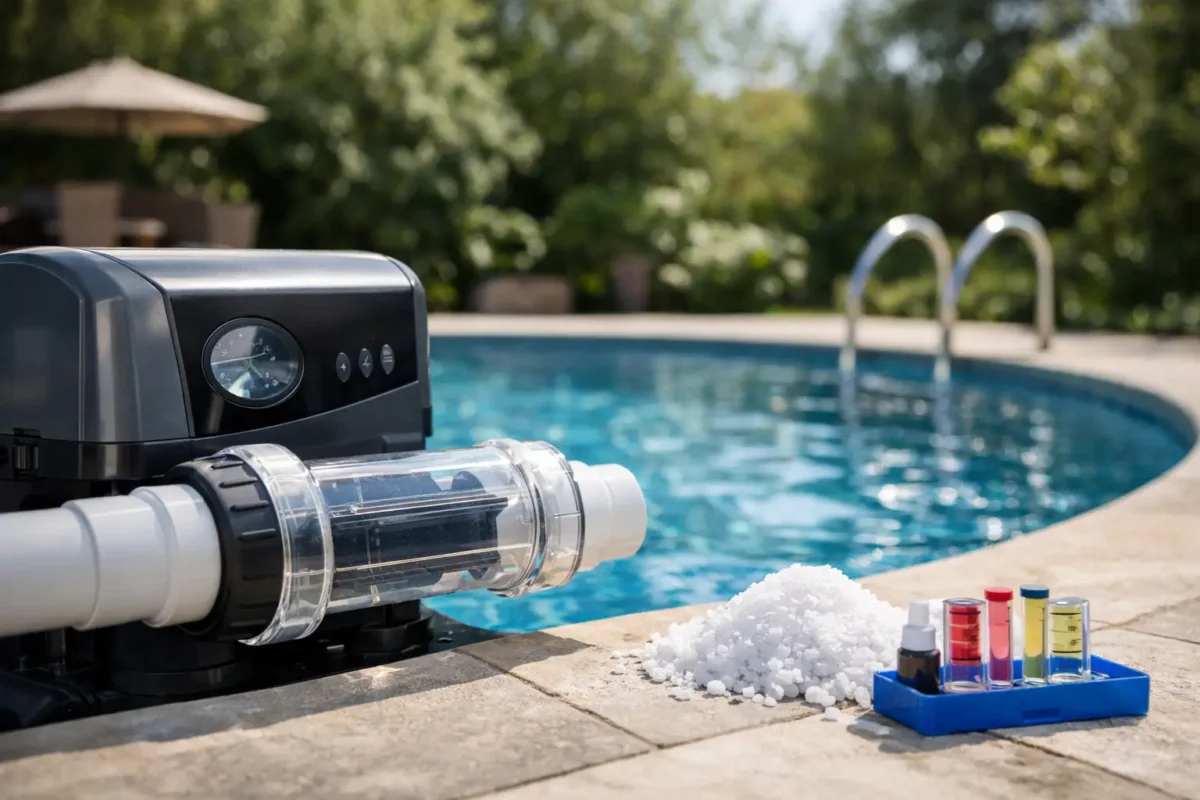
A pool that looks flawless at 10 a.m. can turn cloudy by late afternoon if the chlorination system is undersized, poorly installed, or simply not built for local conditions. That is why any serious pool salt chlorinator review should go beyond brochure claims and focus on what actually affects water quality, equipment life, and day-to-day operating stability.
For villa owners, hospitality operators, and facility managers, a salt chlorinator is not just a convenience upgrade. It is a core part of water treatment performance. The right system can reduce chemical handling, improve swimmer comfort, and deliver more consistent sanitation. The wrong one can create scaling, unstable chlorine output, premature cell failure, and unnecessary maintenance calls.
Pool salt chlorinator review – the criteria that actually matter
Most buyers start by comparing output ratings and price. That is understandable, but it is not enough. A premium chlorinator should be assessed on five practical factors: chlorine production capacity, cell durability, control accuracy, compatibility with the full filtration setup, and after-sales service.
Chlorine production capacity is where many purchasing mistakes begin. Manufacturers often publish ideal output figures under favorable conditions, but real pools rarely operate in ideal conditions year-round. High bather load, intense sunlight, warm water, and long circulation hours all increase chlorine demand. In markets such as Dubai and across the UAE, those factors become even more relevant. A unit that looks sufficient on paper may struggle in actual service if it is sized too close to the pool volume.
Cell durability is equally important. The electrolytic cell is the working heart of the system, and its lifespan depends on coating quality, water balance, run time, and cleaning frequency. Premium models usually justify their higher price through stronger cell construction, more stable output, and better resistance to harsh operating environments. Budget units often become expensive later because replacement intervals arrive sooner than expected.
Control accuracy separates basic systems from professional-grade equipment. A chlorinator that allows precise output adjustment, clear diagnostics, and dependable monitoring gives operators more control over water quality. This matters in both residential and commercial settings. A luxury villa owner wants clean, comfortable water without constant manual corrections. A facility manager wants predictable performance, fewer service interruptions, and easier record-keeping.
What a good salt chlorinator does well
A strong salt chlorinator should produce chlorine consistently without forcing the pool owner to chase chemistry every few days. Good systems maintain output even when conditions shift, provided the pool is properly balanced and circulation is adequate. They also integrate cleanly with pumps, filters, dosing equipment, and control panels rather than operating as a disconnected add-on.
The best units are also straightforward to service. This point is often ignored during purchase. Access to replacement cells, compatible spare parts, and qualified technical support has a direct effect on long-term value. A lower-priced system with weak local support can become a poor investment very quickly.
Another sign of quality is protective intelligence. Better chlorinators include flow detection, salt level warnings, temperature-related safeguards, and fault alerts that help prevent damage. These features are not marketing extras. They reduce avoidable wear and help protect the wider pool system.
Common trade-offs in any pool salt chlorinator review
There is no single best chlorinator for every pool. The right choice depends on pool volume, usage pattern, hydraulic design, exposure to sun, and how much automation the client expects.
A smaller residential pool with modest usage may perform very well with a mid-range unit if the system is correctly sized and maintained. A large villa pool with water features, high temperatures, and frequent guests may need a higher-capacity chlorinator than the water volume alone suggests. Commercial pools, hotel pools, and shared community facilities require even more caution because bather load and compliance expectations are higher.
There is also a clear trade-off between upfront cost and lifecycle value. Entry-level systems can be attractive for initial budgeting, but they may offer shorter cell life, fewer controls, and less refined diagnostics. Premium systems usually cost more because they are engineered for stability, stronger materials, and more dependable long-term operation. For high-value properties, this difference is often worth paying for.
Salt chlorination itself also has limits. It can reduce the need for manual chlorine dosing, but it does not remove the need for proper pH control, filtration, circulation, and routine testing. If these supporting elements are neglected, even an excellent chlorinator will underperform.
Sizing is where most buyers get it wrong
If there is one point every buyer should take from a pool salt chlorinator review, it is this: never size the system to the absolute minimum requirement. A chlorinator should have comfortable production headroom.
Why does that matter? Because chlorine demand changes. Summer heat raises consumption. Heavy pool use raises consumption. Dust, organic debris, and long sun exposure raise consumption. If the system is already operating near maximum output during normal conditions, it has no reserve when demand spikes. That is when water clarity drops and complaints begin.
Oversizing within reason is usually the smarter decision for premium residential and commercial pools. A properly selected larger unit can run at a lower output setting, reducing stress on the cell while preserving strong sanitizing capacity when needed. This can improve reliability and support longer component life.
Installation quality matters as much as product quality
A high-end chlorinator installed badly will not behave like a high-end system. Proper pipe layout, correct flow conditions, suitable cell placement, sound electrical work, and accurate programming all influence performance.
The chlorinator must work as part of a coordinated treatment system. Pump run times need to match chlorine demand. Filters need to be sized and maintained correctly. Water balance must stay within range to avoid scale buildup on the cell. If the installation team understands only the product and not the full pool environment, results can be inconsistent.
This is why many sophisticated property owners and developers prefer working with a supplier that can support specification, installation, and ongoing technical service. Aquatic Pools and Fountains operates in exactly that space, where equipment quality and execution quality are treated as one standard rather than two separate decisions.
Best fit by pool type
For private villa pools, comfort and simplicity usually lead the buying decision. Homeowners want soft-feeling water, reduced chemical odor, and stable sanitation without daily attention. In this case, quiet operation, intuitive controls, and a dependable cell matter more than advanced commercial-style programming.
For hospitality and commercial properties, the priorities shift. Here, output stability, monitoring capability, heavy-duty construction, and service access become essential. Downtime has a higher cost. Water quality issues affect guest experience, reputation, and maintenance workload. Commercial buyers should be especially cautious about selecting systems intended mainly for light residential use.
For real estate developments and shared facilities, standardization can also matter. Using proven systems with consistent parts availability and trained service support can simplify maintenance across multiple assets. That often delivers more value than choosing the lowest initial price on each individual unit.
Red flags to watch before you buy
A chlorinator deserves closer scrutiny if its output rating seems optimistic for the size of pool being promoted, if replacement cell costs are unclear, or if the product has limited technical support in your market. Vague warranty terms are another warning sign. So is any proposal that focuses on the chlorinator alone without reviewing circulation, filtration, and water balance.
Be careful with claims that make salt systems sound maintenance-free. They are lower-touch than many traditional setups, but they still need testing, cleaning, and periodic inspection. Serious suppliers explain that clearly because long-term performance depends on realistic expectations.
Final verdict
The best result from a pool salt chlorinator review is not finding the cheapest box with the highest claimed output. It is choosing a system that matches the pool’s true demand, the site conditions, and the service standard expected from the property.
For premium residential and commercial pools, quality usually shows up in the details – stronger cells, smarter controls, reliable safety features, proper sizing, and professional support after installation. When those factors are in place, a salt chlorinator becomes more than a sanitation device. It becomes part of a cleaner, more stable, and more elegant pool experience.
If you are selecting a chlorinator for a new build, renovation, or replacement project, treat the decision as a technical investment rather than a catalog purchase. The pool will tell you very quickly whether that choice was made well.