
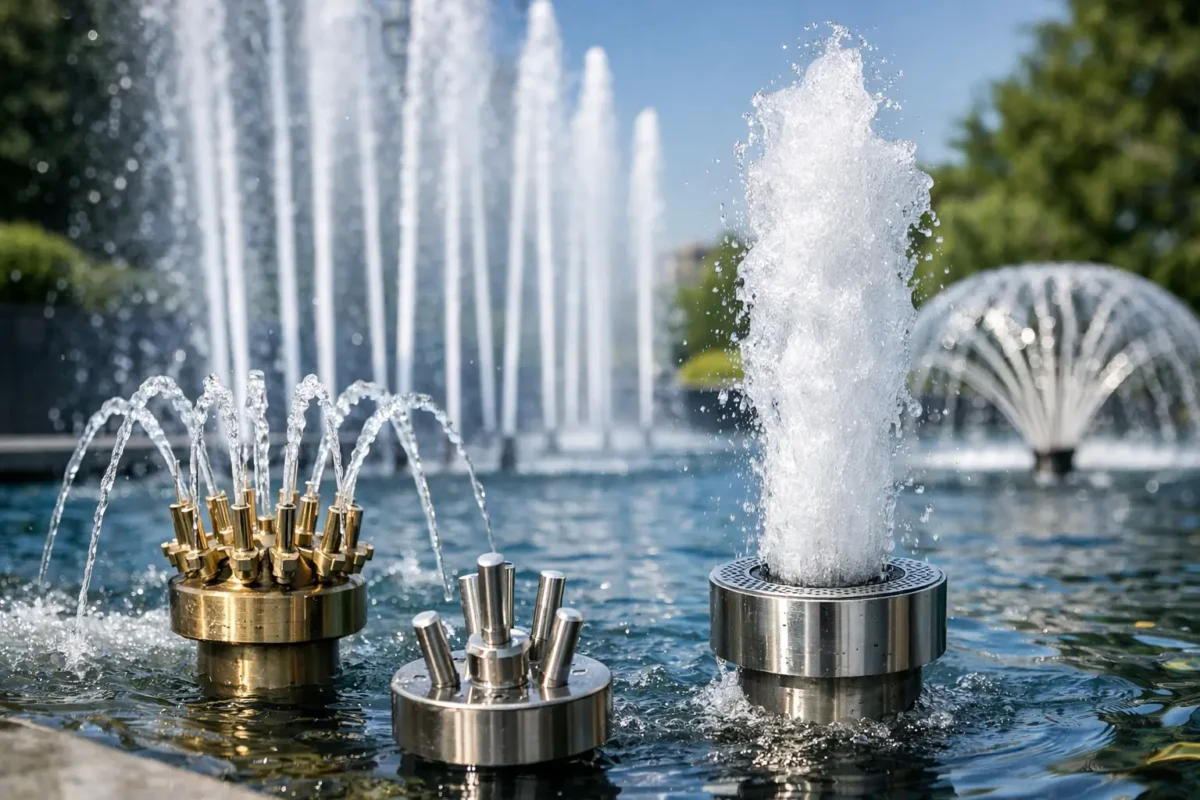
A fountain can look expensive and still fall flat if the water pattern is wrong. The difference often comes down to fountain nozzles – the component that controls shape, movement, height, spray density, and the overall character of the display. For property owners, developers, and facility teams investing in a premium water feature, nozzle selection is not a detail to leave until the end.
The right nozzle gives structure to the design. It turns a basic water system into a clean vertical jet, a soft umbrella effect, a multi-tiered pattern, or a dramatic fan display that holds its form even in demanding environments. The wrong nozzle can create overspray, inconsistent performance, wasted pump capacity, and a finish that looks ordinary instead of refined.
Why fountain nozzles matter so much
In a high-visibility setting, water behavior is part of the architecture. Whether the fountain sits at a villa entrance, in a hospitality courtyard, beside a commercial tower, or within a residential development, visitors notice symmetry, clarity, and consistency immediately. Nozzles are what define those visual cues.
They also influence technical performance. A nozzle must work in balance with pump flow, pipe sizing, water depth, filtration, and system pressure. If one element is off, the pattern may break apart, drift too far, or never reach the intended height. This is why premium fountain projects require more than an attractive catalog image. They need correct specification.
For buyers in the UAE, durability matters just as much as appearance. Fountain hardware operates in demanding outdoor conditions, and material quality directly affects corrosion resistance, maintenance frequency, and long-term finish. Stainless steel and brass remain popular because they support both elegance and dependable service life when properly matched to the installation.
Common types of fountain nozzles
Different fountain nozzles produce very different visual effects, and the best option depends on the project goal rather than a single “best” model.
A jet nozzle is often chosen when the objective is a clean, disciplined stream. These nozzles suit formal landscapes, entry features, and architectural settings where a sharp vertical line creates impact. Their simplicity is an advantage, but they rely on stable pressure and proper alignment to look precise.
Foam and aerating nozzles produce fuller white-water effects. These patterns are highly visible and useful in settings where water movement needs to stand out from a distance. They can also mask minor water inconsistencies better than clear-stream jets, which makes them practical in busier commercial environments.
Bell and mushroom nozzles create smooth, rounded forms that read as elegant and calm. These are often preferred for residential and hospitality applications where the visual language is softer and more decorative. They do, however, require careful water quality management because imperfections in flow are easier to spot in these shapes.
Fan nozzles spread water in a wide plane, making them effective for staged visual presentations or broader fountain compositions. Multi-tier and cluster nozzles are suitable for larger installations that need more complexity and scale. They can create impressive effects, but they also place greater demands on hydraulic design, maintenance access, and system tuning.
Choosing fountain nozzles for the site
Nozzle selection should start with the environment, not just the effect. A compact indoor fountain, an exposed outdoor plaza fountain, and a villa landscape feature all need different performance priorities.
Wind exposure is one of the biggest decision points. In open areas, very fine spray patterns may drift too easily and cause water loss or wet surrounding surfaces. In these cases, a heavier stream or aerated effect often performs better. If the goal is a tall display, that ambition must be balanced against local conditions. A dramatic pattern that cannot hold its shape outdoors will not deliver a premium result.
The basin size matters as well. A nozzle pattern should fit the geometry of the fountain, leaving enough margin to prevent splash-out while preserving visual proportion. An oversized spray in a shallow or narrow basin creates constant operational issues. A pattern that is too small can make the installation feel underdesigned.
Lighting also changes the decision. Some nozzles interact beautifully with underwater illumination, especially clear streams and controlled arcs. Others create a more diffuse effect that emphasizes motion rather than line. When the fountain is intended to perform at night, nozzle choice and lighting design should be considered together from the beginning.
Materials, finishes, and durability
For premium installations, nozzle material is not an area to compromise. The finish must support long-term exposure to treated water, outdoor conditions, and routine maintenance.
Stainless steel is widely specified because it offers a clean appearance and strong corrosion resistance. It suits modern architectural projects and high-end residential designs where finish quality matters. Brass remains a strong option in many fountain systems due to its durability and reliable machining quality. The best choice depends on water chemistry, application type, and the broader equipment package.
Lower-grade components may reduce upfront cost, but they often create avoidable service issues. Threads wear faster, finishes degrade, spray patterns lose consistency, and replacement cycles shorten. In a luxury or commercial setting, those problems quickly cost more than they save. A premium fountain should be built around parts that maintain performance under regular use.
The hydraulic side of nozzle performance
Even the best nozzle will disappoint if it is paired with the wrong hydraulic setup. Flow rate and pressure must match the nozzle specification closely, or the pattern will not form correctly.
This is where many projects go wrong. A buyer may select a nozzle based purely on appearance, only to discover that the existing pump cannot support it or that the pipework creates too much pressure loss. The result is often weak projection, unstable spray, or excessive energy use as the system is pushed to compensate.
A properly designed fountain system accounts for pump selection, filtration, control valves, water level stability, and service access. If multiple nozzles are used, system balancing becomes even more important so each pattern performs consistently. In larger installations, precision matters. A slight mismatch repeated across several nozzles can make the whole display look uneven.
Installation and maintenance expectations
Premium fountain nozzles still require maintenance. The advantage of higher-quality equipment is not that it eliminates upkeep, but that it supports more reliable performance between service intervals.
Mineral buildup, debris, and water quality issues can alter spray shape over time. Adjustable nozzles may also need periodic realignment, particularly in exposed outdoor settings. This is why access for inspection and cleaning should be part of the design conversation early on. A beautiful nozzle that is difficult to maintain becomes a liability.
For commercial properties and hospitality environments, scheduled maintenance is especially important. Water features contribute to brand perception, and even minor irregularities are highly visible to guests and tenants. A professional maintenance plan protects the visual standard of the fountain while extending the life of its mechanical components.
When custom specification makes sense
Standard nozzles cover many needs, but some projects require a more tailored approach. Large entry fountains, branded commercial environments, and architect-led developments often need a custom combination of nozzle styles, heights, and spacing to achieve the intended visual identity.
This is where technical guidance adds real value. Instead of choosing products in isolation, the fountain is designed as a complete system with coordinated components and performance targets. That process helps avoid common issues such as overspray, underpowered effects, poor basin proportion, and difficult servicing.
Aquatic Pools and Fountains supports this level of specification with premium equipment, technical expertise, and installation insight for both residential and commercial projects. For clients who want a water feature that looks exceptional and operates reliably, that combination matters.
Selecting the right fountain nozzles for a premium result
A successful fountain is rarely about one dramatic component. It is the result of disciplined choices that work together – nozzle style, material quality, pump performance, basin design, and maintenance planning. Fountain nozzles sit at the center of that equation because they shape what people actually see.
If the goal is elegance, durability, and consistent performance, the best decision is to specify nozzles with the full project conditions in mind. The visual effect should be impressive, but it should also be practical for the site, sustainable for the system, and aligned with the standard of the property. When those elements are in balance, the fountain does more than decorate a space – it defines it.