
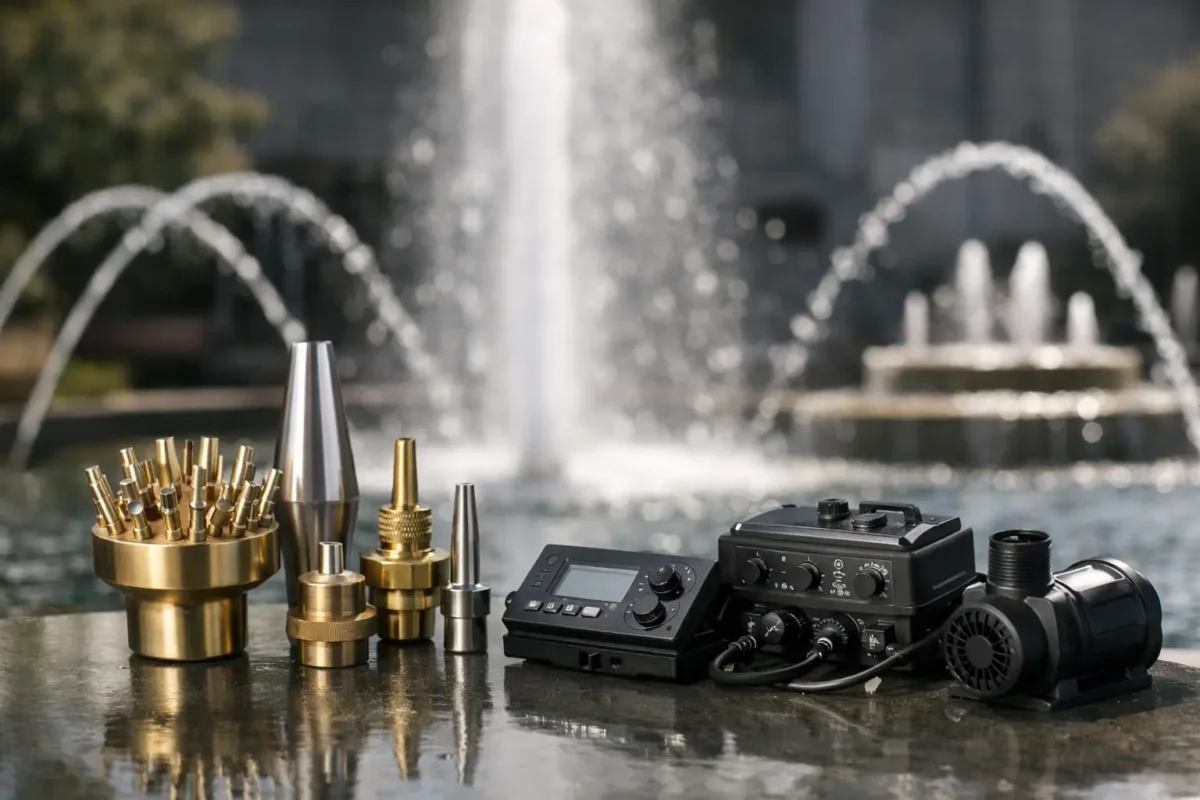
A fountain that looks exceptional for the first five minutes and underperforms for the next five years is a poor investment. That is why fountain nozzles and controllers deserve far more attention than they usually get. They are the components that shape the water effect, define movement, manage timing, and determine whether a feature feels refined and dependable or inconsistent and costly to maintain.
For villa owners, developers, hospitality operators, and facility managers, the right selection is never just about appearance. It is about matching visual ambition with hydraulic performance, environmental conditions, and long-term serviceability. In premium residential and commercial settings, that balance matters.
Why fountain nozzles and controllers matter
The nozzle is the visible signature of any fountain. It decides whether the water rises in a clean vertical jet, forms a soft bell, creates a fan pattern, or produces an aerated, illuminated display with strong visual presence. Different effects suit different spaces. A quiet courtyard may benefit from a calm, elegant pattern, while a hotel entrance or mixed-use development often calls for a more dynamic and structured display.
The controller is what turns those effects into a coordinated system. It governs timing, sequencing, pump interaction, lighting integration, and in many cases wind response or programmed shows. Without the right controller, even premium nozzles can deliver disappointing results. You may have good equipment, but not a well-managed fountain.
This is where many projects go wrong. Buyers may focus on a single visual reference image and assume the nozzle alone creates the effect. In reality, the final result depends on pressure, flow rate, piping layout, pump sizing, water quality, and control logic. The best fountain systems are designed as complete operating environments, not as disconnected parts.
Selecting fountain nozzles for the intended effect
Nozzle selection starts with the visual goal, but it should not end there. A fountain in a luxury villa has different priorities from one installed in a public plaza or hospitality property. In a residential setting, low noise, refined proportion, and low overspray may be the priority. In a commercial environment, consistency, scale, and stronger visual presence often take precedence.
Straight jet nozzles are widely used when clean geometry and height are important. They create disciplined vertical lines and work well in formal layouts. Foam and aerating nozzles produce a fuller, whiter column of water, which improves visibility and can be more effective where ambient light or surrounding activity competes with the fountain visually. Bell and mushroom-style nozzles are more decorative and quieter in character, often suited to intimate landscapes and architectural water features.
The trade-off is simple. More dramatic effects typically demand tighter hydraulic control and can be more sensitive to pump fluctuations or wind. Softer effects may be easier to manage, but they can lose impact in large outdoor settings. There is no universal best choice. It depends on site exposure, desired atmosphere, and how the fountain fits the architecture around it.
Performance depends on more than nozzle design
A premium nozzle can only perform as well as the system supporting it. Flow rate must match the nozzle specification. Pressure must remain stable. Water supply conditions, filtration quality, and pipe sizing all influence the final display. If the hydraulic design is off, the water pattern may break up, drift unevenly, or fail to reach the intended height.
Material quality also matters, especially in demanding climates. Corrosion resistance, machining accuracy, and long-term durability should never be treated as optional in high-value installations. Stainless steel and other high-grade materials are often the preferred choice for premium applications because they hold appearance and performance over time. Lower-grade components may reduce initial cost, but they often create problems later through wear, clogging, and inconsistent spray behavior.
What controllers actually do in a fountain system
A controller is not just an on-off panel. In a modern fountain system, it is the operational center. It can manage scheduled operation, coordinate multiple pumps, switch between programmed scenes, and synchronize water movement with underwater lighting. In more advanced installations, it can also respond to environmental inputs such as wind speed, helping reduce water loss and overspray.
That level of control matters in the UAE, where outdoor conditions can change quickly and site presentation is critical. A fountain in a luxury development or hospitality project should not be left to operate on a fixed manual pattern if conditions demand flexibility. Intelligent control allows the display to remain attractive while protecting the surrounding landscape, hardscape, and equipment.
There is also the issue of energy use. A well-configured controller can help optimize operating hours and effect intensity. That is especially valuable in larger commercial systems, where continuous operation without proper scheduling can increase utility costs and equipment wear.
Basic control versus advanced programming
Not every project needs a complex show controller. For many residential fountains and smaller architectural features, a reliable timing and pump control system may be enough. If the design is static and the goal is elegant consistency, simple control can be the right choice.
For hospitality, retail, mixed-use, or landmark installations, advanced programming often makes more sense. These controllers can manage multiple zones, variable-speed operation, lighting sequences, and changing effects throughout the day. The result is a fountain that feels intentional rather than repetitive.
The key is not to over-specify or under-specify. A controller should match the scale and purpose of the project. Too little control limits performance. Too much complexity can create unnecessary operating challenges if the site team is not prepared to manage it.
Common mistakes in fountain design and equipment selection
One of the most frequent mistakes is choosing nozzles based only on appearance in a catalog image. Water effects in real conditions are influenced by wind, basin dimensions, pump performance, and installation accuracy. A pattern that looks perfect indoors or in a controlled showroom may behave very differently outdoors.
Another issue is poor equipment coordination. Nozzles, pumps, lights, filters, and controllers should be selected to work together. If one element is undersized or incompatible, the system loses stability. This often shows up as irregular spray heights, uneven distribution, or maintenance problems that seem minor at first but become persistent.
Maintenance access is another point buyers sometimes overlook. Decorative equipment still needs service. Nozzles require cleaning, controllers require proper enclosure and protection, and electrical integration must be handled professionally. A visually impressive fountain that is difficult to maintain will rarely remain impressive for long.
Fountain nozzles and controllers in premium projects
In premium projects, expectations are higher. A fountain is not there simply to move water. It supports property identity, creates ambiance, and often becomes part of the first impression. That means the equipment must do more than function. It must perform consistently, preserve its finish, and support a polished visual standard every day.
For villa projects, that usually means selecting elegant nozzles with controlled splash characteristics, reliable automation, and a configuration that complements the surrounding architecture rather than competing with it. For hotels, towers, and commercial developments, it may mean scalable nozzle arrays, programmable effects, and controllers that support both aesthetics and operational discipline.
This is where experienced technical guidance adds real value. The best results come from evaluating the entire fountain environment – design intent, basin size, pump room conditions, exposure, maintenance strategy, and user expectations. Product quality is essential, but specification accuracy is what makes quality visible.
Aquatic Pools and Fountains serves clients who expect that standard. For buyers who want more than off-the-shelf equipment, the advantage lies in working with a supplier that understands installation realities, long-term performance, and the demands of luxury residential and commercial projects.
How to make the right choice
Start with the purpose of the fountain. Is it meant to be calm and architectural, bold and high-impact, or programmable and interactive? From there, assess the operating conditions, including wind exposure, available power, maintenance resources, and water treatment quality. Then specify nozzles and controllers as part of one coordinated system.
It is also worth thinking beyond the handover stage. Ask how the system will perform after months of use, not just on day one. Ask whether replacement parts are readily available, whether the controls are practical for the end user, and whether the installation team can support future maintenance and adjustment.
A strong fountain is built on precision. The right equipment selection creates a display that looks intentional, runs reliably, and continues to reflect the value of the property it serves. When fountain nozzles and controllers are chosen with that level of care, the result is not just a water feature. It is a lasting asset that keeps its presence long after the opening day display.