
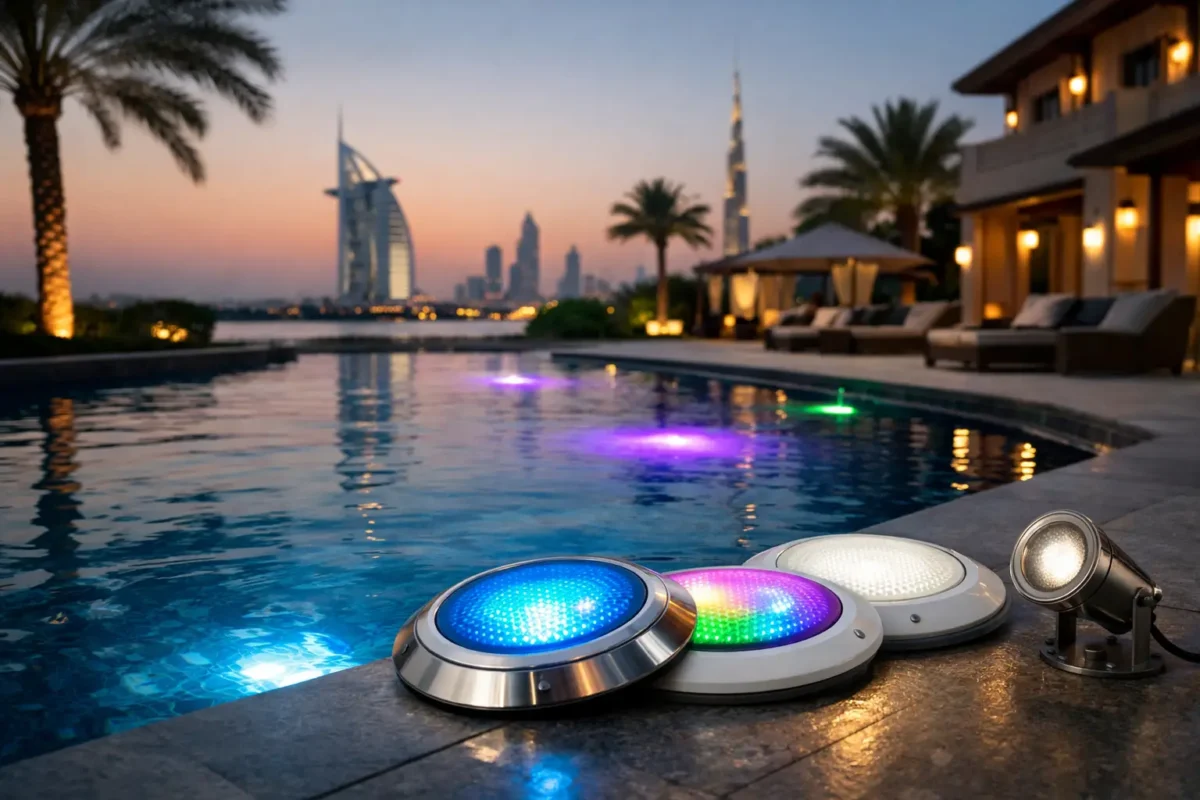
A pool can look exceptional in daylight and still lose its impact after sunset if the lighting is poorly specified. For villas, hotels, residential towers, and commercial leisure facilities, the right LED system turns water into an architectural feature while supporting safe nighttime use. This LED pool lights comparison focuses on the decisions that affect appearance, operating life, maintenance requirements, and project value in the UAE.
The best choice is rarely the lowest-priced fixture or the brightest one on paper. It is the lighting system that suits the pool finish, installation method, control requirements, water chemistry, and expected service conditions. In a premium property, lighting should feel intentional: even color distribution, reliable performance, and equipment that can be serviced without unnecessary disruption.
LED Pool Lights Comparison: The Main Fixture Types
Most pool-lighting decisions begin with the fixture format. Surface-mounted and niche-mounted lights can both deliver excellent results, but they serve different construction conditions and maintenance priorities.
Niche-mounted LED lights
Niche-mounted lights sit inside a purpose-built housing installed within the pool wall during construction or renovation. The fixture face is generally flush or nearly flush with the finish, creating a clean, integrated appearance that suits luxury pools, tiled spas, and high-visibility hospitality projects.
This is often the preferred option for new builds because the wiring route, niche location, and beam direction can be planned before the pool is finished. It also allows a larger light body, which can support stronger output and more sophisticated optics. For a deep pool, a wide pool, or a pool with dark finishes, this additional performance can be valuable.
The trade-off is installation planning. Retrofitting a niche-mounted light into a completed pool can involve more construction work than a surface-mounted alternative. The niche, conduit, cable length, and waterproof connections must be specified correctly from the start.
Surface-mounted LED lights
Surface-mounted lights attach directly to the pool wall or a suitable mounting plate. They are popular for renovations because they can often be installed without creating a new full-depth niche in the shell. Modern surface-mounted units are compact, refined, and available in white-light and color-changing options.
For property owners upgrading old halogen fittings, a surface-mounted LED can be a practical route to lower energy use and improved visual quality. It can also simplify access for future replacement, depending on the mounting arrangement.
However, not every surface-mounted fixture produces the same visual result. The light body may be more visible than a niche-mounted model, particularly in minimalist mosaic pools. In premium installations, fixture finish, profile, cable routing, and placement must be considered carefully to preserve the overall design.
Retrofit LED lamps
A retrofit LED lamp is designed to replace an existing halogen lamp in a compatible housing. This can be the fastest and most economical upgrade where the old niche, lens, and electrical arrangement remain in good condition.
Retrofit solutions can significantly reduce power consumption and eliminate the frequent lamp changes associated with older halogen systems. Yet compatibility must be confirmed before ordering. An older fixture may have a degraded gasket, unsuitable lens, damaged niche, or transformer that does not work correctly with the selected LED lamp. Replacing only the lamp may save money initially while leaving the weakest parts of the original system in place.
White Light or RGB Color Changing?
White light remains the strongest choice for many premium pools. It shows the true tone of water and tile, improves visibility for swimmers, and delivers a calm, elegant look. Warm white can complement beige stone, timber decking, and residential landscaping. Cool white creates a crisp contemporary effect, especially around pale tile, stainless steel details, and modern architecture.
Color-changing RGB and RGBW lights offer greater flexibility. They are well suited to hotel pools, rooftop lounges, entertainment areas, fountains, and properties that use lighting to create different moods for events. RGBW fixtures add a dedicated white channel, which usually provides a more convincing everyday white than RGB mixing alone.
The decision depends on how the pool is used. A family villa may benefit more from high-quality white illumination that is easy to operate every evening. A resort or commercial venue may gain more value from programmable colors, synchronized scenes, and seasonal displays. Color capability should be chosen as a design feature, not simply because it is available.
Output, Beam Angle, and Pool Finish Matter More Than Wattage
Wattage is an incomplete way to compare LED pool lights. LEDs use far less power than halogen lamps, so a lower-wattage fixture can still provide strong, effective illumination. The more useful considerations are light output, beam spread, fixture placement, and the pool surface itself.
A narrow beam can create bright highlights but leave darker areas across the pool floor. A wider beam generally delivers more even coverage, which is often preferable for swimming pools. Deep pools, pools with unusual shapes, and large commercial basins may need several carefully positioned lights rather than a small number of high-output fixtures.
Finish changes the result dramatically. Light-colored plaster, white tile, and pale mosaic reflect light efficiently and make water appear brighter. Dark blue, charcoal, black, and richly patterned finishes absorb more light, requiring higher output or additional fittings to avoid a flat appearance. A lighting plan should be based on actual dimensions, depth changes, steps, ledges, and finish samples, not just a generic fixture count.
Control Systems: Simple Switching Versus Smart Scenes
The control method determines how easy the system is to use after installation. Basic white lights may operate from a standard switch and timer. This remains a dependable option for residences where the goal is straightforward nighttime illumination.
Color-changing systems can be controlled through power cycling, remote controls, wall-mounted controllers, or integrated automation platforms. Power-cycling is simple but less precise, as users must switch the fixture on and off in a sequence to reach a chosen color or program. It may be adequate for small residential pools but is less suitable for larger sites where consistent scenes matter.
Dedicated controllers provide better control of colors, brightness, timing, and synchronization. For villas with integrated landscape lighting, hotel facilities, and multi-pool developments, automation compatibility is worth considering early. A coordinated system can operate pool lights, fountain lighting, garden zones, and schedules from one platform.
The practical question is not whether smart control is impressive. It is whether the property team or homeowner will use it. The best system is intuitive, reliable, and properly commissioned with clear operating instructions.
Material Quality and UAE Service Conditions
Pool lighting works in a demanding environment: continuous moisture, chemical exposure, heat, and regular operating cycles. In Dubai and across the UAE, outdoor installations also face high ambient temperatures, strong UV exposure, and long periods of intensive use.
Quality housings, sealed cable entries, suitable lenses, and corrosion-resistant components are essential. The fixture should be designed for submerged use and installed according to its specified ingress protection, voltage, and grounding requirements. For saltwater pools or pools with aggressive chemical conditions, material selection becomes even more critical.
Low-voltage LED systems are widely used because they support safer poolside operation when correctly installed. The transformer, junction box, cable sizing, and electrical protection must be treated as part of the lighting system, not as secondary accessories. A premium fixture can still perform poorly if paired with an unsuitable transformer or an improperly sealed connection.
For commercial facilities, serviceability should be part of procurement. Ask whether replacement parts, compatible controllers, transformers, and matching fixtures can be sourced locally. Selecting equipment with dependable stock support reduces downtime and helps maintain a consistent visual standard across the property.
Installation and Placement Define the Final Result
Even the best LED fixture cannot compensate for poor placement. Lights are typically positioned to illuminate across the pool rather than directly toward common viewing areas. This reduces glare from terraces, lounges, and interior spaces while making the water feel evenly lit.
Steps, tanning ledges, swim-out areas, and spa benches deserve separate attention. These features improve the pool experience, but they can create shadows if the main lights are aimed only at the open basin. In a commercial environment, well-lit entry points also support safer guest movement after dark.
Professional installation also protects the long-term integrity of the pool shell and waterproofing system. Cable conduits need correct routing, niches must be securely installed, and every connection must remain accessible where required. For renovations, a site inspection can identify whether an existing niche can be reused or whether a new lighting approach will provide a more dependable result.
Choosing the Right LED Pool Lighting System
For a new luxury villa, niche-mounted white or RGBW lights with a properly planned control system often provide the most refined result. For a renovation, surface-mounted fixtures or compatible LED retrofits may deliver a substantial upgrade with less construction work. For hotels, residential communities, and commercial leisure facilities, the priority should be consistent output, controller reliability, local service support, and a lighting layout built for the full operating environment.
Aquatic Pools and Fountains helps property owners, developers, and facility teams select premium pool and fountain lighting that matches the installation, visual objective, and maintenance strategy. The right recommendation considers more than a catalog specification. It accounts for the pool’s finish, electrical infrastructure, operating schedule, and the standard the property needs to maintain.
A well-designed LED lighting system should disappear into the experience: clear water, confident visibility, elegant reflections, and a pool that remains one of the property’s strongest features long after sunset.