Aquatic

Categories
Uncategorized

Pool Chiller Versus Heater for Dubai Villas

A pool that reaches 95°F by midday is not a luxury amenity anyone wants to use. Yet for many Dubai villas, hotels, and residential developments, that is the reality during peak summer. The pool chiller versus heater decision is therefore not simply about adding another piece of equipment. It determines whether the water remains inviting, how efficiently the plant room operates, and whether the pool delivers the comfort expected from a premium property.

For UAE projects, cooling is often the first concern. Heating still has a clear role, especially for evening swimming, shaded pools, indoor facilities, and winter use. The right solution depends on the pool’s exposure, operating schedule, water volume, and the standard of comfort the property intends to provide.

Pool Chiller Versus Heater: The Core Difference

A pool chiller removes heat from the water and rejects it into the surrounding air. Its purpose is to bring overly warm pool water down to a more refreshing temperature. In Dubai’s long hot season, this can transform a pool from a visual feature into a genuinely usable outdoor space.

A pool heater adds heat to raise or maintain water temperature. Traditional pool heaters may use gas or electricity, while a heat pump captures ambient heat and transfers it into the water. Heating is most valuable when air temperatures fall, when pools are used early in the morning or late at night, or when guests expect a consistently warm swimming experience.

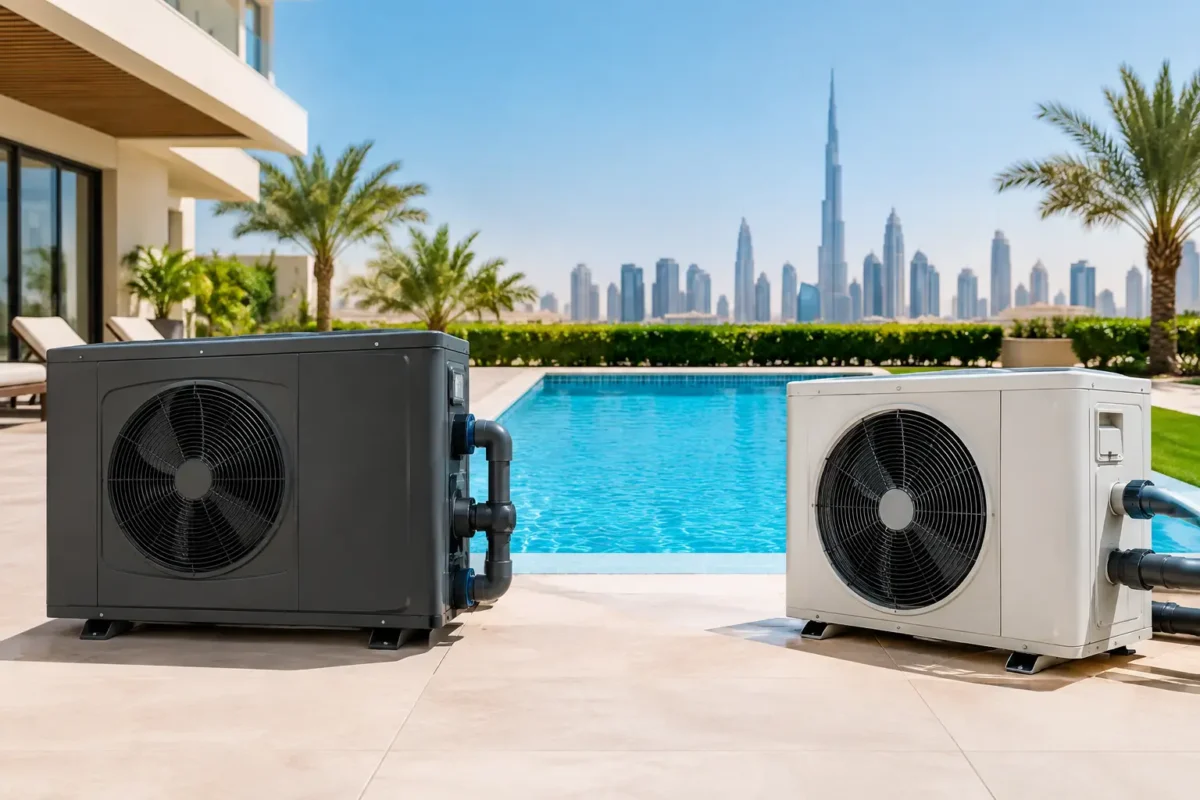
A heat-cool pump combines both functions in one system. It can heat water during cooler months and cool it when summer temperatures push pool water above the desired range. For many high-use UAE pools, this is the most flexible long-term approach, provided the unit is correctly sized and professionally integrated.

Why Dubai Pools Often Need Cooling First

Sun exposure is the dominant factor for outdoor pools in the UAE. A shallow pool with dark tile, limited shade, and long hours of direct sunlight can absorb heat quickly. Warm surrounding decks, high ambient temperatures, and low overnight cooling can keep water uncomfortably hot for extended periods.

A chiller helps maintain a selected setpoint rather than allowing temperatures to climb unchecked. Many owners find that water in the upper 70s to mid-80s Fahrenheit feels more comfortable for active swimming, although the preferred temperature varies by user and pool type. A family recreation pool, a lap pool, and a hotel leisure pool may each require a different target.

Cooling also supports water quality management. Extremely warm water can accelerate chlorine consumption and encourage algae growth if sanitization and circulation are not managed carefully. A chiller is not a substitute for proper filtration, disinfection, chemical balance, or circulation time, but it helps create more stable operating conditions during the hottest months.

When a Pool Heater Is the Better Investment

Heating is the priority when a property uses its pool through the UAE winter or wants reliable comfort beyond daylight hours. While Dubai winters are mild compared with colder climates, water temperature can still drop enough to discourage swimming, particularly in larger pools, shaded courtyards, rooftop installations, and properties with wind exposure.

Hotels, wellness facilities, and premium residential communities often benefit from heating because their pools must meet guest expectations year-round. A warm pool extends usable hours, supports children and older swimmers, and makes the amenity more valuable during cooler evenings.

Indoor pools present a different case. They generally receive less solar gain, so overheating is less severe. However, their heating requirement may be higher because consistent water and air temperatures are central to user comfort. The pool room’s ventilation and dehumidification design must also be considered alongside the heating equipment.

Is a Heat-Cool Pump Worth It?

For a villa or commercial property with year-round pool use, a heat-cool pump is often the strongest answer to the pool chiller versus heater question. Instead of installing separate systems, the property has one unit capable of responding to seasonal conditions. This can simplify controls, reduce plant-room complexity, and offer efficient temperature management across the year.

The investment makes the most sense where the pool is a core lifestyle or hospitality feature rather than an occasional-use amenity. It is particularly suitable for luxury villas, hotels, apartment communities, and corporate properties where a closed pool or overheated pool affects the perception of the entire asset.

That said, a dual-function system is not automatically the right choice for every pool. An outdoor pool used only in summer may gain more immediate value from dedicated chilling. A pool used mainly on winter weekends may justify heating without cooling. Equipment selection should follow the operating requirement, not a one-size-fits-all specification.

Sizing Is More Than Pool Volume

Pool volume is the starting point for selecting a chiller, heater, or heat-cool pump, but it is not enough on its own. Two pools with the same number of gallons can require very different capacities.

A precise assessment considers the surface area exposed to sunlight, depth profile, desired water temperature, local weather conditions, wind, surrounding shade, pool finish, and expected daily use. The equipment must also work with the existing circulation pump, filter system, plumbing diameter, electrical supply, and available installation space.

Undersized equipment runs longer without achieving the target temperature. This increases operating cost and causes unnecessary wear. Oversized equipment can raise the initial investment and may cycle inefficiently if controls are not configured correctly. A professional load calculation protects both performance and long-term value.

Plant Room Conditions Matter

Heat pumps and chillers need adequate airflow to reject or absorb heat effectively. Units placed in tight, poorly ventilated enclosures can lose efficiency and may recirculate hot discharge air. Noise, service access, drainage, and corrosion protection also deserve attention, especially in coastal locations where salt-laden air can affect equipment life.

The installation should allow technicians to inspect connections, clean coils, and service electrical components without disrupting the pool’s wider operation. For commercial facilities, this practical detail is essential for dependable maintenance planning.

Operating Cost and Efficiency Considerations

The lowest purchase price does not always create the lowest ownership cost. Energy consumption depends on the equipment type, capacity, target temperature, runtime, ambient conditions, and the amount of heat entering or leaving the pool each day.

A thermal pool cover is one of the most effective supporting measures. It reduces heat gain in some conditions, limits evaporation, and helps retain warmth when heating is required. For heated pools, it can substantially reduce energy loss overnight. For chilled pools, the right cover strategy should be reviewed carefully because covers can also trap heat if left on during intense sun.

Variable-speed circulation pumps, automated controls, clean filters, balanced water chemistry, and well-maintained plumbing all contribute to efficient temperature control. A premium temperature-management system should be treated as part of the complete pool system, not as an isolated appliance.

Controls That Protect Comfort and Equipment

Modern controls allow operators to set a preferred temperature range, schedule operation around occupancy, and prevent heating and cooling from working against each other. This is especially useful for hospitality properties and residential communities with changing usage patterns.

Automation can also coordinate the chiller or heat pump with circulation schedules and remote monitoring. For facility managers, this provides greater oversight of energy use and equipment status. For villa owners, it offers convenience without sacrificing the precise experience expected from a high-end pool.

Choosing the Right System for Your Property

Choose a dedicated pool chiller when summer comfort is the primary issue and the pool sees most of its use during hot months. Choose a heater when the goal is to extend swimming through cooler weather, support night use, or maintain warm water for a wellness-focused environment.

Select a heat-cool pump when the pool must stay comfortable throughout the year and the property demands flexibility, efficiency, and refined control. This is often the preferred route for premium villas, resorts, and high-visibility commercial amenities, where water temperature has a direct effect on guest satisfaction and asset appeal.

Aquatic Pools and Fountains can assess the pool environment, equipment room, and usage requirements to specify a solution that performs reliably in UAE conditions. The best system is not the unit with the largest capacity or the lowest initial cost. It is the one engineered around how your pool is actually used, so every swim feels intentional rather than dictated by the weather.
Categories
Uncategorized

When Are Pool Alarms Required for Safety?

A beautiful pool should feel like an asset to a villa, hotel, or residential development – never an unmanaged risk. The question of whether pool alarms are required has no single answer because legal obligations vary by jurisdiction, pool type, and the people who can access the water. What does remain consistent is the duty to create multiple, dependable layers of protection around every aquatic installation.

For property owners and facility managers, an alarm is not simply an accessory added after construction. It is part of a wider safety strategy that must work alongside barriers, gates, covers, supervision, lighting, and well-maintained equipment. The right solution protects guests and residents while preserving the refined appearance and efficient operation expected of a premium pool environment.

When Are Pool Alarms Required?

Pool-alarm requirements are determined by local building codes, community regulations, insurance conditions, and the classification of the property. A private residential pool may be governed differently from a hotel pool, apartment complex, school facility, or health club. In some locations, an alarm may be specifically mandated for a pool gate, a door that opens directly onto the pool area, or the water itself. Elsewhere, alarms are strongly recommended as part of compliance with broader barrier and drowning-prevention standards.

For projects in Dubai and across the UAE, owners should confirm the applicable requirements with the relevant municipality, master developer, civil defense authority, and project consultant. Requirements can also differ between a new build, a major renovation, and an existing pool undergoing a safety upgrade. A specialist site review is the most reliable way to avoid assuming that one property’s approval standard applies to another.

Commercial and shared-use environments demand particular care. Hotels, residential towers, compounds, and leisure facilities have changing users, multiple access points, and staff shifts. Even where a water-entry alarm is not explicitly required, a professionally specified alarm system can provide an additional control point that supports responsible risk management.

An Alarm Is One Layer, Not the Entire Safety Plan

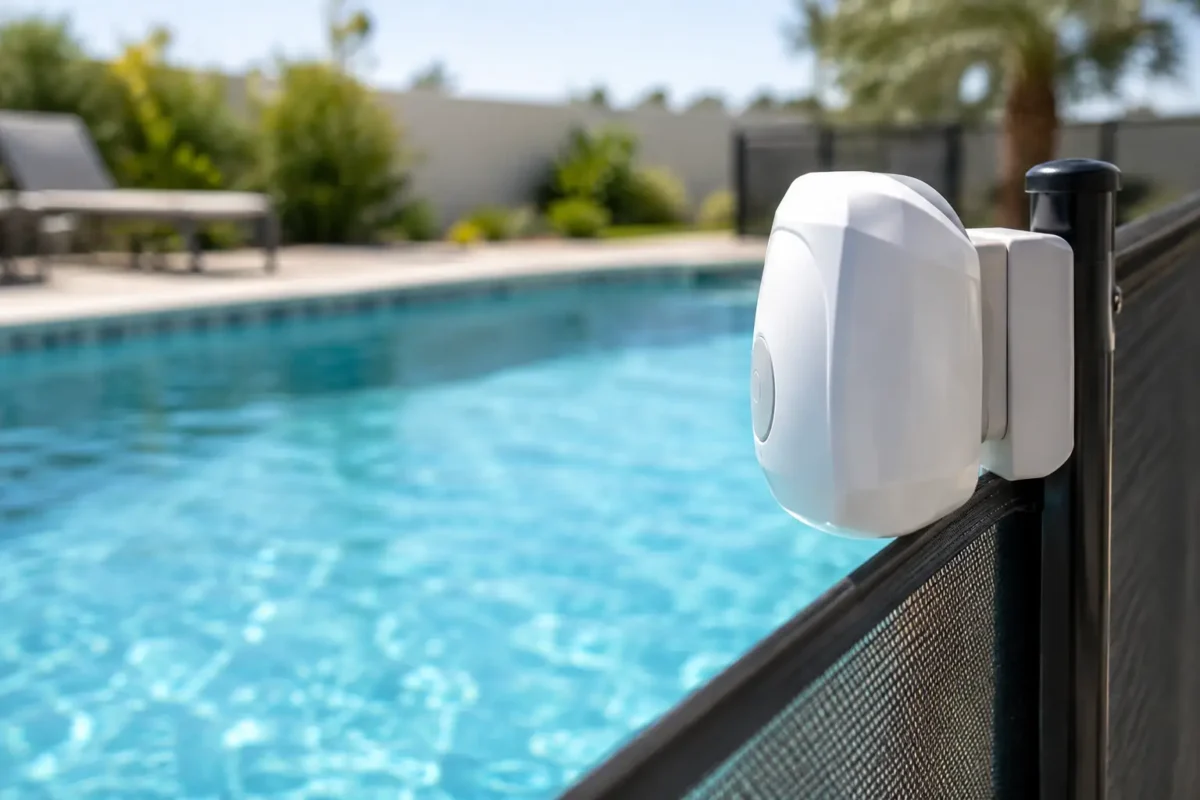
An alarm can notify responsible adults or staff that a gate has opened, a protected door has been used, or there has been movement in the water. It cannot physically prevent access, replace attentive supervision, or compensate for a damaged fence. That distinction matters when selecting equipment and setting realistic expectations.

A premium pool safety plan normally combines a self-closing, self-latching gate; a secure perimeter barrier; slip-resistant surrounding surfaces; clear depth markings where appropriate; compliant drain protection; properly positioned lighting; and a defined emergency response process. The precise combination depends on the site, but the principle is simple: if one safeguard fails, another should still reduce the chance of harm.

For a family villa, the main concern may be preventing a young child from reaching the pool unnoticed. For a hospitality property, the focus often extends to after-hours access, guest behavior, response procedures, and recording maintenance activity. A device that is ideal for a small residential pool may not offer the coverage, durability, or management features required by a busy commercial facility.

Types of Pool Alarms and Where They Fit

There is no universal “best” pool alarm. The right equipment should be selected according to the access route, pool layout, occupancy pattern, and the level of supervision available on site.

Gate and perimeter alarms

Gate alarms sound when a pool gate is opened or left unsecured. They are particularly valuable where the pool is surrounded by a dedicated fence or where service access creates a secondary entry point. Their effectiveness depends on correct installation, reliable latching hardware, and routine checks. A gate that closes slowly, catches on paving, or is routinely propped open will undermine even the best alarm.

Door and window alarms

A door alarm alerts occupants when a home or indoor facility door opens to the pool area. This option suits villas where the pool deck is directly accessible from living spaces, as well as gyms or amenity areas with internal access. These systems should be considered carefully alongside emergency exit requirements so that safety planning does not interfere with safe evacuation.

Water movement alarms

Surface-wave and subsurface alarms detect disturbance in the water. They can offer a useful additional alert when a person or object enters the pool, but conditions matter. Strong wind, water features, spa spillovers, automatic cleaners, and active filtration can affect performance or create nuisance alarms. For this reason, water alarms should be evaluated on the actual site rather than chosen solely from a product specification.

Wearable and proximity systems

Some systems use wristbands, tags, or proximity devices to alert caregivers if a child approaches or enters a designated area. These can add value in tightly managed family settings, but they rely on people consistently wearing and maintaining the device. They are not a substitute for barriers or adult supervision, especially in properties with visitors and changing occupancy.

Design Details That Affect Real-World Performance

Safety equipment should support the property’s architecture, not appear to have been added as an afterthought. On luxury villas, alarm components can be positioned and finished with discretion while keeping speakers, indicators, and controls accessible. On commercial sites, the system should be durable enough for frequent use and easy for authorized staff to test without specialist intervention.

Wireless equipment can reduce disruption during retrofit work, but it requires dependable signal strength, battery management, and environmental protection. Hardwired systems may be more appropriate for large developments, new construction, or areas where centralized monitoring is needed. Neither option is automatically superior. The better choice is the one that suits the site’s infrastructure and can be maintained correctly over time.

Audibility is another essential consideration. An alarm that cannot be heard inside the villa, at a security desk, or in the relevant operating area does not deliver meaningful protection. Large properties may require repeaters, multiple receivers, or integration with an existing building-management or security system. The alarm should be tested from the locations where a responsible person is realistically likely to be.

Installation and Maintenance Protect the Investment

Quality equipment can only perform as intended when it is installed precisely. Sensors need correct placement, gates need accurate alignment, and alarm settings must be calibrated for the surrounding conditions. A rushed retrofit may look complete while leaving blind spots, false triggers, or unreliable communication between the sensor and receiver.

Routine inspection is equally important. Batteries, control panels, latches, hinges, wiring, and sensor housings should be checked on a scheduled basis. For commercial sites, documented testing supports operational discipline and gives facility teams a clear record of the system’s condition. For villas, a simple monthly check is often enough to identify a weak battery, corroded contact, or gate that no longer closes consistently.

Pool maintenance also has a direct connection to safety. Clear water, balanced chemistry, functioning circulation, secure fittings, and properly maintained lighting make the pool easier to supervise and safer to use. A complete service approach considers these systems together instead of treating the alarm as an isolated item.

Choosing the Right Standard for Your Property

The minimum legal requirement is a starting point, not always the ideal final specification. A villa used only by adults may need a different plan from a family home with young children. A boutique hotel may prioritize discreet design and staff notification, while a large residential community may require durable, centrally managed solutions across several pools.

Before selecting equipment, assess who uses the pool, how they reach it, when the area is unattended, and which environmental factors may affect detection. Include future use as well. A property that is safe for an owner-occupied household may need additional controls when leased, sold, or used for events.

Aquatic Pools and Fountains supports residential and commercial clients with safety equipment, technical guidance, installation, and ongoing maintenance planned around the realities of each aquatic environment. The goal is not to add devices without purpose. It is to deliver a reliable, elegant safety system that complements a high-performance pool installation.

A well-designed pool alarm should quietly support confidence: access is controlled, alerts reach the right people, and the property is prepared for the moments when attention can lapse.

Categories
Uncategorized

How to Remove Fountain Algae Safely and Effectively

A green film on the basin floor can make a premium fountain look neglected within days. The right way to remove fountain algae safely is not to pour in a stronger chemical and hope for the best. It requires controlled cleaning, water treatment that matches the fountain’s design, and a close look at the circulation equipment that allowed algae to take hold.

For villas, hotel entrances, residential towers, and commercial landscapes, algae control protects more than appearance. Left untreated, it can block nozzles, restrict pump flow, stain porous finishes, create unpleasant odors, and turn nearby paving into a slip risk. A disciplined maintenance approach preserves the fountain’s visual impact while protecting its pump, finishes, landscaping, and visitors.

Why Fountain Algae Develops So Quickly

Algae needs only a few basic conditions: sunlight, water, nutrients, and limited circulation. Decorative fountains commonly provide all four. In warm climates, especially during long periods of high heat and sun exposure, growth can accelerate quickly between maintenance visits.

Dust, leaves, grass clippings, pollen, and bird activity add organic material to the water. As that debris breaks down, it provides nutrients that algae can use. Low water flow compounds the issue. When a pump is undersized, a filter is clogged, nozzles are partially blocked, or circulation is only operated for short periods, stagnant corners form in the basin. Those areas are where algae usually begins.

The finish also matters. Natural stone, unsealed grout, textured tile, and concrete can hold algae more tightly than smooth glazed tile or stainless steel. An approach that is appropriate for a tiled architectural fountain may damage a stone-clad water feature, so cleaning products and tools must always be selected for the specific installation.

Prepare Before You Remove Fountain Algae Safely

Start by switching off electrical equipment at the appropriate isolator. Do not clean around active suction points, submerged lights, or moving pump components. If the fountain has automated controls, lighting circuits, chemical feeders, or integrated filtration, make sure the system cannot start unexpectedly while work is underway.

Wear chemical-resistant gloves and eye protection, particularly when handling treatment products or scrubbing areas where splashback is possible. Keep children, pets, and visitors away from the fountain until the cleaning process is complete and the water has been returned to a safe operating condition.

Before adding any treatment, identify what is in the fountain. Is it purely ornamental, planted, stocked with fish, connected to a pool system, or fitted with a biological filter? These details change the correct solution. Products intended for conventional ornamental fountains can be harmful to aquatic life, and pool chemicals are not automatically suitable for decorative water features.

Inspect the water level, pump basket, filter, nozzles, intake screens, and overflow before proceeding. If the fountain is losing water, a chemical treatment may be wasted and could affect surrounding soil or finishes. Mechanical problems should be addressed first.

Remove Debris and Clean the Basin Properly

The first stage is physical removal. Use a fine net to take out leaves, floating debris, and loose algae. Empty skimmer baskets and pump strainers, then clean them thoroughly. This simple work reduces the nutrient load and prevents loose material from immediately returning to the water circulation path.

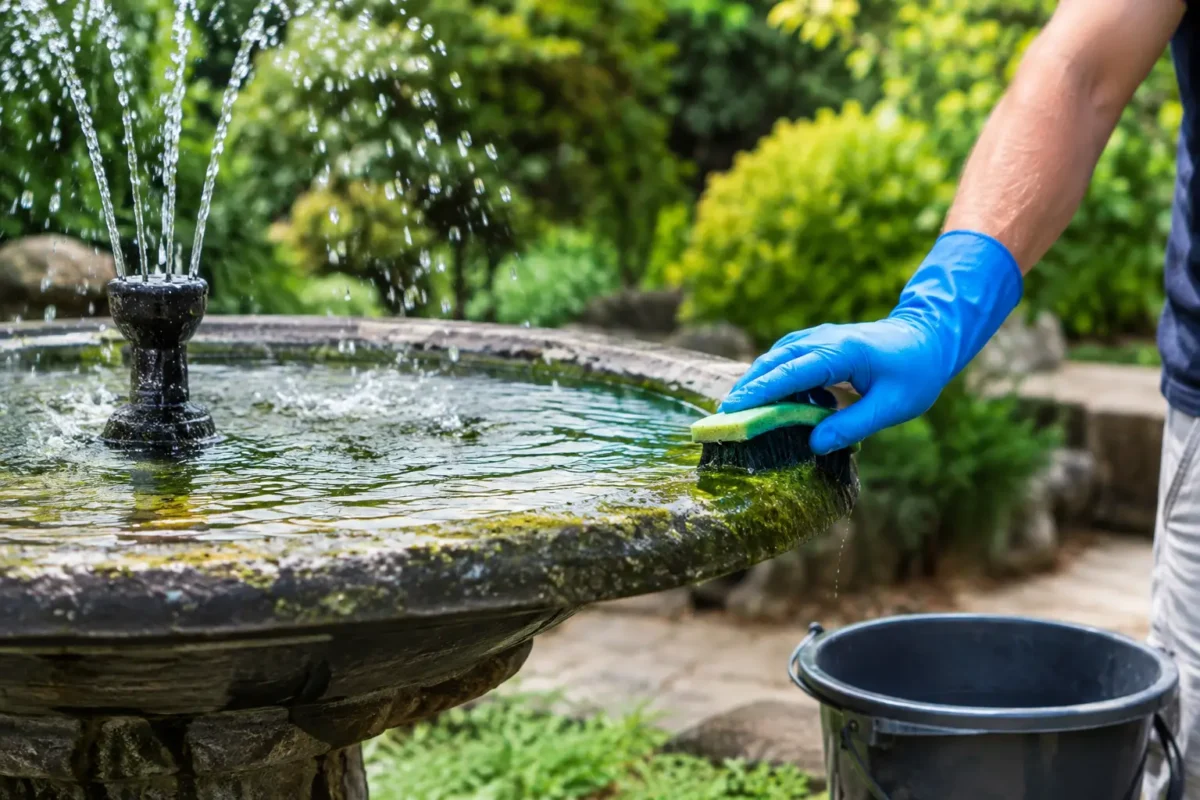
For light algae on accessible surfaces, use a soft nylon brush or non-abrasive pad designed for the basin material. Brush walls, floor sections, corners, and areas around nozzles with controlled pressure. Avoid wire brushes, harsh scouring pads, and abrasive tools on polished stone, acrylic, glass, glazed tile, painted surfaces, or metal finishes. They may remove algae, but they can also leave scratches that make future algae attachment easier.

A heavily affected fountain often needs to be drained before deep cleaning. Drain only according to local site requirements and property procedures, particularly where treated water could enter landscaping, stormwater systems, or public areas. Once empty, remove settled sludge with a wet vacuum or suitable extraction equipment rather than washing it into drains.

Clean basin surfaces with a fountain-safe cleaner compatible with the finish. Rinse thoroughly, because detergent residue can foam when the system restarts and may interfere with chemical treatment. Never mix cleaning agents, acids, chlorine products, or algaecides. Combining chemicals can create dangerous fumes, damage finishes, and make water treatment unpredictable.

Treat Stubborn Stains With Care

Dark green or black marks may be more than surface algae. They can be staining caused by algae, mineral deposits trapping organic matter, or discoloration in grout and porous stone. Strong acid treatments are not a default answer. They can etch limestone, weaken grout, corrode metal fittings, and alter the appearance of premium finishes.

For an expensive or architecturally sensitive fountain, test any cleaner in an inconspicuous area first. When staining persists after standard cleaning, professional assessment is the safer choice than repeated aggressive scrubbing.

Use the Right Water Treatment, Not the Strongest One

Once loose algae and debris are removed, refill the fountain with clean water if it was drained. Then use a commercial fountain algaecide or water-treatment program specifically approved for your type of fountain. Follow the product label precisely for dosage, circulation time, re-entry guidance, and compatibility with plants, fish, finishes, and filtration equipment.

More chemical is not better. Overdosing can cause foam, surface residue, corrosion, damage to seals, or an imbalance that creates another water-quality problem. It may also be unsafe for people who come into contact with splash zones or for landscaping near the fountain.

Water testing provides the information needed to treat effectively. Depending on the system, technicians may assess sanitizer residual, pH, total alkalinity, hardness, dissolved solids, and phosphate levels. The target values depend on the treatment method and fountain design, which is why a generic pool routine should not be copied without review.

Some fountains benefit from carefully managed sanitizer systems, while others perform better with non-chlorine treatment, ultraviolet disinfection, ozone support, or specialized algaecide programs. The best choice depends on water volume, bather contact, sunlight, operating hours, materials, and whether the feature is decorative or biologically balanced.

Restore Circulation and Filtration

After treatment, run the circulation system long enough to distribute the product and capture remaining particles. Clean or backwash the filter according to the manufacturer’s procedure. If the water remains cloudy, inspect the filter media, cartridge condition, pump performance, and plumbing for restrictions or bypass issues.

Nozzles deserve special attention. Algae and scale inside a nozzle can distort the water pattern, reduce visual uniformity, and increase stress on the pump. Remove and clean accessible nozzles only as recommended by the manufacturer. For integrated jets, underwater lighting, or complex feature plumbing, technical service is preferable to forcing components apart.

A clean fountain with weak circulation will become green again. Confirm that water reaches every section of the basin and that no dead zones remain behind features, in shallow ledges, or near collection points. Where the design creates recurring stagnant areas, a circulation upgrade or revised nozzle arrangement may be the long-term solution.

Prevent Algae From Returning

Premium fountains stay clear through consistency, not occasional emergency cleaning. Remove leaves and visible debris several times each week, especially after landscaping work or windy weather. Check water level and pump operation regularly, and keep baskets and intake screens clean.

A scheduled maintenance program should include water testing, filter servicing, inspection of seals and fittings, cleaning of nozzles, and review of treatment dosage. Shading can reduce algae pressure in some installations, but it should be weighed against the design intent and plant requirements. For highly visible commercial fountains, automated dosing and disinfection systems can offer more stable water quality and reduce reliance on reactive manual treatment.

Aquatic Pools and Fountains supports luxury residential and commercial properties with professional fountain equipment, treatment solutions, technical diagnostics, and maintenance support. When algae returns repeatedly, the issue is often not the cleaning itself but an underlying filtration, circulation, or water-balance problem that needs to be corrected at the system level.

A clear fountain is one of the strongest signals of careful property management. Treat algae early, protect the materials that give the feature its character, and maintain the equipment with the same precision expected from the installation itself.

Categories
Uncategorized

Best Pool Water Testers for Reliable Pool Care

A pool can look perfectly clear and still be chemically unbalanced. In Dubai and across the UAE, intense sun, high bather loads, airborne dust, and warm water can change sanitizer levels quickly. The best pool water testers give property owners and facility teams the dependable readings needed to protect water quality, finishes, equipment, and the swimmer experience.

For a private villa, a straightforward kit may be enough for regular checks. For a hotel, residential tower, or high-use commercial facility, testing needs to be faster, more consistent, and recorded as part of a disciplined maintenance program. The right choice is not simply the tester with the most measurements. It is the system that delivers accurate, repeatable information your team can act on.

What the Best Pool Water Testers Should Measure

Every pool requires control of sanitizer, pH, and water balance. At a minimum, a practical tester should measure free chlorine or bromine and pH. Free chlorine is the sanitizer available to manage contaminants. pH affects swimmer comfort, chlorine performance, corrosion risk, and the potential for scale formation.

For premium residential pools and commercial installations, basic readings are rarely the complete picture. Total alkalinity helps stabilize pH. Calcium hardness helps protect plaster, tile grout, heaters, and metal components from either scaling or aggressive water conditions. Cyanuric acid matters in outdoor chlorinated pools because it protects chlorine from sunlight, but excessive levels can reduce chlorine effectiveness.

Facilities with salt chlorinators, heat-cool pumps, automated dosing, or sophisticated filtration should also monitor salt concentration, total dissolved solids, and, where relevant, phosphate levels. These are not readings that must be checked every day in every pool. They are, however, essential when diagnosing persistent cloudiness, corrosion, scale, poor sanitizer control, or unexplained equipment performance issues.

The Main Types of Pool Water Testers

The best testing method depends on the pool’s size, usage, treatment method, and the experience of the person carrying out the test. There is a place for each category when it is used correctly.

Test Strips for Fast Routine Checks

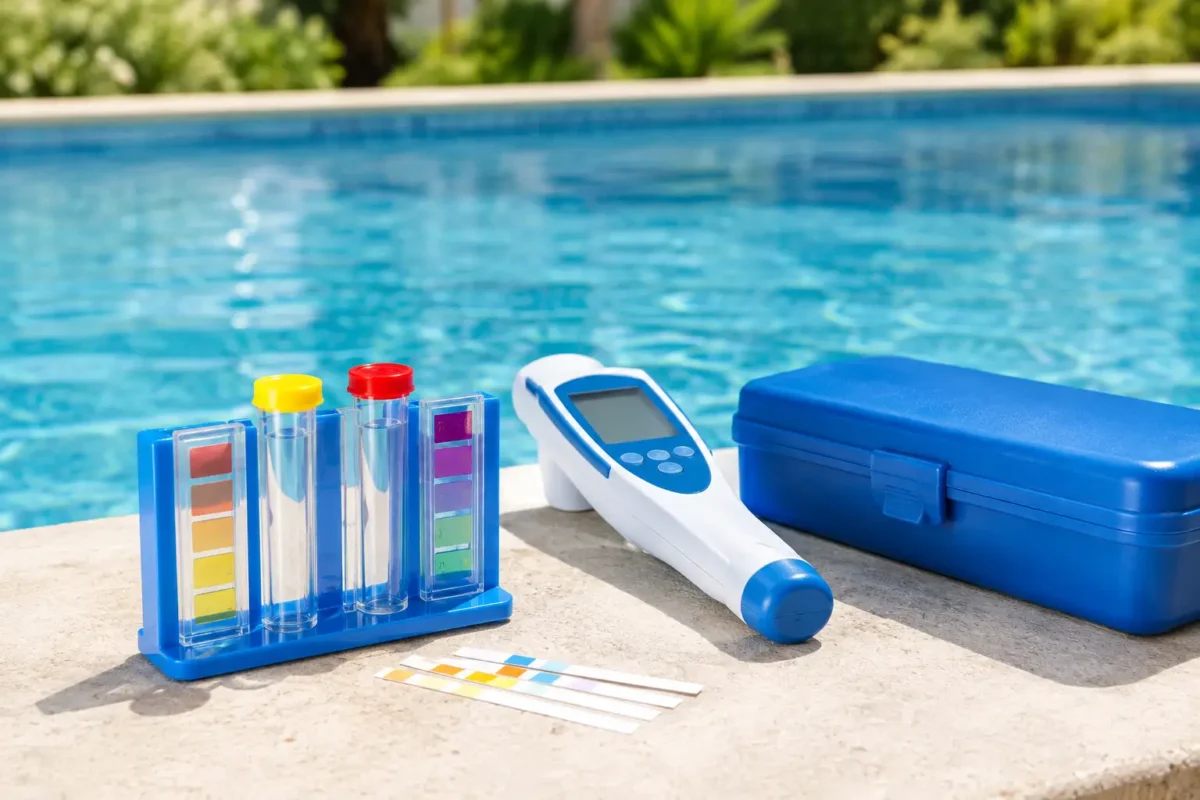
Test strips are quick, compact, and easy for homeowners or on-site staff to use. A strip is dipped into the water, held for the specified time, and compared with a color chart. Many versions measure chlorine, bromine, pH, alkalinity, hardness, and cyanuric acid in one test.

Their advantage is speed. They are useful for a daily confidence check before swimming or for identifying whether a more precise test is needed. Their limitation is interpretation. Sunlight, wet hands, expired strips, and subtle color differences can affect results. For a high-value pool environment, strips are best treated as a convenient screening tool rather than the only basis for chemical dosing.

Liquid Reagent Kits for Hands-On Accuracy

Liquid test kits remain a trusted option because they provide more controlled testing than most strips. The user fills a comparator cell with pool water, adds the specified drops of reagent, and matches the resulting color against a scale.

A quality kit can provide reliable chlorine and pH readings, with more comprehensive models covering alkalinity, calcium hardness, cyanuric acid, and other parameters. This method suits villa owners who want greater confidence in their maintenance decisions and technicians who need dependable field results without relying on electronics.

The trade-off is time and technique. Reagents must be stored away from heat and direct sun, bottles must not be contaminated, and the correct number of drops must be used. In the UAE climate, keeping test supplies in a cool, dry service area is particularly important for accuracy and shelf life.

Digital Pool Testers for Clear Numerical Results

Digital testers and photometers replace subjective color matching with numerical readings. Depending on the model, they may measure free and total chlorine, pH, alkalinity, calcium hardness, cyanuric acid, phosphate, salt, and other water-quality parameters.

For commercial pools, hospitality facilities, and large residential developments, this level of precision offers a real operational advantage. Technicians can document readings consistently, spot emerging trends, and adjust treatment with greater confidence. Digital testing is especially valuable when different team members share maintenance responsibility and results need to be compared over time.

Not every digital meter is automatically superior. Entry-level electronic pens can be useful for specific readings such as pH or total dissolved solids, but may not replace a complete pool photometer. Calibration, clean sample cells, correct tablets or reagents, and proper battery care are part of owning professional electronic equipment.

Automated Controllers for Continuous Oversight

Automated water-testing and dosing systems are designed for pools that demand ongoing control. Sensors measure parameters such as pH and oxidation-reduction potential, while connected dosing equipment can introduce acid or sanitizer according to programmed setpoints.

This is the strongest solution for busy commercial pools, hotels, wellness facilities, and premium properties where water quality must remain stable throughout operating hours. Automation reduces the risk of delayed manual adjustments and supports a more consistent guest experience. It does not eliminate manual verification. Sensors require routine calibration, cleaning, and professional inspection to remain reliable.

How to Choose a Tester for Your Pool

Start with the operating reality of the pool, not a product label. A lightly used residential pool with a standard chlorine system may only require quality strips for frequent checks and a liquid kit for weekly balance testing. A luxury villa with a heat-cool pump, salt system, or sensitive finish benefits from a broader kit or digital tester that can verify more parameters.

Commercial sites should prioritize repeatability, speed, and documentation. A photometer or professional-grade digital system is generally a better investment than relying on visual color comparisons alone. When a facility manager is responsible for multiple pools, standardizing one reliable testing process also improves staff training and maintenance accountability.

Consider these practical factors before selecting equipment:

  • Parameters measured: Choose only the measurements relevant to your sanitizer system, surface finish, equipment, and source water.
  • Required accuracy: Digital photometers provide more exact readings, while strips offer fast guidance for routine use.
  • Testing frequency: Daily commercial testing calls for durable equipment and readily available consumables.
  • Ease of operation: A sophisticated tester is only valuable when staff can use it consistently and correctly.
  • Ongoing supplies: Reagents, tablets, calibration solutions, and replacement parts should be easy to source.

The best purchase is often a layered approach: fast strips for immediate checks, a more precise kit or photometer for scheduled testing, and professional water analysis when a persistent issue requires diagnosis.

Reading Results in a Hot-Climate Pool Environment

Warm, sunny conditions place special pressure on sanitizer management. Direct sun consumes unstabilized chlorine, while higher water temperatures can encourage algae growth and increase chemical demand. After a pool party, heavy occupancy, a dust event, or a period of extreme heat, testing should be increased rather than left to a fixed weekly schedule.

A result should never be viewed in isolation. Low chlorine may be caused by heavy bather load, sunlight exposure, organic debris, or a dosing problem. Repeated pH drift can point to inadequate alkalinity, an incorrect dosing setting, aeration from water features, or untreated source-water characteristics. High calcium hardness may require careful management to prevent scale on tiles, heaters, and fittings.

This is where professional technical support becomes valuable. The goal is not to keep adding chemicals until a single number changes. It is to understand the relationship between the readings and correct the underlying condition without placing unnecessary stress on the pool system.

Testing Habits That Protect Premium Pool Equipment

Take samples away from skimmers, return inlets, chemical feeders, and water features. Test at elbow depth whenever possible, using a clean container if the method requires one. This produces a sample that better represents the pool as a whole.

Follow the tester’s timing instructions exactly. With strips, do not shake off water or read the colors too early or too late. With reagent kits and photometers, use clean cells, avoid fingerprints on optical surfaces, and replace expired reagents. Record results for commercial pools and for any residential pool with automated treatment equipment.

Most importantly, do not treat water based on guesswork. Overcorrection is a common cause of discomfort, corrosion, cloudy water, and avoidable chemical expense. Make measured adjustments, circulate the water fully, and retest before making further changes.

For property owners and facility teams, water testing is not a minor maintenance chore. It is the daily quality-control step behind clear water, protected equipment, and a pool that remains worthy of the property around it. Aquatic Pools and Fountains can help match the right testing solution to the demands of your installation and maintenance program.

Categories
Uncategorized

Choosing the Right Fountain Lighting Controller

A fountain can have exceptional jets, stonework, and water movement yet still look unfinished after sunset. The fountain lighting controller is the component that turns individual fixtures into a coordinated visual feature, giving property owners and operators control over color, brightness, timing, and effects. For luxury villas, hotel entrances, residential towers, and commercial landscapes, selecting the right controller protects both the appearance of the installation and the long-term value of the lighting system.

A quality controller does more than switch lights on and off. It creates repeatable scenes, manages multiple lighting zones, and helps the fountain present the right atmosphere at the right time. The best choice depends on the lighting technology, the number of fixtures, the desired effects, and the level of day-to-day control required.

What a Fountain Lighting Controller Does

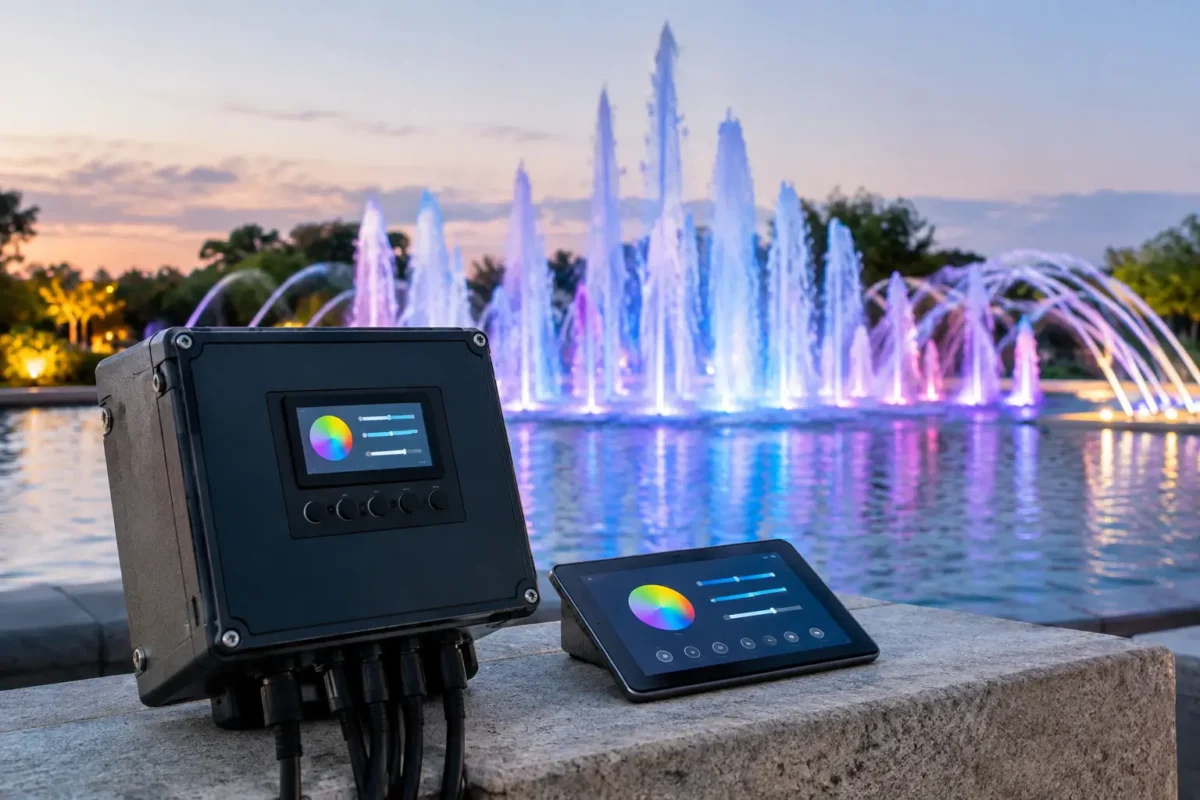
A fountain lighting controller sends commands to compatible underwater or landscape light fixtures. Depending on the system, those commands may control fixed colors, RGB color changes, RGBW white tones, dimming levels, chase sequences, or programmed shows. Some controllers run a simple daily schedule. Others support sophisticated scenes that coordinate lighting with pumps, valves, and fountain movement.

This distinction matters during specification. A small courtyard fountain with a single-color LED arrangement may only need a dependable timer and transformer setup. A hotel arrival fountain with several lighting zones, changing colors, and high-visibility nighttime operation requires a controller designed for more advanced programming and reliable communication.

The controller should always be chosen as part of a complete lighting system, not as an afterthought. Compatibility between the controller, power supply, cables, junction boxes, and fixtures determines whether the installation performs as intended. Mixing components without confirming voltage, protocol, capacity, and environmental rating can cause flickering, limited functionality, or premature equipment failure.

Choosing a Fountain Lighting Controller for the Project

The first consideration is the type of lights installed. Modern fountain projects commonly use LED fixtures because they provide efficient operation, long service life, vivid color options, and lower heat output. However, LED lights do not all communicate in the same way. Some use a basic switched-color system, while others require dedicated control protocols such as DMX or manufacturer-specific communication systems.

For a fixed-color fountain, the requirement may be straightforward: controlled switching, a reliable timer, and appropriately sized electrical protection. For RGB or RGBW lighting, a controller must manage color channels accurately and support the fixtures’ specified voltage and communication method. RGBW systems are often preferred in premium projects because they can deliver saturated colors while also providing a cleaner, more natural white for everyday presentation.

Fixture quantity and zoning are equally important. A controller that supports one lighting circuit may be suitable for a compact residential feature, but it will not provide the flexibility needed for a multi-tier commercial fountain. Separate zones allow operators to illuminate the central jet, perimeter nozzles, waterfall wall, and surrounding landscape independently. This creates depth and visual hierarchy rather than a flat field of uniform light.

Consider the intended operating schedule as well. Villas may need warm white illumination during family evenings and a subtle color scene for private events. Hotels and mixed-use developments may require programmed scenes for holidays, special promotions, or weekend activity, with reduced brightness after peak hours. A capable controller makes these adjustments practical without requiring frequent manual intervention at the electrical panel.

Control Options: Simple, Programmable, and Integrated

Controllers are available at several levels of complexity. The right option is not necessarily the most elaborate one. It is the one that delivers the required visual result while remaining practical for the people responsible for operating and maintaining the fountain.

Basic controllers are ideal for installations that need scheduled on-off operation, fixed color selection, or a limited number of automatic color-changing programs. They are cost-effective and easy to operate, making them a sensible choice for smaller residential fountains where the owner prefers simple, dependable control.

Programmable controllers provide more creative freedom. They can store scenes, adjust color transitions, manage dimming, and assign different effects to multiple fixture groups. These systems suit luxury villas, hospitality properties, and high-end landscape features where the fountain is a focal point after dark. Programming should be planned carefully, however. An overly fast or overly colorful sequence can distract from the architecture rather than enhance it.

Integrated control systems are often specified for larger developments. They may connect fountain lighting to a building management system, central automation platform, or dedicated show-control interface. This level of integration can be valuable when lighting must coordinate with fountain pumps, music, event schedules, or other site-wide lighting. It also requires professional design, commissioning, and documentation to ensure facility teams can operate the system with confidence.

Installation Details That Protect Performance

A premium controller cannot compensate for poor electrical installation. Fountain environments combine water, humidity, outdoor heat, and long cable runs, so every component must be selected and installed with precision. Controllers and power supplies should be located in suitable weather-protected enclosures, with clear access for inspection and service.

Voltage drop deserves close attention, particularly when low-voltage LED fixtures are spread around a large basin. If cable sizing or run length is not calculated correctly, lights at the far end of the fountain may appear dimmer or display inconsistent colors. Proper cable selection, distribution planning, and load calculations prevent this issue before the fountain is finished.

Electrical safety is another non-negotiable requirement. Underwater lights, transformers, junction boxes, grounding arrangements, and protective devices must be specified for the application and installed in accordance with applicable electrical standards. In Dubai and across the UAE, environmental conditions add further demands: high summer temperatures, dust exposure, and intensive operating hours can place unnecessary stress on poorly selected equipment.

For this reason, commercial properties should avoid treating fountain lighting as a standalone decorative purchase. The lighting controller must be considered alongside the hydraulic design, electrical infrastructure, access strategy, and maintenance plan. Professional installation creates a cleaner final appearance and reduces the risk of costly disruptions later.

Design for Elegance, Not Just Effects

Color-changing technology can make a strong statement, but the most successful fountain lighting designs use it with restraint. Warm white often provides the most timeless effect for stone, stainless steel, and architectural water features. It reveals water texture and creates a refined appearance that suits residences, hospitality venues, and corporate properties.

Color scenes are valuable when they support a purpose. Blue and aqua tones can create a calm contemporary mood. Brand colors can be used for a corporate event. Seasonal programming can refresh a hotel entrance or retail destination without altering the physical fountain design. The controller makes these changes possible, but the visual concept should lead the programming.

Brightness also requires balance. Too little light can make water movement disappear, while excessive output creates glare, exposes fixture hardware, and can disturb nearby residents or guests. Dimming capability gives facility managers a useful advantage, allowing the fountain to remain visible and elegant while responding to changing ambient light and operating hours.

Maintenance and Service Planning

Controllers are electronic equipment, and even high-quality units benefit from periodic checks. Facility teams should verify scheduled operation, inspect enclosures for moisture or heat buildup, review cable connections, and confirm that all programmed scenes function correctly. A scene that fails during a major event is often caused by a small issue that could have been identified during routine service.

When replacement or expansion is anticipated, choose a system with accessible technical support and available compatible components. Proprietary systems can offer excellent performance, but owners should understand the availability of replacement controllers, remotes, power supplies, and programming support before committing to a large installation.

Aquatic Pools and Fountains supports premium fountain projects with quality lighting equipment, technical guidance, installation expertise, and ongoing maintenance support. This full-scope approach is especially valuable when a project needs coordinated advice across lighting, pumps, nozzles, electrical components, and water-feature operation.

A well-specified controller lets a fountain remain more than a daytime landscape element. With the correct equipment, thoughtful programming, and professional support, it becomes a dependable evening feature that strengthens the character of the property every night.

Categories
Uncategorized

Ozone Versus Mineral Sanitizers for Pools

A luxury pool can look immaculate while carrying a water-quality problem that is not visible from the deck. For villa owners, hotel operators, and facility managers, the question of ozone versus mineral sanitizers is not simply about reducing chemical use. It is about selecting a treatment approach that protects swimmers, preserves expensive finishes and equipment, and performs reliably through high water temperatures, intense sun, and changing bather loads.

Both systems can improve the swimming experience when engineered correctly. Neither should be treated as a complete replacement for a properly sized circulation system, filtration, balanced water chemistry, and an approved primary sanitizer. The right choice depends on how the pool is used, how much control the operator requires, and whether the installation is residential, hospitality-led, or commercial.

Ozone Versus Mineral Sanitizers: The Core Difference

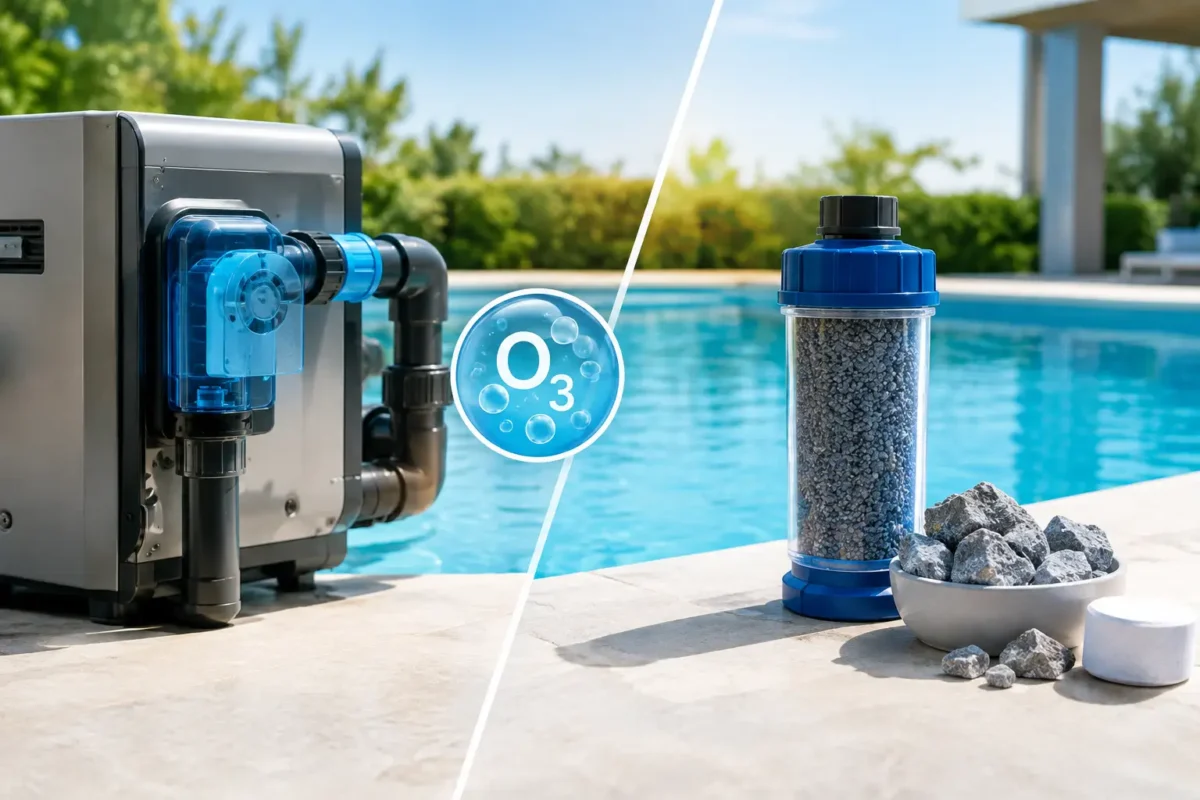
Ozone and mineral systems work in very different ways. Ozone is a powerful oxidizer generated on site. A pool ozone unit typically converts oxygen into ozone gas, injects it into the return line or a dedicated contact chamber, and allows it to react with contaminants before treated water returns to the pool. It is highly effective at breaking down organic waste, including oils, lotions, and compounds that contribute to chloramine odor.

Mineral sanitizers release controlled amounts of antimicrobial metals into the water, most commonly silver and copper. Silver is valued for bacterial control, while copper helps suppress algae. Depending on the system, minerals may be delivered through a replaceable cartridge or an electronic ionizer with metal electrodes.

The key distinction is residual protection. Ozone acts quickly but does not remain in the pool water for long. Minerals remain in the water longer, but they act more gradually and are not a dependable stand-alone answer for rapid disinfection under heavy use. In most professionally managed pools, both approaches are paired with a measured chlorine or bromine residual that remains available throughout the basin.

What Ozone Does Best

Ozone is particularly strong where water receives a high organic load. Think of a hotel pool after a busy afternoon, a family villa pool used daily by children, or a temperature-controlled indoor pool where chloramine smell can become noticeable. By oxidizing contaminants before chlorine has to do all the work, ozone can reduce the chlorine demand and improve water clarity.

This can produce a more refined swimmer experience. Many operators notice less of the sharp “chlorine” smell that guests associate with a poorly maintained pool. In reality, that odor is often caused by chloramines, formed when chlorine reacts with sweat, body oils, and other organics. Effective ozone treatment can reduce those compounds, although it does not eliminate the need for good filtration, periodic testing, and appropriate sanitizer levels.

For premium installations, ozone also offers an operational advantage: it is automated. Once the generator, injector, plumbing, and contact arrangement are correctly selected, the system works with the circulation schedule rather than relying on daily cartridge replacement. However, performance depends on proper hydraulic design. An undersized ozone generator or poor gas-to-water contact will not deliver the expected improvement.

Ozone considerations for UAE pools

In Dubai and across the UAE, warm water and strong sunlight can accelerate sanitizer consumption. Outdoor pools also receive fine dust, sunscreen, and frequent organic loading from bathers. Ozone can help manage that demand, but it must be matched to the pool’s flow rate and run time. It is most effective when the circulation system provides sufficient contact time and the filtration plant is maintained to premium standards.

Ozone equipment also requires professional commissioning. Ozone gas must be injected safely, excess gas must be controlled, and materials in contact with ozone must be compatible with it. For commercial or hospitality facilities, these details are essential rather than optional.

Where Mineral Systems Make Sense

Mineral sanitizers appeal to pool owners who want a lower-chemical routine and a simple, visible way to support water quality. They are often well suited to lightly to moderately used residential pools, especially where the owner wants assistance with algae control and is committed to regular water testing.

Copper can be effective against algae, which is valuable in warm, sun-exposed pools. Silver contributes antimicrobial support, and many owners find that a correctly managed mineral system allows them to operate with a lower chlorine level than a conventional chlorine-only pool. The water may feel less harsh, provided the chemistry is balanced.

The important qualification is that minerals work best as a supplementary system. They do not oxidize bather waste with the speed of ozone, and they do not provide the immediate, broad-spectrum residual protection required for many higher-use pools. A controlled chlorine level remains the practical foundation for sanitation in most applications.

Mineral systems need disciplined monitoring. Excess copper can create staining on plaster, grout, fittings, and light-colored surfaces. It can also cause hair discoloration in certain water conditions. High calcium levels, elevated pH, and poor balance can make these risks more likely, which matters in regions where water hardness requires close attention.

Cartridge systems and ionizers

A cartridge-based mineral system is typically straightforward to operate. The cartridge is installed in the plumbing line and replaced according to the manufacturer’s capacity rating and the pool’s actual use. It can be an attractive option for homeowners who want predictable maintenance intervals.

Electronic ionizers use copper and silver electrodes, releasing ions as water passes through the cell. They allow more adjustment, but they also need inspection for scale buildup and periodic electrode replacement. For properties with hard water, the maintenance team should watch the cell closely and keep pH, total alkalinity, and calcium hardness within the specified operating range.

Comparing Cost, Maintenance, and Results

The initial investment for an ozone system is usually higher than for a basic mineral cartridge solution. It involves a generator, injection components, suitable plumbing, and, in higher-specification systems, a contact vessel and off-gas management. The long-term value comes from lower oxidizer demand, improved water quality, and reduced pressure on the main sanitizer program.

Mineral systems often have a lower entry cost, particularly cartridge models. Their ongoing expense is tied to replacement cartridges, electrodes, and testing. They can be economical for smaller residential pools, but their benefits diminish if water chemistry is not managed consistently or if the pool experiences heavy guest use.

Maintenance is not identical to effort. Ozone systems tend to require less frequent hands-on attention but need qualified servicing of the generator, injector, check valves, and air preparation components. Mineral systems are mechanically simpler, yet they call for regular monitoring of metal levels and closer attention to scale and staining risk.

For a luxury villa pool, the decision may come down to priorities. An owner seeking exceptionally clear water, better oxidation, and minimal odor may favor ozone paired with an automated chlorine controller. An owner focused on manageable upkeep and algae support in a smaller, lightly used pool may prefer minerals, provided the system is installed with accurate testing procedures.

For hotels, residential towers, schools, gyms, and other commercial properties, ozone is often the more capable supplementary technology because it handles bather waste more effectively. That said, the final specification should always account for local health requirements, turnover rate, pool volume, usage patterns, and the operator’s ability to document water-quality readings.

Do Not Design Around a “Chlorine-Free” Promise

Claims of completely chlorine-free pool care deserve careful scrutiny. A pool may use ozone or minerals to reduce chlorine consumption, but reducing chlorine is not the same as removing the need for a residual sanitizer. Water is continually exposed to new contaminants, and treatment that occurs only in plumbing equipment cannot protect every part of the pool at every moment.

Professional pool design starts with dependable circulation and filtration, then adds treatment technologies that serve a defined purpose. Automated dosing, pH control, ultraviolet treatment, ozone, mineral systems, and salt chlorination can all have a role. The best combination is the one that creates stable, testable water quality without compromising surfaces, equipment, or swimmer comfort.

Selecting the Right System for Your Property

Choose ozone when your priority is high-performance oxidation, superior clarity, lower chloramine potential, and stronger support for pools with frequent or variable use. It is especially compelling for premium villas, indoor pools, hospitality projects, and facilities where the guest experience must remain consistently polished.

Choose a mineral sanitizer when your pool has a moderate bather load, algae prevention is a central concern, and you are prepared to test metal levels and water balance carefully. It can be a practical supplementary option for residential pools, but it should be specified with realistic expectations about chlorine reduction rather than chlorine elimination.

Aquatic Pools and Fountains can assess the circulation plant, water conditions, pool finish, operating schedule, and expected usage before recommending equipment that fits the property rather than a one-size-fits-all package. A well-chosen sanitizer system should become part of a quieter, more reliable operation – leaving owners and guests to notice the clarity of the water, not the work required to maintain it.

Categories
Uncategorized

UV Pool System vs Chlorine for UAE Pools

A premium pool should smell clean, feel comfortable, and remain reliably safe through intense heat, heavy bather use, and long operating hours. In the UV pool system vs chlorine decision, the most important point is often missed: UV is not usually a complete replacement for chlorine. It is a powerful secondary disinfection method that can substantially improve water quality when paired with a correctly managed residual sanitizer.

For villas, hotels, residential towers, and commercial facilities in the UAE, the right choice depends on the pool’s use, hydraulic design, maintenance capability, and the standard of guest experience expected. A well-designed system protects both the investment in the pool and the reputation of the property.

UV Pool System vs Chlorine: The Core Difference

Chlorine is a chemical sanitizer. When maintained at the correct level, it kills microorganisms in the pool water and leaves a residual disinfectant behind. That residual is essential because contamination does not occur only inside the circulation pipework. It can enter the water at any point, whether from swimmers, windblown debris, or organic matter.

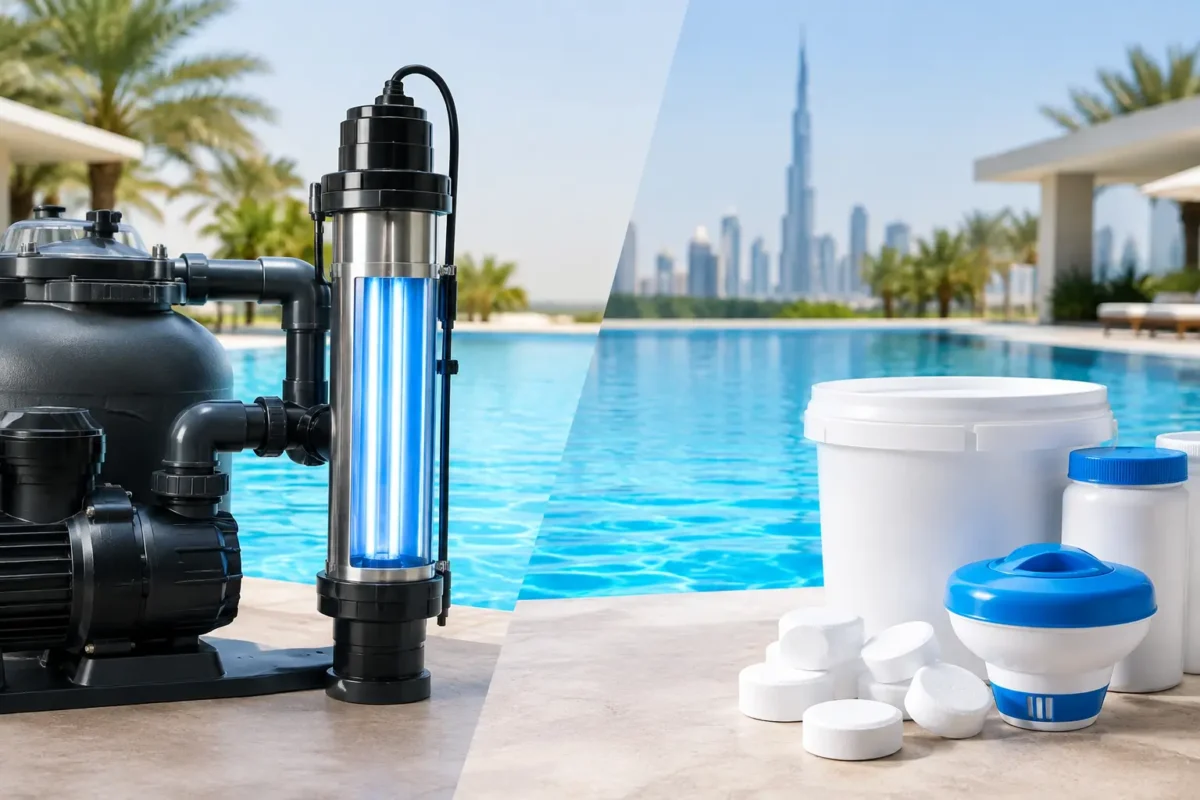
A UV system disinfects water as it passes through a chamber containing an ultraviolet lamp. The UV energy damages the DNA or RNA of microorganisms, preventing them from reproducing. It is highly effective against a wide range of pathogens, including certain chlorine-resistant organisms such as Cryptosporidium.

The limitation is equally important: UV works only on water that travels through the UV chamber. It does not leave a lasting disinfectant residual in the pool. For that reason, a UV installation is generally specified alongside chlorine, salt chlorination, or another approved residual sanitizer, rather than in place of it.

This makes the practical comparison less about choosing one technology over the other and more about deciding whether a UV system justifies its additional capital cost and maintenance requirements.

Why UV Changes the Swimming Experience

The strongest argument for UV is not that it eliminates chlorine. It is that it can reduce the unpleasant byproducts associated with chlorine use.

When chlorine reacts with sweat, body oils, cosmetics, sunscreen, and nitrogen-based contaminants, it can form chloramines. These compounds are often responsible for the familiar sharp pool odor, eye irritation, dry skin, and respiratory discomfort. A strong chlorine smell is not a sign of exceptionally clean water. In many cases, it signals that chloramines need to be controlled.

UV systems help break down chloramines as circulating water passes through the reactor. With effective filtration, balanced chemistry, and correct turnover rates, this can deliver clearer water, less odor, and a more refined swimming environment. That difference is especially valuable in indoor pools, hospitality properties, wellness facilities, and luxury residential projects where comfort and presentation matter every day.

A UV system can also reduce the amount of chlorine needed to maintain the desired residual. The reduction varies significantly by bather load, water temperature, pool volume, environmental exposure, and the control strategy used. It should never be presented as a promise that chemicals will disappear. The pool still requires monitoring, adjustment, and a properly maintained sanitizer level.

Where Chlorine Remains the Practical Foundation

Chlorine remains the industry standard for good reason. It is proven, widely available, cost-effective, and suitable for pools of almost every size. It also provides continuous protection within the pool basin, which UV cannot do alone.

For a lightly used private villa pool with outdoor exposure and a straightforward maintenance routine, a quality chlorine or salt chlorination system may be the most sensible solution. It provides dependable sanitization without adding another piece of specialist equipment to service.

Chlorine is also flexible. It can be delivered manually, through automatic dosing equipment, or generated from salt. When connected to reliable water testing and dosing controls, it offers stable performance and less dependence on daily manual intervention. For facility managers responsible for several pools, that consistency can be more valuable than a system with lower chemical demand but more specialized components.

The trade-off is that chlorine-only pools can require more active attention to chloramines, especially when bather load rises. High-use hotel pools, school pools, fitness facilities, and shaded indoor pools are more likely to benefit from supplementary UV treatment.

Cost, Maintenance, and Equipment Considerations

An accurate decision starts with total cost of ownership, not the purchase price alone. A UV system requires the reactor, lamp or lamp assembly, electrical supply, suitable plumbing integration, and professional commissioning. It also needs routine inspection and periodic lamp replacement. Depending on the model, quartz sleeves must be kept clean so UV transmission remains effective.

Chlorine-based systems have ongoing chemical costs, along with testing, dosing equipment maintenance, and periodic calibration. Salt chlorinators add their own service needs, including cell inspection and replacement over time. Neither approach is maintenance-free.

UV can lower chemical consumption and reduce demand for corrective treatments, but the financial return differs from one installation to another. On a busy commercial pool, the improvement in guest comfort, water quality, and operational control may make UV a compelling long-term investment. On a small residential pool used only on weekends, the payback may be less direct.

Equipment sizing is also critical. A UV reactor must match the actual circulation flow and intended disinfection duty. Oversized or undersized equipment, poor pipework layout, inadequate filtration, or a pump operating outside its design range can compromise results. Premium aquatic installations need the full system to work as one: circulation pump, filter, dosing equipment, UV reactor, plumbing, and control system.

UAE Conditions Demand a System Approach

The UAE’s climate creates pressures that should shape every disinfection decision. High ambient temperatures, warm water, strong sunlight, dust, and frequent use can increase sanitizer demand and place greater strain on water balance. Outdoor pools may experience faster chlorine loss from ultraviolet sunlight, while indoor pools may struggle more with chloramines because of limited ventilation.

For outdoor residential pools, an automatic dosing system and correct stabilizer management may be more significant than UV alone. For indoor hotel or spa pools, UV can be an excellent addition because it supports a more comfortable atmosphere and helps manage combined chlorine.

Commercial properties should also consider operational resilience. If a UV lamp reaches the end of its service life or a control alarm is ignored, the system’s treatment performance declines. Trained maintenance personnel, stocked replacement components, and clear service schedules are essential. The same discipline applies to chlorine testing and dosing. Technology improves results only when it is monitored properly.

Choosing the Right Configuration for Your Pool

For most premium projects, the strongest recommendation is not UV instead of chlorine. It is UV plus a professionally controlled chlorine residual.

A villa owner focused on simplicity may prefer automated chlorination with high-quality filtration, circulation equipment, and scheduled service. A luxury indoor residence, boutique hotel, or wellness facility may gain more from integrating UV to reduce odor and improve swimmer comfort. High-bather-load commercial pools often benefit most when UV is combined with automated chemical dosing, precise water testing, and a maintenance plan built around actual usage patterns.

Before specifying equipment, assess the pool volume, expected bather load, indoor or outdoor location, pump flow rate, filtration condition, existing chemical controls, and local health requirements. It is also wise to consider the visual and operational expectations of the property. A pool that is technically sanitized but carries a harsh odor or causes regular guest complaints does not meet a premium standard.

The right disinfection system should be selected as part of the whole water-treatment design, not added as an afterthought. Aquatic Pools and Fountains can help property owners and facility teams assess the installation, specify compatible equipment, and establish a maintenance approach that keeps water clear, comfortable, and ready for use.

Categories
Uncategorized

How to Clean Cartridge Filters Without Damage

A cartridge filter can look clean on the outside while its pleats are holding the debris that is restricting circulation, clouding water, and forcing the pump to work harder. Knowing how to clean cartridge filters correctly protects the performance of a premium pool or fountain system, especially in high-use villas, hospitality settings, and commercial properties where water quality cannot be left to chance.

Cartridge filtration is valued for its fine filtration capability, compact footprint, and straightforward servicing. However, the cartridge itself is a working component, not a permanent one. Cleaning it with the wrong pressure, harsh chemicals, or poor timing can shorten its life and compromise the water clarity your property depends on.

Why Clean Cartridge Filters on Schedule

As water passes through a cartridge filter, the pleated media captures dust, fine sand, leaves, insects, sunscreen residue, body oils, and other suspended contaminants. In Dubai and across the UAE, airborne dust can build up quickly, particularly in outdoor pools and decorative fountains exposed to wind and open landscaping.

A lightly loaded filter can improve filtration because the first layer of collected particles helps catch finer debris. Once the cartridge becomes overly loaded, though, water flow drops. The circulation pump must then operate against greater resistance, which can reduce turnover, increase energy demand, and place unnecessary strain on equipment.

The pressure gauge is the most reliable service indicator. Record the clean starting pressure after installing or thoroughly cleaning the cartridge. When operating pressure rises around 8 to 10 psi above that baseline, the filter should be cleaned. Do not rely only on a calendar. A shaded residential pool with limited use may need less frequent attention than a hotel pool, a busy villa, or a fountain located near a construction area.

Other signs include weak return flow, cloudy water that does not respond to balanced chemistry, reduced skimmer pull, and a pump that sounds as though it is laboring. These symptoms can also point to other issues, such as a blocked pump basket or undersized plumbing, so professional assessment is valuable when the cause is unclear.

How to Clean Cartridge Filters Properly

Before opening any filter housing, switch off the pump at the breaker or isolator. Never release a pressurized filter tank. Close relevant valves where fitted, open the air relief valve, and confirm that pressure has dropped completely before removing the clamp or lid.

Take the cartridge out carefully and inspect it before cleaning. Look for cracked end caps, torn bands, collapsed pleats, flattened sections, or damaged seals. A cartridge with structural damage should be replaced rather than returned to service. Continuing to operate with a compromised element allows debris to bypass the filter and may create issues elsewhere in the circulation system.

Rinse Between Every Pleat

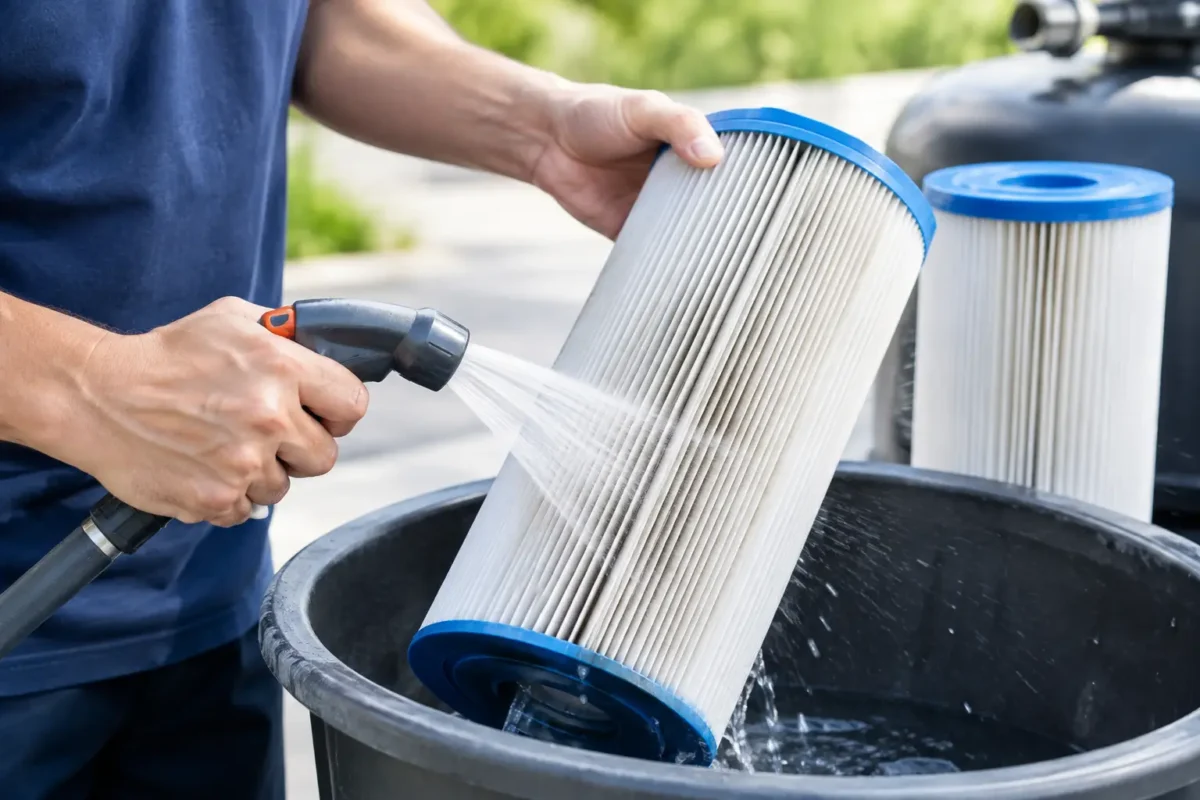
Use a garden hose with a standard spray nozzle. Hold the nozzle at an angle and work from the top of the cartridge down, separating the pleats gently with your fingers as needed. The objective is to flush debris out from deep within the folds without tearing or spreading them apart.

Avoid pressure washers. Their force can damage the fine filter media, deform pleats, and reduce the cartridge’s effective filtration area. A cartridge may appear brighter after pressure washing, yet it can perform worse and need replacement sooner.

Rinse until runoff is clear, then allow the cartridge to drain. If the element only contains routine dust and organic debris, this basic rinse may be sufficient. Reinstall it only after checking that the tank interior, lid O-ring, and sealing surfaces are clean and in good condition.

Remove Oils and Mineral Scale When Needed

A hose rinse does not remove all contaminants. Sunscreen, cosmetics, body oils, and certain environmental residues can coat the media, making the cartridge feel slick or look gray even after rinsing. In these cases, use a cartridge-specific filter cleaner according to the product instructions. Soak the cartridge in a clean container, then rinse it thoroughly before reinstalling.

Scale is another common issue in regions with mineral-rich water. A cartridge may feel stiff, show white or tan deposits, or retain high pressure after being cleaned. For mineral deposits, a properly selected descaling treatment may be required. The order matters: remove oils first, then address scale. Acid applied to an oily cartridge can set contaminants into the media and make cleaning more difficult.

Chemical cleaning should be occasional, not routine. Excessive soaking, overly concentrated solutions, and extended exposure can weaken cartridge materials. For high-value installations, the safest approach is to have a qualified pool technician inspect the element and choose the appropriate cleaning method based on the deposit type.

Common Mistakes That Reduce Filter Life

The most expensive filter problems often begin with a shortcut. Cleaning only the outer pleats leaves the center of the cartridge blocked. Reinstalling an element without lubricating and correctly seating the lid O-ring can lead to air leaks or water leaks. Using household detergents can create foam and introduce residues that affect water balance.

Another common mistake is waiting until water turns visibly cloudy. By that stage, restricted circulation may already be affecting sanitizer distribution and pump efficiency. Routine pressure checks allow maintenance to happen before a minor service need becomes a water-quality complaint.

Do not clean a cartridge more aggressively simply because pressure rises again soon after service. Rapid pressure increase may indicate heavy bather load, an algae event, poor water balance, inadequate sanitizer, or a cartridge nearing the end of its usable life. The correct answer is not always more cleaning.

When to Replace a Cartridge Filter

Even the best cartridge filters have a service life. Cleaning gradually wears the media, while repeated exposure to oils, chemicals, and pressure cycles reduces its ability to capture fine particles effectively. A well-maintained cartridge may last one to three years, but actual life depends on filter size, usage, water chemistry, and cleaning practices.

Replacement is usually the better investment when pleats remain flattened after cleaning, the bands are broken, end caps crack, or pressure rises quickly despite thorough maintenance. Persistent cloudy water with otherwise balanced chemistry can also indicate that the filter media is no longer performing as intended.

Choosing the right replacement requires more than matching the cartridge’s height. Diameter, core size, end-cap style, square-foot rating, and manufacturer compatibility all matter. An incorrect element can cause bypass, poor fitment, circulation restrictions, or damage to the filter housing. Premium pool and fountain systems benefit from quality replacement cartridges that match the equipment specification rather than generic substitutions selected only by appearance.

Protecting Pool and Fountain Equipment Beyond the Filter

Clean filtration works best alongside disciplined water care. Keep skimmer baskets and pump baskets clear, maintain proper water level, and test chemistry consistently. Balanced pH, sanitizer, calcium hardness, and total alkalinity reduce scale formation and help cartridges last longer.

For fountains, maintenance deserves equal attention. Decorative systems often operate for long hours and may collect leaves, dust, and fine debris from surrounding landscapes. Their smaller bodies of water can show contamination quickly, while restricted flow can affect nozzles, visual patterns, and the refined appearance of the feature.

At Aquatic Pools and Fountains, our technical team supports residential and commercial clients with correctly matched filtration equipment, replacement cartridges, water-treatment products, and maintenance guidance for demanding aquatic environments. Whether the priority is a private villa pool, a hospitality asset, or a statement fountain, every component should support reliable circulation and polished water presentation.

A clean cartridge is not just a maintenance detail. It is one of the simplest ways to preserve clear water, protect circulation equipment, and keep an aquatic installation looking as exceptional as the property around it.

Categories
Uncategorized

Pool Maintenance Tools Checklist for Clear Water

A pool can look immaculate at noon and collect a visible layer of dust, leaves, and fine sand by evening. In Dubai and across the UAE, intense sun, airborne debris, high bather loads, and heat place real demands on every system. This pool maintenance tools checklist helps property owners, facility teams, and hospitality operators specify the equipment needed to protect water quality, preserve finishes, and keep premium pools ready for use.

The right kit is not simply a collection of cleaning accessories. It is a coordinated maintenance setup built around the pool’s size, finish, circulation design, usage pattern, and treatment method. A villa plunge pool needs a different approach from a hotel pool or residential tower amenity, but both depend on dependable tools and consistent operating routines.

Pool Maintenance Tools Checklist: Core Equipment

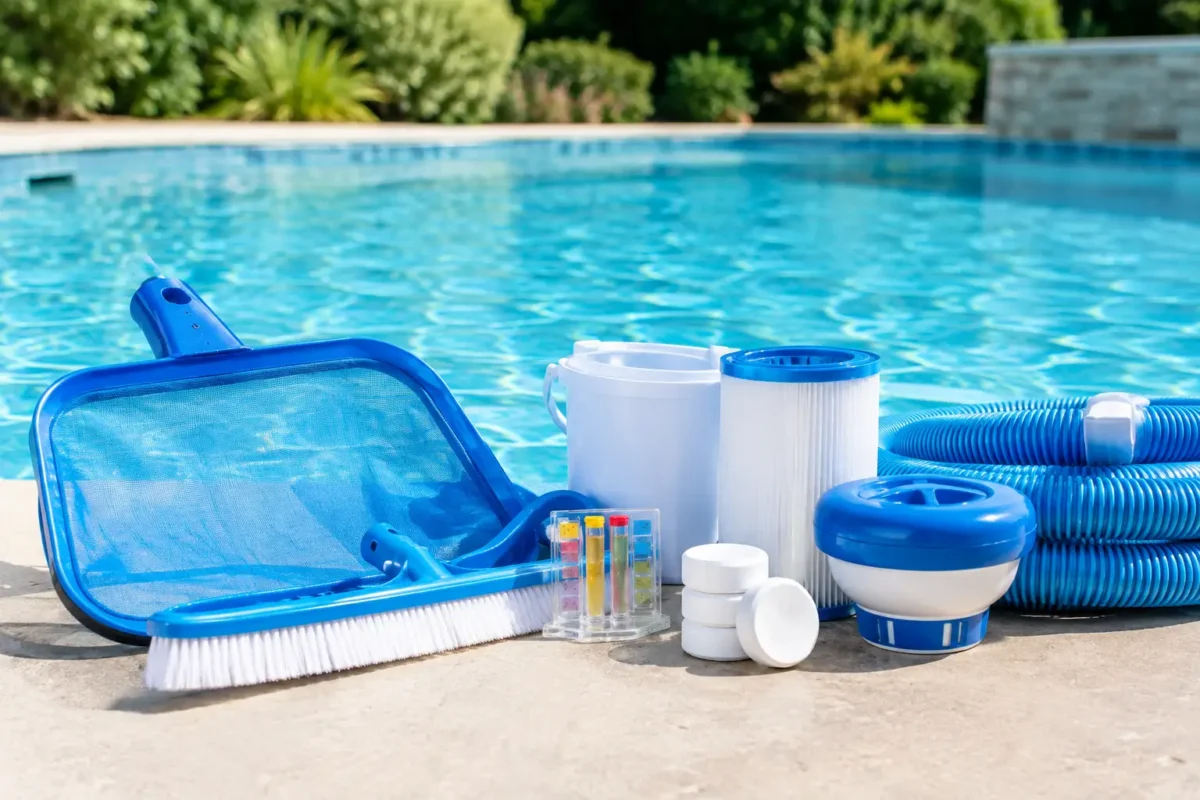
Start with the tools that remove debris before it becomes a water-quality or filtration problem. A telescopic pole is the foundation because it accepts several interchangeable heads and allows staff to reach the floor, walls, steps, and waterline without entering the pool. Choose a corrosion-resistant model with secure locking sections. Lightweight poles are convenient, but a commercial environment may justify a stronger professional-grade option that tolerates daily use.

Your core cleaning equipment should include:

  • A deep leaf net for heavier debris and a flat skimmer net for surface collection
  • A pool brush suited to the finish, such as nylon for vinyl and fiberglass or stainless-steel bristles only where appropriate for plaster
  • A manual vacuum head and vacuum hose sized for the pool dimensions
  • A dedicated waterline brush or pad for oils, sunscreen residue, and mineral buildup
  • A leaf rake for larger debris and a pole-mounted corner brush for steps and tight junctions

Avoid treating all brushes as interchangeable. An overly aggressive brush can scratch a delicate finish, while a brush that is too soft may leave algae attached to grout lines, steps, and textured surfaces. For tiled luxury pools, select tools that clean efficiently without damaging tiles, grout, mosaics, or fittings.

Reliable Circulation and Filtration Tools

Cleaning the visible surface is only one part of maintenance. The circulation system does the continuous work of moving water through filters and treatment equipment. A well-specified pump, filter, skimmer, main drain, return fittings, and valves form the operating core of the pool.

A pump basket cleaning tool or simple debris scoop makes routine basket servicing safer and faster. Keep spare pump lid O-rings, lubricant approved for pool equipment, and replacement baskets on hand for properties that cannot afford downtime. A cracked basket or flattened O-ring may seem minor, yet both can reduce flow, cause air to enter the system, and place unnecessary stress on the pump.

For sand, cartridge, or glass-media filters, include the tools required for the selected technology. Cartridge filters need spare elements so one set can be cleaned and dried while the other remains in service. Sand and glass-media systems need a functioning pressure gauge and clear guidance on backwashing. Backwashing too often wastes water and reduces filtration efficiency; waiting too long restricts flow. The correct timing depends on the filter’s clean operating pressure and the manufacturer’s specification.

An automatic pool cleaner, robotic cleaner, or suction cleaner can reduce labor substantially, especially for larger pools. The best choice depends on the pool shape, floor profile, debris load, and circulation capacity. Robotic cleaners offer independent cleaning and excellent coverage, while suction models can be economical when the filtration system is correctly sized. Neither replaces routine visual inspection of the waterline, skimmers, and equipment room.

Water Testing Equipment That Supports Better Decisions

Clear water is not always balanced water. A professional testing kit is one of the most valuable items in any maintenance room because it identifies developing problems before swimmers feel irritation or surfaces begin to scale.

Use a quality drop-test kit or photometer to measure free chlorine or bromine, pH, total alkalinity, calcium hardness, cyanuric acid where applicable, and total dissolved solids. Test strips are useful for quick checks, but they are less precise and should not be the only basis for chemical adjustments at high-use residential or commercial properties.

Digital meters can provide fast, repeatable readings when they are calibrated and stored correctly. That caveat matters. A poorly maintained meter can create more uncertainty than a fresh, properly used liquid test kit. Keep reagents away from direct sun and excessive heat, check expiration dates, and record results in a maintenance log. Trends in pH, sanitizer demand, and filter pressure often reveal issues that a single reading will not.

Chemical Handling and Dosing Essentials

Testing equipment must be paired with safe chemical handling tools. Use dedicated measuring cups or scoops for each product, chemical-resistant gloves, eye protection, labeled storage containers, and a clean mixing bucket where required by the chemical instructions. Never use household containers for pool chemicals, and never combine products in the same container.

For demanding sites, automated dosing systems improve consistency by monitoring and controlling sanitizer and pH levels. They are particularly valuable for hotels, apartment buildings, schools, and facilities with frequent bather turnover. Automation still requires professional oversight, calibration, and manual verification. It reduces routine variability; it does not eliminate responsibility.

Safety Tools Belong in the Equipment Plan

Maintenance tools should protect the people performing the work as well as the pool itself. An insulated rescue hook, life ring with rope, first-aid kit, clear depth markers, and compliant signage should be available and inspected regularly. Commercial and shared-use pools may have additional local requirements, so facility managers should confirm the applicable standards for their site.

For indoor pools, fountains, and equipment rooms, include non-slip footwear, waterproof lighting, and electrical safety checks. Any portable electrical device used near water must be designed for that environment and connected through appropriate protection. A premium installation deserves the same attention behind the scenes as it receives in visible design details.

Storage, Spares, and Seasonal Readiness

The best tools lose their value when they are left exposed to sun, chemicals, or moisture. Set aside a clean, ventilated storage area with wall hooks for poles and hoses, shelves for test kits, and separated bins for chemicals. Keep acids, chlorinating products, and other reactive materials segregated according to their safety requirements.

A practical spare-parts reserve prevents small failures from becoming service interruptions. Stocking common O-rings, pressure gauges, vacuum hose cuffs, skimmer baskets, test reagents, cleaner bags, and filter cartridges is sensible for high-value homes and commercial properties. The exact stock level should reflect equipment age, supplier lead times, and the cost of a closed pool.

Do not overlook covers and cover reels. A properly fitted pool cover limits debris, reduces evaporation, helps retain heat, and can lower the daily workload. In the UAE climate, the best cover depends on whether the priority is safety, temperature control, evaporation reduction, or protection during periods of low use.

When Professional Service Is the Better Tool

A thorough checklist gives on-site teams control over routine care, but it does not replace technical service. Persistent cloudiness, repeated algae growth, unusual pump noise, electrical faults, leaks, heater errors, or unstable chemical readings call for a trained technician. Continuing to adjust chemicals without diagnosing the cause can damage equipment and delay the correct repair.

For villas, a scheduled service plan keeps maintenance discreet and predictable. For hotels, developers, and facility managers, professional inspections support asset protection, guest confidence, and consistent compliance. Aquatic Pools and Fountains can help match cleaning tools, filtration components, water testing systems, treatment equipment, and maintenance support to the demands of each installation.

A well-equipped pool room creates confidence long before a guest enters the water. Choose durable tools, keep accurate records, replace worn items early, and give the circulation system the professional attention it deserves.

Categories
Uncategorized

Sustainable Pool Design Trends for UAE Properties

A premium pool should look exceptional long after opening day, but its real quality is measured in the energy, water, and maintenance it demands over years of use. Sustainable pool design trends are therefore gaining traction across UAE villas, hospitality projects, residential towers, and commercial properties. The focus is not on sacrificing luxury for efficiency. It is on specifying smarter equipment, durable finishes, and well-engineered systems that protect both the visual standard of the property and its operating budget.

For owners and developers, sustainability is increasingly a performance decision. Dubai’s climate places heavy demands on circulation, cooling, evaporation control, and water treatment. A pool designed around the right technical choices can deliver a refined guest or resident experience while reducing avoidable waste and service interruptions.

Sustainable Pool Design Trends That Deliver Performance

The strongest sustainable designs begin below the waterline. A dramatic tile finish, infinity edge, or custom water feature will always define the visual impact of an installation, but the equipment room determines how efficiently that asset operates. Modern projects are moving away from oversized, basic systems and toward components selected for the pool’s actual hydraulic requirements, bather load, operating schedule, and exposure to heat.

This matters especially for commercial and hospitality settings, where a small efficiency gain repeated every day can materially improve lifecycle costs. For luxury villas, it provides quieter operation, more stable water quality, and less time spent correcting preventable issues.

Variable-Speed Pumps as a Core Upgrade

Variable-speed pumps are among the most practical improvements in sustainable pool design. Unlike single-speed models that operate at full output regardless of demand, variable-speed equipment can run at lower speeds for regular circulation and increase output only when filtration, cleaning, water features, or peak use requires it.

Lower-speed circulation generally uses less power and reduces strain on pipework and filtration equipment. It can also make the pool environment more comfortable by minimizing equipment noise. The correct pump is not simply the highest-capacity unit available. It must be matched to the pool volume, plumbing layout, filter size, water features, and desired turnover rate.

For properties with fountains, cascades, jets, or overflow systems, separate pump circuits are often worth considering. This allows the primary filtration system to operate efficiently while decorative features run only when needed for guest experience or visual presentation.

High-Efficiency Filtration and Better Hydraulic Design

Filtration is another area where long-term sustainability is decided. High-quality sand, glass media, and cartridge filtration systems each have a place, depending on the application. Glass media can offer fine filtration performance and may require less frequent backwashing than conventional media in certain systems. Cartridge filters can reduce backwash water consumption, although they require disciplined cleaning and replacement procedures.

There is no universal best choice. A busy hotel pool has different operational needs than a private villa pool, and a facility manager may prioritize predictable servicing over the lowest possible water use. The right solution should be selected after reviewing water quality targets, available plant room space, maintenance capacity, and local operating conditions.

Hydraulic design is equally important. Correctly sized pipes, balanced returns, properly positioned skimmers or overflow gutters, and efficient suction lines reduce resistance in the system. When water moves through the pool with less friction, the equipment works less hard to achieve the same result. It is an invisible design decision with a very visible impact on energy use and water clarity.

Water-Smart Pool Design for Hot Climates

Evaporation is a persistent challenge in the UAE. Heat, sun exposure, and wind can steadily reduce water levels, increase chemical demand, and place more load on temperature-control equipment. Sustainable pool planning addresses water loss early rather than treating it as a routine operating expense.

Pool covers are a straightforward but underused solution, particularly for private residential pools. A properly selected cover can limit evaporation when the pool is not in use, retain heat where heating is required, and keep debris out of the water. The trade-off is convenience and appearance. Owners who expect a pool to remain visually open at all times may prefer automated cover systems that preserve the design while making regular use more realistic.

Automatic water-level controls can also prevent overfilling and reduce manual intervention. Combined with leak detection and routine inspection of fittings, valves, and underground lines, they help operators identify losses that might otherwise remain unnoticed.

Natural Shade and Heat-Resistant Surrounds

Sustainable design extends to the deck, landscaping, and immediate pool surroundings. Shade structures, pergolas, strategic planting, and architectural screening can reduce direct sun exposure without compromising the openness expected of a luxury outdoor setting. They also create more usable seating areas during hotter periods.

Material selection deserves the same attention. Light-colored, heat-resistant pavers and premium slip-resistant finishes can make the pool deck more comfortable underfoot while supporting a polished visual scheme. Durable materials may cost more at the start, but frequent replacement of cracked, faded, or poorly specified surfaces is rarely a sustainable choice.

Native or low-water landscaping is another sensible complement to a premium pool environment. It reduces irrigation demand and can frame the installation with a more considered, location-appropriate aesthetic. The goal is not an austere landscape. It is a composed outdoor environment that does not require excessive water and labor to maintain.

Smarter Disinfection With Less Chemical Waste

Water quality is non-negotiable. Sustainable pool operation does not mean reducing sanitation standards. It means using reliable treatment systems to maintain clean, balanced water with fewer fluctuations and less unnecessary chemical correction.

Salt chlorination, UV systems, ozone treatment, and automated chemical dosing are increasingly specified as part of high-performance pool systems. Each approach has a different role. Salt chlorination can provide consistent chlorine generation, while UV and ozone systems support oxidation and can reduce the formation of certain chloramine byproducts. Automated dosing helps maintain precise pH and disinfectant levels, which is especially valuable for commercial pools with changing bather loads.

These systems still require monitoring, competent commissioning, and regular service. A salt system, for example, does not remove the need for water testing or balanced chemistry. The sustainable advantage comes from stable operation, informed control, and reduced reliance on reactive chemical treatment.

Automation That Gives Operators Control

Modern pool automation has moved beyond simple timer controls. Integrated systems can manage circulation schedules, lighting, heat-cool pumps, water features, dosing equipment, and alerts from a central interface. For facility managers, this creates better oversight across multiple assets. For villa owners, it simplifies daily operation without reducing control.

The most effective automation strategy is tailored rather than excessive. A small residential pool may benefit from scheduled pump speeds, lighting control, and remote status alerts. A hotel or residential complex may require detailed monitoring, separate zones, automated chemical management, and reporting for maintenance teams. Specifying only the functions that will be used keeps the system efficient and easier to maintain.

Energy-Conscious Heating, Cooling, and Lighting

Temperature management can be one of the largest energy loads in a pool installation. Heat-cool pumps are increasingly favored because they can provide both heating and cooling capability with efficient energy use when correctly sized and installed. They are particularly useful in the UAE, where water temperature may need to be controlled across changing seasons and usage patterns.

Sizing is critical. An undersized unit may run continuously without reaching the desired temperature, while an oversized unit can increase capital cost without delivering proportional value. Pool volume, surface area, shade, wind exposure, operating hours, and cover use all influence the calculation.

LED pool lights are now the clear standard for most premium projects. They consume significantly less energy than older lighting technologies, have a long service life, and offer flexible color and scene options for hospitality and residential settings. Well-planned lighting should enhance steps, edges, seating zones, and water features without creating glare or unnecessarily high wattage.

Designing for Service Life, Not Just Installation Day

A sustainable pool is one that can be maintained efficiently for many years. That requires accessible equipment layouts, durable valves and fittings, quality waterproofing, dependable electrical protection, and enough plant room space for technicians to work safely. These details are often overlooked when visual deadlines take priority, yet they influence future maintenance cost more than many decorative upgrades.

For developers and commercial buyers, standardizing proven equipment across a portfolio can simplify spare-parts planning and staff training. For homeowners, selecting globally established equipment brands can improve access to support and replacement components over the life of the pool.

Aquatic Pools and Fountains supports this approach with premium equipment selection, technical guidance, installation support, and ongoing maintenance services tailored to residential and commercial requirements across the UAE.

The most valuable sustainable choice is not a single product or trend. It is a pool system designed as a complete, serviceable asset: efficient enough for everyday operation, elegant enough for a high-value property, and durable enough to perform with confidence long after the first swim.