Aquatic

Categories
Uncategorized

Variable Speed Pump Comparison for UAE Pools

A pool pump that runs at one fixed, high speed may keep water moving, but it rarely reflects the way a premium pool is actually used. A thoughtful variable speed pump comparison looks beyond the purchase price to evaluate energy consumption, hydraulic performance, noise, control capability, and long-term service reliability. For villas, hotels, residential towers, and commercial facilities across the UAE, those details have a direct effect on operating costs and guest experience.

Variable-speed technology allows the motor to adjust its revolutions per minute to match the task at hand. Filtration, water features, vacuuming, backwashing, heating, and peak bather loads do not require the same flow rate. The right pump provides the required circulation while avoiding unnecessary energy use and excessive noise.

Why Variable-Speed Pumps Are a Premium Upgrade

Traditional single-speed pumps operate at one setting, often selected to meet the most demanding condition rather than the daily filtration requirement. That means the pump may run harder than necessary for many hours each day. A variable-speed pump can operate at a lower programmed speed for routine circulation, then increase output when a cleaner, spa jet system, heater, or water feature calls for more flow.

The energy advantage can be significant because pump power rises sharply as speed increases. Reducing speed modestly can reduce electrical demand far more than many owners expect. The actual savings depend on pool volume, pipework, operating schedule, local electricity rates, and the selected speed program, but variable-speed equipment is generally the stronger choice for pools with long daily run times.

Lower-speed operation also brings a quieter equipment area. This matters for luxury villas where the plant room sits near outdoor living space, and for hotels or residential communities where mechanical noise can affect guests and residents. The result is a more refined pool environment without compromising water quality.

Variable Speed Pump Comparison: What Matters Most

A meaningful comparison starts with the pool system, not the horsepower printed on the pump label. Two pumps with similar motor ratings may deliver very different results once plumbing resistance, filter condition, elevation, heaters, chlorinators, and feature lines are considered.

Flow Rate and Total Dynamic Head

Every pool requires a practical circulation rate based on its water volume and required turnover period. However, flow alone is not enough. The pump must produce that flow against the resistance created by the entire circulation system, known as total dynamic head.

Long pipe runs, undersized plumbing, multiple elbows, elevated equipment rooms, cartridge filters, sand filters, heaters, and salt chlorinators all influence head pressure. For a commercial pool or a large villa installation, selecting a pump solely by horsepower can produce weak circulation or an oversized unit that wastes power. A professional hydraulic assessment identifies the operating point where pump performance and system resistance meet.

Motor Efficiency and Speed Range

Not all variable-speed pumps offer the same efficiency across their operating range. Premium permanent-magnet motors are designed to deliver efficient, controlled performance at lower speeds, where a pool spends much of its operating time.

Look for a model with a broad and useful RPM range, clear programming options, and stable operation at low speed. A pump that only performs well near its maximum output will not provide the full value expected from variable-speed technology. The motor should also be suited to the site’s electrical supply and properly protected by the correct control panel, breaker, and grounding arrangement.

Programming and Automation Compatibility

A basic onboard keypad may be sufficient for a residential pool with one filtration schedule and occasional manual adjustments. For larger residences, hotels, compounds, and commercial properties, integration with automation can be more valuable. This allows the pump to respond to programmed schedules, heating demand, water-feature operation, cleaning cycles, or different occupancy periods.

The best choice depends on how the pool is managed. A facility manager may need locked settings, remote monitoring, and predictable daily programs. A homeowner may prefer simple controls with a dedicated higher-speed setting for vacuuming or spa use. Complexity is not automatically better. The controls should match the operational needs of the property and be easy for authorized users to manage.

Filter, Heater, and Water-Feature Requirements

The circulation pump must work as part of a complete system. A flow rate that is ideal for filtration may be too low for a heater or insufficient for a decorative cascade, fountain nozzle, or in-pool spa jets. Conversely, flow that is excessive for the filter can create high pressure, reduce filtration efficiency, and place unnecessary strain on fittings.

For pools with fountains and water features, separate pumps are often the better technical solution. This allows the filtration pump to run economically at low speed while the feature pump delivers the precise pressure needed for a consistent visual effect. Where one variable-speed pump serves several functions, controls and hydraulic balancing must be carefully designed so that one operating mode does not compromise another.

Build Quality and Service Access

A premium pump should be assessed for more than its advertised efficiency. Housing materials, seals, impeller design, ventilation, drive electronics, and the availability of replacement components all influence service life. In the UAE climate, equipment rooms can be exposed to high ambient temperatures, dust, humidity, and demanding operating schedules. Correct installation, ventilation, and protection from direct weather exposure are essential.

Choose equipment supported by dependable technical expertise and readily available parts. A lower initial price is rarely a saving if a critical component requires a long lead time or if local service support is limited. For high-visibility commercial properties, uptime has value that should be considered alongside energy savings.

How Variable-Speed Pumps Compare With Single-Speed Pumps

Single-speed pumps remain suitable in selected applications. A small, simple pool with limited operating hours and straightforward plumbing may not recover the higher initial cost of a variable-speed unit as quickly as a large, heavily used system. They are also simpler to operate and can be practical for dedicated duties that genuinely require one constant flow rate.

However, variable-speed pumps are usually the more capable long-term investment for premium residential and commercial pools. They offer flexible scheduling, quieter filtration, lower energy demand at reduced speeds, and better control over diverse pool functions. Their higher upfront cost should be evaluated against years of electrical consumption, reduced mechanical stress, and the improved ability to tailor operation to the property’s needs.

The comparison becomes especially clear when a pool operates eight, 12, or more hours per day. Hotels, apartment communities, schools, clubs, and villas with extensive water features are rarely best served by a pump that has only one operating mode.

Selecting the Right Size Without Oversizing

Oversizing is one of the most common pump-selection mistakes. More horsepower does not automatically mean better circulation. An oversized pump can create noisy operation, high filter pressure, accelerated wear, and needless energy use. It may also make water balance more difficult if high flow reduces effective contact time through treatment equipment.

Correct sizing begins with pool volume, desired turnover, pipe diameter, equipment layout, filtration type, and every secondary load on the system. The design should account for normal filtration as well as demanding functions such as vacuuming, backwashing, heating, and water-feature operation. Where these functions have conflicting flow needs, separate circuits or pumps may deliver better performance than one oversized unit.

For an existing pool, the assessment should include the condition of the filter, suction lines, valves, skimmers, and returns. Installing an advanced pump on restricted or deteriorated plumbing will not solve the underlying hydraulic issue. A complete equipment review protects the investment and helps ensure the new pump operates within its intended range.

Recommended Operating Approach for UAE Properties

In many UAE installations, the most efficient strategy is to run filtration at a lower speed for a longer, controlled period rather than at maximum output for a short period. This can maintain consistent circulation while reducing energy demand and noise. The final schedule should be based on water temperature, pool use, bather load, sanitizer system, and filtration performance.

A practical setup often includes a low-speed daily filtration program, a medium-speed period for stronger circulation or heating, and a high-speed mode reserved for cleaning, feature operation, or exceptional demand. After installation, the schedule should be reviewed using filter pressure, water clarity, chemical readings, and actual energy consumption. Fine-tuning is where variable-speed technology delivers its strongest value.

Aquatic Pools and Fountains can help property owners and project teams compare pump curves, specify compatible equipment, and install a system built for reliable long-term performance. The right pump is not simply the most powerful model available. It is the one engineered around the pool, the property, and the standards expected from a premium aquatic installation.
Categories
Uncategorized

Pool Backwash Process: Clean Filters, Clear Water

A pool can look perfectly blue while its filter is working far harder than it should. Reduced return flow, a rising pressure gauge, cloudy water after heavy use, or debris that reappears soon after vacuuming are all signs that the filter needs attention. The pool backwash process is the controlled cleaning cycle that flushes trapped dirt from compatible filters and restores efficient circulation without dismantling the entire system.

For villas, hospitality properties, residential developments, and commercial facilities, backwashing is not simply a routine valve adjustment. Done correctly, it protects expensive pumps, preserves water clarity, and helps the complete filtration system perform to premium standards. Done too often or with the wrong settings, it wastes treated water, disrupts chemical balance, and can reduce filtration performance.

What Backwashing Does Inside a Pool Filter

During normal filtration, pool water travels through the filter media and leaves dirt, leaves, fine particles, sunscreen residue, and other contaminants behind. Over time, this buildup restricts water flow. The pressure on the filter gauge increases because the pump must work harder to push water through the media.

Backwashing reverses that flow. Water enters the filter from the opposite direction, lifts the trapped debris from the media, and sends the dirty water out through a waste line. Once the discharge runs clear, the filter is rinsed and returned to normal filtration.

This process applies to sand filters and diatomaceous earth, or DE, filters. Cartridge filters operate differently. They should be removed and cleaned according to the manufacturer’s instructions rather than backwashed. Attempting to backwash a cartridge filter can damage the equipment or simply fail to clean it properly.

When the Pool Backwash Process Is Necessary

The filter pressure gauge is the most reliable guide. Record the clean operating pressure after installing a clean filter, starting the system, and allowing circulation to stabilize. In many systems, backwashing becomes necessary when pressure rises approximately 8 to 10 psi above that baseline. The precise threshold depends on the filter model, pump capacity, plumbing layout, and manufacturer guidance.

Visual conditions matter too. Weak water flow from return inlets, poor skimmer pull, persistent cloudiness, and a noticeable reduction in vacuum performance can point to a loaded filter. After a dust storm, a high-bather-load weekend, landscaping work near the pool, or algae treatment, the filter may need cleaning sooner than usual.

Backwashing on a fixed weekly schedule is not always best. A filter with a moderate layer of trapped material can capture fine debris more effectively than a freshly cleaned filter. Excessive backwashing removes that useful filtration layer, consumes water, and requires additional chemical balancing. Premium pool care is based on measured system performance, not guesswork.

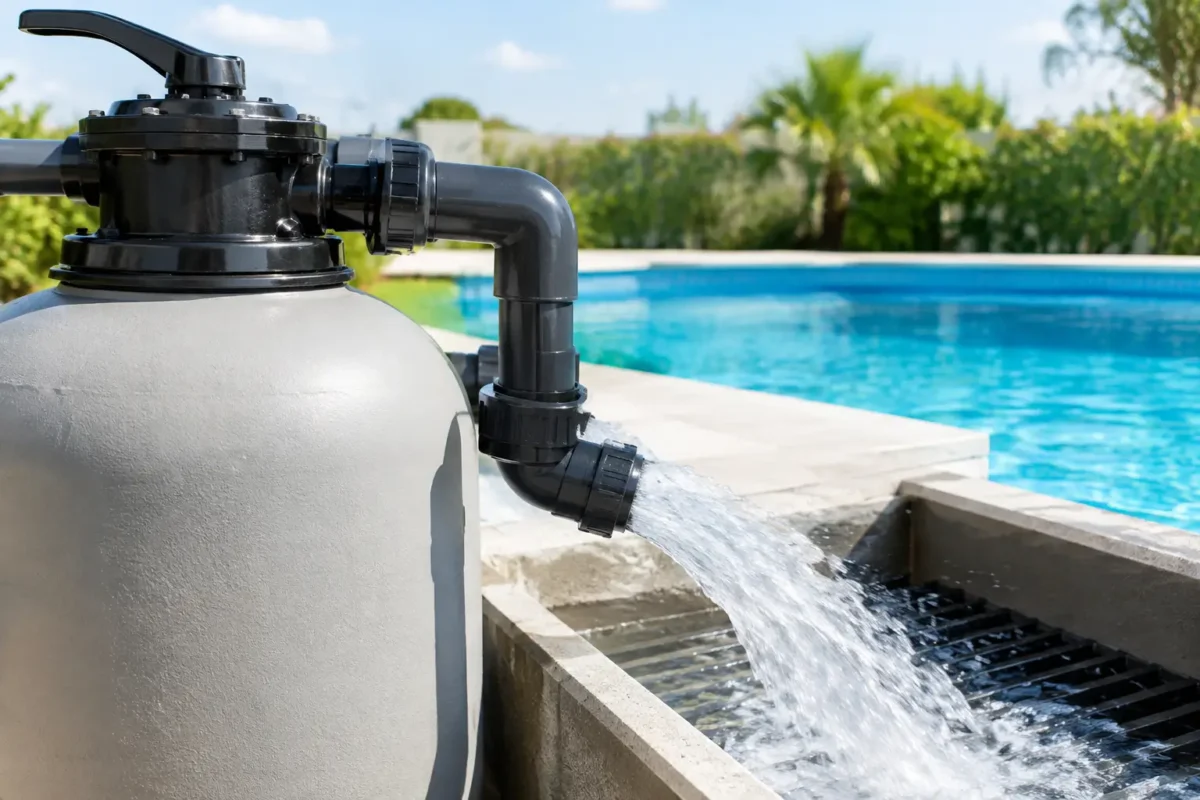
How to Backwash a Sand or DE Filter

Before changing any multiport valve setting, turn the pump off. Moving the handle while the pump is running can damage the valve gasket, create leaks, and place unnecessary stress on the system.

1. Prepare the waste discharge

Confirm that the waste line is connected, unobstructed, and directed to an approved drainage point. Backwash water contains concentrated debris and treatment chemicals. It should never be discharged where it can flood landscaping, neighboring property, or equipment areas. Local drainage requirements and property policies should always be followed.

If the pool has an automatic water leveler, check that it will not continuously refill the pool while water is being discharged. For larger commercial installations, a technician may need to coordinate the process with the balance tank, drainage system, and water treatment controls.

2. Set the valve to Backwash

With the pump off, press down the multiport valve handle and move it to the Backwash position. On systems with a push-pull valve, follow the equipment manufacturer’s operating sequence. Never force a stiff valve handle. Resistance may indicate a worn gasket, damaged valve assembly, or internal debris that needs service.

3. Run the pump and watch the sight glass

Start the pump and allow the system to backwash. Most residential sand filters need roughly two to three minutes, but the sight glass provides the better indicator. At first, the water in the sight glass may appear cloudy or discolored. Continue until it runs clear.

Do not extend the cycle simply because the timer has not reached a familiar number. Over-backwashing wastes substantial water, particularly on large pools. If the water does not clear within a reasonable period, there may be an algae issue, damaged filter media, a valve problem, or unusually heavy contamination that requires a more complete service response.

4. Rinse the filter before returning to service

Turn the pump off again. Move the valve to Rinse, then restart the pump for approximately 20 to 30 seconds. Rinsing settles the sand bed and flushes remaining debris from the valve and plumbing to waste. Skipping this step can send a small burst of dirty water back into the pool when filtration resumes.

Turn the pump off once more and return the valve to Filter. This stop-start sequence is essential for protecting the valve and maintaining a dependable seal.

5. Restore water level and test balance

Backwashing lowers the pool water level. Refill with fresh water until the level is near the middle of the skimmer opening, then restart normal circulation. Test and adjust the water chemistry because fresh fill water can affect pH, alkalinity, sanitizer demand, calcium hardness, and total dissolved solids.

For DE filters, add the correct amount of DE media through the skimmer after the backwash and rinse cycle, following the filter manufacturer’s stated quantity. Running a DE filter without replacing the media compromises filtration and can allow fine contaminants back into the water.

Common Mistakes That Reduce Filter Performance

The most common mistake is using backwash as a cure for every water-quality issue. A dirty filter may contribute to cloudy water, but poor sanitation, imbalanced chemistry, inadequate circulation time, or early algae growth can produce the same result. Backwashing alone will not correct those underlying conditions.

Another issue is ignoring the pressure gauge. A faulty, stuck, or unreadable gauge turns filter maintenance into guesswork. Replacing a low-cost gauge promptly can prevent pump strain and unnecessary water loss. It is also wise to inspect the multiport valve for leaks around the handle or waste line after each service cycle.

For sand filters, replacing sand too frequently is not usually necessary. Quality filter sand often remains effective for several years, depending on water conditions and maintenance practices. However, channeling, hardened media, persistent cloudy water despite correct chemistry, or sand returning to the pool may signal a need for inspection. DE grids, manifolds, laterals, seals, and valve spiders also require periodic professional assessment.

Protecting Premium Pool Systems in Hot Conditions

High ambient temperatures, fine airborne dust, frequent pool use, and extended pump run times can place exceptional demand on filtration equipment. Properties in Dubai and across the UAE often require closer monitoring than pools in milder climates, especially during peak summer use. A properly sized pump and filter, combined with correct turnover time, makes the backwash cycle more effective and less frequent.

Aquatic Pools and Fountains supports residential and commercial clients with filtration equipment, replacement media, valves, pumps, water-testing solutions, and technical maintenance for high-performance pool environments. The objective is not merely to clear a pressure reading, but to keep the entire circulation and treatment system operating with reliability, efficiency, and a refined finish.

A clean, correctly managed filter is one of the quiet foundations of an exceptional pool. Keep a record of clean pressure, watch how quickly it rises, and treat unusual changes as an early service signal rather than a minor inconvenience.

Categories
Uncategorized

How to Prevent Pool Algae in Luxury Pools

A pool can look clear in the morning and begin showing a faint green tint by afternoon when heat, sunlight, and weak water treatment combine. Knowing how to prevent pool algae is not simply about adding more chemicals. It is about maintaining a controlled water environment where circulation, filtration, sanitation, and regular cleaning work to premium standards.

For villa owners, hospitality operators, facility managers, and developers, algae prevention protects far more than appearance. It helps preserve water quality, avoids slippery pool surfaces, reduces chemical correction costs, and keeps a high-value aquatic installation ready for daily use. In Dubai and across the UAE, where elevated temperatures and intense sun place greater demands on pool systems, prevention must be consistent rather than reactive.

How to Prevent Pool Algae With Consistent Water Control

Algae spores enter nearly every outdoor pool through wind, rain, dust, leaves, swimwear, and surrounding landscaping. Their presence alone is not a concern. Problems begin when spores find warm water, sunlight, nutrients, and insufficient sanitizer.

The most reliable prevention strategy is to remove the conditions algae need to establish themselves. A pool with properly balanced water and dependable circulation is significantly less likely to turn green, yellow, or black, even during the hottest months.

Pool owners should avoid treating water clarity as the only measure of pool health. Water can appear clear while sanitizer levels are declining, filter pressure is rising, or circulation is insufficient in steps, corners, and shallow ledges. These are the areas where algae often begins before it becomes visible across the main pool surface.

Maintain the Correct Sanitizer Level

Sanitizer is the primary defense against algae. Chlorine remains a widely used option because it both disinfects water and suppresses algae growth when maintained at the appropriate level. Saltwater pools also rely on chlorine generated through the salt chlorination system, so they require the same level of attention to testing and water balance.

The exact target depends on the pool’s treatment system, bather load, water temperature, and stabilizer level. Rather than relying on a fixed dose, test regularly and adjust according to the readings. In high-use residential pools, hotel pools, and shared community facilities, testing should be more frequent because sunscreen, body oils, cosmetics, and organic debris consume sanitizer quickly.

A sudden sanitizer drop is often an early warning sign. It may indicate heavy contamination, high demand from organic material, an improperly sized disinfection system, or inadequate chemical dosing. Correct the underlying cause instead of repeatedly adding chemicals without a measurement-based plan.

Balance pH, Alkalinity, and Stabilizer

Chlorine cannot perform effectively if pool water is poorly balanced. High pH can reduce sanitizer efficiency and encourage scale formation, while low pH can create discomfort for swimmers and contribute to corrosion of equipment and fittings. Total alkalinity supports pH stability, helping prevent rapid swings that make day-to-day water management difficult.

Cyanuric acid, commonly called stabilizer, is another consideration for outdoor pools. It helps protect chlorine from ultraviolet degradation, which is particularly valuable under strong sun exposure. However, too much stabilizer can reduce chlorine’s active effectiveness. This is a common reason a pool may develop algae despite apparently acceptable chlorine readings.

Professional water testing provides a clearer picture than visual inspection or basic test strips alone. For premium installations, a reliable testing routine should evaluate sanitizer, pH, alkalinity, calcium hardness, stabilizer, and total dissolved solids. The right balance protects both water quality and expensive pool finishes, pumps, heaters, lights, and filtration equipment.

Circulation and Filtration Keep Algae From Settling

Algae favors still water. A powerful sanitizer program will underperform if water is not moving through the filtration and treatment system long enough each day. Proper circulation distributes chemicals, captures fine debris, and prevents stagnant zones from developing around benches, steps, drains, water features, and recessed details.

Run time depends on pool volume, pump capacity, filter condition, bather use, and seasonal temperature. During periods of intense heat, heavy use, or dusty conditions, pools often require longer daily circulation. Variable-speed pumps offer valuable control because they can maintain steady, energy-conscious circulation for extended periods while increasing output when vacuuming, operating water features, or responding to heavy pool use.

Filtration is equally critical. A clogged cartridge, overloaded sand filter, damaged filter element, or neglected backwashing schedule reduces water flow and leaves fine particles available as algae nutrients. Monitor filter pressure and follow the cleaning or backwashing requirements for the specific equipment installed. Cleaning too rarely is a problem, but cleaning a sand filter too frequently can also reduce its ability to capture fine material until the media develops its normal filtration layer.

For larger villas, hotels, residential towers, and commercial facilities, equipment sizing matters. An undersized pump or filter may appear to work under light conditions but struggle during peak heat or occupancy. Selecting durable, correctly matched equipment is a long-term algae prevention decision, not merely a performance upgrade.

Clean the Surfaces Algae Uses as a Starting Point

Even a well-treated pool needs physical cleaning. Brushing disrupts the thin layer of early algae growth that can cling to plaster, tile grout, coping lines, ladders, steps, and corners. It also pushes settled debris toward the main drain and skimmer so the filtration system can remove it.

Brush walls and floors on a regular schedule, with extra attention to shaded areas and surfaces with reduced water movement. Pools surrounded by trees, gardens, construction activity, or open desert landscaping may require more frequent skimming and vacuuming because dust, leaves, pollen, and fine debris increase the organic load in the water.

Do not overlook the skimmer baskets, pump basket, automatic cleaner, and vacuum hose. Restricted flow through any of these components can weaken circulation. A robotic cleaner can reduce routine labor and provide dependable floor coverage, but it should complement rather than replace water testing, brushing, and filter maintenance.

Water features deserve special consideration. Fountains, spillways, and decorative waterfalls add elegance, but they also introduce more exposed surface area and can collect debris in basins or channels. Ensure these systems circulate adequately, remain clean, and are included in the property’s regular maintenance program.

Control the Conditions That Feed Algae

Algae needs more than sunlight to grow. It also benefits from phosphates, nitrates, decaying leaves, poor drainage, and excess organic waste. Pool chemicals should be selected based on testing, not used as a substitute for removing the source of contamination.

Phosphate treatments can be useful where tests confirm elevated levels, particularly in pools exposed to landscaping runoff or frequent dust. They are not a replacement for sanitizer. If chlorine is low or circulation is poor, lowering phosphate levels alone will not resolve an active algae issue.

Encourage swimmers to rinse off before entering the pool, especially after using sunscreen, tanning products, or fitness facilities. In commercial settings, clear poolside rules and attentive maintenance reduce the amount of organic material entering the water. After storms, large gatherings, or unusual debris exposure, test the pool promptly and clean it before a small imbalance becomes a larger recovery project.

Pool covers can also help, though the benefit depends on the property and operating routine. A cover can limit debris and water evaporation, but a covered pool still requires testing and treatment. Leaving a pool covered for long periods with low sanitizer or poor circulation may create conditions that support algae rather than prevent it.

Respond Quickly to Early Signs of Growth

The first sign of algae is not always bright green water. Watch for dullness, cloudy patches, slippery walls, a green or yellow dust-like film, or small dark spots in grout and corners. Yellow algae, sometimes called mustard algae, commonly appears in shaded areas and can be resistant to routine treatment. Black algae can root deeply into porous surfaces and generally requires more intensive brushing and professional correction.

When algae appears, avoid simply adding an algaecide and waiting. Brush affected surfaces, remove debris, test and correct water balance, restore appropriate sanitizer levels, and inspect circulation and filtration performance. Clean or backwash the filter as needed after the treatment process, since dead algae must be removed from the system.

Repeated algae outbreaks deserve a technical assessment. The cause may be poor circulation design, an aging pump, inadequate filtration capacity, a failing chlorinator, inaccurate testing, or water chemistry that has drifted beyond a simple adjustment. Aquatic Pools and Fountains can support property owners and operators with quality equipment, professional maintenance, and technically matched treatment solutions for demanding residential and commercial pools.

A clear pool is maintained one measured decision at a time. Establish a disciplined service schedule, use dependable equipment sized for the installation, and address small changes in water quality before they have the opportunity to affect the experience your property is designed to deliver.

Categories
Uncategorized

Infinity Pool Edge Design for Lasting Performance

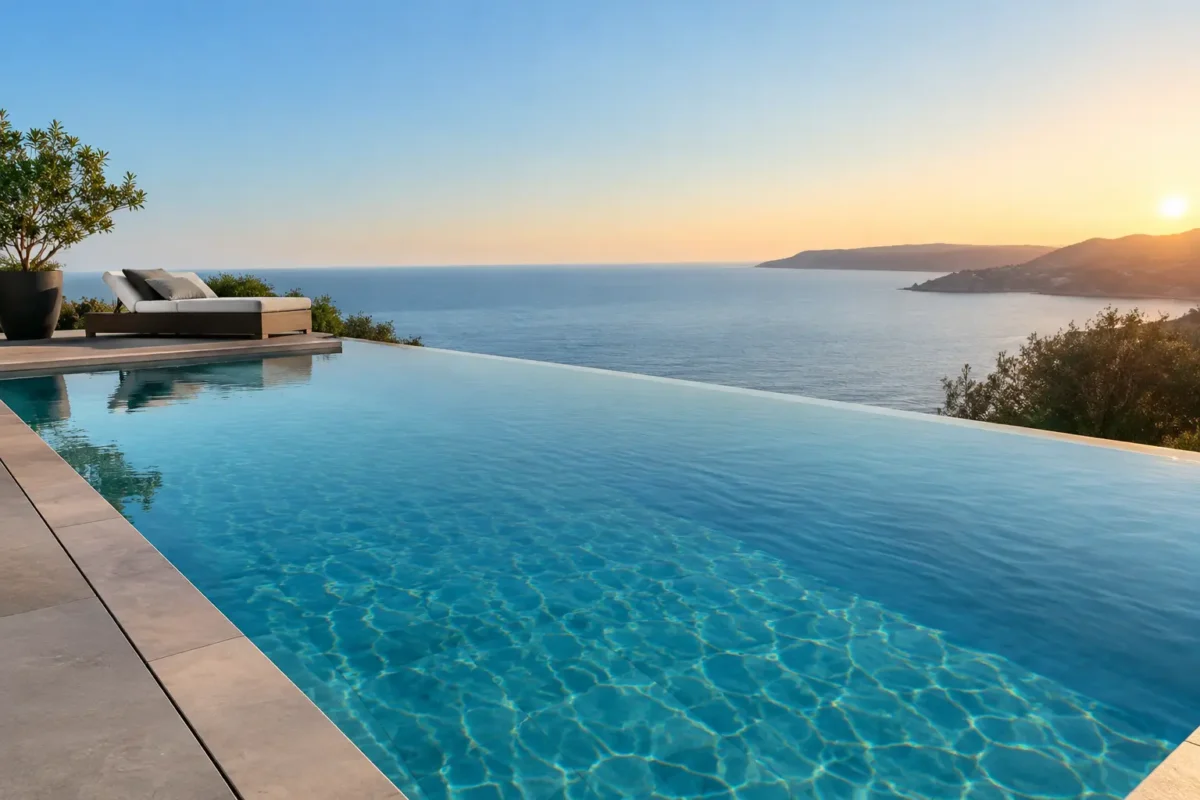
A well-executed infinity pool edge can make water appear to merge with the skyline, sea, garden, or surrounding architecture. That visual simplicity is the result of detailed engineering below the waterline. For villas, hotels, residential towers, and high-visibility commercial properties, the edge must perform as precisely as it looks – in intense sun, wind, heavy use, and changing water levels.

The defining feature is not simply an open side of a pool. It is a coordinated system of structure, waterproofing, tile or stone finishes, catch basin capacity, circulation equipment, and level control. When one element is undersized or poorly installed, the visual effect can be interrupted by uneven flow, exposed coping, water loss, noise, or persistent maintenance demands.

What Creates the Infinity Pool Edge Effect?

An infinity edge pool, also called a vanishing-edge or negative-edge pool, uses a lowered overflow wall on one or more sides. Water passes evenly over this wall into a concealed gutter or catch basin, then returns to the main pool through a separate circulation system. From the viewing side, the waterline appears to disappear.

The overflow wall must be level to an exceptionally fine tolerance. A variation that may seem minor during construction can produce a visibly heavier sheet of water at one end and a weak trickle at the other. This is why premium edge installations require careful setting-out, quality materials, and experienced technical supervision rather than a finish-first approach.

The view also matters. An infinity pool edge is most effective when it frames a deliberate focal point: a Dubai skyline, coastal horizon, landscaped garden, lower courtyard, or architectural water feature. On a site with no natural long view, a reflective edge can still create a refined visual plane, but the design should be adapted to the property rather than copied from a resort image.

Hydraulics Determine Whether the Edge Looks Premium

The visible sheet of water is only one part of the system. Behind it is a hydraulic design that has to manage constant overflow without compromising filtration, water quality, or energy efficiency.

Catch Basin Capacity and Water Balance

The catch basin, often located below or behind the overflow wall, receives water displaced by bathers and the continuous flow over the edge. Its capacity must account for the pool volume, bather load, surge volume, evaporation, and operational water level. A basin that is too small can overflow when the pool is busy. One that is poorly configured may allow the main pool level to drop, exposing the edge and breaking the intended effect.

Automatic level controls are particularly valuable for luxury residences and commercial facilities. They help maintain stable water levels despite evaporation and splash-out, which is especially relevant in the UAE climate. However, level control does not replace correct basin sizing or routine inspection of sensors, valves, and make-up water lines.

Pumps, Filtration, and Return Flow

An infinity edge normally requires dedicated circulation planning. The pump must provide enough flow to create a consistent water sheet, while the filtration system must still turn over the pool water effectively. Pump selection depends on edge length, pipe runs, elevation changes, friction losses, and desired visual flow. Oversizing can create excessive noise, turbulence, and unnecessary energy consumption. Undersizing produces a weak, inconsistent edge.

Variable-speed pumps are often a strong choice because they allow the system to operate at a higher visual-flow setting when the pool is in use and at an efficient maintenance setting during quieter periods. For hotels, apartment developments, and facilities with long operating hours, this flexibility can support both presentation and operating cost control.

Returns should be positioned to move water toward the overflow edge without creating disruptive surface patterns. Skimmer-style circulation logic does not automatically translate to a vanishing-edge pool. Proper hydraulic balancing is essential, especially where the pool has multiple edges, irregular geometry, or an attached spa.

Quiet Operation Is Part of the Luxury Standard

A premium pool should not announce its equipment operation through vibration or persistent mechanical noise. Equipment rooms need correct pump mounting, pipe support, valve access, and ventilation. Water entering the catch basin should be managed to avoid unnecessary splashing and resonance.

This detail is often underestimated. A silent-looking infinity edge paired with loud equipment or a noisy trough loses much of its appeal in a villa terrace, hotel deck, or private rooftop setting.

Materials and Finishes at the Waterline

The edge wall is constantly exposed to treated water, sunlight, temperature variation, and cleaning activity. Material selection must therefore balance appearance with durability.

Porcelain and glass mosaic are popular options because they offer color consistency and a polished waterline finish. Natural stone can create a more architectural result, but it requires careful selection, compatible sealing, and attention to porosity. Some stones can show mineral deposits, discoloration, or surface deterioration if the water chemistry is not controlled.

The edge itself must be finished with exceptional accuracy. Tile lines, grout joints, and coping details become more visible at the vanishing point than on a conventional pool perimeter. Dark finishes often enhance reflection and make the water appear deeper, while pale finishes can create a brighter resort character. Neither is universally better. The right selection depends on sun exposure, surrounding materials, desired water color, and the level of maintenance the owner is prepared to maintain.

Waterproofing beneath the finish is equally critical. The overflow wall, gutter, catch basin, and surrounding deck details must be treated as connected wet-area components. Cosmetic repairs after leakage appears are more disruptive and expensive than specifying a complete waterproofing and movement-joint system from the outset.

Designing for Dubai and UAE Conditions

An infinity pool edge in the UAE faces conditions that influence every technical decision. High temperatures increase evaporation and can affect water balance. Wind may push surface water unevenly across a long edge. Fine dust can accumulate in gutters, drains, and filters. Strong sunlight places added demands on finishes, sealants, and exposed equipment.

For outdoor pools, the drainage around the catch basin and deck should be planned to prevent stormwater, irrigation runoff, or debris from entering the pool system. Equipment selection should also consider heat load, accessibility for service, and protection from dust. A clean, well-designed plant room supports reliable performance far more than concealed equipment installed without maintenance access.

Commercial properties need additional consideration for bather load and operational consistency. A hotel pool can experience sudden surges in occupancy, while a residential tower may need the pool to remain visually perfect throughout the day. In these environments, basin capacity, automation, disinfection, water testing, and preventive maintenance should be specified as part of one operating strategy.

Maintenance That Protects the Visual Effect

An infinity edge needs regular attention, but maintenance should be planned rather than treated as a reaction to visible issues. The edge channel and catch basin should be checked for leaves, dust, scale, and debris. Filter pressure, water level, pump performance, and chemical readings should be monitored consistently.

Water chemistry has a direct impact on the appearance and service life of tiles, grout, stone, metal fittings, and equipment. Calcium buildup can dull the edge and restrict water flow. Unbalanced water can damage finishes or encourage staining. Automated dosing and reliable testing equipment help maintain consistency, but professional review remains valuable for identifying trends before they become costly repairs.

The pool’s visual flow should also be inspected from the main viewing position. If water is no longer passing uniformly over the edge, the cause may be as simple as a changed water level or dirty filter, or it may indicate a valve, pump, or structural-level issue. Early diagnosis protects both the aesthetic result and the wider circulation system.

Choosing the Right Delivery Partner

Infinity-edge projects benefit from one accountable technical partner across equipment supply, installation coordination, commissioning, and ongoing service. Separating these responsibilities without clear specifications can create gaps between structural work, waterproofing, finishes, and hydraulics.

Aquatic Pools and Fountains supports premium residential and commercial installations with quality pool equipment, technical guidance, and maintenance expertise. The objective is not only to create an impressive first view, but to ensure the edge continues to operate with dependable flow, controlled water quality, and durable finishes over time.

The most successful infinity pool edge is the one that appears effortless years after completion. That result comes from disciplined design, correctly matched equipment, and maintenance that respects the precision behind the view.

Categories
Uncategorized

Pool Covers That Protect Premium UAE Pools

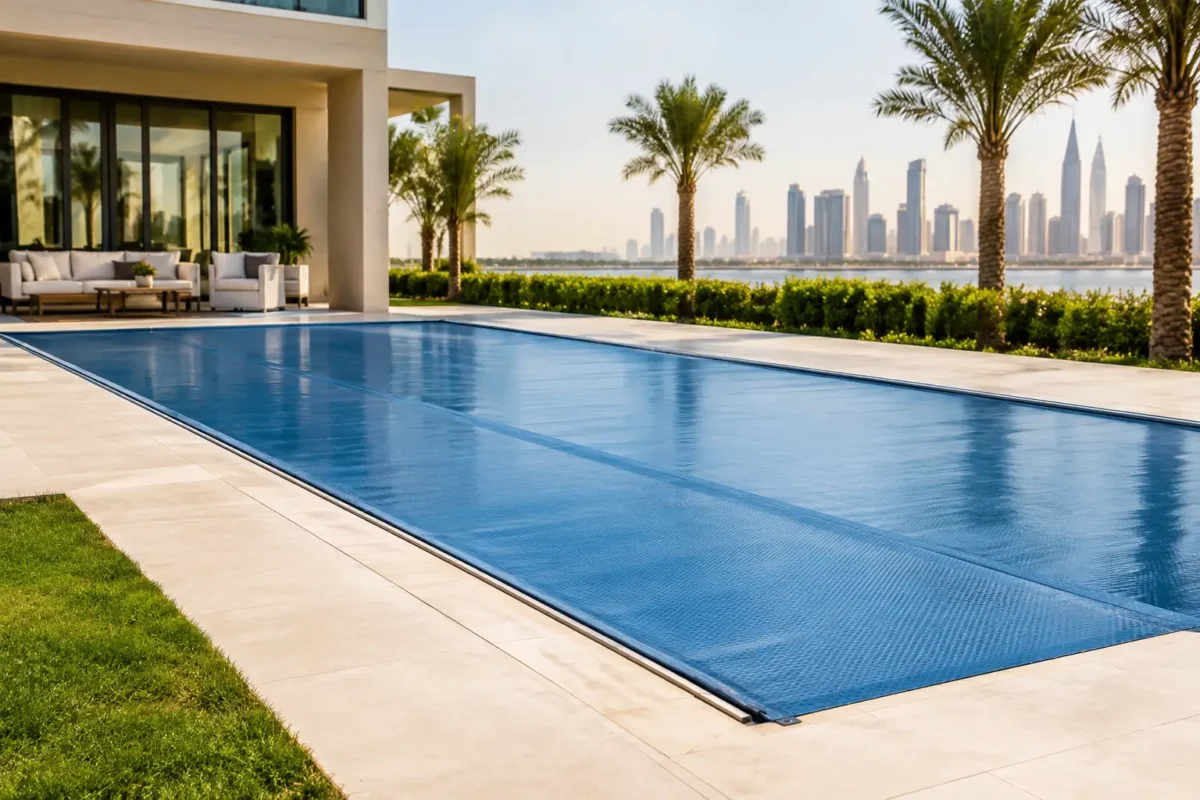
A pool can lose a surprising amount of water overnight in Dubai’s dry climate. Add wind-blown dust, intense sunlight, and constant cooling or heating demands, and the cost of leaving water exposed becomes clear. Premium pool covers provide a practical layer of protection while preserving the polished appearance and operating efficiency expected from high-value residential and commercial pools.

For villa owners, hospitality operators, facility managers, and developers, the right cover is not an afterthought. It is part of a well-planned aquatic system. The best choice depends on how the pool is used, who has access to it, the desired visual finish, and whether safety, energy conservation, or debris control is the leading priority.

Why Pool Covers Matter in the UAE

An uncovered pool is continuously exposed to evaporation, airborne debris, ultraviolet radiation, and temperature fluctuations. In the UAE, these factors can place extra pressure on filtration, chemical balance, heating, and cooling equipment. A properly selected cover reduces that exposure and helps keep the water in more stable condition between maintenance visits.

Water conservation is one of the strongest reasons to install a cover. Evaporation is a daily operating cost, particularly for large pools and facilities with extended open hours. By limiting the surface area exposed to air and sun, a cover can significantly reduce water loss. This also means fewer top-ups and less disruption to the pool’s chemical balance.

Covers can also reduce heat loss overnight and help retain warmth in heated pools. For pools using heat pumps, this improves efficiency because the system does not need to work as hard to restore the target temperature each morning. In cooled pools, the same principle applies: less exposure can help manage the operating load during hotter periods.

The benefit is not only technical. A clean, protected pool is easier to present to residents, guests, buyers, and visitors. That matters in luxury villas, boutique hotels, residential communities, spas, and corporate properties where every visible detail supports the value of the space.

Choosing the Right Type of Pool Cover

There is no single cover that suits every pool. A cover designed mainly to limit evaporation may not deliver the access control or structural strength required for a family villa or public-facing facility. Selection should begin with the pool’s operational needs, not simply its dimensions.

Solar and Thermal Covers

Solar and thermal covers are designed to retain heat and reduce evaporation. They are typically lightweight and practical for pools that are used frequently, especially when water temperature is a priority. These covers can help lower energy demand, but they are not a substitute for a certified safety barrier.

For residential pools, they can be an effective option when the main objective is to maintain comfortable water temperature and reduce chemical consumption. For hospitality and commercial projects, they may work well where staff can remove and store the cover efficiently as part of daily operating procedures.

Automatic Pool Covers

Automatic covers offer a premium, streamlined solution for properties where convenience and aesthetics are central to the design brief. With a motorized mechanism, the cover can open or close at the touch of a control, reducing manual handling and encouraging consistent use.

These systems are particularly suited to luxury villas, high-end residences, and commercial settings where the pool must look refined when not in use. The installation must be coordinated carefully with the pool structure, deck finish, drainage, electrical supply, and equipment layout. Retrofitting is possible in some cases, but integrating the system during construction usually provides the cleanest result.

Safety Covers

Safety covers are intended to create a protective barrier over the pool when it is closed. They are especially relevant for homes with children or pets, as well as shared residential and hospitality environments where access must be controlled outside operating hours.

Not every cover marketed as protective has the same performance standard. Load capacity, anchoring method, edge detailing, and installation quality all matter. Property owners should confirm that the selected system is appropriate for the expected use and complies with applicable safety requirements. A cover must be fitted precisely to perform as intended.

Winter and Debris Covers

Debris covers are designed to keep leaves, sand, dust, and other contaminants out of the pool. Although the UAE does not face a traditional cold winter, many owners close or reduce pool use during travel periods, renovations, or seasonal changes. A durable debris cover can protect the water and reduce the cleanup required before reopening.

For outdoor pools near landscaped areas or active construction zones, this type of cover can also reduce the burden on skimmers, pumps, and filters. It will not eliminate maintenance, but it can make routine cleaning substantially more manageable.

What Premium Pool Covers Should Deliver

A premium cover should fit the pool accurately, operate reliably, and support the wider performance of the aquatic installation. Material quality matters because constant sun exposure, high temperatures, chemicals, and repeated handling can quickly affect inferior products.

Look for UV-resistant materials, durable stitching or reinforced seams where applicable, dependable rollers or automatic mechanisms, and hardware designed for outdoor use. The cover should also complement the pool’s surroundings. In a luxury landscape, visible tracks, storage systems, and cover boxes need thoughtful planning so they do not compromise the deck, garden, or architectural lines.

For commercial properties, operational practicality is equally important. A cover that requires complex handling may be used inconsistently by busy teams. Staff should be able to deploy, secure, remove, and store it safely. Where a large pool is involved, a motorized system or properly specified roller can make daily operation far more efficient.

Installation Is Part of the Investment

Even a high-quality cover can underperform if it is poorly measured or installed without attention to the pool environment. Steps, ladders, overflow edges, raised spa areas, irregular curves, water features, and surrounding deck levels all influence the final specification.

An experienced pool professional will assess more than the waterline. They will consider how the cover interacts with coping, drainage channels, filtration access, lighting, handrails, and pool equipment. For automatic systems, they will also evaluate electrical requirements, housing placement, control access, and future maintenance needs.

This detailed approach is particularly valuable for custom pools, where standard sizes rarely provide an acceptable fit. A tailored solution may require a larger upfront investment, but it can deliver better protection, a cleaner appearance, and a longer service life.

Maintenance Keeps the Cover Performing

Pool covers need routine care just like pumps, filters, and water treatment systems. Dirt and standing water should not be allowed to build up on the surface. Covers should be cleaned using methods suitable for their material, and moving parts should be inspected periodically for wear, tension, alignment, and corrosion.

It is also wise to inspect anchors, straps, rails, rollers, and electrical components before periods of heavy use. Small issues, such as a damaged edge or a misaligned mechanism, can become more costly if ignored. Regular professional pool maintenance provides an opportunity to identify these concerns before they affect pool safety or daily operation.

A Smarter Finish for High-Value Pools

The right pool cover protects more than water. It supports energy efficiency, reduces exposure to debris, helps manage maintenance demands, and strengthens the safety strategy around the pool. It can also preserve the elegant, orderly appearance that premium residential and commercial properties require.

Aquatic Pools and Fountains can help property owners and project teams specify a cover solution that works with the pool’s design, equipment, usage pattern, and performance expectations. When the cover is selected as part of the overall system rather than added at the end, it becomes a dependable asset that quietly protects the investment every day.

Categories
Uncategorized

SunSun Fountain Pumps for Reliable Water Features

A fountain that starts strongly but loses its shape after a few hours is rarely a design issue. More often, it is a pump selection issue. SunSun fountain pumps are a practical option for decorative ponds, wall fountains, courtyard basins, and compact water features when the model is correctly matched to the feature’s water volume, lift height, and nozzle design.

For villa owners, developers, and facility teams, the pump is the working core of the installation. The visible water pattern may create the first impression, but dependable circulation, stable pressure, manageable maintenance, and safe electrical installation determine whether that impression lasts.

Why SunSun Fountain Pumps Are a Popular Choice

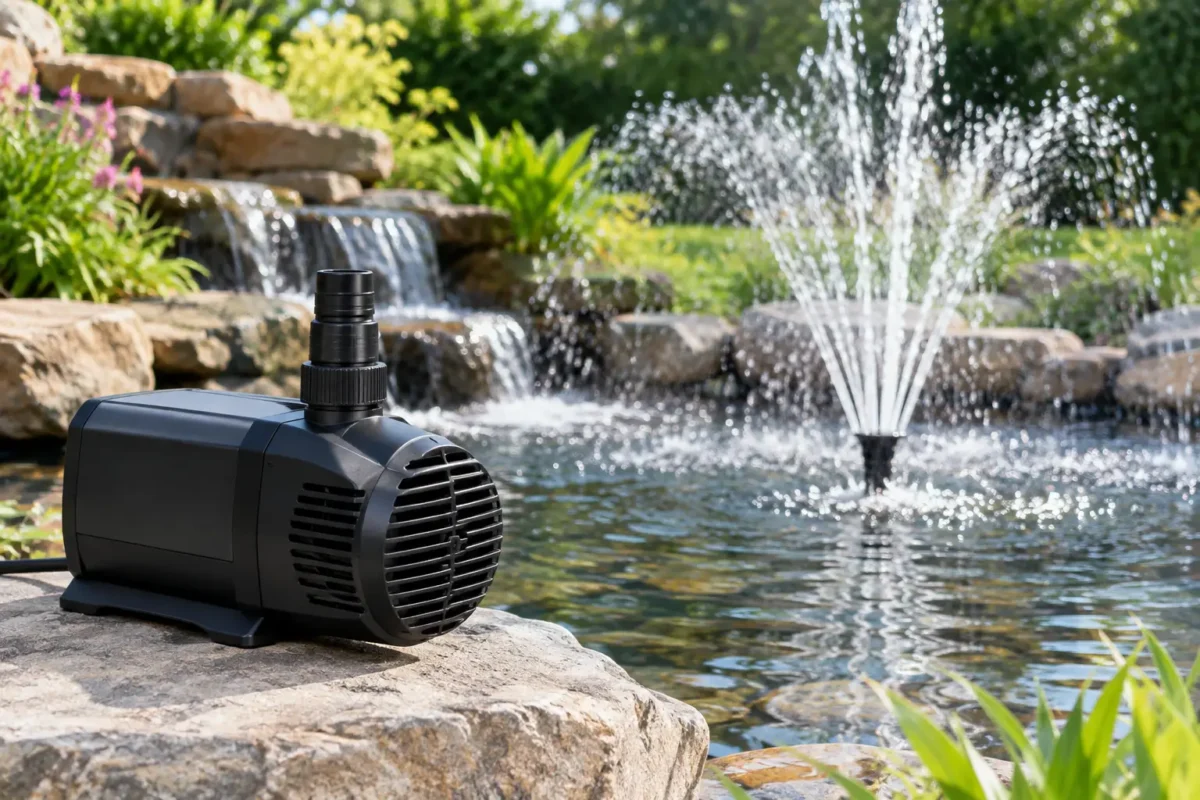
SunSun fountain pumps are commonly selected for decorative applications because they offer accessible flow-rate options across a broad range of compact and mid-sized water features. Many models are submersible, allowing the equipment to remain concealed within a basin or reservoir while delivering water to a fountain head, spillway, small waterfall, or circulation line.

Their appeal is straightforward: a well-matched pump can support an attractive water display without requiring oversized equipment or unnecessary operating costs. However, the right choice depends on the project. A small tabletop fountain, a landscaped pond, and a multi-tier villa entrance feature place very different demands on the pump.

For premium installations, the purchase decision should extend beyond the published maximum flow figure. The pump must maintain the desired visual effect after water travels through pipework, fittings, valves, filters, and the fountain nozzle. That is where professional selection makes a measurable difference.

Selecting SunSun Fountain Pumps by Performance

The most common mistake is choosing a pump only by gallons per hour or liters per hour. Flow rate matters, but it is only one part of the specification. A pump may move a high volume of water at basin level yet produce a weak display once it must lift water several feet and push it through narrow plumbing.

Start with the required water effect

Decide what the feature needs to do. A gentle bubbling urn requires modest circulation and a low-pressure outlet. A vertical jet needs sufficient pressure to reach a consistent height. A waterfall needs volume more than height, while a decorative pond may require both fountain circulation and basic water movement to reduce stagnant areas.

Nozzle choice changes the calculation as well. Bell, mushroom, spray, and multi-tier nozzles each create different resistance. A nozzle that looks refined at a lower flow rate can lose definition if the pump is too powerful, creating splash, overspray, and unnecessary water loss. Conversely, an undersized pump can turn an intended centerpiece into a weak trickle.

Calculate total head, not just vertical lift

Head height is the resistance a pump must overcome before water reaches the outlet. Vertical distance from the pump to the highest discharge point is the starting point, but not the full calculation. Long pipe runs, undersized pipe diameter, elbows, tees, control valves, and filtration components all reduce available performance.

For example, a pump positioned at the bottom of a fountain basin may need to lift water 5 feet to a nozzle. If the plumbing includes a long route with several bends, the effective resistance is higher than that 5-foot measurement. Reviewing the pump curve is essential because it shows how flow decreases as head increases.

A professional equipment supplier can help translate the design intent into the correct operating point. This is especially valuable for custom-built fountains where pipe routing is concealed and later changes can be disruptive or expensive.

Size plumbing to protect the display

Pipework should support the pump rather than restrict it. A small outlet connection does not automatically mean the entire system should use the smallest possible pipe. Narrow lines increase friction and can reduce water volume substantially over distance.

The best pipe diameter depends on the pump’s actual operating flow, line length, and the visual effect required. Larger plumbing can provide a more stable supply to a nozzle or waterfall, while a properly placed valve can fine-tune the final water pattern. Restricting a pump excessively is not an efficient substitute for selecting the correct model in the first place.

Installation Details That Protect Pump Life

A quality pump still needs a disciplined installation. Submersible fountain pumps should sit on a stable, clean base rather than directly in sediment. Raising the pump slightly above the floor of the basin helps prevent leaves, grit, and debris from being pulled into the intake.

The electrical connection requires equal attention. Outdoor fountain equipment should be installed with appropriate weather-protected electrical components and ground-fault protection in accordance with applicable local requirements. Cables should be protected from damage, and all connections should remain accessible for inspection and service.

Never allow a submersible pump to run dry. Water cools and lubricates many fountain pump designs. When the basin level falls below the intake, the motor can overheat or suffer premature wear. A reliable auto-fill arrangement, water-level monitoring, or scheduled inspection is particularly useful for outdoor features exposed to evaporation and wind.

Water Quality, Cleaning, and Routine Maintenance

Fountain pumps operate in a demanding environment. Dust, landscaping debris, mineral deposits, and algae can collect in the basin and reduce intake performance. In warm climates, routine cleaning is not optional if the goal is clear water and consistent flow.

Inspect the intake screen and prefilter regularly, especially after high winds or garden maintenance. Remove debris before it reaches the impeller chamber. If flow drops noticeably, switch off the power before checking for a clogged intake, blocked nozzle, fouled filter, or mineral buildup in the pipework.

Hard water can also affect fountain performance. Scale may accumulate on nozzles and reduce the crispness of the water pattern. Use water treatment methods suited to the feature and its materials, and avoid chemicals that are incompatible with the pump, seals, finishes, or surrounding stonework.

For commercial properties and hospitality environments, a planned maintenance schedule is the stronger approach. Regular inspection helps identify declining flow, unusual noise, worn components, and water-balance concerns before they interrupt the guest experience or damage a high-visibility installation.

When a SunSun Pump Is the Right Fit

SunSun fountain pumps can be an effective fit for compact to medium decorative features where the required duty point falls within the selected model’s performance range. They are particularly useful when discreet submersible placement, practical operation, and a controlled fountain effect are priorities.

They may not be the right answer for every project. Large architectural fountains, long-distance circulation systems, high-pressure jets, or installations requiring advanced control integration may call for specialized commercial pumps, redundant equipment, external filtration, variable-speed control, or a more extensive hydraulic design. The right equipment is the equipment that meets the feature’s actual operating demands, not simply the lowest initial purchase price.

Aquatic Pools and Fountains supports property owners and project teams with pump selection, fountain equipment supply, installation guidance, and maintenance solutions tailored to the scale and finish standard of each project. For a luxury villa feature or a demanding commercial environment, matching the pump to the hydraulic design protects both the visual result and the long-term investment.

A well-designed fountain should look effortless, but its performance should never be left to chance. Specify the flow, head, nozzle, pipework, and maintenance plan together, and the water feature will have the consistency and elegance it was designed to deliver.

Categories
Uncategorized

Best Fountain Mist Makers for Premium Water Features

A still fountain basin can look elegant, but a controlled layer of cool mist gives it presence. The best fountain mist makers transform water features into immersive focal points, softening hard architectural lines, enhancing lighting effects, and creating the refined atmosphere expected in premium villas, hotels, reception areas, and commercial landscapes.

The right unit is not simply the one that produces the most fog. It must match the fountain’s dimensions, water depth, operating environment, control requirements, and maintenance plan. In Dubai and across the UAE, where high temperatures, wind exposure, dust, and continuous operation place real demands on equipment, selection should be based on engineering performance as well as visual impact.

What Makes a Fountain Mist Maker Effective?

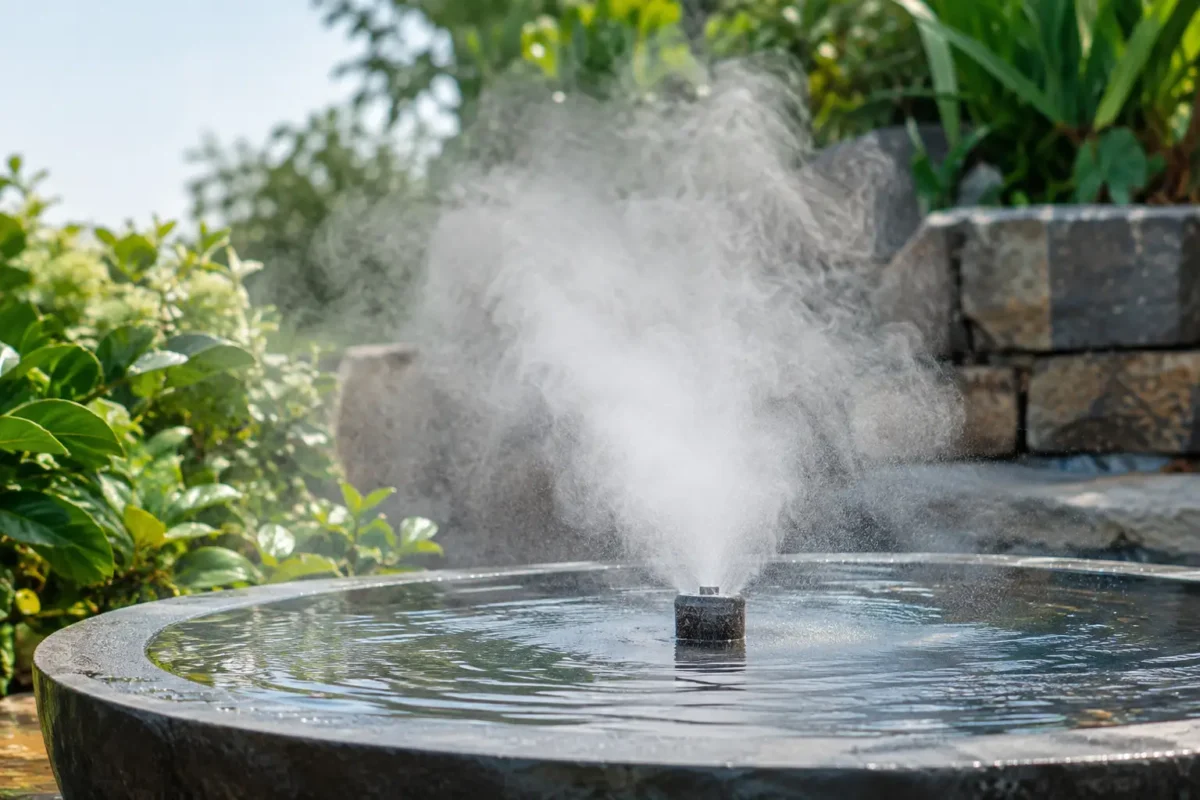
Most decorative fountain mist makers use ultrasonic technology. A ceramic diaphragm vibrates at an extremely high frequency, breaking water into microscopic droplets that form a low-lying mist. Unlike a conventional spray nozzle, an ultrasonic unit creates atmosphere without projecting a visible stream of water into the air.

This effect is especially valuable when paired with underwater LED lighting. The mist catches the light above the basin, making a modest water feature appear deeper, more dramatic, and more luxurious after dark. It can also help create separation between a fountain and its surrounding hardscape, giving the feature a more tranquil, layered appearance.

However, output alone is not the measure of quality. A premium mist system needs stable fog production, dependable electrical protection, corrosion-resistant construction, accessible replacement components, and controls that avoid running the unit dry. A low-cost fogger may perform well during a short test, then lose consistency because of diaphragm wear, poor water-level management, or inadequate power equipment.

Best Fountain Mist Makers: The Main Types

There is no single best choice for every project. The best fountain mist makers are selected according to the scale and function of the water feature.

Single-Head Ultrasonic Mist Makers

Single-head units are suitable for small decorative bowls, tabletop fountains, compact indoor water features, and narrow reflecting basins. They provide a subtle mist effect and are often chosen where the design calls for a delicate visual accent rather than dense fog.

Their advantage is straightforward installation and lower initial cost. Their limitation is coverage. In an open outdoor location, even a light breeze can disperse the mist before it becomes visible. For a small sheltered fountain, they can be an excellent solution. For a hotel entrance or large villa courtyard, they are rarely sufficient as a stand-alone feature.

Multi-Head Ultrasonic Mist Makers

Multi-head units are the preferred option for medium and large fountains where consistent visual coverage matters. Available with several misting heads, these systems generate a fuller layer of fog across a larger surface area and can be configured in groups for broader basins.

They are particularly effective in reception fountains, restaurant terraces, landscaped courtyards, spa environments, and premium residential outdoor features. A multi-head system provides stronger visual performance, but it also requires careful electrical sizing, water-level control, and service access. The more heads operating, the more important it becomes to use quality transformers and properly protected cabling.

Industrial and Commercial Mist Systems

For large hospitality, retail, public-realm, and commercial installations, fountain misting is best treated as part of the complete water-feature system. Commercial-grade units may include higher-output foggers, central control panels, automatic filling arrangements, timed operation, low-water cutoffs, and integration with lighting or building automation.

These systems are built for longer operating periods and higher visibility applications. They demand professional planning because mist output needs to complement, not obstruct, circulation areas, signage, cameras, or nearby finishes. In a high-traffic environment, a beautifully designed mist effect must also remain safe, contained, and easy to maintain.

How to Size a Mist Maker for Your Fountain

Fountain size is a starting point, but basin geometry and exposure matter just as much. A shallow bowl may show mist quickly, while a deep or wide basin may require multiple units to create even coverage. Waterfall movement and strong jets can also disrupt the fog layer, so mist makers should be positioned away from aggressive turbulence whenever possible.

For sheltered indoor features, a lighter output can create a sophisticated effect without overwhelming the space. For outdoor fountains, especially in open villa gardens or hotel forecourts, stronger output or multiple units are often needed to compensate for heat and air movement. If the goal is a dramatic evening display, plan the mist system together with the lighting layout rather than adding it after installation.

The desired operating schedule also affects sizing. A mist maker running for short evening intervals faces different demands from one operating for many hours every day. Continuous use calls for a higher-quality diaphragm assembly, reliable cooling through adequate water depth, and a service plan that accounts for normal consumable replacement.

Technical Features That Protect Performance

A premium fountain mist maker should include or be paired with automatic water-level protection. Ultrasonic heads must remain at the correct depth to generate consistent mist and avoid damage. Float rings, water-level sensors, or dedicated controllers help maintain that operating range as evaporation occurs.

Power supply quality is equally critical. The mist maker, transformer, cables, and connectors should be specified for wet-area use and installed with proper protection. Electrical equipment should never be treated as an afterthought in a fountain project. Professional installation protects the equipment, supports reliable operation, and ensures the feature remains suitable for residential or commercial use.

Material quality deserves close attention as well. Fountain environments expose components to moisture, chemicals, heat, and sometimes saline conditions. Stainless steel housings, well-sealed connectors, durable ceramic diaphragms, and corrosion-resistant fittings provide better long-term value than units designed only for occasional indoor display use.

Water Quality and Maintenance Requirements

Mist makers operate directly in the fountain water, which means water quality affects their output and lifespan. Mineral scale can build up on ceramic diaphragms, reducing fog production. Dust, leaves, algae, and suspended debris can also interfere with operation, especially in outdoor basins.

Routine cleaning is therefore part of owning a high-performance mist feature. The basin should be kept clear of debris, diaphragms should be inspected regularly, and worn components should be replaced before output becomes uneven. The exact maintenance frequency depends on water chemistry, operating hours, and environmental exposure.

Chemical balance requires care. Standard fountain treatment may be necessary to control algae and maintain water clarity, but excessive chemical concentration can shorten the service life of delicate misting components. Saltwater or highly chlorinated features need equipment selected specifically for those conditions. This is one area where technical advice before purchase can prevent repeated replacement costs later.

Installation Details That Define the Final Result

Mist makers should be installed where they can be serviced without draining or dismantling the entire fountain. In a luxury installation, equipment access is often hidden from view, but it should never be inaccessible. A service technician must be able to inspect the unit, clean the basin area, replace diaphragms, and check electrical connections efficiently.

Water depth must also remain stable around the unit. A dedicated recessed section, suitable float assembly, or controlled water-level system can keep the fogger operating within its recommended range. Positioning the unit near a return flow or strong pump suction may cause unstable mist, so hydraulic layout should be considered before final placement.

For outdoor projects, wind is the deciding factor many buyers overlook. Mist that looks impressive in a covered showroom may disappear in an exposed courtyard. Strategic placement near walls, planting, architectural screens, or within a partially enclosed basin can preserve the intended visual effect without requiring excessive equipment capacity.

Choosing a Supplier for Premium Fountain Misting

The best product is only part of the investment. A fountain mist maker should be specified alongside compatible transformers, controls, water-treatment requirements, lighting, and maintenance access. This is particularly important for high-value villas, hospitality properties, and commercial developments where a non-functioning water feature affects the entire presentation of a space.

Aquatic Pools and Fountains supports this process with premium fountain equipment, technical guidance, installation support, and ongoing maintenance solutions for demanding aquatic environments. The objective is not simply to add fog to a basin, but to create a dependable feature that performs beautifully throughout its intended service life.

Choose the mist maker around the fountain’s real operating conditions, not just the visual effect seen on a product specification. When output, controls, water quality, and service access are planned together, mist becomes a lasting design feature rather than a short-lived accessory.

Categories
Uncategorized

Can Fountains Run Continuously? What It Takes

A fountain that stops during a hotel arrival, outside a luxury villa, or in the lobby of a residential tower immediately loses part of its impact. But can fountains run continuously without wasting energy or damaging critical equipment? Yes, when the installation has been engineered for continuous duty, matched to its operating environment, and maintained to premium standards. The answer is not simply to leave the pump switched on. It depends on pump selection, hydraulic design, water quality, heat management, and a practical maintenance plan.

Can Fountains Run Continuously?

Most well-designed decorative fountains can operate around the clock. In fact, many commercial fountains are intended to do exactly that. Continuous movement keeps the feature visually active, supports water circulation, and can help reduce stagnant-water conditions. For hospitality venues, commercial properties, and high-visibility developments, uninterrupted operation may be a central part of the design brief.

The important distinction is between a fountain that can run continuously and one that has merely been left running. A residential tabletop feature, a small garden fountain, and a large architectural water wall do not place the same demands on their pumps or filtration systems. Equipment must be selected for the actual flow rate, vertical lift, piping layout, nozzle type, and daily run time.

A quality continuous-duty fountain pump is built to operate for extended periods when it receives adequate water flow and proper electrical protection. However, even premium equipment will have a shortened service life if it is undersized, overheats, runs dry, or is forced to push water through a poorly designed system.

The Pump Sets the Operating Limit

The pump is the working heart of a fountain. Its job is not only to move water but to deliver the required pressure at the feature nozzle after accounting for pipe friction, fittings, filters, elevation, and control valves. A pump that looks adequate on paper can struggle in operation if these losses have not been calculated correctly.

For continuous operation, specify a pump rated for continuous duty rather than a light-duty or intermittent application. The pump should have enough capacity to maintain the desired water effect without running at the extreme edge of its performance curve. Constant overload produces excess heat, higher electrical consumption, vibration, and premature wear on seals, bearings, and impellers.

Variable-speed pumps can be an excellent solution for installations with different operating requirements. A property may run a calm, lower-flow water display through most of the day, then increase output during evening hours or event periods. This approach can reduce energy use while preserving the visual quality expected from a premium feature.

Dry running is one of the fastest ways to damage a fountain pump. Water cools and lubricates many pump components, so a low basin level, blocked intake, failed make-up water system, or air leak must be addressed immediately. A properly designed installation includes low-water protection and reliable level controls, especially where wind and high ambient temperatures accelerate water loss.

Water Loss Is a Major UAE Consideration

In Dubai and across the UAE, fountain operation must account for conditions that are less demanding in cooler climates. High temperatures increase evaporation. Wind can carry fine spray away from the basin. A poorly selected nozzle may create an attractive pattern during testing but lose significant water once exposed to an open outdoor setting.

For an outdoor fountain intended to operate continuously, the basin should have enough volume to accommodate normal fluctuation without exposing the pump intake. Automatic make-up water is not a luxury addition in many installations. It is a practical safeguard that maintains the required operating level and protects expensive equipment.

Nozzle selection also matters. Laminar jets, bubbling effects, water walls, cascades, and aerated sprays each have different evaporation and splash characteristics. In exposed areas, a lower, more controlled display can often deliver a more elegant result than a high spray that is repeatedly disrupted by wind.

Continuous operation also increases the importance of water treatment. Evaporation leaves minerals behind, which can raise total dissolved solids and contribute to scale on nozzles, tiles, pump components, and filters. Regular testing, balanced water chemistry, and appropriate filtration help preserve clear water and protect the finish of the fountain.

Filtration and Treatment Protect the Visual Finish

A fountain is judged by what guests and residents see: clean water, consistent flow, polished finishes, and no visible debris. The equipment room determines whether that standard is possible day after day.

A recirculating fountain requires filtration sized for its water volume and bather-free but debris-prone environment. Leaves, dust, sand, landscaping material, and airborne contaminants can clog strainers and nozzles quickly. Indoor features may have less organic debris, but they can still accumulate dust and require careful treatment to prevent cloudy water or biological growth.

Disinfection should be selected based on the feature’s use, water volume, exposure, and local requirements. Chemical dosing, ultraviolet treatment, and other water management technologies can be incorporated into a professionally specified system. The objective is consistent water quality without over-treating the water or risking damage to finishes and equipment.

Cleaning should be scheduled rather than delayed until the feature looks dirty. Pump baskets and strainers need regular inspection, filters need cleaning according to pressure and condition, and nozzles should be checked for mineral buildup. A small restriction at a nozzle can distort the entire water pattern and make an otherwise refined installation look poorly maintained.

Energy Use Depends on Design, Not Just Run Time

A fountain that runs 24 hours a day naturally uses more electricity than one that operates only in the evening. Yet continuous operation does not automatically mean excessive costs. The real figure depends on pump wattage, hydraulic efficiency, lighting load, control strategy, and how hard the system must work to create the desired effect.

An oversized pump controlled by a throttled valve is rarely an efficient long-term choice. Neither is an undersized pump that runs constantly under strain. Correct pump sizing, efficient motors, sensible pipe diameters, and properly designed filtration reduce unnecessary energy demand before any control system is introduced.

Timers and programmable controllers give property managers flexibility. A residential fountain may operate during morning and evening leisure periods, while a hotel entrance feature may run continuously at a reduced flow overnight. Lighting can be programmed independently, allowing the water feature to remain active without operating high-output illumination through the entire night.

For commercial properties, this balance is especially valuable. The fountain remains a reliable part of the guest or tenant experience while operating costs stay aligned with the building’s energy strategy.

When Continuous Operation Is Not the Best Choice

There are situations where a fountain should not run nonstop. Small decorative units with non-continuous-duty pumps may need rest periods. Features in areas with heavy dust, construction activity, or frequent debris may be better operated on a managed schedule until surrounding conditions improve. Maintenance, chemical balancing, and cleaning also require planned shutdowns.

Seasonal or event-based operation can make sense for certain landscape features. If a property is vacant for long periods, or the fountain is primarily used as an evening focal point, scheduled operation may offer the better balance of presentation and operating cost.

A fountain should also be stopped immediately if the water level falls below the safe operating point, the pump becomes unusually noisy, flow changes sharply, electrical protection trips, or the water becomes visibly cloudy. These are not cosmetic concerns. They are early warnings that can prevent a larger equipment failure.

Specify the System for the Result You Expect

The most impressive fountains are not defined by one premium component. They are the product of a coordinated system: a correctly sized continuous-duty pump, efficient filtration, dependable level control, suitable nozzles, protective electrical controls, and disciplined maintenance. This is particularly relevant for luxury villas, hospitality venues, residential developments, and commercial assets where a water feature represents the standard of the property itself.

Aquatic Pools and Fountains supports premium fountain installations with quality equipment, technical guidance, and maintenance capability tailored to the feature’s design and operating requirements. Before committing to 24-hour operation, have the pump duty, basin capacity, water treatment, controls, and environmental conditions assessed as one system. That professional attention is what keeps a fountain elegant, efficient, and ready to perform every time people see it.

Categories
Uncategorized

Foam Nozzle Selection for Premium Water Features

A fountain should look composed, not merely active. The right foam nozzle produces a dense, white-water column with a clean, architectural presence – a strong choice for villa entrances, hotel courtyards, residential developments, and commercial landscapes where the water feature must perform as well as it presents.

Unlike a conventional spray nozzle, which breaks water into visible streams or fine droplets, a foam nozzle aerates and shapes the flow into a solid-looking plume. The effect can be bold and sculptural, yet it is also practical: the water generally stays closer to the intended display area, helping designers manage splash in compact basins and high-traffic settings.

What a Foam Nozzle Does Differently

A foam nozzle blends water and air within its internal chamber before the flow leaves the outlet. That aeration creates the familiar bright, opaque appearance associated with foaming fountain jets. Rather than a transparent arc, the nozzle delivers a defined column that catches light exceptionally well, particularly when paired with properly positioned underwater LED lighting.

This makes it a versatile feature for contemporary projects. A single vertical plume can create a focal point in a formal reflecting pool. A row of matched nozzles can add rhythm along a resort walkway or within a commercial entrance fountain. In a larger installation, foam jets can balance more delicate effects, such as fan sprays or laminar streams, by introducing visual weight and movement.

The appearance is not identical in every application. Water pressure, pipe sizing, nozzle diameter, wind exposure, and water quality all affect the final result. A premium installation begins with the expected visual effect, then selects equipment capable of delivering it consistently.

Selecting the Right Foam Nozzle for the Project

Nozzle selection should never be based on outlet size alone. A component that looks appropriate in a product image may deliver an underwhelming plume, excessive splash, or inconsistent height if the hydraulic conditions are not matched to the design.

Start with the required jet height and shape

The first question is what the water feature needs to communicate. A low, broad foam jet can suit an intimate courtyard fountain where guests stand nearby. A tall, concentrated jet may be better for a grand entrance, podium deck, or open landscape where the fountain must remain visible from a distance.

Jet height is affected by available pressure and flow rate, but it should also be considered alongside basin dimensions. Higher displays need adequate fall distance and a basin designed to contain the water on windy days. In exposed UAE locations, a slightly lower and denser plume may provide a better real-world result than a dramatic jet that loses definition in the wind.

Match the nozzle to pump performance

Every foam nozzle operates within a specific flow and pressure range. If the pump is undersized, the jet may appear weak, uneven, or lower than expected. If it delivers too much flow, the display can become turbulent and produce unwanted splash.

Pump selection must account for more than the nozzle requirement. The calculation should include friction losses through pipework, valves, filters, fittings, elevation changes, and any treatment equipment in the fountain system. This is where professional technical guidance protects the finish of the project as well as the equipment investment.

Variable-speed pumps can be particularly valuable where the desired fountain effect changes by time of day or event. A hospitality property may run a calm daytime display, then increase the feature’s presence for evening operation when lighting is active. The system must still remain within the nozzle’s recommended operating range at each setting.

Consider material for water conditions and service life

For premium fountain projects, material selection is a long-term decision. Stainless steel foam nozzles are widely specified for their refined appearance, strength, and resistance to corrosion. High-grade stainless steel is especially appropriate where the nozzle will remain visible above the waterline or where the installation calls for a polished architectural finish.

Brass and engineered plastics may also be suitable depending on the water chemistry, budget, and intended setting. The key is compatibility. Chlorinated water, saline environments, and chemically treated fountain systems each place different demands on metal components, seals, and fittings. Selecting a quality nozzle without reviewing the full water environment can shorten its working life.

For outdoor installations in Dubai and across the UAE, heat, dust, sun exposure, and demanding operating schedules also matter. Durable materials and correctly specified fittings help reduce premature wear and make routine maintenance more straightforward.

Design for lighting, sound, and surrounding finishes

A foam jet has a strong visual relationship with light. Its aerated, white-water texture reflects illumination differently than a clear stream, often creating a brighter, more dramatic night-time effect. For the best presentation, lighting should be planned with the nozzle location, water depth, viewing angles, and intended jet height already defined.

Sound deserves equal attention. Foam nozzles create a fuller water sound than certain precision jet types, which can be an advantage in a lobby approach, garden, or leisure area where the goal is to soften surrounding noise. In a quiet residential setting, however, excessive height or flow may create more sound than the owner expects. Scale the effect to the environment rather than assuming bigger is better.

The finish of the basin should also be considered. Dark stone, tile, and mosaic can make the white plume stand out sharply. Lighter finishes create a softer, more understated visual result. Both can be elegant when the fountain is designed as a complete composition.

Installation Details That Protect Performance

Even the highest-quality nozzle depends on correct installation. The nozzle must be level, securely mounted, and supplied through properly sized pipework. A slight misalignment can be obvious in a vertical display, especially when several jets are installed in a line.

A regulated valve arrangement is typically needed to fine-tune each effect during commissioning. This is particularly valuable in multi-nozzle fountains, where small variations in pipe length or hydraulic resistance can cause one jet to rise higher than another. Proper balancing gives the finished feature its disciplined, premium appearance.

Filtration is another essential part of the specification. Debris, scale, and sediment can obstruct internal passages, distort the plume, and reduce performance over time. A well-designed fountain system includes suitable filtration, access for cleaning, and a maintenance plan that reflects the operating environment.

Water level management should not be overlooked. If the pump draws air because the basin level falls too low, the foam effect can become unstable and the pump may be damaged. Automatic top-up systems, level sensors, and appropriate suction design help maintain reliable operation, especially in outdoor installations affected by evaporation.

Common Mistakes in Foam Jet Applications

The most frequent issue is specifying a nozzle before the system hydraulics are finalized. A fountain is not a collection of separate components. The nozzle, pump, pipework, filtration, water treatment, lighting, basin, and control system must work together.

Another mistake is overlooking splash behavior. Foam nozzles can be more controlled than wide spray patterns, but they are not splash-free. A shallow basin, narrow catch area, or tall jet in a windy location can lead to water loss and wet surrounding surfaces. This is a design issue, not simply a nozzle issue.

Finally, some projects prioritize the initial visual effect while underestimating maintenance access. Nozzles should be reachable for inspection and cleaning without disrupting stonework, draining an oversized basin, or creating unnecessary downtime. This is especially relevant for hotels, residential towers, and commercial sites where the fountain is part of the property’s daily presentation.

A Better Approach to Fountain Nozzle Specification

The most reliable approach is to define the design intent first: desired height, density, sound level, lighting effect, setting, and viewing distance. From there, the fountain system can be engineered around verified flow and pressure requirements rather than assumptions.

Aquatic Pools and Fountains supports this process with quality fountain equipment, technical selection, professional installation support, and maintenance expertise for residential and commercial aquatic environments. For a single villa feature or a complex multi-jet display, the right specification creates a result that remains elegant long after commissioning.

A foam nozzle may be a small component within a larger fountain system, but it has a decisive role in the feature’s character. Choose it with the same care given to the basin finish, lighting, and pump system, and the water display will continue to look intentional, balanced, and worthy of the property around it.

Categories
Uncategorized

Pool Circulation System Design That Performs

A premium pool can look exceptional on opening day and still disappoint within months if the water does not move correctly. Pool circulation system design determines how effectively water reaches the filter, receives treatment, returns to the basin, and stays clear from one end of the pool to the other. For villas, hospitality properties, residential towers, and commercial facilities, this is the engineering behind water that looks polished and performs reliably.

The right design is not simply a matter of selecting a pump and filter. It requires accurate hydraulic calculations, suitable equipment sizing, thoughtful pipe routing, correct placement of suction and return points, and a maintenance strategy that protects the investment over time. In the UAE, where high ambient temperatures, heavy pool use, and demanding aesthetic standards are common, precision from the start makes a measurable difference.

Start With the Pool’s Real Operating Demands

Every circulation system should be designed around the specific pool rather than a standard equipment schedule. Pool volume is the starting point, but it is only one part of the calculation. A compact private pool, a hotel leisure pool, an infinity-edge feature, and a high-use community pool can have similar volumes while needing very different circulation approaches.

The required turnover rate establishes how long it takes for the system to circulate the full pool volume through filtration. Faster turnover is not always better. Oversizing a pump can create unnecessary energy use, excess noise, high flow resistance, and poor filter performance. Undersizing it can leave dead zones, reduce water clarity, and make chemical control more difficult. The correct target depends on pool type, bather load, local operating requirements, water features, and the chosen treatment system.

A residential villa pool may prioritize quiet operation, discreet equipment placement, and energy efficiency. A hotel pool must be prepared for extended daily use, changing bather loads, and rapid recovery after peak periods. Commercial and shared-residential pools often need greater redundancy and easier service access because downtime affects many users. The strongest design balances these conditions before equipment is selected.

Pool Circulation System Design Begins With Hydraulics

Hydraulics is the practical science of moving water through the system with the right flow rate and the least unnecessary resistance. Pipe diameter, pipe length, bends, valves, elevation changes, fittings, and equipment all create friction loss. If these factors are ignored, a pump that looks suitable on paper may fail to deliver its intended flow once installed.

A professional design calculates total dynamic head, which combines the resistance created by the entire circulation path. This figure helps determine the pump duty point: the flow rate the pump can actually provide at the system’s operating pressure. Selecting a pump solely by its maximum advertised flow can lead to disappointing results, especially where the plant room is distant from the pool or includes multiple water features.

Pipework deserves the same attention as the pump. Undersized lines increase water velocity and friction, which raises energy demand and can create audible noise. Excessively large pipework may add cost without meaningful benefit. The right diameter is based on design flow, acceptable velocity, distance, and future operational needs. Clean routing with fewer sharp changes in direction supports efficient operation and makes future maintenance more straightforward.

Suction Points Must Protect Both Performance and Safety

Water must be collected consistently from the pool surface and lower areas of the basin. Skimmers or overflow gutters remove floating debris, oils, and contaminants before they settle. Main drains support deeper water movement and help prevent stagnant areas, but they must be specified and installed with appropriate anti-entrapment protection.

The number and location of suction outlets should suit the pool shape, depth profile, and circulation pattern. A long rectangular pool may perform well with a straightforward arrangement, while a freeform pool, vanishing-edge pool, or pool with integrated spa zones requires more detailed planning. Safety fittings, compliant drain covers, balanced suction lines, and accessible valves are essential parts of a premium installation, not optional additions.

Return Inlets Create the Water Movement You Can See

Return inlets should guide filtered, treated water across the pool rather than simply push it back into the nearest area. Correct placement creates a circulation path that carries debris toward skimmers or overflow channels and distributes sanitizer more evenly.

Inlets are commonly positioned to encourage surface movement, although the exact configuration depends on the pool geometry and depth. Steps, tanning ledges, swim-out areas, corners, and attached spas can interrupt water movement. These spaces may require dedicated returns or adjusted inlet direction. When a pool has an infinity edge, water feature, or fountain element, those flows must be considered as part of the complete hydraulic system rather than treated as separate decorative components.

Select Equipment as a Matched System

A circulation plant works best when its components are selected to operate together. The pump, filter, valves, heater or heat-cool pump, sanitizer, automation controls, and pipework should all support the required flow and pressure range.

Variable-speed pumps are often the preferred choice for premium residential and commercial pools. They allow the system to run at lower speeds during normal filtration, reducing electricity consumption and operating noise. Higher speeds can be programmed for backwashing, vacuuming, water features, peak bather periods, or rapid circulation after treatment adjustments. The investment is especially worthwhile where pools operate for long daily hours, though the final decision should reflect the property’s usage pattern and equipment budget.

Filter selection also depends on operating priorities. Sand and glass-media filters are widely used for their dependable performance, familiar maintenance requirements, and suitability for a broad range of pool sizes. Cartridge filters can be effective where water conservation and compact installation are priorities, but they require regular cleaning and sufficient access for cartridge removal. For commercial applications, filter sizing must account for sustained demand and maintenance intervals, not only ideal conditions.

Treatment equipment must be integrated with circulation capacity. Salt chlorination, UV systems, ozone, dosing systems, and traditional chemical treatment each have different installation requirements. They can improve water quality and reduce manual intervention, but none can compensate for inadequate filtration or poorly distributed flow. Treatment is most effective when the circulation design delivers water through the equipment at the correct rate and returns it evenly to the pool.

Design the Plant Room for Service, Not Just Installation

An equipment room that is difficult to access will eventually cost more to maintain. Premium system design includes adequate working space around pumps and filters, clear labeling, reliable drainage, ventilation, appropriate electrical protection, and a logical arrangement of valves and unions.

Technicians should be able to isolate a pump, remove a filter lid, inspect strainers, service dosing equipment, and identify pipe runs without dismantling unrelated components. This is particularly valuable for hotels, apartment developments, and commercial properties where scheduled maintenance must be completed efficiently and with minimal disruption.

Plant room conditions in Dubai and the wider UAE also require consideration. High temperatures can affect equipment performance and shorten the life of poorly protected electrical components. Proper ventilation, durable materials, quality fittings, and a clean layout help preserve reliability. Where equipment is located outdoors, weather-resistant enclosures and thoughtful shading can provide additional protection without restricting service access.

Build Efficiency Into Everyday Operation

Energy efficiency is not one product feature. It is the result of correct sizing, low-resistance plumbing, suitable filtration, smart controls, and disciplined maintenance. A variable-speed pump running at an optimized low speed can consume significantly less power than a single-speed pump operating unnecessarily at full output. However, the system must still achieve the flow needed for filtration, sanitation, and any active water features.

Automation gives property owners and facility teams greater control over this balance. Timed schedules can coordinate filtration, heating or cooling, lighting, dosing, and feature pumps. Monitoring systems can also flag abnormal pressure, low flow, or treatment issues before they become visible water-quality problems. For a luxury property, this supports a consistently refined pool environment. For a commercial facility, it supports predictable operations and clearer maintenance planning.

Regular maintenance remains essential. Pump baskets, skimmer baskets, filter pressure, water balance, valves, and dosing equipment should be checked on a planned schedule. A system that was designed correctly can still lose efficiency when filters are neglected, air enters suction lines, or equipment settings are changed without reviewing the overall flow requirement.

Aquatic Pools and Fountains approaches each project as a complete aquatic system, combining quality equipment with technical guidance, installation support, and maintenance expertise. Whether the requirement is a private villa pool, a resort feature, or a demanding commercial installation, the objective is the same: dependable circulation that protects water quality, equipment life, and the visual standard of the property.

The most valuable circulation systems are rarely the most visible. When design, equipment, and maintenance work together, the result is simply clear, inviting water that performs exactly as the property demands.