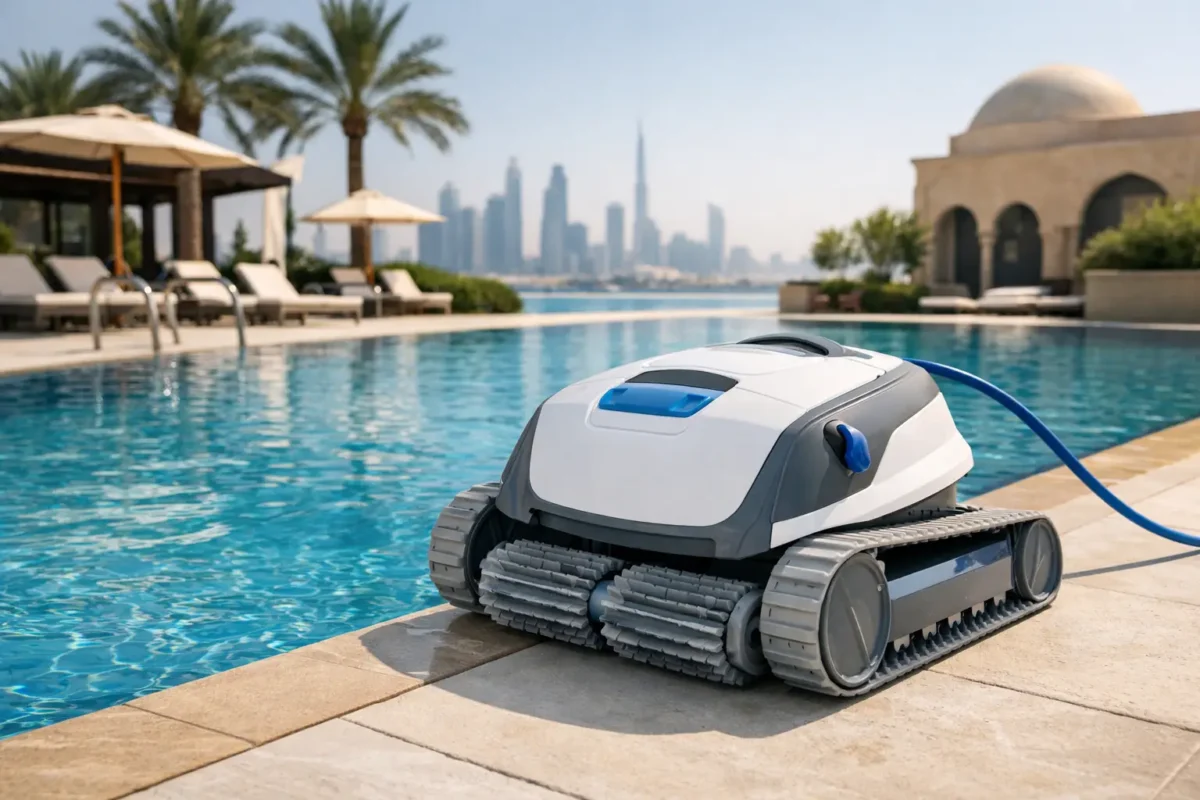
A pristine pool should look effortless, but Dubai heat, airborne dust, fine sand, and frequent pool use create a demanding cleaning cycle. A robotic pool cleaner gives villa owners, hospitality teams, and facility managers an efficient way to maintain a polished pool interior without placing unnecessary strain on the main circulation system.
For premium residential and commercial environments, the right machine does more than collect visible debris. It supports consistent water presentation, captures fine particles that can dull the finish, and reduces the manual work required to keep floors, walls, and waterlines looking professionally maintained. The result is a cleaner pool experience and a maintenance routine built around performance rather than constant intervention.
Why UAE Pools Need a Higher Cleaning Standard
In the UAE, a pool can collect fine dust even when it is covered or lightly used. Windblown sand settles in corners and along the floor, while sunscreen residue, body oils, leaves, and insects can accumulate at the waterline. These conditions affect appearance quickly, especially in pools with pale tiles, mosaic finishes, or dark interiors where every particle is visible.
Conventional suction cleaning can be effective for routine debris removal, but it depends on the pool pump and filter system. This can add load to the circulation equipment and may not always deliver the detailed wall and waterline coverage expected in a luxury property. Manual vacuuming remains useful for specific situations, yet it requires time, labor, and close attention.
A robotic unit operates independently. It draws in water, filters debris through its own basket or cartridge, and returns filtered water to the pool. Because it has dedicated motors, intelligent movement patterns, and active brushing, it can produce a more controlled clean without relying on the pool’s main filtration line.
What a Robotic Pool Cleaner Does Differently
The value of a robotic cleaner lies in the combination of mobility, brushing action, and fine filtration. Rather than moving passively with water flow, it travels across the pool surface using programmed navigation or sensor-based mapping. Premium models are designed to cover the floor, climb walls, and address the waterline where oils and debris often form a visible ring.
Active brushes are particularly valuable for pools exposed to dust or frequent use. They agitate settled particles and help lift residue from tile, plaster, fiberglass, and other compatible surfaces. The cleaner then captures the loosened material in its internal filter instead of sending all debris directly to the main pool filter.
This independent filtration is a practical advantage for larger villas, hotels, residential compounds, and commercial facilities. It can reduce the amount of debris reaching the pump basket and primary filter, helping the entire system operate under a more manageable load. It is not a replacement for circulation, balanced water chemistry, or scheduled technical maintenance. It is a high-performance complement to those essential services.
Choosing a Robotic Pool Cleaner for Your Pool
No single cleaner is correct for every installation. Pool dimensions, interior finish, water depth, bather load, and cleaning expectations should guide the selection. A compact plunge pool and a large overflow pool have very different requirements, even if both are located in the same property.
Pool shape, size, and surface coverage
Start with the pool’s physical layout. Confirm the cleaner is rated for the pool length and that its cable length, battery capacity where applicable, or operating range suits the installation. For a pool with deep ends, steps, ledges, curves, or complex geometry, choose a model known for dependable navigation rather than one designed only for simple rectangular basins.
Wall climbing is another important consideration. A floor-only unit may be sufficient for a lightly used pool with regular manual attention. However, properties that demand a consistently refined finish should consider a cleaner capable of floor, wall, and waterline cleaning. This is especially relevant in hospitality settings and premium villas, where the pool is part of the property’s visual standard.
The interior surface also matters. Tile, mosaic, plaster, painted finishes, and fiberglass each create different traction conditions. Equipment should be selected with compatible brushes and wheels to protect the finish while delivering reliable grip.
Filtration quality and debris capacity
Fine filtration is one of the strongest reasons to invest in a premium robotic unit. Large debris baskets are helpful after landscaping work or during periods of leaf fall, but UAE pools often need filters that can also capture dust and small suspended particles. A cleaner with easily removable, washable filter cartridges or baskets makes daily operation faster for homeowners and maintenance teams.
Capacity should match usage. A residential pool may only require cleaning every few days, depending on conditions. A hotel, serviced residence, or community facility may need a cleaner that can be deployed frequently and emptied quickly between cycles. If the filter is too small for the debris load, cleaning performance falls and staff time rises.
Navigation, cycle control, and convenience
Entry-level robotic cleaners can offer straightforward timed cycles. Higher-specification models may include multiple cleaning modes, mobile app controls, programmable schedules, gyroscopic navigation, or sensor-driven route adjustment. These features should be selected for operational benefit, not simply as an upgrade.
For a facility manager responsible for multiple water features, predictable cycle times and easy handling can save meaningful labor. For a villa owner, a lightweight model with a convenient caddy and simple top-access filter may be the better choice. It depends on who will operate the equipment, how often it will be used, and whether the pool requires fast attention before entertaining or guest arrivals.
The Trade-Offs Behind Premium Performance
A robotic cleaner delivers convenience, but it is not a fit-and-forget appliance. It needs regular filter cleaning, proper storage, and periodic inspection of brushes, tracks, cables, and moving components. A unit left with a full filter will not clean efficiently, and a cable stored carelessly can become tangled over time.
Higher-capability models also carry a greater initial cost than basic manual or suction solutions. That investment can be justified when labor reduction, waterline cleaning, fine-particle filtration, and improved pool presentation are priorities. For a simple, low-use pool with a reliable existing cleaning routine, a more basic solution may remain appropriate.
Corded models generally offer consistent power and longer cleaning cycles, but users must manage the cable correctly. Cordless cleaners remove cable handling from the equation and can be convenient for certain pool layouts, though runtime and recharge planning become part of the routine. The best decision is based on the pool environment and service workflow, not on one feature alone.
Installation Is Simple, Selection Is Technical
Most robotic cleaners do not require permanent plumbing modifications. The unit is placed in the water, connected to its power supply or charged, and started according to the manufacturer instructions. This makes it an attractive upgrade for existing pools as well as new installations.
Still, professional guidance is valuable before purchase. The equipment should be matched to the pool’s finish, size, geometry, and expected use. Technicians should also assess practical details such as safe power access, storage space, the condition of the pool surface, and whether the primary pump and filtration system are already operating correctly.
For commercial properties, procurement decisions should look beyond the purchase price. Availability of service support, replacement filters, brushes, drive components, and technical expertise can determine the real lifetime value of the cleaner. A premium product supported by the right team protects uptime and helps maintain the standard residents and guests expect.
Protecting the Cleaner and the Pool
A robotic unit works best in a pool with balanced water chemistry. Excessive calcium, poor pH control, or aggressive sanitizer levels can affect equipment materials over time, just as they can affect tile, grout, fittings, and circulation equipment. Cleaning the filter after each cycle, rinsing the unit with fresh water when appropriate, and storing it away from direct sun when not in use will support a longer service life.
The cleaner should also be removed before certain maintenance tasks, such as shock treatment, major chemical dosing, or intensive manual cleaning. Do not use the cable to lift a corded unit from the pool. Use the handle and allow water to drain before placing it on its caddy or storage area.
A robotic cleaner cannot correct cloudy water caused by chemical imbalance, algae growth, or inadequate circulation. If water quality changes suddenly, the right response is testing, diagnosis, and corrective pool maintenance. The cleaner then helps restore and sustain the visual finish once the underlying issue is resolved.
A Smarter Standard for Pool Care
A robotic pool cleaner is a practical investment in appearance, efficiency, and equipment protection when it is selected for the realities of the installation. For high-value homes, hotels, residential developments, and commercial spaces, it supports the standard of care that premium aquatic environments require.
Aquatic Pools and Fountains can help match the right cleaning equipment to your pool’s technical requirements and long-term maintenance plan. The most effective choice is the one that fits your pool precisely, is easy for your team to operate, and keeps the waterline, walls, and floor ready to impress every day.