
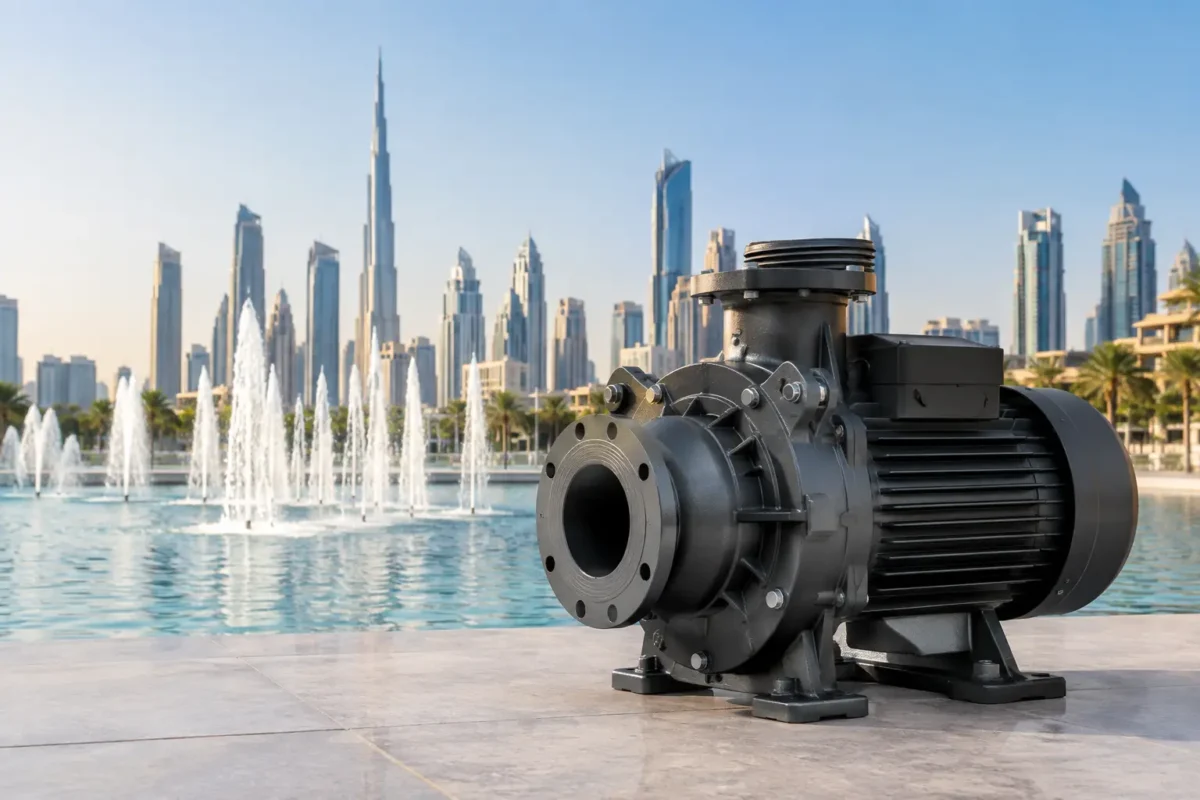
A fountain is judged in seconds: the height of its water, the consistency of each jet, the clarity of the display, and the sound it creates around the property. The sfp-48000 fountain pump is therefore not simply an item on an equipment schedule. For villas, hotels, residential developments, and commercial landscapes, it is a central component in delivering a refined water feature that performs reliably day after day.
Selecting a high-capacity fountain pump requires more than matching a model name to a desired spray effect. The correct choice depends on the fountain’s hydraulic design, nozzle configuration, pipework, electrical supply, control requirements, and operating environment. In the UAE, heat, dust, long operating hours, and demanding presentation standards make professional sizing and installation especially valuable.
What the SFP-48000 Fountain Pump Must Deliver
A fountain pump’s job is to move a defined volume of water at sufficient pressure to create the intended visual effect. With a model such as the SFP-48000 fountain pump, the decision should begin with the design duty point, not the pump’s maximum flow figure alone.
The duty point combines two measurements: flow rate and total dynamic head. Flow rate determines how much water reaches the feature, while total dynamic head accounts for the vertical lift, friction through pipework and fittings, losses through valves and filters, and the pressure needed at the nozzle. A pump may appear powerful on paper yet produce a weak display if it is selected without these real-world losses.
For a formal cascade, the priority may be steady, even water delivery across a wide spillway. For a jet fountain, the pump must provide the pressure and flow needed to maintain the specified jet height. Laminar nozzles, aerating jets, fan sprays, and water walls all behave differently. Their requirements should be evaluated as a complete system.
Maximum output is not the operating output
The maximum stated capacity of a pump is measured under particular conditions. In an installed fountain, pipe length, pipe diameter, bends, manifolds, control valves, strainers, and elevation all change the delivered performance. This is why pump curve review is essential before purchase.
A properly selected unit operates close to its efficient working range at the required duty point. An oversized pump can increase energy use, create excessive turbulence, and place unnecessary stress on nozzles and fittings. An undersized pump may fail to achieve the intended water height or leave distant nozzles visibly weaker than those closest to the pump.
Start With the Fountain Design, Not the Equipment List
Premium fountain projects are designed from the water effect outward. Before specifying an SFP-48000 fountain pump, establish what the feature is meant to do visually and operationally.
A decorative courtyard fountain may require a calm, balanced display that can operate for extended daily periods. A hotel arrival feature may need more dramatic jet heights, lighting coordination, and programmable sequences. A large public landscape installation may require zoned circuits so that different effects can operate independently and maintenance can be carried out without shutting down the entire feature.
The following project details directly affect pump selection:
- The number, type, and intended height of fountain nozzles
- The elevation between the pump water level and the highest discharge point
- Pipe diameters, route lengths, fittings, and manifold arrangement
- Whether the system uses filters, UV treatment, valves, or other inline equipment
- Required operating hours, control modes, and visual sequences
- Electrical capacity, equipment-room ventilation, and access for service
These details allow technicians to calculate realistic hydraulic losses and recommend equipment that supports the design rather than compromising it.
Pipework can make or break the display
Correct pipe sizing is often underestimated. Undersized pipework creates high friction losses, forcing the pump to work harder while reducing flow at the nozzle. The result can be inconsistent spray patterns, higher operating costs, and unnecessary mechanical load.
For larger fountain systems, well-designed manifolds are equally important. A balanced manifold helps distribute water evenly across multiple nozzles. Isolation valves should be positioned so individual zones can be adjusted or serviced. Where visual precision matters, these details distinguish a professional installation from a system that looks acceptable only on the first day.
Installation Considerations for UAE Conditions
Dubai and the wider UAE demand more from fountain equipment than many mild-climate locations. Outdoor equipment can be exposed to high ambient temperatures, airborne dust, intense sunlight, and variable water quality. Equipment selection should account for these conditions from the beginning.
The pump location needs adequate ventilation, safe drainage, and clear access for inspection. A cramped equipment room can trap heat and make basic maintenance more difficult than it should be. Electrical protection, correct cable sizing, grounding, and suitable control panels are also fundamental to dependable operation.
Water quality has a direct effect on both appearance and equipment life. Scale formation, debris, and poor chemical balance can restrict nozzles, stain finishes, and reduce hydraulic performance. A well-planned fountain system includes the appropriate filtration and water treatment approach for the basin volume, operating pattern, and source water conditions.
For exposed outdoor features, regular removal of leaves, sand, and debris from strainers is not optional. It protects the pump, preserves circulation, and helps maintain the clean visual standard expected in luxury properties and hospitality spaces.
Controls That Add Value Without Adding Complexity
The right controls can make a high-capacity fountain installation more efficient and more impressive. A basic on-off timer may be suitable for a private garden feature with fixed operating hours. However, commercial, hospitality, and high-visibility residential projects often benefit from more advanced control strategies.
Variable-speed control can allow a fountain to run at a lower output during quiet hours and increase performance for evening events or peak visitor periods. Zoned controls can operate separate nozzle groups independently, creating movement and variation without requiring several fountains. Coordinated lighting controls can also ensure that water effects and illumination activate together for a polished presentation.
There is a trade-off. Sophisticated programming adds flexibility, but it should remain practical for the property team responsible for daily operation. The best system is not the one with the most functions. It is the one that delivers the desired effect consistently, with controls that facility staff can understand and maintain.
Plan Maintenance Before the Fountain Opens
A premium fountain should be designed for serviceability from the first installation phase. Pumps, filters, valves, and control components need enough clearance for inspection and replacement. If a technician cannot access a strainer basket or isolation valve without dismantling surrounding equipment, routine maintenance becomes slower and more expensive.
A maintenance program for an SFP-48000 fountain pump installation typically includes checking flow and pressure behavior, cleaning strainers, inspecting nozzles, monitoring water balance, verifying electrical connections, and reviewing control settings. The schedule depends on site conditions. A sheltered indoor feature may require less frequent attention than a busy outdoor hotel fountain exposed to dust and organic debris.
Early warning signs should be addressed promptly. Reduced jet height, uneven nozzle output, unusual noise, visible air in the lines, or repeated tripping can indicate a blockage, air leak, valve issue, electrical concern, or developing pump fault. Prompt technical assessment protects both the equipment investment and the fountain’s visual impact.
A Professional Approach to Fountain Pump Selection
For property owners and project teams, the most reliable route is to treat the pump as part of an engineered fountain package. The product specification, nozzle layout, hydraulic calculations, filtration, control panel, pipework, and commissioning process should work together.
Aquatic Pools and Fountains supports this approach with premium fountain equipment, technical guidance, professional installation support, and ongoing maintenance capability for residential and commercial UAE projects. Whether the goal is an elegant villa centerpiece or a high-output feature for a hospitality development, proper assessment helps ensure the selected equipment matches the project’s actual operating demands.
A fountain should feel effortless to the people who see it. That result comes from careful hydraulic planning, quality equipment, and a service plan that keeps every jet performing as intended long after the opening day.