
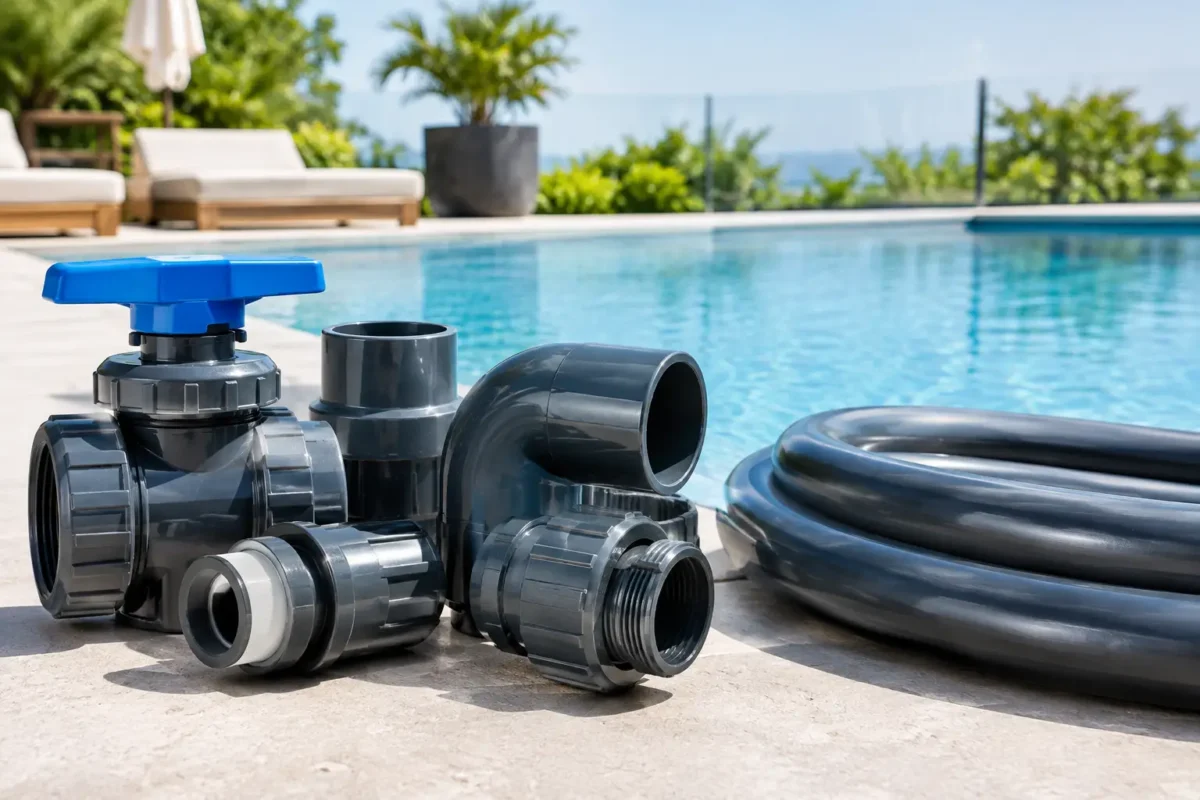
A pool can have a powerful pump, advanced filtration, and exceptional tile work, yet still underperform because of poor-quality connections behind the finish. Pool fittings are the components that direct water, connect plumbing lines, control flow, and create the polished details guests see around the pool edge. Their role is technical, but their impact reaches everything from water clarity and energy use to safety, comfort, and the long-term appearance of the installation.
For luxury villas, hotels, residential towers, and commercial facilities in Dubai and across the UAE, fittings should never be treated as minor accessories. They must be selected as part of a complete hydraulic and architectural system, with the right materials, dimensions, finishes, and installation methods for the project.
Why Pool Fittings Deserve Early Attention
Every pool relies on a continuous circulation path. Water enters through inlets, moves across the pool, passes through skimmers or overflow channels, travels through suction points to the equipment room, and returns after filtration and treatment. Fittings make each transition possible.
A weak fitting, incorrect reducer, poorly sealed penetration, or mismatched thread can create issues that are expensive to trace once the pool is tiled and operational. Small leaks may waste treated water, affect surrounding finishes, or introduce air into suction lines. Restricted fittings can increase resistance in the plumbing network, placing unnecessary demand on pumps and reducing circulation quality.
The visible side matters as well. A return inlet placed incorrectly can leave stagnant areas. A drain cover that does not sit flush can interrupt a premium tile finish. An inferior stainless steel component may stain or corrode in a demanding chlorinated environment. High-quality fittings protect both the engineering performance and the refined character of the pool.
The Main Types of Pool Fittings
Pool fittings include more than the connectors found in the plant room. A properly planned system brings together structural, hydraulic, operational, and visual components.
Suction and Drain Fittings
Main drains, suction outlets, vacuum points, and balancing tank connections draw water toward the filtration system. These fittings require particular attention because they influence bather safety and pump performance. Drain covers must be secure, appropriately rated, and selected with the pool’s hydraulic design and applicable safety requirements in mind.
For commercial pools and high-use facilities, suction design should be assessed at the engineering stage rather than decided during finishing works. The number and location of outlets, pipe sizing, flow velocity, and anti-entrapment provisions all need to work together. A premium installation is not simply about specifying a good-looking grille. It is about managing water movement safely and reliably beneath it.
Return Inlets and Directional Eyeballs
Return fittings bring filtered water back into the pool. Directional eyeballs allow the installer to guide that flow, helping distribute disinfectant, reduce dead zones, and move debris toward collection points. Their placement depends on pool shape, depth, bather load, water features, and whether the pool uses skimmers or an overflow system.
In a rectangular villa pool, returns may be positioned to create a consistent sweep toward the skimmer line. In a large overflow pool, the goal may be to maintain even water quality across a broader surface. Decorative ledges, tanning shelves, spas, and integrated fountains can require dedicated return circuits with separate flow control.
Skimmers, Overflow Components, and Level Control
Skimmers collect surface debris in traditional pool designs. Overflow gutters, perimeter channels, surge tanks, and balance tank fittings serve the same broad purpose in deck-level pools, but with greater hydraulic complexity and a more architectural finish.
For hospitality and luxury residential projects, the choice between skimmer and overflow systems affects the fittings package from the start. Overflow pools need carefully coordinated gutter outlets, drain connections, equalization lines, level sensors, and tank penetrations. These components must be accessible for maintenance while remaining discreet within the overall design.
Valves, Unions, Elbows, and Pipe Connectors
The equipment room contains many of the fittings that determine whether future service is straightforward or disruptive. Ball valves, butterfly valves, check valves, unions, elbows, tees, reducers, couplings, and threaded adapters allow the system to be isolated, adjusted, and maintained.
A union placed near a pump, filter, heater, chlorinator, or UV system can save considerable time during replacement or inspection. Check valves prevent unwanted reverse flow, particularly where chemical treatment equipment, heating systems, or raised water features are involved. Valves should be positioned with clear access and labeled according to the system layout. This is a simple detail that makes a major difference for facility teams.
Lights, Jets, and Feature Fittings
Pool lights, spa jets, air blowers, fountain nozzles, waterfall outlets, and water feature fittings all need compatible niches, housings, seals, and plumbing connections. They should be selected as a coordinated package, not assembled from unrelated parts on site.
For example, the fitting behind a stainless steel fountain nozzle must handle the expected pressure and allow alignment at the finished surface. A pool light niche must be suitable for the shell construction and lighting system. Precision at this stage supports the clean, uninterrupted finish expected in premium aquatic environments.
Material Selection: Match the Fitting to the Environment
Material selection depends on water chemistry, operating pressure, installation location, finish requirements, and exposure to sun and heat. There is no single material that is ideal for every component.
PVC and uPVC fittings are widely used for pressure plumbing because they are durable, corrosion-resistant, and compatible with common pool pipe systems. Quality matters, however. Properly rated fittings with accurate tolerances create dependable solvent-welded joints and reduce the risk of cracking under pressure or temperature variation.
ABS components are commonly used in visible pool applications such as fittings, grilles, and certain skimmer or inlet assemblies. They can provide a neat finish and good chemical resistance when sourced from established manufacturers. For exposed metal components, marine-grade stainless steel is often preferred for its strength and premium appearance, although it still requires correct water balance and regular care.
Brass may be suitable for selected threaded applications, while specialty elastomers are required for gaskets, O-rings, and seals. The key is compatibility. Mixing materials without considering threads, adhesives, chemical exposure, and thermal movement can lead to premature failure.
Selecting the Right Pool Fittings for a Project
The best selection begins with a hydraulic drawing and a clear understanding of the pool’s use. A private plunge pool, a rooftop amenity pool, a competition facility, and a hotel infinity pool may share similar equipment categories, but their fittings requirements are not identical.
Pipe diameter must be matched to the required flow rate and acceptable water velocity. Undersized plumbing and restrictive fittings can create friction loss, reduce circulation, and force pumps to operate less efficiently. Oversizing every line is not always the answer either, as it can add unnecessary cost and complicate installation. The right solution is calculated around the system’s actual demand.
Thread standards and pipe dimensions should also be confirmed before procurement. Imported equipment may use metric or imperial connections, and an improvised adapter arrangement can introduce weak points. Using compatible fittings from trusted manufacturers produces a cleaner installation and simplifies future maintenance.
Finish coordination is equally important. Inlets, drains, grilles, and feature outlets should complement the pool tile, coping, and surrounding architecture. White ABS remains practical for many pools, while stainless steel, bronze-toned finishes, and concealed fittings may better suit a high-end design brief. The visual choice should not compromise access, flow performance, or serviceability.
Installation Quality Determines Long-Term Reliability
Even premium pool fittings can fail when installation is rushed. Pipe ends must be cut square, cleaned, and prepared according to the adhesive system being used. Solvent-welded joints need adequate curing time. Threaded connections require the correct sealing method and should not be overtightened. Penetrations through concrete shells need reliable waterproofing coordination before tiling begins.
Pressure testing is essential before finishes conceal the pipework. It is far more efficient to identify a pressure loss during construction than after a pool deck, mosaic finish, or landscaped area has been completed. Equipment-room fittings should be installed in an orderly arrangement with enough clearance to operate valves, remove equipment, and inspect for leaks.
Aquatic Pools and Fountains supports clients with premium fittings, compatible pool equipment, technical guidance, installation coordination, and maintenance expertise. For complex residential and commercial installations, working with one experienced supplier helps ensure that every connection supports the larger system rather than becoming a future point of failure.
Maintenance Keeps Connections Performing
Fittings require periodic inspection even when they are hidden from view. Facility managers should look for damp areas around equipment-room joints, mineral deposits, air bubbles in pump lids, declining flow, loose drain covers, and damaged O-rings. Any unexplained increase in water consumption or chemical demand may also justify a plumbing inspection.
Visible fittings should be cleaned with products appropriate for their material. Stainless steel needs regular care to preserve its finish, especially in humid coastal environments. Seals and gaskets should be replaced when they become flattened, brittle, or worn. During scheduled maintenance, valves should be exercised and unions checked so they remain serviceable when equipment work is required.
The right fittings may be small compared with pumps and filters, but they carry the responsibility of keeping every major component connected, controlled, and protected. Specify them with the same care given to the pool’s visible finish, and the result is an aquatic environment built to perform beautifully for years.