
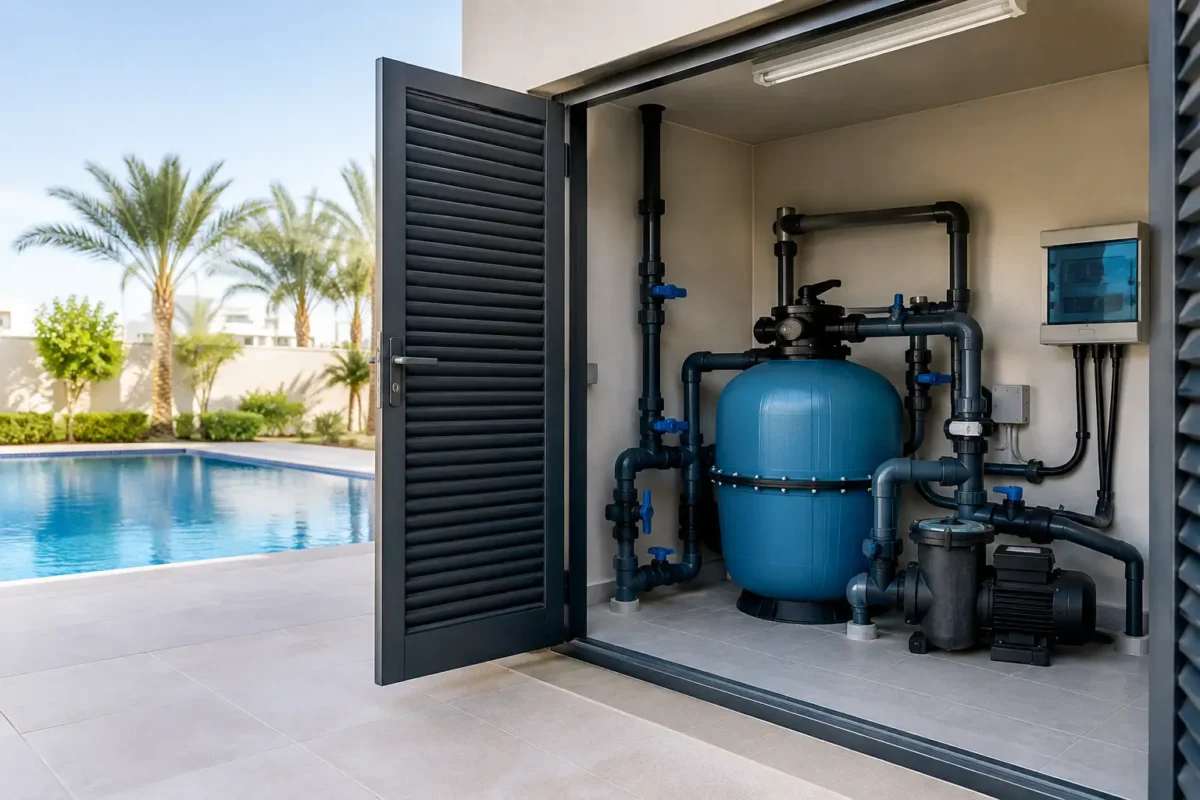
A luxury pool can look effortless from the terrace, but its performance is decided behind a closed door. This villa pool equipment room guide explains how to create a clean, accessible, and technically sound space for the pumps, filters, controls, and treatment systems that protect your investment. For villas in Dubai and across the UAE, the room must also withstand extreme heat, humidity, dust, and frequent use without compromising water quality or visual standards.
A well-planned equipment room is not simply a place to hide machinery. It is the service center of the pool. When dimensions, drainage, ventilation, and equipment selection are handled correctly from the outset, maintenance becomes faster, noise is reduced, and premium equipment can deliver its intended lifespan.
Start With Location, Access, and Space
The best equipment room location balances hydraulic efficiency with practical service access. It should be close enough to the pool to limit unnecessary pipe runs and pressure loss, while remaining discreet from primary entertaining areas. Positioning the room below the pool water level is often preferred because it helps the circulation pump maintain prime. Where this is not possible, the system needs correctly engineered suction lines, valves, and pump specifications to avoid recurring priming issues.
Do not design the room around the footprint of today’s equipment alone. A premium villa may later add heating and cooling, automated dosing, salt chlorination, UV treatment, water features, or a dedicated spa circuit. Leave clear working space around every serviceable component, particularly pump baskets, filter lids, control panels, and chemical dosing units.
As a practical standard, technicians should be able to stand, inspect, and remove parts without climbing over pipes or disconnecting adjacent equipment. Doorways must be wide enough for filter replacement or pump removal. A room that is difficult to enter will make even routine maintenance slower, more expensive, and more disruptive.
Keep Noise Away From Living Areas
Pumps, blowers, and some water-feature systems generate vibration as well as sound. Avoid placing the equipment room directly beside bedrooms, majlis areas, home offices, or quiet outdoor lounges. Use suitable vibration pads, quality pipe supports, and correctly sized equipment to control operational noise. Oversized pumps are a common cause of excessive noise, wasted energy, and premature wear.
Design the Room for UAE Conditions
Dubai heat places genuine stress on motors, automation components, and chemical systems. An enclosed, unventilated room can reach temperatures that shorten equipment life and make servicing unpleasant. Provide purposeful ventilation through louvers, mechanical extraction, or a properly designed ventilation system, depending on the room’s size and its equipment load.
Ventilation must not invite excessive dust into sensitive equipment. This is particularly relevant in areas exposed to construction activity or open desert conditions. Protected intake points and a regular cleaning program help prevent dust buildup around motor fans, electrical enclosures, and automation panels.
The room floor should be finished with a durable, non-slip, water-resistant surface and should slope toward a trapped floor drain. Leaks, filter backwashing, and cleaning are normal parts of pool operation. Without drainage, standing water can damage equipment, create a safety risk, and leave the room with persistent humidity.
Electrical installations require the same level of care. Use appropriately rated enclosures, dedicated circuits, grounding, circuit protection, and a clear disconnect arrangement. Electrical panels should remain accessible and should never be positioned where leaking water, chemical fumes, or splash can reach them. Local codes and project-specific authority requirements should always guide final installation details.
Choose Equipment as One Integrated System
A high-performance pool room relies on matched equipment, not a collection of individual products selected in isolation. The circulation pump, filter, piping, sanitization method, heating and cooling system, and control panel must be sized around the pool’s water volume, desired turnover rate, bather load, hydraulic layout, and any added features.
Circulation Pumps and Variable-Speed Control
The circulation pump is responsible for moving water through the entire treatment process. Its capacity must match the actual hydraulic resistance created by pipe length, bends, valves, filters, heaters, and water features. A pump that is too small may not provide adequate circulation. One that is too large can increase energy consumption, create noisy flow, and place unnecessary strain on the system.
For many villa pools, a variable-speed pump is the premium choice. It can run at lower speeds for daily filtration, then increase output for vacuuming, backwashing, heating, or feature operation. The initial investment is higher than a basic single-speed model, but the efficiency, lower noise level, and operational flexibility can justify the difference over time.
Filters That Match Water Use
Sand filters remain a proven option for many residential installations because they are dependable and straightforward to maintain. Glass media can offer improved filtration performance and may require less frequent backwashing, depending on water conditions and operating practices. Cartridge filters can be highly effective where water conservation is a priority, although they need manual cleaning and suitable access for cartridge removal.
The right option depends on the pool’s use and the owner’s maintenance preference. A family villa with regular weekend use may have different needs from a holiday property or a high-occupancy hospitality environment. Filter selection should also account for the source water and the amount of dust the pool receives.
Sanitization, Dosing, and Water Balance
Clear water is not automatically safe water. Effective treatment requires controlled sanitation and stable water chemistry. Chlorine dosing systems, salt chlorinators, UV units, and ozone systems can each play a role, but no single technology removes the need for testing and balanced chemistry.
Automated dosing is particularly valuable for premium villas because it monitors and adjusts key parameters with greater consistency than manual dosing alone. It is not a substitute for professional inspection, especially after heavy use, dust storms, maintenance work, or water top-ups. Chemical tanks and dosing equipment should be separated from heat-sensitive electrical controls where possible, with secure storage and clear labeling.
Plan Pipework and Valves for Serviceability
A neat pipe installation is more than an aesthetic detail. Correctly sized pipework protects circulation performance, while organized valves allow individual lines to be isolated for maintenance. Label every valve and line clearly, including skimmers, main drains, vacuum points, returns, water features, spa lines, and backwash connections.
Include unions at major equipment connections so pumps, filters, heaters, and chlorinators can be removed without cutting pipework. Install pressure gauges where they provide useful diagnostic information, particularly around the filter system. A rising filter pressure reading can indicate that cleaning or backwashing is required before circulation performance suffers.
If the pool includes a fountain, overflow edge, spa, or multiple water features, it may require separate pumps and control zones. Combining every function onto one pump can reduce upfront cost, but it often limits control and makes troubleshooting harder. The right design depends on the complexity of the feature package and the owner’s expectations for independent operation.
Include Heating, Cooling, and Automation Early
In the UAE, a heat-cool pump can extend comfortable swimming months and protect the owner’s ability to use the pool as intended. It needs adequate airflow, correct pipe sizing, a stable electrical supply, and room for service access. Crowding it into a poorly ventilated enclosure will reduce efficiency and may lead to repeated fault conditions.
Pool automation brings the system together. A properly selected controller can schedule filtration, manage lighting, operate water features, coordinate heating and cooling, and provide useful status information. Automation is most effective when it is designed with the full equipment package, rather than added after pipework and electrical layouts are already fixed.
For larger villas or properties managed by staff, simple labeling and a clearly organized control layout matter as much as advanced app control. The objective is reliable operation by the people who will actually use and maintain the system.
Commission Before Handover
Before the villa is handed over, every function should be tested under operating conditions. A professional commissioning process should confirm the following:
- Pump flow, priming, and operating pressure are within the design range.
- Filter, backwash, drainage, and waste lines operate correctly.
- Heating, cooling, lights, water features, and automation respond as programmed.
- Dosing equipment is calibrated and water chemistry is balanced.
- All valves, isolators, and controls are labeled for future service.
The owner or facility manager should also receive a clear operating briefing. This includes basic checks, alarm awareness, backwash or cleaning requirements, and the recommended maintenance schedule. Premium equipment performs best when it is paired with consistent professional care, not when it is left unseen until a fault appears.
Aquatic Pools and Fountains supports villa owners, developers, and facility teams with premium equipment selection, technical installation, and maintenance guidance tailored to each aquatic environment. The right equipment room gives every visible pool finish, feature, and waterline its dependable foundation – and keeps that standard intact long after the project is complete.