
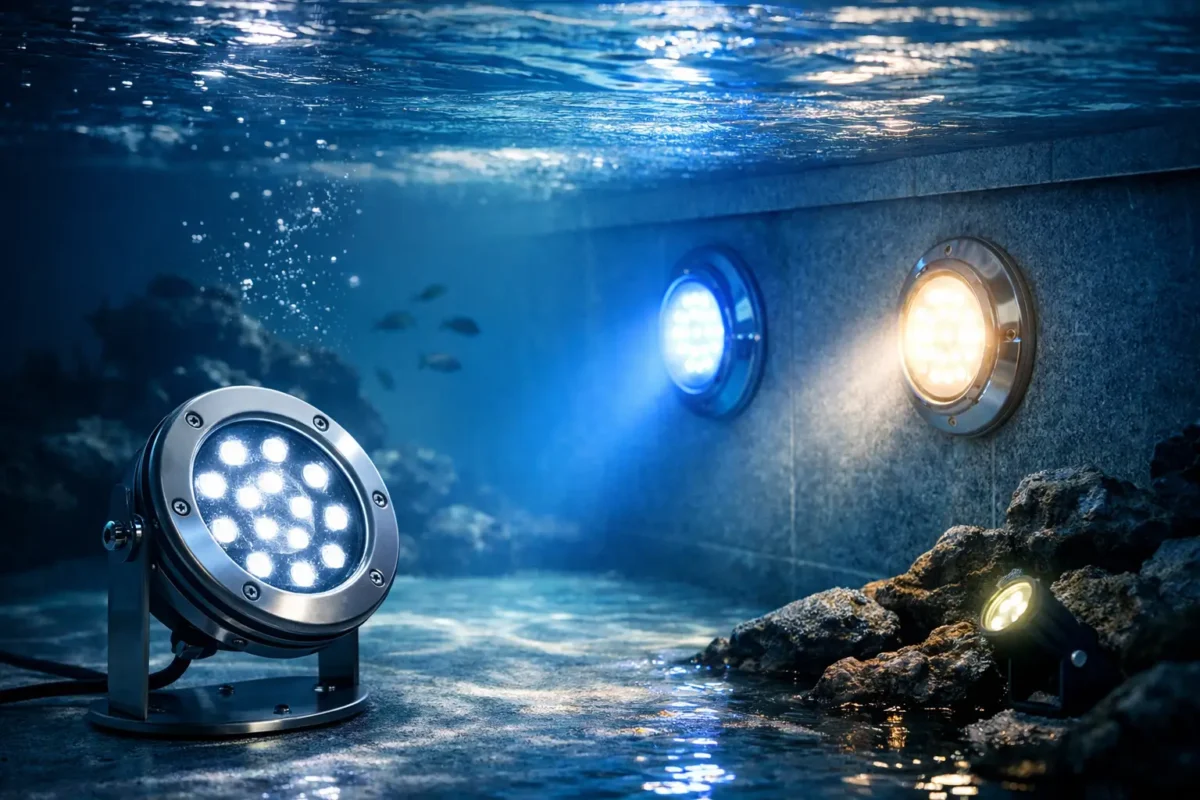
A pool can look exceptional in daylight and still lose its impact after sunset. The right underwater lighting changes that completely, defining water depth, highlighting finishes, improving visibility, and giving a villa pool, hotel feature, or fountain its intended presence at night. This underwater LED lights review focuses on the factors that separate a premium, long-lasting installation from a light fitting that looks attractive only on day one.
For projects in Dubai and across the UAE, lighting selection should never be based on color options alone. High ambient temperatures, water chemistry, frequent use, architectural expectations, and access for future service all affect which underwater LED system will deliver the best result.
Underwater LED Lights Review: Performance Beyond Color
Modern LED pool and fountain lights are popular for good reason. They use considerably less energy than traditional incandescent and halogen lamps, generate less heat, and can provide a long service life when the fixture, driver, and installation are correctly specified. Their compact design also gives designers greater control over the finished appearance of pools, spas, water walls, and decorative fountains.
However, not all LED lights produce the same quality of illumination. A low-cost fixture may offer multiple colors and a remote control, yet provide uneven light distribution, weak sealing, poor heat management, or limited availability of replacement components. These limitations become expensive when a fitting is installed inside a finished pool shell or behind a fountain cladding system.
Premium underwater lighting should be assessed as a complete system. The lamp body, lens, cable, niche or mounting method, transformer, control equipment, and electrical protection must work together. Selecting only the visible fixture is one of the most common causes of disappointing results.
Brightness Is About Placement, Not Just Wattage
Many buyers begin by comparing wattage. While wattage indicates energy consumption, it does not tell the full story about visible output or how the water will appear. Lumens, beam angle, lens design, pool finish, water clarity, and fixture placement have a stronger influence on the final effect.
A narrow-beam light can create dramatic shafts of light in a deep fountain or emphasize a vertical water feature. In a swimming pool, that same narrow beam may leave dark areas and create uncomfortable glare. A wider beam generally produces more even coverage, particularly in rectangular pools, shallow ledges, and family-use areas where safe nighttime visibility matters.
Pool interior finishes also change the result. White or light-blue mosaics reflect light efficiently and often require less output than dark stone, charcoal tile, or deep-blue finishes. Dark finishes deliver a striking, luxurious water color, but they absorb more light. They usually benefit from careful fixture spacing and stronger illumination rather than simply placing a single high-output lamp at one end.
For commercial pools, hotel settings, and high-visibility fountain installations, a lighting plan should account for surrounding architecture. Light spill onto glazing, polished stone, or adjacent seating can affect guest comfort and the perceived quality of the environment. Professional positioning prevents bright hotspots while ensuring steps, entries, and changes in depth remain visible.
White Light or RGB Color Control?
White LED lighting remains the preferred choice for many luxury pools because it presents water, tile, and landscaping with clarity. Warm white can complement natural stone and residential outdoor living spaces. Cool white creates a sharper contemporary appearance and is often suited to clean-lined commercial environments.
RGB and RGBW systems add a different level of flexibility. They allow programmed colors, scene selection, and changing effects for events, hospitality venues, and fountain displays. RGBW is often the stronger premium option because it includes a dedicated white channel. Standard RGB lights create white by mixing red, green, and blue, which can appear less natural than a purpose-built white LED.
Color-changing lighting is not automatically the right answer for every project. In an elegant villa pool, frequently changing colors may distract from refined landscaping and architecture. In contrast, a resort pool deck, entertainment venue, or public fountain may benefit from programmable scenes that align with seasonal events, brand colors, or special occasions. The correct choice depends on how the space will be used after dark.
The Details That Determine Durability
Underwater lights operate in a demanding environment. They must withstand water pressure, chemicals, heat, and constant exposure to moisture. For that reason, fixture construction deserves close attention.
A suitable ingress protection rating is essential, but the rating should not be treated as the only measure of quality. IP68 is commonly expected for permanently submerged fixtures, yet real-world reliability also depends on the housing material, lens seal, cable entry point, and manufacturing precision. A weak cable gland or poor-quality gasket can undermine an otherwise impressive specification sheet.
Marine-grade stainless steel, high-quality resin, and corrosion-resistant engineered plastics are common materials in premium systems. The best choice depends on the application and water conditions. Stainless steel offers a refined finish but should be selected carefully where water chemistry is aggressive. Resin-bodied fittings can be highly durable and are often excellent for pools, particularly when paired with a quality niche and compatible components.
The cable is another overlooked component. It must be rated for underwater use, correctly sized for the cable run, and routed so that future servicing is possible. A light that cannot be removed without draining the pool or opening finished surfaces turns a routine replacement into an avoidable project.
Low Voltage Is the Professional Standard
Most quality underwater LED systems operate at low voltage, commonly 12V AC or DC depending on the product design. This approach supports safer operation around water when paired with correctly rated transformers, junction boxes, bonding, grounding, and circuit protection.
Compatibility matters. An LED fixture designed for a specific DC driver may not perform correctly on an AC transformer, and vice versa. Mixing components from different systems without confirming electrical requirements can lead to flickering, shortened life, control failures, or damage to the light.
For large pools and fountain projects, voltage drop must be calculated before installation. Long cable runs can reduce the voltage reaching fixtures, causing uneven brightness or unreliable color performance. This is especially relevant in expansive villa landscapes, hotel pools, and multi-zone water features. Skilled technicians address cable sizing, transformer location, and load distribution during planning rather than after the installation is complete.
Installation Quality Controls the Final Result
Even the best underwater LED fixture cannot compensate for poor installation. Lights should be positioned to illuminate the pool toward the main viewing area without shining directly into swimmers’ eyes or toward nearby seating. In many pools, fixtures are installed on the side opposite the primary viewing position. This helps the water surface appear illuminated while reducing glare.
Niches and mounting points must be aligned accurately before finishing work begins. A light installed slightly off level can be noticeable once the water is filled and the system is switched on. For fountains, the relationship between lighting, nozzles, water movement, and viewing angles is even more precise. A fixture may need to illuminate a water arc, a falling sheet, or a central jet without revealing the source of the light.
Installation should also allow service access. This includes accessible control equipment, appropriately placed junction boxes, and sufficient cable length for fixture removal. Premium projects are designed for years of operation, not only for handover day.
Controls Should Match the Property
A basic on-off switch may be sufficient for a small residential pool with white lighting. Larger installations often benefit from timers, remote controls, wall keypads, mobile app control, or integration with broader pool automation systems. The practical value is not novelty. It is consistency, convenience, and the ability to manage energy use without manual intervention.
For RGBW fixtures, confirm how scenes are controlled before purchasing. Some systems use a simple power-cycle sequence, while others require dedicated controllers or automation interfaces. Power cycling can be acceptable for a modest installation, but it is not ideal for a hotel, residential development, or fountain display that requires repeatable scenes and reliable scheduling.
Maintenance Is Part of the Investment
LED lights require less routine attention than older lamp technologies, but they are not maintenance-free. Lens surfaces should be inspected for scale buildup, water chemistry should remain balanced, and electrical connections should be checked as part of scheduled pool or fountain maintenance.
If a fixture begins flickering, changing color incorrectly, or showing condensation behind the lens, it should be inspected promptly. Continuing to operate a compromised fitting can create a larger repair requirement. Early diagnosis often identifies whether the issue lies with the light, cable connection, transformer, controller, or water ingress.
Aquatic Pools and Fountains supports premium pool and fountain projects with lighting solutions selected for performance, finish quality, and serviceability. The goal is not simply to install more lights. It is to create the correct lighting effect with equipment that can withstand demanding operating conditions.
Before selecting an underwater LED system, review the pool finish, dimensions, depth, intended use, control preference, and future service access as one complete brief. A properly specified lighting plan gives the water feature its nighttime identity while protecting the long-term value of the installation.