
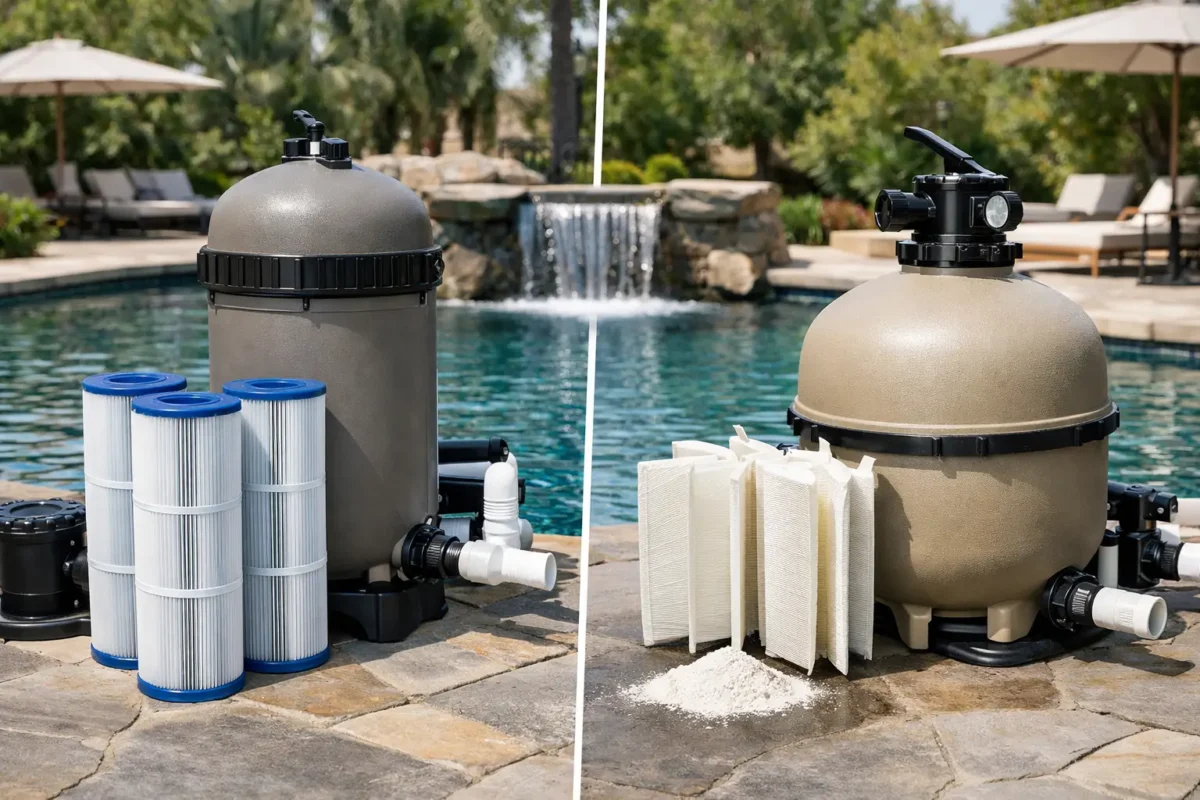
A luxury pool can have beautiful tile, precise lighting, and a perfectly balanced finish, yet still look underwhelming when the water lacks brilliance. The cartridge versus DE filters decision has a direct effect on that result. Both systems can protect pumps, improve circulation, and keep water inviting, but they achieve it with very different levels of filtration, maintenance, and water use.
For villa owners, hospitality operators, and facility managers, the better choice is not simply the filter that captures the smallest particles. It is the system that suits the pool’s bather load, available plant-room space, maintenance plan, and expected visual standard throughout Dubai’s demanding climate.
Cartridge Versus DE Filters: The Core Difference
A cartridge filter uses one or more pleated polyester elements to trap debris as pool water passes through the filter tank. The pleats create a large surface area, allowing the filter to collect leaves, dust, hair, and many fine suspended particles without needing sand or filter media. When pressure rises or flow falls, the cartridges are removed, rinsed, and periodically deep-cleaned or replaced.
A diatomaceous earth, or DE, filter uses a grid assembly coated with DE powder. This naturally occurring, highly porous material forms an exceptionally fine filtration layer. Water passes through that layer, leaving very small particles behind. After cleaning, the grids are recoated with fresh DE before the system returns to service.
The practical difference is visible in the water. A well-maintained DE filter generally delivers the finest filtration available in a conventional pool system. Cartridge filters deliver excellent clarity with simpler operation and no backwashing. The right answer depends on which advantage matters most for the property.
Water Clarity and Filtration Performance
DE filtration is often selected where water presentation is non-negotiable. Depending on the equipment design and operating conditions, DE filters can capture particles in the approximate 2 to 5 micron range. That fine level of filtration helps remove the dust, pollen, and microscopic debris that can make water appear dull even when chemical readings are within range.
This makes DE a strong choice for high-visibility pools in luxury villas, hotels, spas, and commercial facilities. In a setting where guests view the pool from terraces, lobbies, or guest rooms, the polished appearance of highly filtered water supports the overall quality of the property.
Cartridge filters commonly capture particles in an approximate 10 to 20 micron range, although performance varies by cartridge quality, flow rate, and system condition. That is still more than adequate for many residential pools and moderately used facilities. With correct circulation, water chemistry, and routine cleaning, a cartridge-filtered pool can look exceptionally clear.
The key distinction is that cartridge filtration may require more time, circulation, or supporting water treatment to reach the same ultra-polished finish that a DE system can produce more readily. For many private pools, that difference is not significant. For a signature pool with constant use or high aesthetic expectations, it can be decisive.
Maintenance: Simple Cleaning Versus Detailed Service
Cartridge systems appeal to owners who want straightforward maintenance. There is no backwash valve and no DE powder to measure or recharge. The technician isolates the filter, removes the cartridges, rinses them carefully, and reinstalls them once clean. Cartridges also benefit from occasional chemical soaking to remove oils, scale, and embedded contaminants that routine rinsing cannot release.
The trade-off is downtime and hands-on cleaning. The filter cannot operate while the elements are out of the tank. Properties that need continuous circulation may keep a spare cartridge set, allowing one set to be cleaned while the other returns the system to service. Cartridge elements are consumable components and eventually need replacement.
DE filters require a more technical service routine. They are typically cleaned by backwashing, after which fresh DE is added according to the manufacturer’s specified quantity. Periodically, the tank must be opened so the grids can be inspected for tears, broken manifolds, scale buildup, or worn seals. A damaged grid can allow DE to return to the pool, creating visible powder at the returns.
Neither option is maintenance-free. Cartridge maintenance is generally simpler, while DE maintenance requires greater precision. For commercial properties or premium residences with scheduled professional pool care, the additional servicing of a DE filter is often manageable. For an owner seeking the least complicated routine, a cartridge system is usually more comfortable.
Water Use Matters in the UAE
Water conservation is a meaningful consideration for every pool owner in Dubai and across the UAE. Cartridge filters have a major advantage here because they do not require backwashing. Cleaning is completed by rinsing the elements, which uses water but usually far less than repeated backwash cycles.
DE filters do require backwashing as part of normal operation. The amount of water lost depends on filter size, plumbing arrangement, frequency of cleaning, and how heavily the pool is used. That water must be replaced, and replacement water needs to be rebalanced for sanitizer, pH, alkalinity, and hardness. In areas where mineral content and evaporation already demand close water management, those adjustments are part of the real operating cost.
This does not mean DE is unsuitable for water-conscious properties. It means the filtration benefit should justify the water and service commitment. A properly sized DE filter that is cleaned only when pressure indicates need is far more efficient than one that is backwashed on an unnecessary schedule.
Sizing and Flow Rate Cannot Be Treated as an Afterthought
A filter should be selected as part of the complete circulation system, not as an isolated purchase. The pump’s actual flow rate, pipe diameter, pool volume, turnover target, water features, heating equipment, and disinfection system all influence the correct filter size.
Undersizing is one of the most expensive mistakes in pool equipment planning. A small filter loads quickly, restricts water flow, raises pump pressure, and needs frequent cleaning. It can also place unnecessary strain on pumps and heaters. Oversizing is often beneficial within reason because it provides a larger filtration area, lower operating pressure, and longer intervals between service.
DE filters must be sized for their rated design flow and grid area. Cartridge filters should provide enough total square footage to handle the intended circulation rate and debris load. A pool beside landscaped areas, exposed to windblown dust, or used heavily by guests needs more filtration capacity than a lightly used indoor plunge pool of the same volume.
For fountains and decorative water features, filter selection deserves separate consideration. Fine filtration may be valuable where water quality affects nozzle appearance and feature performance, but the correct solution depends on debris exposure, reservoir volume, and the specific equipment installed.
Which Filter Fits Your Property?
Choose a cartridge filter when low water consumption, simple servicing, and reliable everyday clarity are the priorities. It is particularly well suited to private villas, apartment pools with planned maintenance, and projects where plant-room simplicity and lower waste-water production matter.
Choose a DE filter when the finest possible water clarity is the goal and a trained maintenance team is available to service it correctly. It is a compelling option for luxury pools, hospitality environments, and high-use installations where the water itself is part of the property’s visual standard.
There are also situations where the decision is less obvious. A private villa with a shaded pool and frequent windblown debris may benefit from a generously sized cartridge filter. A boutique hotel with a smaller pool but exceptionally high presentation standards may find DE filtration worthwhile. Bather load, landscaping, operating hours, and maintenance discipline matter as much as the pool’s physical size.
Aquatic Pools and Fountains can assess these factors alongside pump capacity, plumbing, disinfection equipment, and site requirements to specify a filtration solution built for durable performance rather than a short-term equipment swap.
The strongest filtration system is the one that keeps circulation stable, maintenance predictable, and water visibly exceptional week after week. Select the filter around the way the property is actually used, then protect that investment with correct installation and disciplined service.