
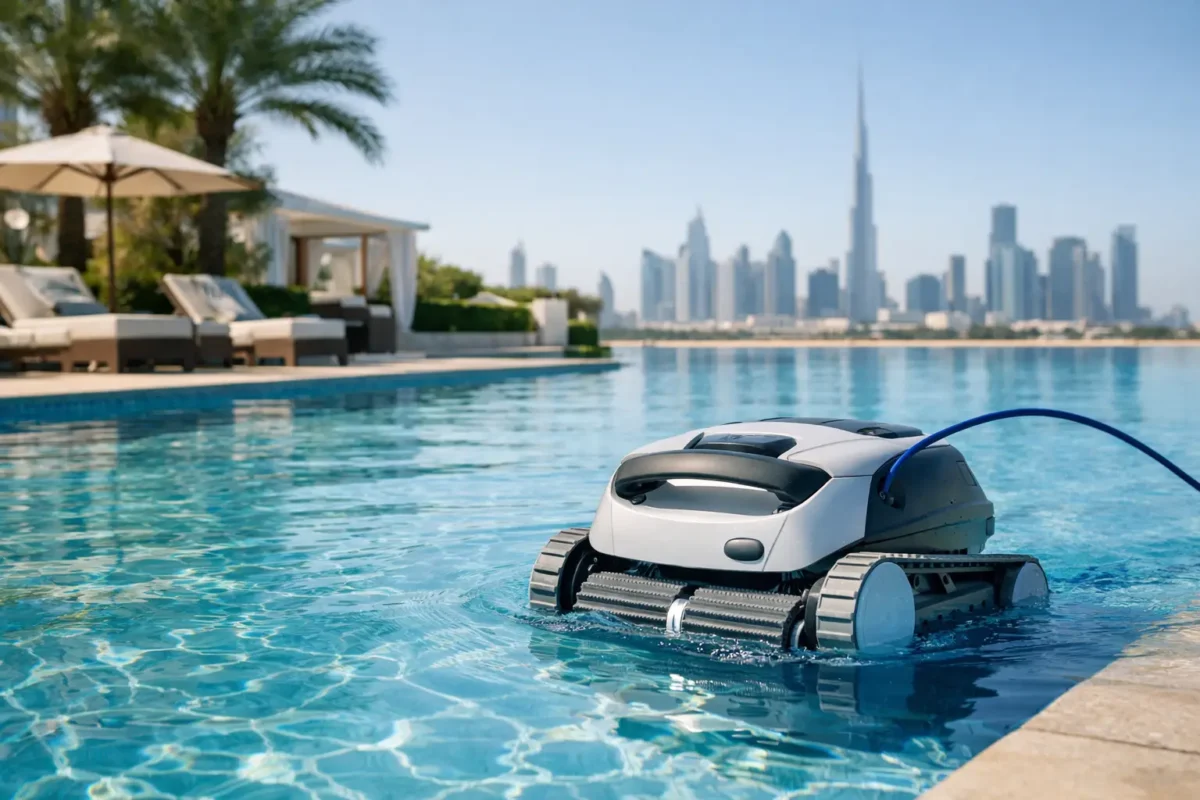
A pool that looks clear at noon can still hold a fine layer of dust, sand, and organic debris by evening. That is the practical test behind any pool vacuum robot review in Dubai: not whether the unit looks impressive in a showroom, but whether it keeps pace with the local environment, the pool’s shape, and the standard expected of a premium property.
Robotic pool cleaners can reduce the daily burden on villa owners, facility teams, and hospitality operators. They are not, however, a substitute for correct circulation, balanced water chemistry, or scheduled professional maintenance. The right robot becomes a highly effective part of a complete pool-care system. The wrong one can leave corners untouched, struggle with steps, or create another piece of equipment that needs constant attention.
Pool Vacuum Robot Review: What Matters Most
The best pool vacuum robots work independently from the pool’s main pump and filtration system. They use an internal motor to move across the floor, collect debris through a filter basket or cartridge, and, in higher-specification models, climb walls and scrub the waterline. This independent operation is a major advantage for pools with demanding cleaning requirements because it removes fine debris before it places additional load on the main filter.
For UAE properties, suction power alone is not the deciding factor. Fine desert dust can pass through coarse filtration, while leaves, insects, and sunscreen residue call for a cleaner that can handle mixed debris without losing efficiency. A premium robot should combine strong water flow with fine filtration and an easy-to-clean basket. If emptying the filter is difficult, cleaning staff are less likely to use the unit correctly and often enough.
Navigation also separates a capable cleaner from a basic one. Random-pattern robots may eventually cover a simple rectangular pool, but they can be inefficient in larger pools or pools with tanning ledges, deep ends, curves, and integrated features. Intelligent mapping or sensor-guided navigation delivers more consistent coverage, shorter cleaning cycles, and fewer missed areas.
Cleaning Performance by Pool Surface and Design
Most premium robotic cleaners are designed for common pool finishes, including tile, plaster, fiberglass, and vinyl. Even so, the brush type and traction system should suit the installed surface. A robot that grips effectively on smooth mosaic tile may perform differently on a textured finish. In a new-build villa or commercial project, this should be confirmed before equipment selection rather than treated as an afterthought.
Floor-only cleaning can be sufficient for small, lightly used pools where manual brushing is already part of the maintenance routine. For luxury villas, residential communities, hotels, and high-visibility commercial pools, wall-climbing capability is usually the better investment. Walls collect fine dust and biofilm, while the waterline can develop visible residue from oils, cosmetics, and airborne contaminants. A cleaner that reaches the waterline supports the polished appearance guests and residents expect.
Steps remain a trade-off. Even advanced robots may not clean every step profile, narrow bench, or complex ledge. A technician should review the pool geometry before promising full automated coverage. In many installations, the robot manages the main floor, walls, and waterline exceptionally well, while a short manual clean addresses the areas no autonomous unit can access reliably.
Fine Filtration Is Essential in Desert Conditions
A large debris basket is useful after landscaping work, windy days, or periods of heavy pool use. But filtration fineness matters more than basket volume when the concern is persistent dust. Look for a robot with a fine or ultra-fine filter option that captures small particles without rapidly restricting water flow.
The ideal setup often includes both a standard basket for larger debris and a finer insert for dust-heavy conditions. This gives pool operators flexibility rather than forcing one filter configuration to handle every season and every property condition. The filter should be simple to remove from the top or side, rinse clean, and reinstall without tools.
Corded or Cordless: The Practical Choice
Corded robotic cleaners remain a strong choice for large pools and frequent commercial use. They generally offer longer cleaning cycles, consistent power, and a proven design for demanding applications. Their cable requires sensible handling and storage, and some units need a swivel system to reduce tangling. For a hotel or facility team, these are manageable considerations when performance and coverage are the priority.
Cordless robots provide a cleaner, more convenient experience for many residential users. There is no floating cable across the pool, and deployment is quick. They are particularly attractive for compact pools, indoor pools, and villa owners who prefer a simple lift-and-drop routine. The limitation is runtime. Battery capacity, recharge time, and cleaning mode must be matched to the pool size so the unit does not return to the wall before completing its cycle.
For either format, a robot should be stored correctly after use. Leaving it permanently underwater can shorten the service life of seals, brushes, and electronic components. In Dubai’s heat, avoid exposing the power supply or battery to direct sun for extended periods. A shaded, dry equipment area protects the investment and keeps the cleaner ready for its next cycle.
Features Worth Paying For
Not every added feature delivers equal value. App control can be useful for checking battery status, scheduling cleaning, or selecting a cycle without handling the unit. It is less valuable if the app is unreliable or if cleaning staff still need to inspect and empty the basket manually. Treat connectivity as a convenience feature, not the foundation of performance.
More meaningful upgrades include active brushing, intelligent navigation, selectable cleaning modes, waterline cleaning, and an effective fine-filter system. A caddy or transport trolley is also worthwhile for heavier corded units, particularly at commercial sites where equipment moves between storage and the pool deck regularly.
A good robot should also be easy to lift from the water. Water drains from the unit as it rises, but a larger cleaner can still be heavy. Ergonomic handles and quick-drain design make a real difference for daily use. For facility managers, this affects both staff efficiency and safe handling.
The Cost Behind the Purchase Price
The least expensive robot is rarely the lowest-cost choice over several years. Consider the availability of replacement brushes, filter panels, tracks, cables, batteries, and service support. A premium cleaner with accessible spare parts can remain productive long after a lower-cost unit has become uneconomical to repair.
This is especially relevant for commercial pools, where downtime is visible. A property may have a perfectly functioning circulation system but still look poorly maintained if dust gathers on the floor before guests arrive. Specifying a reliable robot from a supported product range helps avoid that risk.
At Aquatic Pools and Fountains, cleaner selection can be aligned with the pool’s dimensions, finish, bather load, surrounding landscape, and existing maintenance plan. This approach is more dependable than selecting by price or marketing claims alone, particularly for large villas, hospitality properties, and multi-pool developments.
When a Robot Is Not the Entire Answer
A robotic cleaner collects debris, but it does not replace water testing, chemical dosing, brushing inaccessible areas, cleaning skimmer baskets, backwashing or servicing the main filter, or maintaining proper circulation. If algae is developing or water clarity is poor, the root cause may be filtration, sanitization, hydraulics, or chemical balance rather than the cleaner itself.
Likewise, a robot should not be expected to remove construction debris, large stones, sharp objects, or excessive leaves after a storm. Inspect the pool before starting a cycle. This simple habit protects the impeller, brushes, and drive system.
For many premium pools, the strongest routine combines automated cleaning several times a week with regular technical maintenance. The robot maintains presentation between service visits, while trained technicians protect water quality and equipment performance over the long term.
The right pool vacuum robot earns its place by making the pool consistently easier to maintain, not by claiming to eliminate maintenance altogether. Choose for the pool you actually own, the debris it receives, and the service support available after installation. That is how a cleaning accessory becomes a dependable part of a refined aquatic environment.