
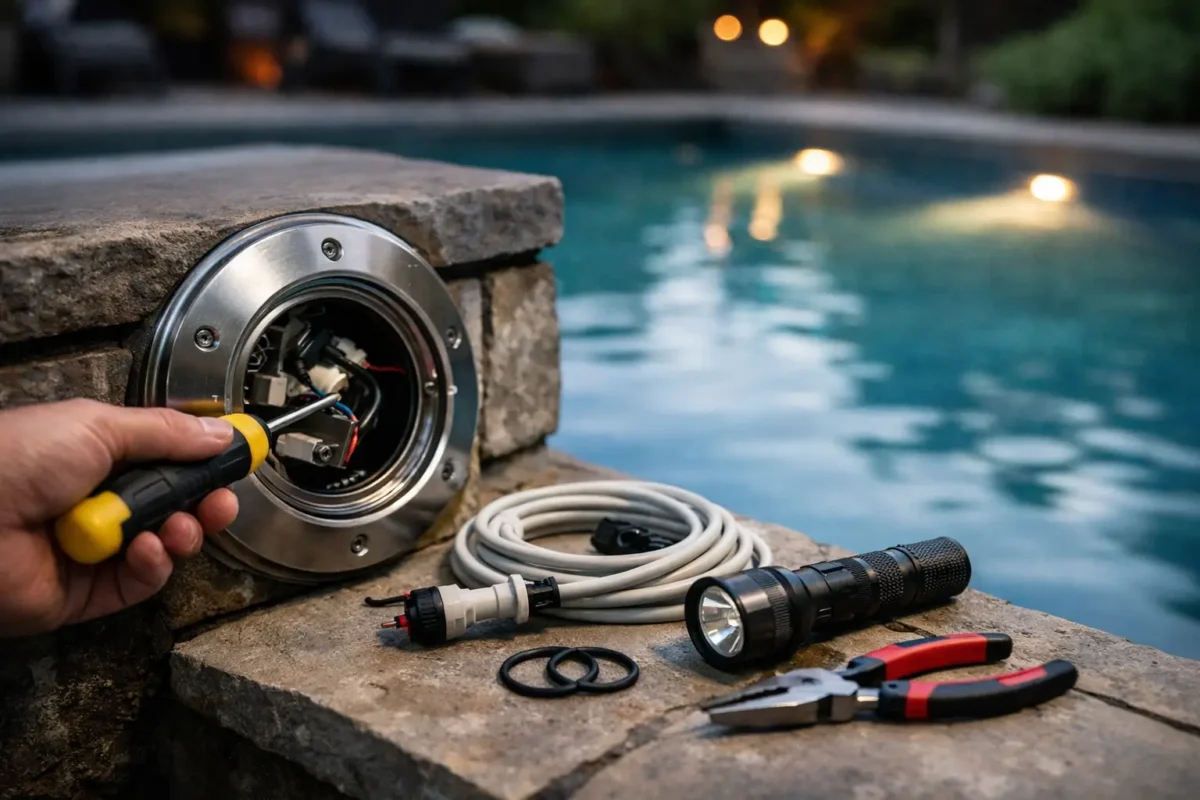
A pool can be perfectly clean, balanced, and ready for evening use, yet feel unfinished the moment its lighting fails. Understanding why pool lights stop working helps property owners and facility teams respond correctly, protect electrical safety, and avoid replacing equipment that may only need a precise repair. In premium villas, hotels, residential towers, and commercial settings, pool lighting is not simply decorative. It supports nighttime visibility, enhances architectural finishes, and preserves the polished appearance guests and residents expect.
The cause may be as simple as a tripped safety device or as technical as moisture entering a fixture, a damaged underground cable, or a failing LED driver. The right solution depends on the age of the installation, the type of light, and the condition of the electrical system behind it.
Why Pool Lights Stop Working: The Most Common Causes
Pool lights operate in a demanding environment. They are exposed to heat, humidity, chemically treated water, vibration, and frequent switching cycles. Even a high-quality fixture needs correct installation and periodic inspection to deliver long-term performance.
A tripped GFCI or circuit breaker
The first place to check is the electrical protection circuit. Many pool lights are connected through a ground-fault circuit interrupter, commonly called a GFCI, or a similar safety device at the distribution panel. If it detects an imbalance in current, it cuts power immediately to reduce the risk of electrical shock.
A GFCI may trip because of temporary moisture, a power fluctuation, a faulty light fixture, damaged wiring, or another component sharing the circuit. Resetting it once may restore the light. If it trips again, do not keep resetting it. Repeated tripping is a warning that requires diagnosis by a qualified pool electrical technician.
A failed lamp, LED module, or driver
Older incandescent and halogen pool lights use replaceable lamps. Like any bulb, they eventually burn out. Modern LED pool lights last much longer and consume less energy, but they are not maintenance-free. Their LED boards, internal drivers, and control components can fail over time, particularly where heat management or voltage quality is poor.
An LED fixture that flickers, changes color incorrectly, dims, or works only intermittently may have a driver or control issue rather than a total lamp failure. In many sealed units, replacing one internal part is neither practical nor advisable. A complete, compatible fixture replacement may offer better reliability and warranty protection.
Water inside the light niche or fixture
A properly installed underwater light is designed to remain sealed. When a gasket hardens, a lens cracks, screws are not tightened correctly, or the cable entry point deteriorates, water can enter the fixture. This can cause a lamp to fail, corrode terminals, trip the GFCI, or damage internal electronics.
Condensation behind the lens is not a detail to ignore. It often indicates that the seal has been compromised. Turning off the power and arranging a professional inspection is the correct next step. Continuing to operate a light with suspected water ingress can turn a minor gasket repair into a fixture and wiring replacement.
Damaged cable, junction box, or transformer
The visible pool light is only one part of the system. Many low-voltage installations rely on a transformer, junction box, conduit, cable connections, and a controller. A fault anywhere along this route can leave the light dark.
In Dubai and across the UAE, prolonged heat, outdoor exposure, and moisture around equipment areas can accelerate wear on electrical enclosures and connections when they are not correctly rated or maintained. Landscape works, renovations, pest activity, and aging conduits can also damage concealed cabling. Testing voltage at each point in the circuit helps identify whether the fault is at the fixture or upstream.
Control system or timer settings
Smart lighting controls, timers, remote receivers, and automation panels add convenience, but they introduce additional points of failure. A timer may be programmed incorrectly after a power outage. A remote-control receiver may lose pairing. A color-changing LED system may need a specific power-cycle sequence to select a mode.
Before assuming the light itself has failed, confirm that the control panel is powered, the timer schedule is active, and any switches or automation commands are set correctly. This is especially relevant for larger hospitality and community pools, where lighting circuits may be managed from a central control system.
A Safe Way to Troubleshoot a Pool Light
Water and electricity demand a disciplined approach. Property owners should limit their checks to accessible controls and visual observations. Never open a pool light, handle wiring, or enter the water to inspect a light while the circuit is energized.
Start by switching the pool light off at the dedicated breaker. Check whether the GFCI or breaker has tripped, then reset it once only. Verify that the timer or automation system is calling for the lights to operate. Look for visible signs of concern, including moisture in the lens, cracked fittings, corrosion around a junction box, or lights that have become noticeably dimmer or inconsistent.
If the breaker trips again, the fixture shows moisture, or the light remains off despite a healthy power supply, professional testing is needed. A technician can isolate the circuit, test voltage and insulation resistance, inspect the transformer and connections, and determine whether repair or replacement is the most cost-effective option.
When Replacement Is Better Than Repair
Repair is often sensible when the issue is a worn gasket, failed conventional lamp, loose connection, timer setting, or accessible transformer fault. Replacement becomes the stronger long-term choice when a fixture is heavily corroded, repeatedly leaks, uses obsolete components, has a failed sealed LED assembly, or no longer meets the visual standard of the pool environment.
Upgrading from older halogen lighting to premium LED pool lights can reduce energy use, improve brightness, and create a more refined nighttime presentation. Color-changing options can also complement fountains, landscape lighting, and architectural finishes. However, compatibility matters. The new fixture must match the niche, voltage, transformer capacity, cable arrangement, and control system. Selecting a light based only on diameter or appearance can create installation delays and electrical issues.
For a luxury residence, a matching set of modern LED fixtures may deliver a more consistent result than replacing a single aging lamp. For a commercial property, standardizing on durable, serviceable lighting equipment can simplify future maintenance and spare-parts planning.
Preventing Pool Lighting Failures
The most reliable pool lighting systems are designed with quality components and maintained before small faults become disruptive. During routine pool service, the lighting circuit should be included in the inspection process, not treated as an afterthought.
Technicians should check fixture seals, lens condition, mounting hardware, cable integrity, junction boxes, transformer performance, and GFCI operation. After major storms, electrical works, pool renovations, or prolonged periods of nonuse, testing the lights before an event or busy season is particularly worthwhile.
Water chemistry also plays a role. Poorly balanced water can accelerate corrosion on metal components and seals. Excessive heat around equipment spaces can shorten the life of transformers and drivers. Premium-grade equipment, properly sized for the installation and fitted by experienced professionals, provides a better defense against these conditions than low-cost fixtures selected without technical review.
Choose a Solution That Protects Safety and Appearance
A dark pool light may be a simple maintenance issue, but it can also be the first sign of an electrical fault that should not be ignored. The goal is not merely to make the light turn on again. It is to restore safe, dependable illumination that complements the quality of the entire pool or fountain installation.
Aquatic Pools and Fountains supports residential and commercial clients with premium lighting equipment, technical diagnosis, replacement planning, and professional maintenance solutions. A careful inspection now can protect your investment and ensure your pool remains as impressive after sunset as it is during the day.