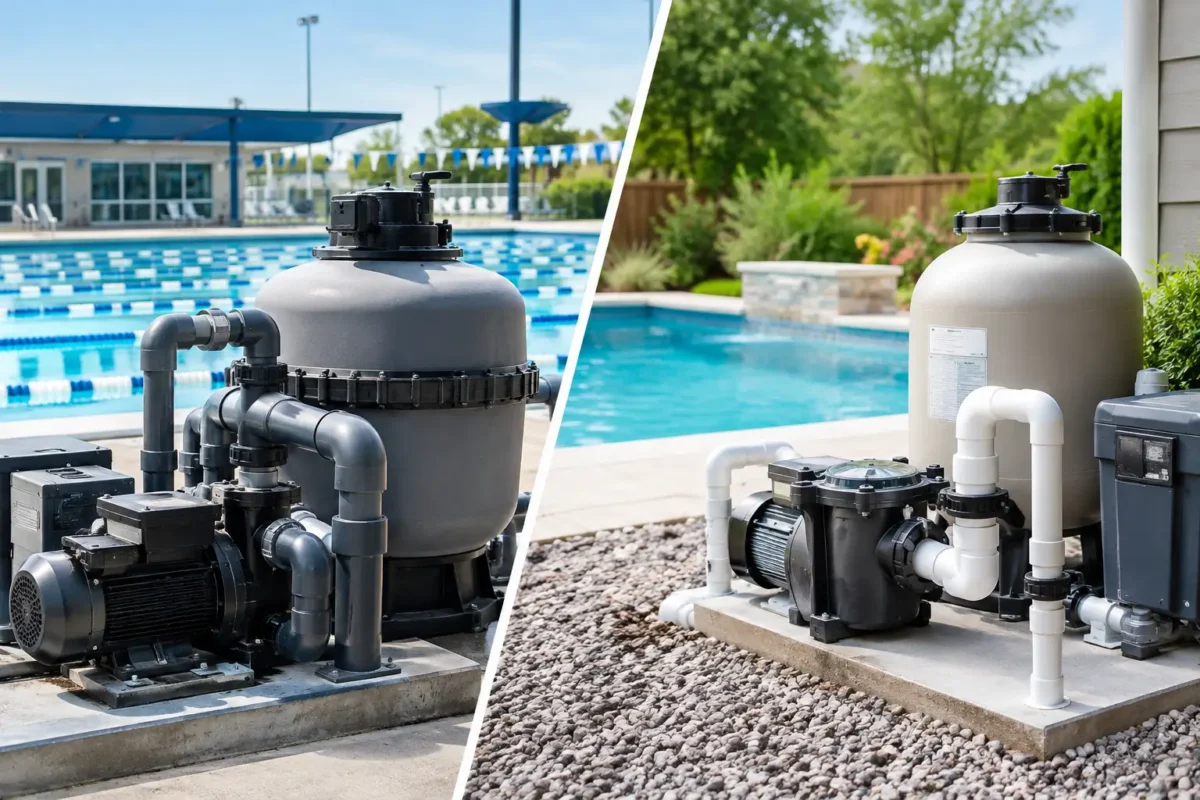
A pool at a private villa may welcome a family for a few hours each weekend. A hotel, residential tower, school, or fitness club pool may serve hundreds of swimmers every day. That difference defines the choice between commercial versus residential pool equipment. Both systems must deliver clear, comfortable, safe water, but their capacity, construction, controls, compliance requirements, and maintenance expectations are fundamentally different.
For property owners and decision-makers in Dubai and across the UAE, selecting equipment by appearance or purchase price alone can create expensive operating issues. The right specification starts with how the pool will actually be used, the water volume, peak bather load, available plant room space, and the standard of experience the property intends to provide.
Commercial Versus Residential Pool Equipment: The Core Difference
Residential equipment is designed for lighter, more predictable use. A premium villa pool may require excellent filtration, energy-efficient circulation, automated sanitization, and elegant lighting, but it usually has a limited number of users and a manageable daily contamination load. Equipment can be sized for comfort, efficiency, and quiet operation without the demand for continuous high-volume performance.
Commercial equipment is built for greater hydraulic demand and longer duty cycles. Hotel pools, community pools, spas, water features, and apartment developments must manage heavier swimmer loads, more oils and contaminants, faster changes in water chemistry, and stricter expectations for water clarity. Their systems commonly operate for extended periods and must remain dependable when access for repairs is limited.
This does not mean every commercial project needs the largest available pump or filter. Oversizing can increase capital cost, power consumption, and noise without improving water quality. A proper design balances pool volume, turnover requirements, bather load, pipework, head loss, treatment method, and the property’s operational schedule.
Pumps: Flow Rate, Duty Cycle, and Redundancy
The circulation pump is the working heart of the pool system. In a residential setting, a variable-speed pump is often an excellent choice because it can run at lower speeds for routine filtration, reducing energy use and operating noise. It can then increase output for backwashing, vacuuming, water features, or heat pump operation.
Commercial pumps are generally selected for sustained flow under higher resistance. Larger pools have longer pipe runs, more fittings, multiple return lines, balance tanks, water features, and treatment equipment that create hydraulic head. The pump must maintain the required flow rate through this system without operating at the edge of its performance curve.
Redundancy also separates many commercial installations from residential ones. A hotel or residential tower cannot always wait for a replacement pump if a single unit fails. Duty-and-standby pump arrangements allow one pump to operate while another remains ready for automatic or manual changeover. This approach supports business continuity and planned maintenance, particularly for high-visibility amenities.
Filtration Capacity Determines Water Quality
A residential pool filter is typically selected to process the full pool volume within a suitable daily turnover period. Sand filters remain a dependable option for many villas because they are durable, straightforward to service, and compatible with common treatment systems. Cartridge filters can be appropriate where water conservation and compact installation are priorities, provided cleaning access and maintenance routines are considered.
Commercial filtration must deal with higher debris and contaminant loads without sacrificing flow. Large-diameter sand or glass-media filters are common because they offer substantial filtration area and can be backwashed efficiently. Glass media can provide finer filtration performance than conventional sand in many applications, although the best choice depends on system design, budget, and the operator’s maintenance plan.
Filter selection should never be separated from the backwash strategy. Commercial facilities require adequate drainage capacity, water supply, and equipment controls to complete backwash cycles correctly. In the UAE, where water use and utility costs deserve close attention, efficient filtration and well-timed backwashing can make a meaningful difference to long-term operating expenses.
Turnover Is Not a One-Size-Fits-All Number
Turnover refers to the time required for the circulation system to move a volume of water equal to the pool’s total volume through the treatment process. A lightly used private pool can often operate effectively with a different turnover target than a busy hospitality or community pool. High bather loads, shallow leisure areas, spas, and warm water environments may require more frequent circulation and more intensive treatment.
The key is not simply achieving a calculated turnover on paper. Flow must be distributed effectively through the pool, skimmers or overflow gutters must capture surface debris, and return inlets must prevent dead zones. Good hydraulic design is as important as the equipment’s stated capacity.
Sanitization and Water Balance Need More Control in Commercial Pools
Residential owners may choose manual dosing, salt chlorination, or compact automated systems. For a well-maintained villa pool, these solutions can provide a convenient balance of water quality, comfort, and routine oversight. Automation is particularly valuable for owners who travel frequently or prefer predictable treatment without daily adjustment.
Commercial pools generally require automated chemical dosing and continuous monitoring. Controllers can measure parameters such as disinfectant level and pH, then dose chemicals in response to real-time water conditions. This helps maintain stable treatment during changing bather loads and reduces the risk of under-treatment or excessive chemical use.
Commercial projects may also incorporate ultraviolet or ozone disinfection as secondary treatment. These technologies can reduce combined chlorine and support improved water quality, but they do not eliminate the need for a residual sanitizer in the pool. Their value depends on the pool’s use, design, local requirements, and the facility team’s ability to maintain the system correctly.
Controls, Monitoring, and Energy Management
A residential pool control panel can bring pumps, lights, heaters, and water features into one user-friendly interface. Homeowners benefit from simple schedules, remote control, and automation that makes the pool enjoyable rather than labor-intensive.
Commercial controls need a broader operational view. Timers, variable-frequency drives, chemical controllers, flow switches, alarms, and interlocks protect equipment while supporting consistent water treatment. Facility managers may need to monitor pump status, filter pressure, chemical tank levels, and fault alerts across multiple pools or water features.
Energy efficiency remains essential in both settings. Variable-speed pumps, correctly sized pipework, high-efficiency heat-cool pumps, LED lighting, and thoughtful operating schedules can reduce consumption without compromising performance. Yet energy-saving settings must be tested against water quality requirements. Running a commercial circulation system too slowly to lower electricity costs can lead to poor filtration, unstable chemistry, and greater corrective costs later.
Safety Equipment Has Different Priorities
Residential safety commonly focuses on secure covers, anti-entrapment drains, clear depth marking, safe access, and effective lighting. Families with children may also prioritize pool alarms, barriers, and non-slip surrounding surfaces.
Commercial properties need these measures and more. Public and semi-public pools require durable ladders, handrails, depth markers, safety signage, compliant suction fittings, emergency equipment, and accessible entry solutions where applicable. Equipment must withstand frequent use, cleaning chemicals, sun exposure, and the demands of a busy environment.
Aesthetic quality should not be treated as separate from safety. Premium stainless steel rails, properly positioned lights, well-finished grilles, and high-quality fittings improve the visual standard of a facility while supporting safe use and easier maintenance.
Choosing the Right System for Your Property
The best equipment package begins with a technical assessment, not a catalog selection. A luxury villa may benefit from quiet variable-speed circulation, premium LED lighting, automated disinfection, and heat-cool technology that extends year-round comfort. A hotel or large residential development may require commercial-grade pumps, high-capacity filters, automated dosing, secondary disinfection, and standby equipment planned around continuous operation.
There are middle-ground projects as well. A large private estate with an infinity pool, spa, fountain features, and frequent entertaining may require equipment closer to commercial standards. Conversely, a small low-occupancy pool within a boutique property may not need the same plant room complexity as a major resort. Usage patterns, not property labels alone, should guide the specification.
Aquatic Pools and Fountains supports premium residential and commercial projects with equipment selection, installation guidance, maintenance expertise, and access to leading global brands. A coordinated approach helps ensure that pumps, filtration, disinfection, heating, controls, fittings, and water features perform as one engineered system.
A pool is a visible asset, but its long-term value is decided in the plant room. Specify equipment for the real demands of the property, and the result is clearer water, more dependable operation, and an aquatic environment that continues to reflect a premium standard.