
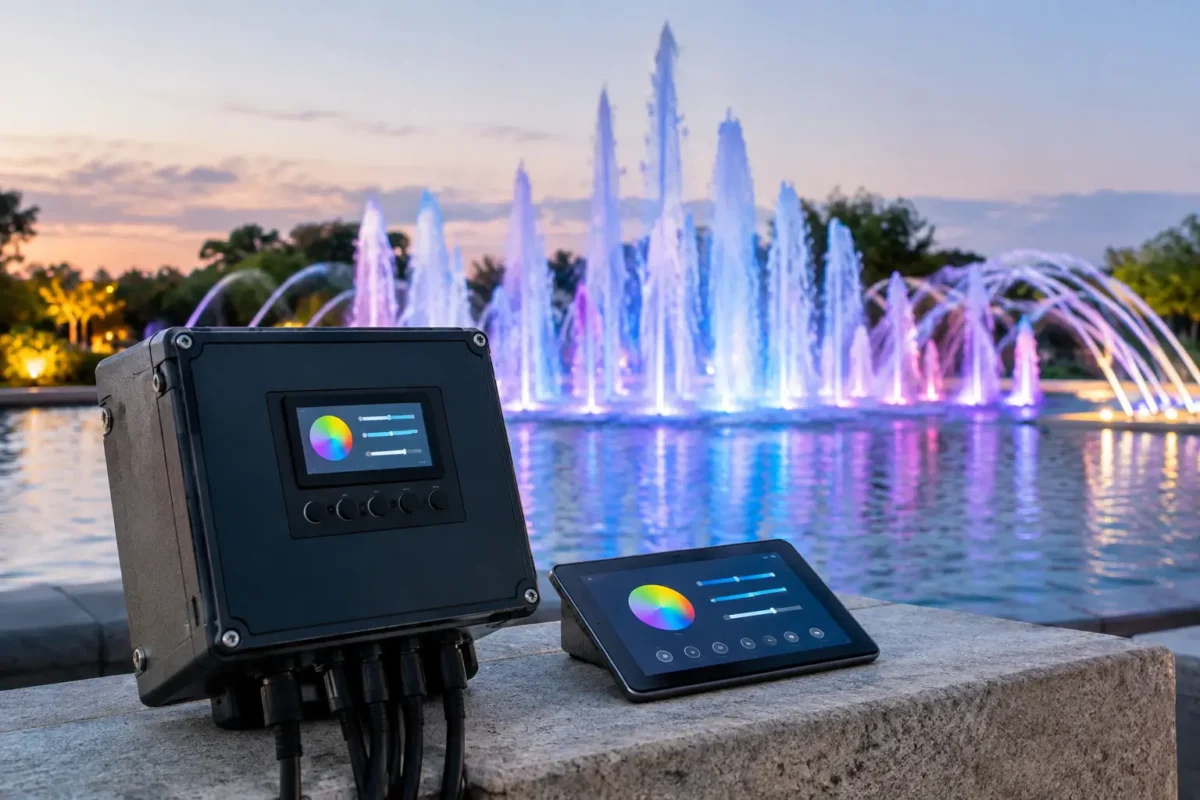
A fountain can have exceptional jets, stonework, and water movement yet still look unfinished after sunset. The fountain lighting controller is the component that turns individual fixtures into a coordinated visual feature, giving property owners and operators control over color, brightness, timing, and effects. For luxury villas, hotel entrances, residential towers, and commercial landscapes, selecting the right controller protects both the appearance of the installation and the long-term value of the lighting system.
A quality controller does more than switch lights on and off. It creates repeatable scenes, manages multiple lighting zones, and helps the fountain present the right atmosphere at the right time. The best choice depends on the lighting technology, the number of fixtures, the desired effects, and the level of day-to-day control required.
What a Fountain Lighting Controller Does
A fountain lighting controller sends commands to compatible underwater or landscape light fixtures. Depending on the system, those commands may control fixed colors, RGB color changes, RGBW white tones, dimming levels, chase sequences, or programmed shows. Some controllers run a simple daily schedule. Others support sophisticated scenes that coordinate lighting with pumps, valves, and fountain movement.
This distinction matters during specification. A small courtyard fountain with a single-color LED arrangement may only need a dependable timer and transformer setup. A hotel arrival fountain with several lighting zones, changing colors, and high-visibility nighttime operation requires a controller designed for more advanced programming and reliable communication.
The controller should always be chosen as part of a complete lighting system, not as an afterthought. Compatibility between the controller, power supply, cables, junction boxes, and fixtures determines whether the installation performs as intended. Mixing components without confirming voltage, protocol, capacity, and environmental rating can cause flickering, limited functionality, or premature equipment failure.
Choosing a Fountain Lighting Controller for the Project
The first consideration is the type of lights installed. Modern fountain projects commonly use LED fixtures because they provide efficient operation, long service life, vivid color options, and lower heat output. However, LED lights do not all communicate in the same way. Some use a basic switched-color system, while others require dedicated control protocols such as DMX or manufacturer-specific communication systems.
For a fixed-color fountain, the requirement may be straightforward: controlled switching, a reliable timer, and appropriately sized electrical protection. For RGB or RGBW lighting, a controller must manage color channels accurately and support the fixtures’ specified voltage and communication method. RGBW systems are often preferred in premium projects because they can deliver saturated colors while also providing a cleaner, more natural white for everyday presentation.
Fixture quantity and zoning are equally important. A controller that supports one lighting circuit may be suitable for a compact residential feature, but it will not provide the flexibility needed for a multi-tier commercial fountain. Separate zones allow operators to illuminate the central jet, perimeter nozzles, waterfall wall, and surrounding landscape independently. This creates depth and visual hierarchy rather than a flat field of uniform light.
Consider the intended operating schedule as well. Villas may need warm white illumination during family evenings and a subtle color scene for private events. Hotels and mixed-use developments may require programmed scenes for holidays, special promotions, or weekend activity, with reduced brightness after peak hours. A capable controller makes these adjustments practical without requiring frequent manual intervention at the electrical panel.
Control Options: Simple, Programmable, and Integrated
Controllers are available at several levels of complexity. The right option is not necessarily the most elaborate one. It is the one that delivers the required visual result while remaining practical for the people responsible for operating and maintaining the fountain.
Basic controllers are ideal for installations that need scheduled on-off operation, fixed color selection, or a limited number of automatic color-changing programs. They are cost-effective and easy to operate, making them a sensible choice for smaller residential fountains where the owner prefers simple, dependable control.
Programmable controllers provide more creative freedom. They can store scenes, adjust color transitions, manage dimming, and assign different effects to multiple fixture groups. These systems suit luxury villas, hospitality properties, and high-end landscape features where the fountain is a focal point after dark. Programming should be planned carefully, however. An overly fast or overly colorful sequence can distract from the architecture rather than enhance it.
Integrated control systems are often specified for larger developments. They may connect fountain lighting to a building management system, central automation platform, or dedicated show-control interface. This level of integration can be valuable when lighting must coordinate with fountain pumps, music, event schedules, or other site-wide lighting. It also requires professional design, commissioning, and documentation to ensure facility teams can operate the system with confidence.
Installation Details That Protect Performance
A premium controller cannot compensate for poor electrical installation. Fountain environments combine water, humidity, outdoor heat, and long cable runs, so every component must be selected and installed with precision. Controllers and power supplies should be located in suitable weather-protected enclosures, with clear access for inspection and service.
Voltage drop deserves close attention, particularly when low-voltage LED fixtures are spread around a large basin. If cable sizing or run length is not calculated correctly, lights at the far end of the fountain may appear dimmer or display inconsistent colors. Proper cable selection, distribution planning, and load calculations prevent this issue before the fountain is finished.
Electrical safety is another non-negotiable requirement. Underwater lights, transformers, junction boxes, grounding arrangements, and protective devices must be specified for the application and installed in accordance with applicable electrical standards. In Dubai and across the UAE, environmental conditions add further demands: high summer temperatures, dust exposure, and intensive operating hours can place unnecessary stress on poorly selected equipment.
For this reason, commercial properties should avoid treating fountain lighting as a standalone decorative purchase. The lighting controller must be considered alongside the hydraulic design, electrical infrastructure, access strategy, and maintenance plan. Professional installation creates a cleaner final appearance and reduces the risk of costly disruptions later.
Design for Elegance, Not Just Effects
Color-changing technology can make a strong statement, but the most successful fountain lighting designs use it with restraint. Warm white often provides the most timeless effect for stone, stainless steel, and architectural water features. It reveals water texture and creates a refined appearance that suits residences, hospitality venues, and corporate properties.
Color scenes are valuable when they support a purpose. Blue and aqua tones can create a calm contemporary mood. Brand colors can be used for a corporate event. Seasonal programming can refresh a hotel entrance or retail destination without altering the physical fountain design. The controller makes these changes possible, but the visual concept should lead the programming.
Brightness also requires balance. Too little light can make water movement disappear, while excessive output creates glare, exposes fixture hardware, and can disturb nearby residents or guests. Dimming capability gives facility managers a useful advantage, allowing the fountain to remain visible and elegant while responding to changing ambient light and operating hours.
Maintenance and Service Planning
Controllers are electronic equipment, and even high-quality units benefit from periodic checks. Facility teams should verify scheduled operation, inspect enclosures for moisture or heat buildup, review cable connections, and confirm that all programmed scenes function correctly. A scene that fails during a major event is often caused by a small issue that could have been identified during routine service.
When replacement or expansion is anticipated, choose a system with accessible technical support and available compatible components. Proprietary systems can offer excellent performance, but owners should understand the availability of replacement controllers, remotes, power supplies, and programming support before committing to a large installation.
Aquatic Pools and Fountains supports premium fountain projects with quality lighting equipment, technical guidance, installation expertise, and ongoing maintenance support. This full-scope approach is especially valuable when a project needs coordinated advice across lighting, pumps, nozzles, electrical components, and water-feature operation.
A well-specified controller lets a fountain remain more than a daytime landscape element. With the correct equipment, thoughtful programming, and professional support, it becomes a dependable evening feature that strengthens the character of the property every night.