
A green film on the basin floor can make a premium fountain look neglected within days. The right way to remove fountain algae safely is not to pour in a stronger chemical and hope for the best. It requires controlled cleaning, water treatment that matches the fountain’s design, and a close look at the circulation equipment that allowed algae to take hold.
For villas, hotel entrances, residential towers, and commercial landscapes, algae control protects more than appearance. Left untreated, it can block nozzles, restrict pump flow, stain porous finishes, create unpleasant odors, and turn nearby paving into a slip risk. A disciplined maintenance approach preserves the fountain’s visual impact while protecting its pump, finishes, landscaping, and visitors.
Why Fountain Algae Develops So Quickly
Algae needs only a few basic conditions: sunlight, water, nutrients, and limited circulation. Decorative fountains commonly provide all four. In warm climates, especially during long periods of high heat and sun exposure, growth can accelerate quickly between maintenance visits.
Dust, leaves, grass clippings, pollen, and bird activity add organic material to the water. As that debris breaks down, it provides nutrients that algae can use. Low water flow compounds the issue. When a pump is undersized, a filter is clogged, nozzles are partially blocked, or circulation is only operated for short periods, stagnant corners form in the basin. Those areas are where algae usually begins.
The finish also matters. Natural stone, unsealed grout, textured tile, and concrete can hold algae more tightly than smooth glazed tile or stainless steel. An approach that is appropriate for a tiled architectural fountain may damage a stone-clad water feature, so cleaning products and tools must always be selected for the specific installation.
Prepare Before You Remove Fountain Algae Safely
Start by switching off electrical equipment at the appropriate isolator. Do not clean around active suction points, submerged lights, or moving pump components. If the fountain has automated controls, lighting circuits, chemical feeders, or integrated filtration, make sure the system cannot start unexpectedly while work is underway.
Wear chemical-resistant gloves and eye protection, particularly when handling treatment products or scrubbing areas where splashback is possible. Keep children, pets, and visitors away from the fountain until the cleaning process is complete and the water has been returned to a safe operating condition.
Before adding any treatment, identify what is in the fountain. Is it purely ornamental, planted, stocked with fish, connected to a pool system, or fitted with a biological filter? These details change the correct solution. Products intended for conventional ornamental fountains can be harmful to aquatic life, and pool chemicals are not automatically suitable for decorative water features.
Inspect the water level, pump basket, filter, nozzles, intake screens, and overflow before proceeding. If the fountain is losing water, a chemical treatment may be wasted and could affect surrounding soil or finishes. Mechanical problems should be addressed first.
Remove Debris and Clean the Basin Properly
The first stage is physical removal. Use a fine net to take out leaves, floating debris, and loose algae. Empty skimmer baskets and pump strainers, then clean them thoroughly. This simple work reduces the nutrient load and prevents loose material from immediately returning to the water circulation path.
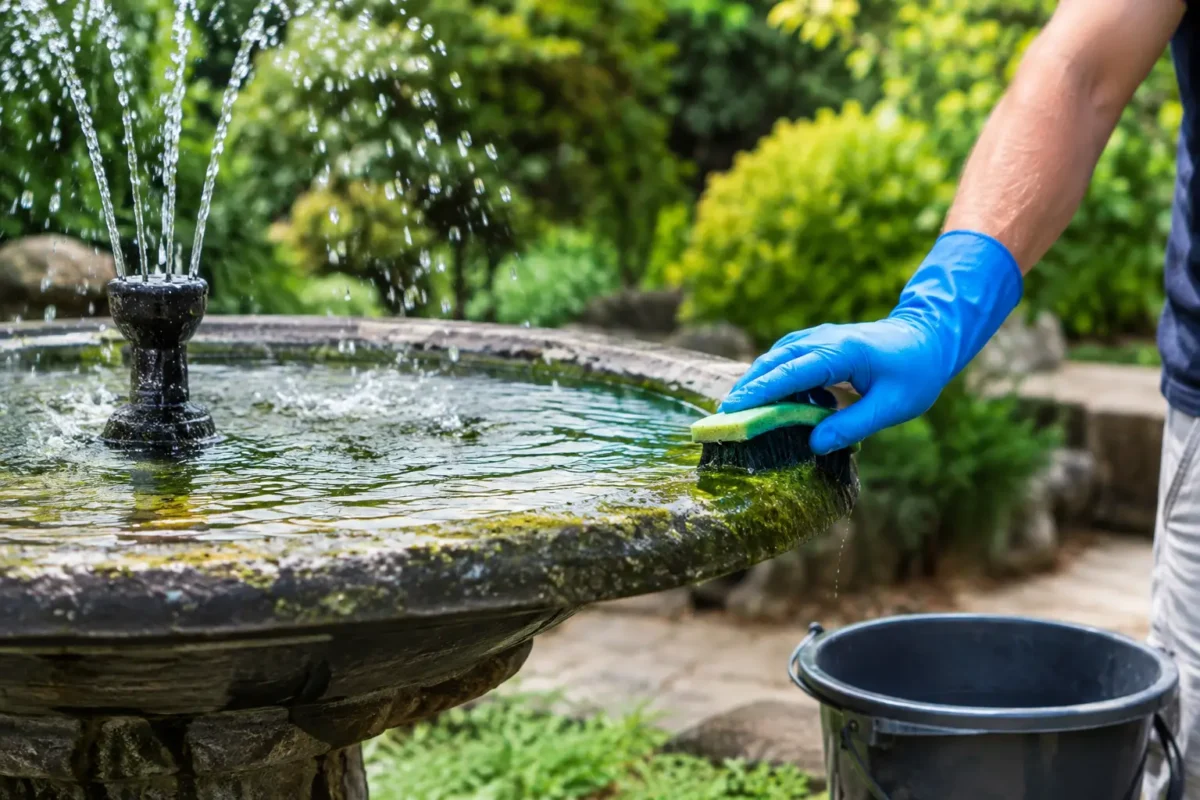
For light algae on accessible surfaces, use a soft nylon brush or non-abrasive pad designed for the basin material. Brush walls, floor sections, corners, and areas around nozzles with controlled pressure. Avoid wire brushes, harsh scouring pads, and abrasive tools on polished stone, acrylic, glass, glazed tile, painted surfaces, or metal finishes. They may remove algae, but they can also leave scratches that make future algae attachment easier.
A heavily affected fountain often needs to be drained before deep cleaning. Drain only according to local site requirements and property procedures, particularly where treated water could enter landscaping, stormwater systems, or public areas. Once empty, remove settled sludge with a wet vacuum or suitable extraction equipment rather than washing it into drains.
Clean basin surfaces with a fountain-safe cleaner compatible with the finish. Rinse thoroughly, because detergent residue can foam when the system restarts and may interfere with chemical treatment. Never mix cleaning agents, acids, chlorine products, or algaecides. Combining chemicals can create dangerous fumes, damage finishes, and make water treatment unpredictable.
Treat Stubborn Stains With Care
Dark green or black marks may be more than surface algae. They can be staining caused by algae, mineral deposits trapping organic matter, or discoloration in grout and porous stone. Strong acid treatments are not a default answer. They can etch limestone, weaken grout, corrode metal fittings, and alter the appearance of premium finishes.
For an expensive or architecturally sensitive fountain, test any cleaner in an inconspicuous area first. When staining persists after standard cleaning, professional assessment is the safer choice than repeated aggressive scrubbing.
Use the Right Water Treatment, Not the Strongest One
Once loose algae and debris are removed, refill the fountain with clean water if it was drained. Then use a commercial fountain algaecide or water-treatment program specifically approved for your type of fountain. Follow the product label precisely for dosage, circulation time, re-entry guidance, and compatibility with plants, fish, finishes, and filtration equipment.
More chemical is not better. Overdosing can cause foam, surface residue, corrosion, damage to seals, or an imbalance that creates another water-quality problem. It may also be unsafe for people who come into contact with splash zones or for landscaping near the fountain.
Water testing provides the information needed to treat effectively. Depending on the system, technicians may assess sanitizer residual, pH, total alkalinity, hardness, dissolved solids, and phosphate levels. The target values depend on the treatment method and fountain design, which is why a generic pool routine should not be copied without review.
Some fountains benefit from carefully managed sanitizer systems, while others perform better with non-chlorine treatment, ultraviolet disinfection, ozone support, or specialized algaecide programs. The best choice depends on water volume, bather contact, sunlight, operating hours, materials, and whether the feature is decorative or biologically balanced.
Restore Circulation and Filtration
After treatment, run the circulation system long enough to distribute the product and capture remaining particles. Clean or backwash the filter according to the manufacturer’s procedure. If the water remains cloudy, inspect the filter media, cartridge condition, pump performance, and plumbing for restrictions or bypass issues.
Nozzles deserve special attention. Algae and scale inside a nozzle can distort the water pattern, reduce visual uniformity, and increase stress on the pump. Remove and clean accessible nozzles only as recommended by the manufacturer. For integrated jets, underwater lighting, or complex feature plumbing, technical service is preferable to forcing components apart.
A clean fountain with weak circulation will become green again. Confirm that water reaches every section of the basin and that no dead zones remain behind features, in shallow ledges, or near collection points. Where the design creates recurring stagnant areas, a circulation upgrade or revised nozzle arrangement may be the long-term solution.
Prevent Algae From Returning
Premium fountains stay clear through consistency, not occasional emergency cleaning. Remove leaves and visible debris several times each week, especially after landscaping work or windy weather. Check water level and pump operation regularly, and keep baskets and intake screens clean.
A scheduled maintenance program should include water testing, filter servicing, inspection of seals and fittings, cleaning of nozzles, and review of treatment dosage. Shading can reduce algae pressure in some installations, but it should be weighed against the design intent and plant requirements. For highly visible commercial fountains, automated dosing and disinfection systems can offer more stable water quality and reduce reliance on reactive manual treatment.
Aquatic Pools and Fountains supports luxury residential and commercial properties with professional fountain equipment, treatment solutions, technical diagnostics, and maintenance support. When algae returns repeatedly, the issue is often not the cleaning itself but an underlying filtration, circulation, or water-balance problem that needs to be corrected at the system level.
A clear fountain is one of the strongest signals of careful property management. Treat algae early, protect the materials that give the feature its character, and maintain the equipment with the same precision expected from the installation itself.