A pool can look perfectly calm while presenting a serious risk to children, pets, guests, and staff. The pool cover vs safety net decision is therefore not simply about closing the pool after use. For villas, hospitality properties, residential developments, and commercial facilities, it affects safety management, water quality, operating costs, appearance, and the daily routine around the pool.
The right answer depends on what the pool needs to do when it is unattended. A safety net is designed primarily to prevent access and reduce fall risk. A pool cover can provide a physical barrier too, depending on its specification, while also helping manage leaves, dust, evaporation, and heat loss. Premium properties often benefit from evaluating both options as part of a wider pool safety and maintenance plan.
Pool Cover vs Safety Net: The Core Difference
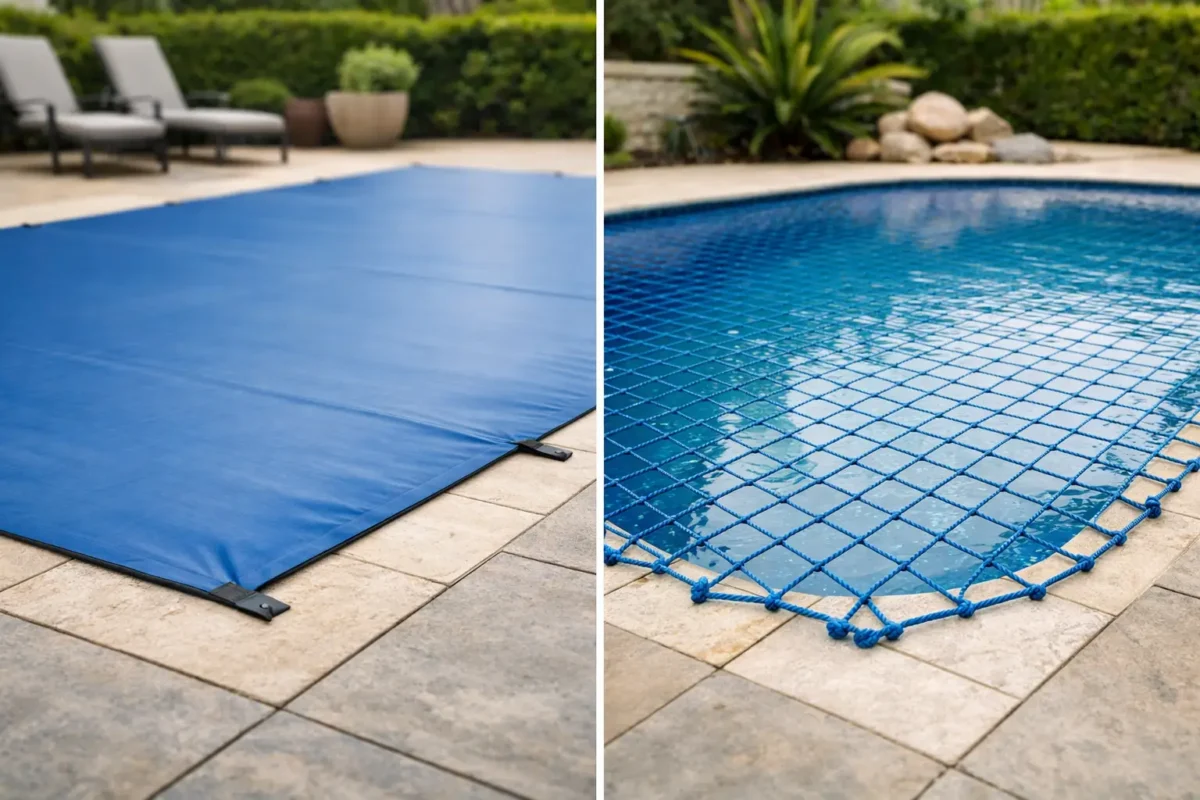
A safety net is a tensioned, high-strength mesh system installed over the pool perimeter. It is secured with anchors and tensioning hardware, creating a firm barrier over the water. Properly specified and professionally fitted nets are intended to prevent children and animals from entering the pool area through the water surface.
A pool cover is a broader category. It may be a lightweight floating cover, a mesh debris cover, a solid winter cover, a thermal blanket, or a purpose-built safety cover. Not every cover is a safety product. A basic floating or thermal cover can support no body weight and must never be treated as a child-safety barrier.
That distinction matters. If your main requirement is access prevention, select a rated safety solution with suitable anchoring, load performance, and professional installation. If the main concern is evaporation, debris, or water temperature, a thermal or debris cover may be the more practical investment. In many installations, the best specification combines a certified safety barrier with a cover chosen for water-care performance.
When a Safety Net Is the Better Choice
Safety nets suit pool owners who need a dedicated, visible safety measure without permanently changing the character of the pool area. They are particularly effective for family villas where children visit regularly, properties with pets, and managed residences where pool access needs clear control between uses.
Because the net is tensioned above the water, it creates a strong visual and physical reminder that the pool is closed. Unlike a floating cover, it does not sit directly on the water, which can make removal and refitting more manageable for some households. A well-designed net is also generally less susceptible to water accumulation on its surface than a solid cover.
For outdoor pools in Dubai and across the UAE, a net does not solve every maintenance issue. Fine dust, sand, and airborne debris can still reach the water. It also provides minimal insulation, so it will not meaningfully reduce heat loss or evaporation. This makes a safety net a focused safety investment rather than a complete pool-protection system.
What to assess before specifying a net
The quality of the mesh, anchors, straps, and tensioning system is as important as the net itself. The system must fit the exact pool shape, including Roman ends, curves, steps, raised edges, and nearby landscaping. Poorly positioned anchors, loose straps, or excessive gaps around the perimeter can compromise both performance and appearance.
Commercial and hospitality properties should also consider operational accountability. A safety net must be reinstalled and tensioned correctly every time the pool is closed. Clear procedures and trained staff are essential. For properties with frequent daily access, this routine may become less convenient than an automated safety cover.
When a Pool Cover Delivers More Value
A pool cover becomes the stronger option when safety is only one part of the requirement. For many luxury villas and high-use commercial pools, water conservation and cleanliness are equally significant. In hot, dry conditions, evaporation can steadily increase water top-up requirements and chemical demand. A properly selected cover can reduce exposure to sun, wind, dust, and debris during periods when the pool is not in use.
Thermal covers are commonly selected for pools that are heated or cooled. They help retain conditioned water temperature, reducing the burden on heat-cool pumps and supporting more efficient operation. This is particularly valuable for pools used early in the morning, in the evening, or throughout the year.
Debris covers can simplify daily maintenance by keeping larger leaves and airborne contaminants out of the pool. Yet they should not be confused with safety covers. Their material, anchoring, and load capacity may not be designed to prevent accidental entry. A premium installation should make this distinction explicit for every family member, guest, and facility employee.
Manual, automatic, and safety-rated covers
Manual covers are cost-effective and can be an excellent choice for smaller residential pools with predictable use. Their limitation is consistency: the cover only provides its benefits when someone takes the time to install it correctly.
Automatic covers improve convenience and encourage regular use. With a suitable track and drive system, they can close the pool quickly at the touch of a control. They are often an elegant solution for modern villas and hospitality environments where visual order and daily efficiency matter. However, automatic systems require precise engineering, compatible pool geometry, reliable electrical installation, and scheduled maintenance.
Safety-rated covers are designed to meet defined performance requirements, but standards and approvals vary by product and jurisdiction. Confirm the manufacturer’s load rating, locking design, anchoring method, installation requirements, and applicable local safety expectations before treating any cover as a primary barrier.
Compare Performance Beyond the Initial Price
The lowest purchase price rarely represents the best long-term pool protection decision. A basic cover may cost less initially but demand frequent replacement under strong UV exposure, provide little safety value, and create additional labor. A professionally engineered system costs more because it includes durable materials, accurate measurement, secure fittings, and installation expertise.
Safety nets are often attractive where owners want a dedicated child-safety measure with a relatively clean visual profile. They can be removed when the pool is actively being used and reinstalled when it is closed. Their value lies in controlled access, not water treatment efficiency.
Covers can deliver broader operating savings, especially on pools with substantial evaporation or heating and cooling requirements. Their return depends on how consistently they are used, the local environment, and whether the pool is heated, cooled, or exposed to heavy debris. For a pool that remains open and active all day, even an excellent cover may spend limited time in place.
For commercial buyers, factor in labor, storage, cleaning, inspection, and replacement planning. A system that looks excellent on installation day but is difficult for staff to operate will not deliver reliable protection over time.
Choosing for Villas, Hotels, and Shared Properties
For a family villa, start with the household risk profile. Young children, visiting grandchildren, pets, or a pool located close to living areas usually justify a dedicated safety barrier. A safety net may be ideal when the pool is used intermittently and the owners want a removable option. A safety-rated automatic cover can be more appropriate where daily convenience is the deciding factor.
For hotels, compounds, and residential towers, pool safety must work alongside supervision policies, compliant fencing, gates, signage, and staff procedures. Neither a cover nor a net replaces active supervision or controlled access to the pool deck. A cover may add meaningful operational value by reducing cleaning time and managing water loss during closed hours, while a net can be useful for pools that are fully closed for extended periods.
Aesthetic expectations should also be considered early. Recessed automatic covers can preserve clean architectural lines, while custom safety nets can be designed around complex pool shapes. The best time to plan either system is during design or renovation, before surrounding stonework, decking, drains, and equipment locations are finalized.
Installation and Maintenance Determine Real Performance
The most capable product cannot compensate for poor installation. Covers and nets should be measured on site and installed with attention to coping materials, anchor placement, deck thickness, drainage, pool features, and access routes. For automatic systems, drive components, tracks, electrical controls, and emergency operation should be reviewed before commissioning.
Routine care is straightforward but essential. Inspect straps, buckles, mesh, anchors, seams, cover tracks, and motorized components for wear or damage. Keep tracks clean, remove accumulated debris, and never operate a damaged system. If a cover or net has been subjected to unusual loading, impact, or harsh weather exposure, arrange a professional inspection before relying on it again.
Aquatic Pools and Fountains can help property owners and project teams evaluate pool geometry, usage patterns, safety priorities, and water-management needs before selecting a solution. That technical assessment is what turns a safety product into a dependable part of the property.
The best choice is the one your household or operations team will use correctly every time. Specify safety first, then choose the level of water care, convenience, and architectural finish that matches the standard of your pool.