
A pool can look perfectly clear and still be chemically unbalanced. In Dubai and across the UAE, intense sun, high bather loads, airborne dust, and warm water can change sanitizer levels quickly. The best pool water testers give property owners and facility teams the dependable readings needed to protect water quality, finishes, equipment, and the swimmer experience.
For a private villa, a straightforward kit may be enough for regular checks. For a hotel, residential tower, or high-use commercial facility, testing needs to be faster, more consistent, and recorded as part of a disciplined maintenance program. The right choice is not simply the tester with the most measurements. It is the system that delivers accurate, repeatable information your team can act on.
What the Best Pool Water Testers Should Measure
Every pool requires control of sanitizer, pH, and water balance. At a minimum, a practical tester should measure free chlorine or bromine and pH. Free chlorine is the sanitizer available to manage contaminants. pH affects swimmer comfort, chlorine performance, corrosion risk, and the potential for scale formation.
For premium residential pools and commercial installations, basic readings are rarely the complete picture. Total alkalinity helps stabilize pH. Calcium hardness helps protect plaster, tile grout, heaters, and metal components from either scaling or aggressive water conditions. Cyanuric acid matters in outdoor chlorinated pools because it protects chlorine from sunlight, but excessive levels can reduce chlorine effectiveness.
Facilities with salt chlorinators, heat-cool pumps, automated dosing, or sophisticated filtration should also monitor salt concentration, total dissolved solids, and, where relevant, phosphate levels. These are not readings that must be checked every day in every pool. They are, however, essential when diagnosing persistent cloudiness, corrosion, scale, poor sanitizer control, or unexplained equipment performance issues.
The Main Types of Pool Water Testers
The best testing method depends on the pool’s size, usage, treatment method, and the experience of the person carrying out the test. There is a place for each category when it is used correctly.
Test Strips for Fast Routine Checks
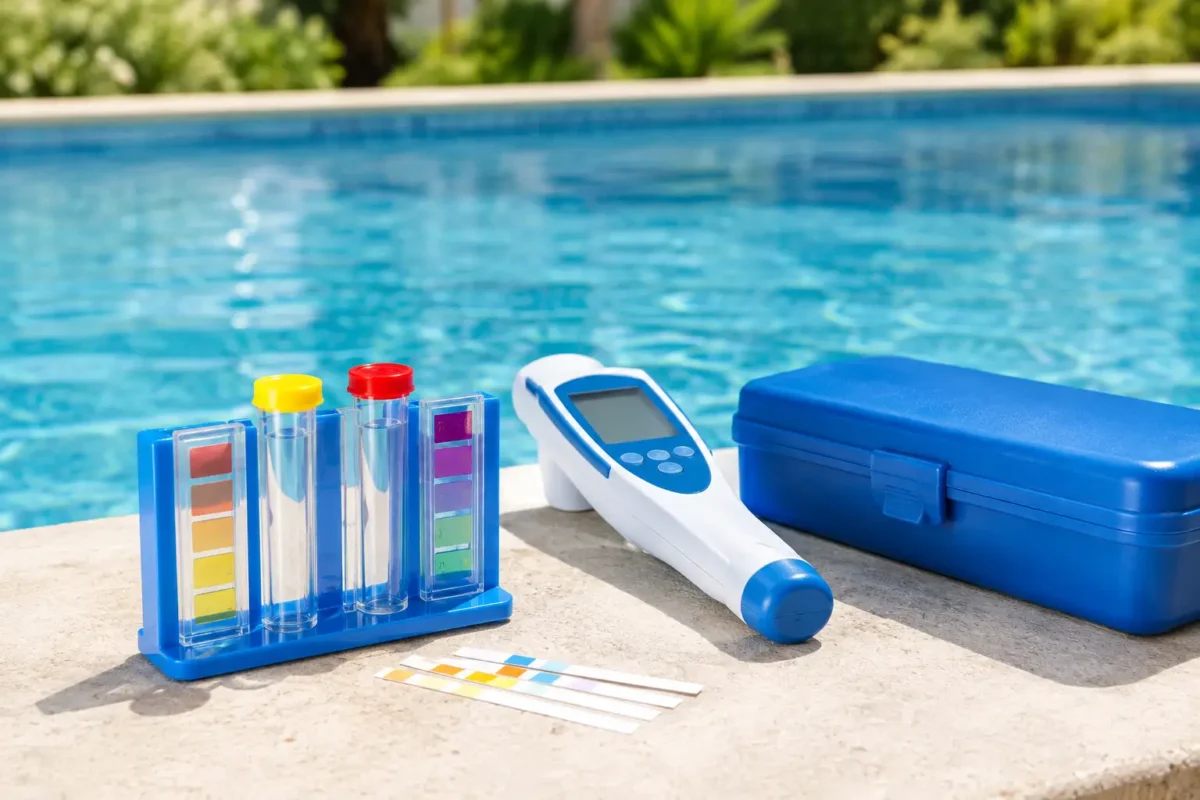
Test strips are quick, compact, and easy for homeowners or on-site staff to use. A strip is dipped into the water, held for the specified time, and compared with a color chart. Many versions measure chlorine, bromine, pH, alkalinity, hardness, and cyanuric acid in one test.
Their advantage is speed. They are useful for a daily confidence check before swimming or for identifying whether a more precise test is needed. Their limitation is interpretation. Sunlight, wet hands, expired strips, and subtle color differences can affect results. For a high-value pool environment, strips are best treated as a convenient screening tool rather than the only basis for chemical dosing.
Liquid Reagent Kits for Hands-On Accuracy
Liquid test kits remain a trusted option because they provide more controlled testing than most strips. The user fills a comparator cell with pool water, adds the specified drops of reagent, and matches the resulting color against a scale.
A quality kit can provide reliable chlorine and pH readings, with more comprehensive models covering alkalinity, calcium hardness, cyanuric acid, and other parameters. This method suits villa owners who want greater confidence in their maintenance decisions and technicians who need dependable field results without relying on electronics.
The trade-off is time and technique. Reagents must be stored away from heat and direct sun, bottles must not be contaminated, and the correct number of drops must be used. In the UAE climate, keeping test supplies in a cool, dry service area is particularly important for accuracy and shelf life.
Digital Pool Testers for Clear Numerical Results
Digital testers and photometers replace subjective color matching with numerical readings. Depending on the model, they may measure free and total chlorine, pH, alkalinity, calcium hardness, cyanuric acid, phosphate, salt, and other water-quality parameters.
For commercial pools, hospitality facilities, and large residential developments, this level of precision offers a real operational advantage. Technicians can document readings consistently, spot emerging trends, and adjust treatment with greater confidence. Digital testing is especially valuable when different team members share maintenance responsibility and results need to be compared over time.
Not every digital meter is automatically superior. Entry-level electronic pens can be useful for specific readings such as pH or total dissolved solids, but may not replace a complete pool photometer. Calibration, clean sample cells, correct tablets or reagents, and proper battery care are part of owning professional electronic equipment.
Automated Controllers for Continuous Oversight
Automated water-testing and dosing systems are designed for pools that demand ongoing control. Sensors measure parameters such as pH and oxidation-reduction potential, while connected dosing equipment can introduce acid or sanitizer according to programmed setpoints.
This is the strongest solution for busy commercial pools, hotels, wellness facilities, and premium properties where water quality must remain stable throughout operating hours. Automation reduces the risk of delayed manual adjustments and supports a more consistent guest experience. It does not eliminate manual verification. Sensors require routine calibration, cleaning, and professional inspection to remain reliable.
How to Choose a Tester for Your Pool
Start with the operating reality of the pool, not a product label. A lightly used residential pool with a standard chlorine system may only require quality strips for frequent checks and a liquid kit for weekly balance testing. A luxury villa with a heat-cool pump, salt system, or sensitive finish benefits from a broader kit or digital tester that can verify more parameters.
Commercial sites should prioritize repeatability, speed, and documentation. A photometer or professional-grade digital system is generally a better investment than relying on visual color comparisons alone. When a facility manager is responsible for multiple pools, standardizing one reliable testing process also improves staff training and maintenance accountability.
Consider these practical factors before selecting equipment:
- Parameters measured: Choose only the measurements relevant to your sanitizer system, surface finish, equipment, and source water.
- Required accuracy: Digital photometers provide more exact readings, while strips offer fast guidance for routine use.
- Testing frequency: Daily commercial testing calls for durable equipment and readily available consumables.
- Ease of operation: A sophisticated tester is only valuable when staff can use it consistently and correctly.
- Ongoing supplies: Reagents, tablets, calibration solutions, and replacement parts should be easy to source.
The best purchase is often a layered approach: fast strips for immediate checks, a more precise kit or photometer for scheduled testing, and professional water analysis when a persistent issue requires diagnosis.
Reading Results in a Hot-Climate Pool Environment
Warm, sunny conditions place special pressure on sanitizer management. Direct sun consumes unstabilized chlorine, while higher water temperatures can encourage algae growth and increase chemical demand. After a pool party, heavy occupancy, a dust event, or a period of extreme heat, testing should be increased rather than left to a fixed weekly schedule.
A result should never be viewed in isolation. Low chlorine may be caused by heavy bather load, sunlight exposure, organic debris, or a dosing problem. Repeated pH drift can point to inadequate alkalinity, an incorrect dosing setting, aeration from water features, or untreated source-water characteristics. High calcium hardness may require careful management to prevent scale on tiles, heaters, and fittings.
This is where professional technical support becomes valuable. The goal is not to keep adding chemicals until a single number changes. It is to understand the relationship between the readings and correct the underlying condition without placing unnecessary stress on the pool system.
Testing Habits That Protect Premium Pool Equipment
Take samples away from skimmers, return inlets, chemical feeders, and water features. Test at elbow depth whenever possible, using a clean container if the method requires one. This produces a sample that better represents the pool as a whole.
Follow the tester’s timing instructions exactly. With strips, do not shake off water or read the colors too early or too late. With reagent kits and photometers, use clean cells, avoid fingerprints on optical surfaces, and replace expired reagents. Record results for commercial pools and for any residential pool with automated treatment equipment.
Most importantly, do not treat water based on guesswork. Overcorrection is a common cause of discomfort, corrosion, cloudy water, and avoidable chemical expense. Make measured adjustments, circulate the water fully, and retest before making further changes.
For property owners and facility teams, water testing is not a minor maintenance chore. It is the daily quality-control step behind clear water, protected equipment, and a pool that remains worthy of the property around it. Aquatic Pools and Fountains can help match the right testing solution to the demands of your installation and maintenance program.