
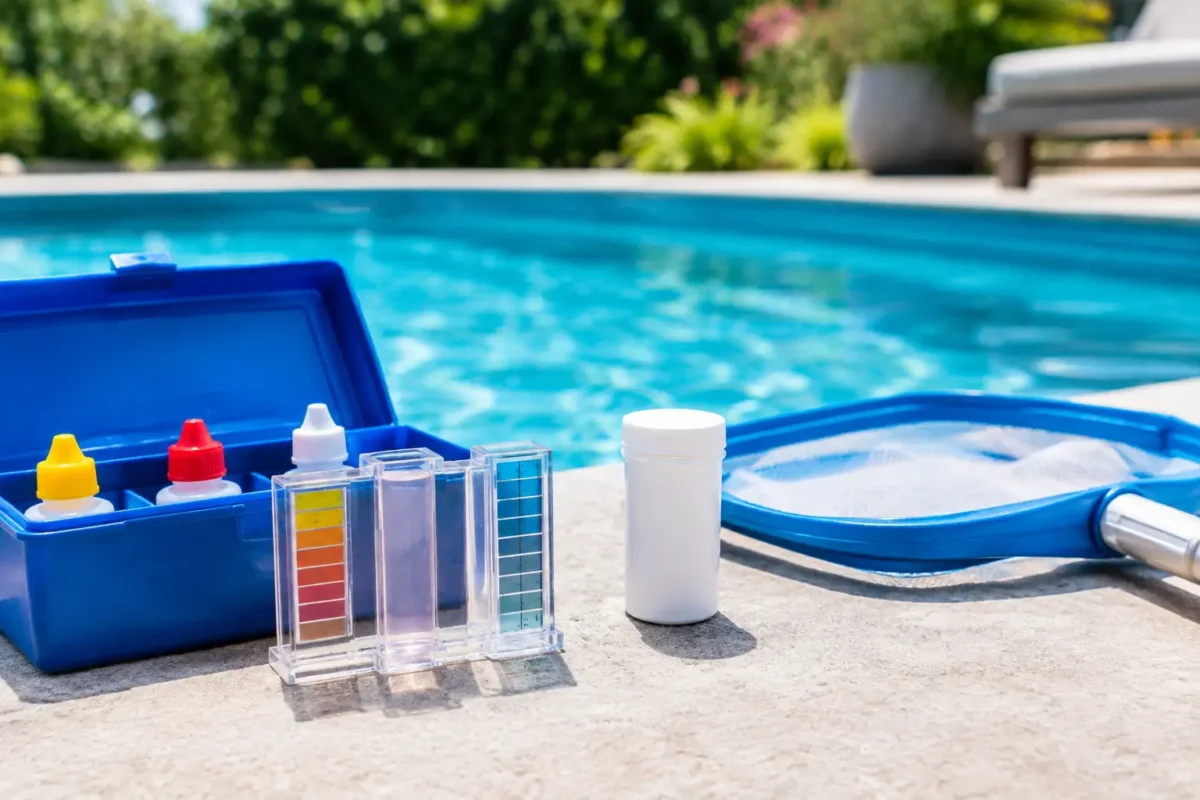
A pool can look brilliantly clear while its sanitizer is quietly losing effectiveness. In sun-exposed residential and commercial pools, knowing how often test cyanuric acid is a practical part of protecting water quality, equipment, finishes, and the guest experience. Cyanuric acid, also called CYA or pool conditioner, helps chlorine withstand ultraviolet sunlight. But when its level rises too far, chlorine becomes less responsive – a costly problem for high-use pools and premium aquatic installations.
How Often to Test Cyanuric Acid
For most outdoor pools, test cyanuric acid at least once a month during the active swimming season. This is a dependable baseline for a well-maintained private pool using stabilized chlorine products.
Monthly testing is not always enough. Test CYA every one to two weeks when a pool receives intense sunlight, frequent swimmer use, regular top-ups with treated water, or daily doses of stabilized chlorine tablets or granular shock. These conditions are common in warm, bright climates and at hotels, apartment communities, and other commercial properties where consistency cannot be left to guesswork.
A test is also required after a major chemical correction, significant rainfall, a partial drain and refill, or an unexplained period of cloudy water and weak chlorine performance. CYA does not evaporate or get consumed in the normal sanitizing process. It generally leaves the pool only when water is removed, splashed out, backwashed, or diluted. That is why levels can climb gradually without an obvious visual warning.
For indoor pools, cyanuric acid is often unnecessary because there is no direct UV exposure to protect against. Indoor facilities should confirm their treatment program with a qualified pool technician rather than adding conditioner by routine.
Why Cyanuric Acid Needs Consistent Attention
Cyanuric acid has a specific role: it forms a protective relationship with free chlorine, slowing the rate at which sunlight destroys it. Without enough CYA outdoors, chlorine can disappear quickly, especially during hot, clear days. Operators may keep adding chlorine but struggle to hold a measurable residual.
The trade-off is equally significant. Excess CYA holds chlorine too tightly, reducing the amount of active chlorine available to sanitize the water efficiently. A test strip may show an acceptable free-chlorine number, yet the pool can still be slow to control algae, contaminants, and early signs of cloudiness.
This is sometimes described as chlorine lock, although the term can oversimplify the issue. Chlorine is not permanently locked. It is less active relative to the CYA concentration, so the pool needs a carefully managed chlorine level and, in many cases, partial water replacement to restore balance.
For a luxury villa, the result may be avoidable chemical expense and a pool that loses its polished appearance. For a hotel, fitness club, or residential development, it can create operational disruption, guest complaints, and unnecessary strain on the maintenance team. Precise testing protects both visual standards and water-treatment performance.
Recommended CYA Ranges for Outdoor Pools
The right target depends on the disinfection method and the pool’s operating conditions. Most traditionally chlorinated outdoor pools perform well with cyanuric acid in the 30 to 50 ppm range. This provides useful UV protection without allowing conditioner to dominate chlorine activity.
Saltwater chlorine generator pools commonly operate at a somewhat higher range, often 60 to 80 ppm, depending on the manufacturer’s requirements. The salt system manual should always take priority, since cell design, output capacity, bather load, and local conditions affect the recommended setting.
Once CYA reaches 80 ppm in a conventional chlorine pool, closer attention is warranted. At 100 ppm or higher, dilution is frequently the most reliable correction. Adding more chlorine may temporarily improve a reading, but it does not remove the underlying excess conditioner.
There is no benefit in chasing a single number without context. A shaded pool with low swimmer use behaves differently from an exposed infinity pool, a busy hospitality pool, or a water feature with its own treatment circuit. The goal is a stable range supported by an appropriate chlorine program, circulation time, filtration performance, pH control, and regular professional oversight.
Test More Often When Using Stabilized Chlorine
The fastest route to excessive cyanuric acid is routine use of stabilized chlorine. Trichlor tablets and dichlor granules both add CYA along with chlorine. They are convenient products, but convenience should not replace testing.
A tablet feeder can steadily raise CYA over weeks or months, particularly in pools with limited water replacement. Dichlor shock can do the same when it is used as the primary shock treatment. If either product is part of the maintenance routine, a monthly CYA test is the minimum, not the ideal maximum.
Unstabilized chlorine options do not add cyanuric acid. These may include liquid chlorine, calcium hypochlorite, or chlorine generated by a saltwater system. They still require balanced water chemistry and correct handling, but they can help prevent CYA from continuing to rise once the desired level has been reached.
The right product combination depends on the pool’s design and operating needs. Calcium-based products, for example, may affect calcium hardness, while liquid chlorine can influence pH. A premium maintenance plan considers the complete water balance rather than addressing one reading in isolation.
How to Test Cyanuric Acid Accurately
CYA is commonly measured with test strips, a liquid reagent kit, or a digital water-testing system. Test strips are fast and useful for routine checks, but their CYA color blocks can be difficult to interpret, especially under artificial lighting or when levels are high. They are best treated as a screening tool.
For more dependable decisions, use a quality drop-based test kit or have the sample analyzed with professional water-testing equipment. Collect water from elbow depth, away from return jets, skimmers, and chemical feeders. Use a clean container, and test promptly rather than leaving the sample in direct sun.
Cyanuric acid tests are naturally less precise than tests for pH or free chlorine. A result may reasonably fall within a range rather than an exact point. That is another reason to act on a consistent trend, not one isolated reading that appears slightly above or below target.
For commercial sites and managed properties, document each result with the date, free chlorine, pH, total alkalinity, and any chemicals added. This record makes it easier to identify why a pool’s chemistry is changing and supports efficient maintenance planning.
What to Do When CYA Is Too Low or Too High
If cyanuric acid is below 30 ppm in an outdoor chlorine pool, add conditioner carefully according to the product label and pool volume. CYA dissolves slowly and should not be poured directly into a skimmer unless the equipment manufacturer specifically permits it. A common method is to place the required amount in a sock or fine mesh bag and position it in front of a return flow, keeping it away from surfaces.
Do not retest immediately after adding conditioner. It can take 24 to 48 hours, and sometimes longer, to distribute fully. Keep the circulation system running and avoid adding more product based on an early result.
If CYA is too high, there is no dependable chemical shortcut that replaces dilution in most pools. The usual corrective action is a partial drain and refill with fresh water, followed by retesting and rebalancing. The amount of water replaced should be calculated carefully, particularly for tiled pools, elevated structures, and commercial installations where hydrostatic pressure, water costs, drainage arrangements, and local operating procedures matter.
Never drain a pool without professional assessment. In some locations and construction types, groundwater pressure can create serious structural risk when a pool is emptied or substantially lowered.
Build CYA Testing Into a Better Maintenance Standard
Cyanuric acid should be part of a regular testing schedule, not a number checked only when algae appears. Daily or frequent checks of free chlorine and pH remain essential, while CYA provides the wider context that explains whether chlorine is likely to perform as intended under sunlight.
For property managers and hospitality operators, a scheduled professional water analysis brings added value. It helps align chemical use with actual pool conditions, reduces unnecessary product consumption, and protects filters, pumps, heaters, salt cells, and premium finishes from the consequences of imbalanced water.
Aquatic Pools and Fountains supports pool owners and commercial facilities with quality testing systems, treatment equipment, chemicals, and technical maintenance guidance designed for reliable long-term performance. When CYA results do not make sense alongside chlorine readings, a complete water-balance assessment is the most efficient next step.
A clear pool should not be judged by appearance alone. Make cyanuric acid testing a disciplined monthly habit – and increase the frequency whenever sunlight, stabilized chlorine, or heavy use gives the water chemistry more to manage.