Aquatic

Categories
Uncategorized

Choosing the Right Spa and Pool Fittings

A pool can look flawless on the surface and still underperform because of the small components behind the finish. That is why spa and pool fittings deserve more attention during planning, specification, and maintenance. These parts control water movement, support safety, protect equipment, and shape the overall user experience in both residential and commercial installations.

For villa owners, developers, hospitality operators, and facility teams, fittings are not a minor line item. They influence circulation quality, visual finish, durability, and service life. In a market like Dubai and the wider UAE, where pools and spas operate in demanding conditions and design standards are high, selecting the right fittings is a technical decision as much as an aesthetic one.

Why spa and pool fittings matter more than most buyers expect

A premium pool system depends on more than pumps, filters, and lights. The fittings connect the system, direct the water, and help each core component do its job properly. Return inlets, main drains, suction fittings, vacuum points, skimmers, overflow components, and jets all work together to maintain circulation and keep the water clean, balanced, and comfortable.

When these components are chosen well, the system runs efficiently and the finish remains refined. When they are selected based only on price or appearance, issues tend to appear later – poor circulation, pressure imbalance, difficult maintenance access, visible wear, or premature replacement.

For commercial properties, the stakes are even higher. Hotels, residential towers, and wellness facilities need fittings that perform consistently under heavy use. Residential buyers may prioritize appearance and ease of care, while commercial buyers often focus on durability, code alignment, and serviceability. In practice, both groups need the same thing: dependable fittings that match the demands of the project.

Core spa and pool fittings and what they do

Not every project uses the same configuration, but certain fittings are central to most systems. Main drains and suction fittings help pull water through the circulation system. Return inlets send treated water back into the pool and influence how effectively water moves across the vessel. Skimmers remove floating debris before it sinks or reaches the filtration equipment.

In spa systems, jets, air controls, and specialized suction and return fittings shape the comfort experience. The placement and quality of these parts affect hydrotherapy performance, noise levels, and overall user comfort. A spa that looks impressive but delivers uneven jet pressure will never feel premium in use.

Overflow and balancing tank fittings are also critical in many high-end and commercial designs. These elements support water level management and cleaner visual lines, especially where mirror-edge or infinity-edge effects are part of the design brief. In decorative or architecturally sensitive settings, the fitting must do its job without disrupting the visual language of the installation.

How to evaluate spa and pool fittings for premium projects

The right selection starts with matching the fitting to the hydraulic design, finish material, and usage profile. A fitting that performs well in a compact private plunge pool may not be suitable for a large commercial pool or a heavily used spa. Flow rate, vessel size, bather load, and maintenance access all matter.

Material quality is one of the first things to assess. In premium projects, buyers typically look for fittings built to resist chemical exposure, UV stress, and constant water contact without fading, cracking, or degrading. This is particularly important in outdoor UAE environments where heat and prolonged sun exposure can accelerate wear.

Finish is another practical concern, not just a visual one. Stainless steel, engineered plastics, and specialty finishes each have their place. Stainless steel often suits high-visibility or luxury environments because it offers a polished appearance and strong durability. High-grade plastic fittings can also perform very well, especially where corrosion resistance, cost control, or discreet integration are priorities. The better choice depends on the environment and the design intent.

Installation compatibility should never be treated as an afterthought. The fitting must work cleanly with the pool shell, tile or stone finish, waterproofing approach, and pipe layout. A premium-looking component that creates installation complications or future leak risks is not a premium solution.

Spa and pool fittings for residential vs commercial use

Residential projects usually allow more flexibility in styling and feature selection. Homeowners may want discreet returns, elegant drain covers, and spa jets that blend into the finish. In these settings, the best outcome often comes from balancing performance with a clean visual presentation.

Commercial projects tend to demand a tougher specification. Fittings in hotels, health clubs, residential towers, and public-use environments must handle heavier cycles, more frequent maintenance, and stricter operational expectations. In these cases, easy access, repeatable performance, and long-term durability often carry more weight than purely decorative concerns.

That said, the difference is not always strict. A luxury villa with a large family spa may need fittings closer in quality and durability to commercial-grade selections. A boutique hospitality project may also require fittings that are both visually refined and technically resilient. The right specification depends on actual use, not labels alone.

Common mistakes when selecting fittings

One of the most common issues is treating fittings as interchangeable. They are not. Small differences in flow capacity, mounting style, material grade, and compatibility can affect system performance and maintenance over time.

Another mistake is underestimating the importance of hydraulic balance. If returns, suctions, or jets are poorly placed or wrongly sized, the result may be dead spots, weak circulation, and inconsistent treatment distribution. These problems can lead to higher maintenance effort and less reliable water quality.

Buyers also sometimes focus heavily on visible equipment while overlooking hidden system components. Pumps and lights attract attention, but fittings often determine whether those premium systems perform as intended. The visible finish may set the first impression, yet the concealed details protect long-term value.

A final issue is choosing products without technical guidance. On paper, many fittings look similar. In real applications, installation conditions, water chemistry, and operating patterns reveal major differences. Experienced support during specification helps avoid expensive corrections later.

The value of coordinated supply and technical support

Sourcing spa and pool fittings from a supplier with technical depth offers a clear advantage. Product availability matters, but project success depends on more than stock. Buyers benefit when the supplier can guide selection, align fittings with pumps and filtration systems, support installation teams, and remain available for maintenance needs after commissioning.

This is especially valuable for developers, facility managers, and procurement teams handling multiple assets or complex sites. Standardizing quality across projects, reducing replacement cycles, and simplifying service planning all start with the right specification stage support.

For premium residential clients, technical support brings confidence. It means the chosen fitting is not only elegant but also suitable for the vessel design, finish detail, and expected usage. That combination protects both the appearance and the performance of the investment.

Aquatic Pools and Fountains serves this need by combining product range, technical guidance, and installation and maintenance support for high-end residential and commercial aquatic environments.

What to look for in a supplier of spa and pool fittings

A serious supplier should offer breadth, but also clarity. Buyers need access to quality fittings across key categories, along with practical guidance on what suits each application. The ability to source from recognized global brands is important, yet so is the ability to recommend the right product rather than simply the most available one.

Responsiveness matters too. Delays in replacing a drain cover, return fitting, or spa jet can affect project timelines and operational continuity. Strong stock availability helps, but reliable after-sales support is what turns a supplier into a long-term project partner.

It is also worth assessing whether the supplier understands the level of finish your property requires. In luxury and commercial settings, details are visible. A poorly matched fitting can interrupt the design language of the entire water feature. A well-selected one supports the architecture quietly and effectively.

Spa and pool fittings as a long-term investment

The most successful pool and spa environments are built on consistent technical decisions. Fittings may be smaller than pumps, filters, or heat systems, but they have an outsized impact on circulation, appearance, maintenance, and user satisfaction.

Choosing well means looking beyond catalog images and unit pricing. It means asking how the fitting will perform after months of heat, chemicals, daily use, and routine cleaning. It means selecting components that support both the engineering of the system and the standard of the property.

When spa and pool fittings are specified with care, they help create water environments that look polished, operate reliably, and hold their value over time. That is the level of detail premium projects deserve, and it is often where the difference between average and exceptional becomes clear.

Categories
Uncategorized

Pool Chlorine vs Bromine: Which Fits Best?

A pool can look flawless on the surface and still have the wrong sanitizer working behind the scenes. When clients ask about pool chlorine vs bromine, they are usually not asking for chemistry theory. They want to know which option protects water quality better, which one is easier to manage, and which one makes more sense for a premium residential or commercial installation.

That is the right question. Sanitizer choice affects swimmer comfort, maintenance routines, operating costs, equipment performance, and the long-term consistency of your water treatment strategy. In luxury villas, hospitality projects, residential towers, and high-use commercial facilities, the best answer is rarely about trends. It is about matching the sanitizer to the environment, the system design, and the performance standard expected from the pool.

Pool chlorine vs bromine: the core difference

Both chlorine and bromine are disinfectants. Their main role is to kill bacteria, control contaminants, and help keep pool water safe and clear. The difference is in how they behave once they enter the water.

Chlorine is the more common choice for swimming pools. It is widely available, cost-effective, and highly efficient when properly balanced. It works quickly, responds well to regular water treatment programs, and suits a broad range of residential and commercial pool applications.

Bromine is also an effective sanitizer, but it is more often associated with spas, hot tubs, and warmer water environments. It tends to remain stable at higher temperatures and can be gentler in terms of odor. That said, it usually comes at a higher operating cost and is not always the first choice for large outdoor pools.

For most standard pool installations, chlorine remains the dominant option. Bromine has strengths, but those strengths are more specific.

How chlorine performs in residential and commercial pools

Chlorine is popular for good reason. It acts fast, it is easier to source, and it integrates well with many modern disinfection setups. For property owners and facility managers focused on dependable performance, it offers a practical and scalable solution.

In outdoor pools, chlorine has a major advantage because it works well within established maintenance programs and can be supported by stabilizers, automated dosing systems, and regular testing routines. This makes it suitable for villa pools, apartment amenities, hotel pools, and large recreational systems where clarity and sanitation must remain consistent.

Chlorine also gives operators more straightforward control. If there is a sudden rise in swimmer load, debris, or contamination, chlorine can be adjusted quickly. That responsiveness matters in commercial settings where water conditions can change fast.

The trade-off is familiar. Chlorine can produce a stronger smell if water balance is poor, and some swimmers report eye or skin irritation when the chemistry is not managed correctly. In many cases, that is less a chlorine problem and more a maintenance problem. Proper pH, filtration, circulation, and dosing make a major difference.

Where bromine stands out

Bromine has a different profile. Its most recognized advantage is stability in warm water, which is why it is frequently chosen for spas and heated environments. If a water feature or small leisure pool runs at elevated temperatures, bromine may hold its disinfecting ability more effectively than chlorine.

It also tends to create less noticeable chemical odor. For indoor environments or enclosed leisure spaces, that can be attractive. Some users also find bromine-treated water more comfortable on the skin.

However, bromine is not automatically the premium choice just because it feels gentler. It is usually more expensive than chlorine, especially over time, and its use in larger pools can become less economical. It is also less common in standard outdoor pool operations, which means some owners and operators may find chlorine-based systems easier to support with readily available products, service routines, and technical expertise.

Sunlight is another factor. Bromine is not the strongest choice for outdoor pools exposed to intense UV conditions. In climates with strong year-round sun, this matters. A sanitizer that performs well in a spa or indoor setting may not deliver the same value in a large open-air pool.

Pool chlorine vs bromine in the UAE climate

In hot, high-UV conditions, sanitizer performance cannot be evaluated in isolation. Ambient temperature, water temperature, bather load, dust, evaporation, and strong sunlight all influence the result. That is why pool chlorine vs bromine should always be considered in the context of the site.

For many outdoor pools in Dubai and across the UAE, chlorine is the more practical and reliable option. It supports efficient large-scale treatment, works well with automated systems, and aligns with the operational needs of both residential and commercial pools exposed to harsh environmental conditions.

Bromine becomes more relevant in specific installations, especially indoor pools, spas, hydrotherapy systems, and heated water applications where temperature stability and user comfort are priorities. In those cases, the added cost may be justified by the operating environment.

This is where technical planning matters. A premium pool should not be treated with a one-size-fits-all chemical strategy. The sanitizer should suit the design, circulation system, usage pattern, and maintenance framework from day one.

Cost, maintenance, and long-term value

If cost is a deciding factor, chlorine usually wins. The product itself is generally more affordable, and the broader market availability makes replenishment and service planning easier. For large pools, this can have a significant impact on annual operating budgets.

Bromine often carries a higher product cost and may require a more deliberate approach to supply and monitoring. That does not make it a poor option. It simply means it is better suited to installations where its specific benefits outweigh the expense.

From a maintenance perspective, both sanitizers still require disciplined water testing, filtration support, and proper balancing. Neither one eliminates the need for professional oversight. A well-designed treatment program includes sanitizer control, pH management, circulation efficiency, and regular equipment inspection.

High-end pools deserve that level of attention. The sanitizer is only one part of the performance picture. Pumps, filters, dosing systems, test kits, and operator response all affect the final water quality.

Which one is better for swimmer comfort?

This is often where opinions become subjective. Some bathers prefer bromine because it can feel less harsh and produce less chemical smell. Others are perfectly comfortable in chlorine-treated water when the system is balanced correctly.

The key point is this: properly maintained water should not feel aggressive regardless of sanitizer type. Red eyes, strong odor, or irritated skin usually point to imbalance, poor ventilation, or inadequate treatment control rather than a simple chlorine-versus-bromine issue.

For hospitality and luxury residential environments, comfort is essential. Guests and residents expect water that looks inviting and feels clean without the heavy chemical impression associated with neglected pools. That standard can be achieved with either sanitizer, but chlorine tends to offer more flexibility and value in larger pool settings.

How to choose the right sanitizer

The strongest choice depends on the application. For most outdoor residential and commercial pools, chlorine is the preferred solution because it delivers efficient sanitation, easier system integration, and stronger cost control. It is the industry standard because it performs consistently across a wide range of pool types.

Bromine is worth considering when the installation involves heated water, enclosed environments, or spa-focused use where temperature resilience and lower odor are priorities. In those scenarios, it can be an excellent fit.

For developers, facility managers, and property owners, the smartest decision is not just choosing a chemical. It is building the right treatment strategy around the pool. That means selecting the correct sanitizer, pairing it with dependable equipment, and ensuring the maintenance approach is designed for the actual demands of the site.

At Aquatic Pools and Fountains, that is where technical guidance adds value. Premium pools require more than stocked products. They require the right specification, the right system support, and a service partner that understands performance over the long term.

Final thought

If you are deciding between chlorine and bromine, start with how the pool will actually be used, not with assumptions about which sanitizer sounds more advanced. The best water treatment choice is the one that stays effective under your conditions, supports elegant water quality every day, and protects the investment you have made in the pool itself.

Categories
Uncategorized

Pool Salt Chlorinator Review: What Matters

A pool that looks flawless at 10 a.m. can turn cloudy by late afternoon if the chlorination system is undersized, poorly installed, or simply not built for local conditions. That is why any serious pool salt chlorinator review should go beyond brochure claims and focus on what actually affects water quality, equipment life, and day-to-day operating stability.

For villa owners, hospitality operators, and facility managers, a salt chlorinator is not just a convenience upgrade. It is a core part of water treatment performance. The right system can reduce chemical handling, improve swimmer comfort, and deliver more consistent sanitation. The wrong one can create scaling, unstable chlorine output, premature cell failure, and unnecessary maintenance calls.

Pool salt chlorinator review – the criteria that actually matter

Most buyers start by comparing output ratings and price. That is understandable, but it is not enough. A premium chlorinator should be assessed on five practical factors: chlorine production capacity, cell durability, control accuracy, compatibility with the full filtration setup, and after-sales service.

Chlorine production capacity is where many purchasing mistakes begin. Manufacturers often publish ideal output figures under favorable conditions, but real pools rarely operate in ideal conditions year-round. High bather load, intense sunlight, warm water, and long circulation hours all increase chlorine demand. In markets such as Dubai and across the UAE, those factors become even more relevant. A unit that looks sufficient on paper may struggle in actual service if it is sized too close to the pool volume.

Cell durability is equally important. The electrolytic cell is the working heart of the system, and its lifespan depends on coating quality, water balance, run time, and cleaning frequency. Premium models usually justify their higher price through stronger cell construction, more stable output, and better resistance to harsh operating environments. Budget units often become expensive later because replacement intervals arrive sooner than expected.

Control accuracy separates basic systems from professional-grade equipment. A chlorinator that allows precise output adjustment, clear diagnostics, and dependable monitoring gives operators more control over water quality. This matters in both residential and commercial settings. A luxury villa owner wants clean, comfortable water without constant manual corrections. A facility manager wants predictable performance, fewer service interruptions, and easier record-keeping.

What a good salt chlorinator does well

A strong salt chlorinator should produce chlorine consistently without forcing the pool owner to chase chemistry every few days. Good systems maintain output even when conditions shift, provided the pool is properly balanced and circulation is adequate. They also integrate cleanly with pumps, filters, dosing equipment, and control panels rather than operating as a disconnected add-on.

The best units are also straightforward to service. This point is often ignored during purchase. Access to replacement cells, compatible spare parts, and qualified technical support has a direct effect on long-term value. A lower-priced system with weak local support can become a poor investment very quickly.

Another sign of quality is protective intelligence. Better chlorinators include flow detection, salt level warnings, temperature-related safeguards, and fault alerts that help prevent damage. These features are not marketing extras. They reduce avoidable wear and help protect the wider pool system.

Common trade-offs in any pool salt chlorinator review

There is no single best chlorinator for every pool. The right choice depends on pool volume, usage pattern, hydraulic design, exposure to sun, and how much automation the client expects.

A smaller residential pool with modest usage may perform very well with a mid-range unit if the system is correctly sized and maintained. A large villa pool with water features, high temperatures, and frequent guests may need a higher-capacity chlorinator than the water volume alone suggests. Commercial pools, hotel pools, and shared community facilities require even more caution because bather load and compliance expectations are higher.

There is also a clear trade-off between upfront cost and lifecycle value. Entry-level systems can be attractive for initial budgeting, but they may offer shorter cell life, fewer controls, and less refined diagnostics. Premium systems usually cost more because they are engineered for stability, stronger materials, and more dependable long-term operation. For high-value properties, this difference is often worth paying for.

Salt chlorination itself also has limits. It can reduce the need for manual chlorine dosing, but it does not remove the need for proper pH control, filtration, circulation, and routine testing. If these supporting elements are neglected, even an excellent chlorinator will underperform.

Sizing is where most buyers get it wrong

If there is one point every buyer should take from a pool salt chlorinator review, it is this: never size the system to the absolute minimum requirement. A chlorinator should have comfortable production headroom.

Why does that matter? Because chlorine demand changes. Summer heat raises consumption. Heavy pool use raises consumption. Dust, organic debris, and long sun exposure raise consumption. If the system is already operating near maximum output during normal conditions, it has no reserve when demand spikes. That is when water clarity drops and complaints begin.

Oversizing within reason is usually the smarter decision for premium residential and commercial pools. A properly selected larger unit can run at a lower output setting, reducing stress on the cell while preserving strong sanitizing capacity when needed. This can improve reliability and support longer component life.

Installation quality matters as much as product quality

A high-end chlorinator installed badly will not behave like a high-end system. Proper pipe layout, correct flow conditions, suitable cell placement, sound electrical work, and accurate programming all influence performance.

The chlorinator must work as part of a coordinated treatment system. Pump run times need to match chlorine demand. Filters need to be sized and maintained correctly. Water balance must stay within range to avoid scale buildup on the cell. If the installation team understands only the product and not the full pool environment, results can be inconsistent.

This is why many sophisticated property owners and developers prefer working with a supplier that can support specification, installation, and ongoing technical service. Aquatic Pools and Fountains operates in exactly that space, where equipment quality and execution quality are treated as one standard rather than two separate decisions.

Best fit by pool type

For private villa pools, comfort and simplicity usually lead the buying decision. Homeowners want soft-feeling water, reduced chemical odor, and stable sanitation without daily attention. In this case, quiet operation, intuitive controls, and a dependable cell matter more than advanced commercial-style programming.

For hospitality and commercial properties, the priorities shift. Here, output stability, monitoring capability, heavy-duty construction, and service access become essential. Downtime has a higher cost. Water quality issues affect guest experience, reputation, and maintenance workload. Commercial buyers should be especially cautious about selecting systems intended mainly for light residential use.

For real estate developments and shared facilities, standardization can also matter. Using proven systems with consistent parts availability and trained service support can simplify maintenance across multiple assets. That often delivers more value than choosing the lowest initial price on each individual unit.

Red flags to watch before you buy

A chlorinator deserves closer scrutiny if its output rating seems optimistic for the size of pool being promoted, if replacement cell costs are unclear, or if the product has limited technical support in your market. Vague warranty terms are another warning sign. So is any proposal that focuses on the chlorinator alone without reviewing circulation, filtration, and water balance.

Be careful with claims that make salt systems sound maintenance-free. They are lower-touch than many traditional setups, but they still need testing, cleaning, and periodic inspection. Serious suppliers explain that clearly because long-term performance depends on realistic expectations.

Final verdict

The best result from a pool salt chlorinator review is not finding the cheapest box with the highest claimed output. It is choosing a system that matches the pool’s true demand, the site conditions, and the service standard expected from the property.

For premium residential and commercial pools, quality usually shows up in the details – stronger cells, smarter controls, reliable safety features, proper sizing, and professional support after installation. When those factors are in place, a salt chlorinator becomes more than a sanitation device. It becomes part of a cleaner, more stable, and more elegant pool experience.

If you are selecting a chlorinator for a new build, renovation, or replacement project, treat the decision as a technical investment rather than a catalog purchase. The pool will tell you very quickly whether that choice was made well.

Categories
Uncategorized

Choosing Commercial Pool Maintenance Equipment

A hotel pool that looks perfect at 8 a.m. can be under pressure by noon. Heavy swimmer loads, heat, windblown debris, and strict hygiene expectations leave very little room for equipment failure. That is why commercial pool maintenance equipment is not a minor purchasing decision. For hospitality operators, facility managers, developers, and property owners, it directly affects water quality, operating cost, guest experience, and asset value.

Commercial pools demand a different standard than residential systems. They run longer, serve more users, and face tighter performance expectations every day. Equipment in these settings must handle continuous circulation, reliable filtration, accurate dosing, and consistent cleaning without becoming a maintenance burden itself. When the right system is specified from the start, the pool stays clearer, safer, and easier to manage.

What commercial pool maintenance equipment really includes

Many buyers think first about vacuums or cleaning tools, but the category is much broader. Commercial pool maintenance equipment includes pumps, filters, disinfection systems, chemical dosing units, water testing systems, automatic cleaners, skimmers, strainers, UV or supplementary sanitation components, and the supporting fittings that keep everything working together.

In premium properties, the equipment room is where performance is won or lost. A strong finish, attractive lighting, and elegant decking matter, but poor circulation or unstable chemistry will quickly overshadow every design feature. The most successful commercial installations are built around dependable mechanical and water treatment systems that can perform under daily pressure.

Start with circulation and filtration

If the circulation system is undersized, every other maintenance task becomes harder. Pumps need to move water efficiently enough to support turnover requirements without driving energy consumption too high. In a commercial setting, this balance matters. Oversizing can waste power, but undersizing often creates more expensive problems through poor water movement, uneven chemical distribution, and stressed filtration.

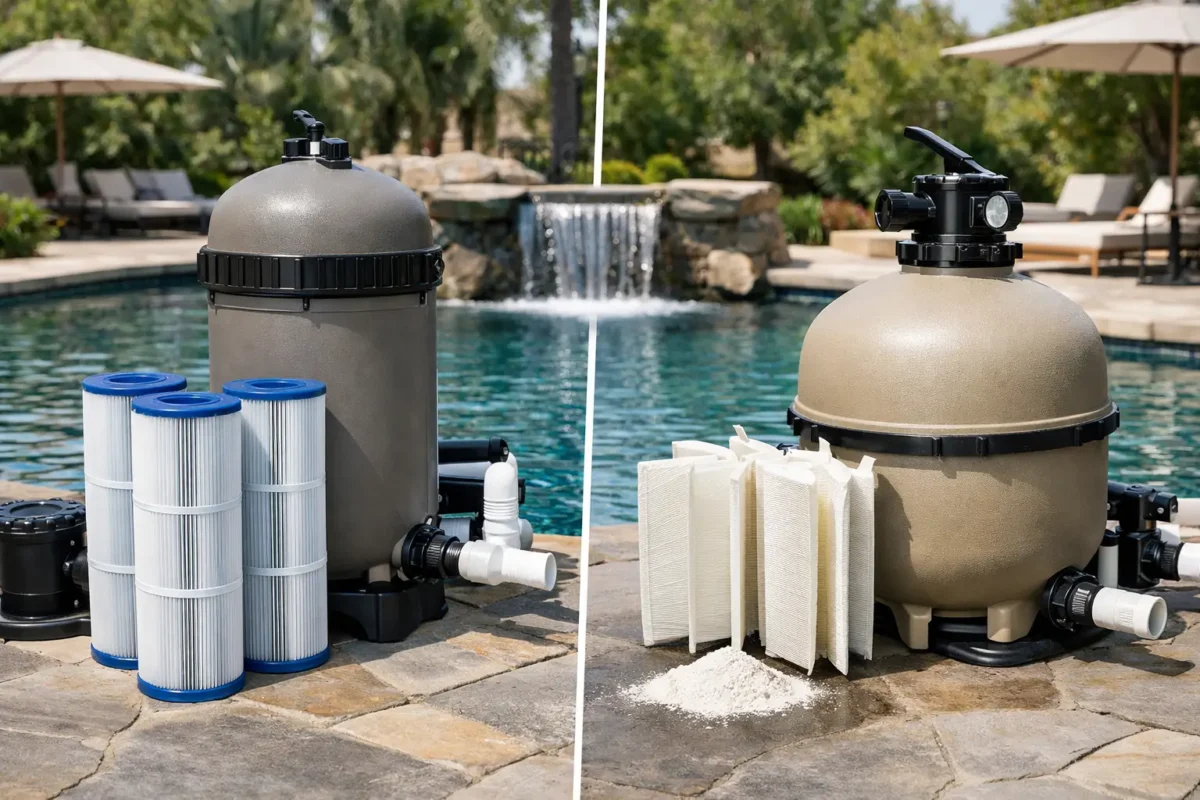
Filters are just as critical. The right filter depends on bather load, operating hours, water features, and the level of clarity the property expects. Sand filters remain a common choice for durability and straightforward maintenance. Media filters can offer improved fine-particle capture, while cartridge and other specialized solutions may suit selected applications. There is no single best answer for every site. A resort pool, a residential tower amenity pool, and a therapy pool may all require different filtration strategies.

For commercial buyers, the key question is not simply which filter is popular. It is which filter can maintain water clarity consistently while fitting the maintenance capacity of the site team. Backwash demand, service intervals, replacement cost, and hydraulic compatibility all need to be considered together.

Disinfection systems are where reliability matters most

A commercial pool cannot rely on inconsistent manual treatment. Water chemistry must stay controlled throughout operating hours, especially in facilities with changing swimmer loads. That is why high-quality disinfection and dosing systems are central to any serious commercial pool maintenance equipment plan.

Automatic chemical dosing helps maintain stable sanitizer and pH levels with far greater accuracy than manual intervention alone. This protects bathers, reduces chemical waste, and helps prevent the swings that lead to irritation, cloudy water, or premature wear on finishes and equipment. In high-end facilities, precision is not a luxury. It is part of protecting the property’s reputation.

Supplementary systems such as UV or advanced disinfection technologies can also strengthen performance, particularly in heavily used pools where water quality expectations are high. These systems do not replace the core sanitation process, but they can support better overall treatment when integrated correctly. The right setup depends on pool usage, local requirements, and the operator’s maintenance goals.

Cleaning equipment should match the pool’s operating reality

Cleaning is where many facilities underinvest. A commercial pool may look manageable on paper, yet daily debris load can vary dramatically depending on landscaping, foot traffic, weather exposure, and surrounding construction activity. Choosing cleaning tools without factoring in these conditions often leads to wasted labor and inconsistent results.

Automatic pool cleaners can reduce manual effort and improve cleaning frequency, especially in larger basins or properties that need presentable water at all times. Manual vacuums, brushes, leaf tools, and telescopic equipment still have an important role, especially around steps, corners, overflow edges, and detail areas where automated systems may miss buildup.

The best approach is usually a combination. Automation handles routine floor coverage, while manual tools support targeted cleaning and visual finishing. For busy hotels, residential communities, and commercial leisure spaces, that blend often produces the most reliable result.

Water testing systems protect both safety and efficiency

Without accurate testing, maintenance becomes guesswork. Commercial water conditions can shift quickly, particularly during peak occupancy periods. Reliable water testing systems allow operators to respond before small imbalances become visible problems.

Digital monitoring and dependable test equipment support better control of sanitizer, pH, alkalinity, and other key values. This protects swimmer comfort and helps preserve the life of pumps, heaters, filters, and finishes. It also reduces the hidden cost of overcorrecting water chemistry, which is common when readings are delayed or inconsistent.

For developers and property managers, this is where premium equipment earns its value over time. Better monitoring typically means fewer disruptions, less reactive maintenance, and stronger confidence that the pool is operating at the expected standard.

Durability is not optional in the UAE climate

In Dubai and across the UAE, equipment selection must reflect environmental reality. Heat, dust, high usage cycles, and demanding water conditions can expose weaknesses fast. Commercial-grade materials, corrosion-resistant components, and dependable brand quality matter far more than headline pricing alone.

This is especially true for pumps, fittings, dosing assemblies, and control systems installed in equipment rooms that run daily under sustained load. Lower-grade equipment may appear cost-effective during procurement, but repeated service issues, reduced efficiency, and shorter replacement cycles usually erase those savings. Premium facilities need equipment that holds performance over time, not only at handover.

Why integration matters more than single-product selection

One strong pump will not fix a poorly planned system. Commercial pool maintenance equipment performs best when it is selected as a coordinated package. Flow rates, filter capacity, dosing response, automation compatibility, and servicing access all need to align.

This is where experienced technical guidance makes a measurable difference. The goal is not just to supply parts. It is to create a maintenance ecosystem that works efficiently under real operating conditions. That may mean recommending a different pump curve, revising filter sizing, improving access for service teams, or adding monitoring equipment that reduces long-term intervention.

For commercial properties, integrated planning often delivers the biggest operational gains. It supports cleaner water, more predictable maintenance schedules, and less downtime during high-demand periods.

What commercial buyers should evaluate before purchasing

Price always matters, but it should never be the only measure. Commercial buyers should look at expected daily load, ease of maintenance, spare parts availability, energy efficiency, service support, and brand reliability. Equipment that is difficult to maintain or slow to service can create ongoing operational friction, even if the initial purchase cost looks attractive.

It is also worth considering whether the supplier can support installation, commissioning, troubleshooting, and future upgrades. Commercial pool environments rarely stay static. A hospitality property may expand services, a residential asset may increase occupancy, or a facility may need to improve sanitation standards. Working with a capable full-scope partner provides far more value than sourcing isolated products from multiple channels.

For this reason, many property owners and operators prefer a supplier that can advise across pumps, filters, cleaning systems, chemicals, testing, and technical support rather than treating each category as a separate transaction. Aquatic Pools and Fountains serves this need with a broad equipment portfolio and service-driven expertise tailored to premium residential and commercial environments.

Choosing for performance, not just compliance

Meeting baseline requirements is only the starting point. The stronger objective is to equip the pool for consistent visual appeal, dependable hygiene control, and practical ease of operation. That is what protects the guest experience in hospitality settings and the long-term value of high-end real estate assets.

Commercial pool maintenance equipment should never be selected as an afterthought once the pool is already built. It deserves the same level of planning as the visible design elements because it determines whether the water stays inviting day after day. When the equipment is right, the pool looks better, operates smarter, and demands less reactive attention from the people responsible for it.

The right investment is the one that keeps your pool ready for use, easy to manage, and worthy of the property around it.

Categories
Uncategorized

10 Best Pool Cleaning Brushes to Choose

A pool can look perfectly balanced at the waterline and still hide early algae film, calcium buildup, and fine debris on its walls and floor. That is why choosing the best pool cleaning brushes is not a minor accessory decision – it directly affects water quality, surface protection, and how much time your maintenance team spends correcting preventable issues.

For villa pools, hospitality environments, and high-visibility commercial properties, the right brush needs to do more than scrub. It must match the pool finish, hold up under frequent use, and clean efficiently without damaging expensive surfaces. A brush that is too soft leaves scale behind. One that is too aggressive can mark vinyl, wear coatings, or scratch delicate finishes.

What makes the best pool cleaning brushes?

The best-performing brushes combine three things: the right bristle material, a stable brush body, and proper width for the pool layout. This sounds simple, but performance changes significantly depending on whether you are maintaining plaster, concrete, fiberglass, vinyl liner, ceramic tile, or mosaic finishes.

Nylon bristles are the safest all-around choice for routine maintenance. They are dependable on most pool surfaces and work well for weekly brushing of walls, steps, corners, and shallow-floor areas. For premium residential pools and many commercial applications, a high-grade nylon brush delivers the best balance between cleaning power and finish protection.

Stainless steel bristles are more aggressive and are generally used on hard surfaces such as concrete or plaster when algae adhesion or stubborn deposits require more force. They are effective, but they are not universal. On vinyl liners, fiberglass, and some decorative finishes, steel can be too harsh.

There are also combination brushes that use both nylon and stainless steel. These are practical for operators managing heavy-duty cleaning on durable surfaces, especially where brushing needs to remove difficult buildup without moving straight to chemical correction.

Best pool cleaning brushes by surface type

Nylon brushes for vinyl and fiberglass

If your pool has a vinyl liner or fiberglass shell, nylon is the correct starting point. These surfaces need regular brushing, but they also require a more controlled contact pressure. A curved nylon wall brush is especially effective because it keeps better contact along transitions where the wall meets the floor.

For homeowners and facility teams who want dependable routine cleaning without surface risk, this is often the smartest choice. It may take slightly more passes on stubborn spots than a steel brush, but that trade-off is worth it when finish preservation matters.

Stainless steel brushes for plaster and concrete

Plaster and concrete pools usually tolerate firmer brushing, and in many cases they need it. If algae starts anchoring into microscopic surface texture or scale begins forming near the tile line, a stainless steel brush can restore control faster than a soft brush.

That said, even on plaster, overly aggressive brushing is not always better. Newer plaster surfaces, specialty finishes, and areas with visible wear may call for a gentler approach. In those cases, a mixed-bristle brush or stiff nylon model is often the better fit.

Tile-line brushes for scale and residue

A standard wall brush is not always ideal at the waterline. Tile, grout lines, and decorative bands often collect calcium residue, sunscreen film, and mineral deposits that need more focused contact. A narrower tile brush with dense bristles helps target these areas without wasting effort across the full wall span.

This matters in luxury settings where visual finish is part of the property value. The waterline is the first thing guests, buyers, and residents notice.

10 best pool cleaning brushes to consider

1. Curved nylon wall brush

This is the leading choice for general-purpose brushing. The curved ends help maintain edge contact and reduce missed debris lines in corners. It is suitable for weekly maintenance on most residential pools.

2. Straight heavy-duty nylon brush

A straight brush gives a firm, even push across flat wall sections and floors. For operators who prefer simple control and consistent pressure, it is a reliable option.

3. Stainless steel algae brush

Designed for concrete and plaster pools, this brush is best for persistent algae or rougher surface cleaning. It is effective, but should only be used where the finish can safely handle it.

4. Combination bristle brush

This style blends nylon with steel bristles for stronger cleaning while staying more controlled than full stainless steel. It is useful for commercial pools with recurring heavy-load maintenance.

5. Waterline tile brush

A compact tile brush is ideal for cleaning the scum line, mineral residue, and decorative edge details. It adds precision where a full-size wall brush feels oversized.

6. Corner brush

Corners, step edges, and ladder areas often trap debris and early algae growth. A dedicated corner brush improves access and reduces blind spots in regular maintenance.

7. Vacuum-handle compatible wall brush

Some brushes are designed with stronger reinforcement around the handle mount, which matters in larger pools where cleaning teams apply more force. This small design detail improves longevity.

8. Wide commercial-grade brush

For hotels, apartment towers, and large private pools, a wider brush covers more area in less time. The key is choosing one with a rigid body so it does not flex excessively during use.

9. Flexible-body brush for curved pools

Freeform pools and custom designs benefit from a brush that follows surface contours. A flexible body improves contact in rounded walls and custom water-feature transitions.

10. Brush with replaceable pad or bristle sections

For high-use environments, serviceability matters. A brush with replaceable wear components can be more economical over time than replacing the full unit repeatedly.

How to choose the best pool cleaning brushes for your property

The right choice depends on three practical factors: surface material, cleaning frequency, and pool usage intensity. A private villa pool with weekly care has different requirements than a hospitality pool with constant bather load and stricter appearance standards.

If your priority is finish protection, start with premium nylon. If your challenge is persistent algae on plaster, consider stainless steel or mixed bristles. If appearance at the tile line is the issue, add a narrower detail brush instead of expecting one tool to handle every task.

Brush width also matters. Wider brushes reduce labor time in large pools, but they can become awkward around steps, spas, and tight corners. Many professional maintenance teams use more than one brush because a single model rarely performs equally well across all areas.

Handle compatibility should not be overlooked. A high-quality brush paired with a weak pole connection becomes a maintenance problem quickly. Look for durable mounting hardware and a stable frame, especially in commercial settings where equipment sees repeated use.

Common mistakes when buying pool brushes

One of the most common mistakes is choosing the stiffest brush available under the assumption that stronger always means better. In reality, over-aggressive brushing can shorten the life of liners, coatings, and decorative finishes.

Another mistake is treating all debris as the same problem. Fine dust, algae film, calcium scale, and oily residue do not respond equally to one brush type. The best pool cleaning brushes are selected based on the deposit you are trying to remove, not just the pool size.

Low-grade plastic bodies are another weak point. In hot climates and frequent-use environments, inferior brush heads can warp, crack, or lose bristle retention faster than expected. For premium pools, durable materials are worth the investment because replacement cycles and inconsistent cleaning cost more over time.

Why brush quality matters in premium pool maintenance

In high-end residential and commercial environments, pool maintenance is not just about cleanliness. It is about asset protection, guest impression, and operational consistency. A poor brush can leave behind film that increases chemical demand, contributes to staining, or allows algae to gain a foothold.

A better brush supports a better maintenance system. It helps reduce corrective treatments, protects surface finishes, and makes routine cleaning more efficient. For property owners and facility managers, that translates into lower disruption and stronger long-term presentation.

For buyers sourcing equipment at a higher standard, Aquatic Pools and Fountains supports this process with premium pool maintenance products, technical guidance, and solutions suited to both elegant residential installations and demanding commercial environments.

When to replace a pool cleaning brush

A brush should be replaced when bristles become bent, uneven, or noticeably worn down. At that stage, cleaning pressure becomes inconsistent and operators often compensate by scrubbing harder, which reduces efficiency and can strain surface finishes.

You should also replace a brush if the body begins to flex excessively, the mounting connection loosens, or corrosion appears on metal components. These signs are easy to ignore, but they usually lead to poor cleaning coverage and wasted labor.

The best brush is the one that matches the pool surface, performs consistently, and stands up to the maintenance schedule you actually have – not the one that looks strongest on the shelf. If you are selecting for a luxury villa, residential tower, hotel, or commercial asset, a surface-specific, durable brush is a smarter investment than a generic one-size-fits-all option.

Categories
Uncategorized

Choosing Fountain Nozzles and Controllers

A fountain that looks exceptional for the first five minutes and underperforms for the next five years is a poor investment. That is why fountain nozzles and controllers deserve far more attention than they usually get. They are the components that shape the water effect, define movement, manage timing, and determine whether a feature feels refined and dependable or inconsistent and costly to maintain.

For villa owners, developers, hospitality operators, and facility managers, the right selection is never just about appearance. It is about matching visual ambition with hydraulic performance, environmental conditions, and long-term serviceability. In premium residential and commercial settings, that balance matters.

Why fountain nozzles and controllers matter

The nozzle is the visible signature of any fountain. It decides whether the water rises in a clean vertical jet, forms a soft bell, creates a fan pattern, or produces an aerated, illuminated display with strong visual presence. Different effects suit different spaces. A quiet courtyard may benefit from a calm, elegant pattern, while a hotel entrance or mixed-use development often calls for a more dynamic and structured display.

The controller is what turns those effects into a coordinated system. It governs timing, sequencing, pump interaction, lighting integration, and in many cases wind response or programmed shows. Without the right controller, even premium nozzles can deliver disappointing results. You may have good equipment, but not a well-managed fountain.

This is where many projects go wrong. Buyers may focus on a single visual reference image and assume the nozzle alone creates the effect. In reality, the final result depends on pressure, flow rate, piping layout, pump sizing, water quality, and control logic. The best fountain systems are designed as complete operating environments, not as disconnected parts.

Selecting fountain nozzles for the intended effect

Nozzle selection starts with the visual goal, but it should not end there. A fountain in a luxury villa has different priorities from one installed in a public plaza or hospitality property. In a residential setting, low noise, refined proportion, and low overspray may be the priority. In a commercial environment, consistency, scale, and stronger visual presence often take precedence.

Straight jet nozzles are widely used when clean geometry and height are important. They create disciplined vertical lines and work well in formal layouts. Foam and aerating nozzles produce a fuller, whiter column of water, which improves visibility and can be more effective where ambient light or surrounding activity competes with the fountain visually. Bell and mushroom-style nozzles are more decorative and quieter in character, often suited to intimate landscapes and architectural water features.

The trade-off is simple. More dramatic effects typically demand tighter hydraulic control and can be more sensitive to pump fluctuations or wind. Softer effects may be easier to manage, but they can lose impact in large outdoor settings. There is no universal best choice. It depends on site exposure, desired atmosphere, and how the fountain fits the architecture around it.

Performance depends on more than nozzle design

A premium nozzle can only perform as well as the system supporting it. Flow rate must match the nozzle specification. Pressure must remain stable. Water supply conditions, filtration quality, and pipe sizing all influence the final display. If the hydraulic design is off, the water pattern may break up, drift unevenly, or fail to reach the intended height.

Material quality also matters, especially in demanding climates. Corrosion resistance, machining accuracy, and long-term durability should never be treated as optional in high-value installations. Stainless steel and other high-grade materials are often the preferred choice for premium applications because they hold appearance and performance over time. Lower-grade components may reduce initial cost, but they often create problems later through wear, clogging, and inconsistent spray behavior.

What controllers actually do in a fountain system

A controller is not just an on-off panel. In a modern fountain system, it is the operational center. It can manage scheduled operation, coordinate multiple pumps, switch between programmed scenes, and synchronize water movement with underwater lighting. In more advanced installations, it can also respond to environmental inputs such as wind speed, helping reduce water loss and overspray.

That level of control matters in the UAE, where outdoor conditions can change quickly and site presentation is critical. A fountain in a luxury development or hospitality project should not be left to operate on a fixed manual pattern if conditions demand flexibility. Intelligent control allows the display to remain attractive while protecting the surrounding landscape, hardscape, and equipment.

There is also the issue of energy use. A well-configured controller can help optimize operating hours and effect intensity. That is especially valuable in larger commercial systems, where continuous operation without proper scheduling can increase utility costs and equipment wear.

Basic control versus advanced programming

Not every project needs a complex show controller. For many residential fountains and smaller architectural features, a reliable timing and pump control system may be enough. If the design is static and the goal is elegant consistency, simple control can be the right choice.

For hospitality, retail, mixed-use, or landmark installations, advanced programming often makes more sense. These controllers can manage multiple zones, variable-speed operation, lighting sequences, and changing effects throughout the day. The result is a fountain that feels intentional rather than repetitive.

The key is not to over-specify or under-specify. A controller should match the scale and purpose of the project. Too little control limits performance. Too much complexity can create unnecessary operating challenges if the site team is not prepared to manage it.

Common mistakes in fountain design and equipment selection

One of the most frequent mistakes is choosing nozzles based only on appearance in a catalog image. Water effects in real conditions are influenced by wind, basin dimensions, pump performance, and installation accuracy. A pattern that looks perfect indoors or in a controlled showroom may behave very differently outdoors.

Another issue is poor equipment coordination. Nozzles, pumps, lights, filters, and controllers should be selected to work together. If one element is undersized or incompatible, the system loses stability. This often shows up as irregular spray heights, uneven distribution, or maintenance problems that seem minor at first but become persistent.

Maintenance access is another point buyers sometimes overlook. Decorative equipment still needs service. Nozzles require cleaning, controllers require proper enclosure and protection, and electrical integration must be handled professionally. A visually impressive fountain that is difficult to maintain will rarely remain impressive for long.

Fountain nozzles and controllers in premium projects

In premium projects, expectations are higher. A fountain is not there simply to move water. It supports property identity, creates ambiance, and often becomes part of the first impression. That means the equipment must do more than function. It must perform consistently, preserve its finish, and support a polished visual standard every day.

For villa projects, that usually means selecting elegant nozzles with controlled splash characteristics, reliable automation, and a configuration that complements the surrounding architecture rather than competing with it. For hotels, towers, and commercial developments, it may mean scalable nozzle arrays, programmable effects, and controllers that support both aesthetics and operational discipline.

This is where experienced technical guidance adds real value. The best results come from evaluating the entire fountain environment – design intent, basin size, pump room conditions, exposure, maintenance strategy, and user expectations. Product quality is essential, but specification accuracy is what makes quality visible.

Aquatic Pools and Fountains serves clients who expect that standard. For buyers who want more than off-the-shelf equipment, the advantage lies in working with a supplier that understands installation realities, long-term performance, and the demands of luxury residential and commercial projects.

How to make the right choice

Start with the purpose of the fountain. Is it meant to be calm and architectural, bold and high-impact, or programmable and interactive? From there, assess the operating conditions, including wind exposure, available power, maintenance resources, and water treatment quality. Then specify nozzles and controllers as part of one coordinated system.

It is also worth thinking beyond the handover stage. Ask how the system will perform after months of use, not just on day one. Ask whether replacement parts are readily available, whether the controls are practical for the end user, and whether the installation team can support future maintenance and adjustment.

A strong fountain is built on precision. The right equipment selection creates a display that looks intentional, runs reliably, and continues to reflect the value of the property it serves. When fountain nozzles and controllers are chosen with that level of care, the result is not just a water feature. It is a lasting asset that keeps its presence long after the opening day display.

Categories
Uncategorized

Pool Automation System Guide for Smarter Pools

A pool that looks exceptional at noon can become a maintenance headache by evening if circulation, lighting, temperature, and sanitation are all managed separately. That is exactly why a pool automation system guide matters for property owners, developers, and facility teams who expect premium performance without constant manual adjustment. In high-value residential and commercial environments, automation is no longer a luxury add-on. It is a practical way to protect equipment, improve water quality, and keep the entire pool operation under control.

What a pool automation system actually does

A pool automation system connects key equipment into one controlled platform. Instead of turning pumps on and off manually, adjusting lights one by one, or relying on inconsistent timing for heating and disinfection, the system coordinates these functions from a central controller, wall panel, or mobile app.

In most premium installations, automation manages pump schedules, filtration cycles, pool lighting, heating and cooling, water features, and sanitation equipment. More advanced systems can also integrate level sensors, chemical monitoring, backwash controls, and energy-saving logic. For larger projects, that level of coordination is not just convenient. It reduces operational error and helps maintain consistent performance across the entire installation.

That said, not every pool needs the same level of automation. A private villa pool may only require scheduling, remote access, and lighting control. A hotel, residential tower, or commercial property usually needs broader system integration, monitoring, and stronger protection against equipment downtime.

Why automation makes sense for premium properties

The strongest case for automation is not novelty. It is control. Pools depend on timing, balance, and consistent mechanical performance. When those elements are handled manually, small oversights turn into bigger problems – poor circulation, wasted energy, uneven chemical treatment, or unnecessary strain on pumps and heaters.

For villa owners, automation adds comfort and simplicity. The pool is ready when it should be ready, lighting scenes are easy to manage, and heating can be adjusted before use rather than after arrival. For developers and hospitality operators, the value is broader. Automated systems support predictable operation, simplify routine oversight, and help maintain the polished standards expected in premium environments.

There is also a brand and guest experience angle. A pool with perfectly timed lighting, stable temperature, clear water, and responsive water features presents a far stronger impression than one that feels manually managed and inconsistent. In luxury properties, these details matter.

Core features to prioritize in this pool automation system guide

A good automation platform starts with the pump and filtration cycle. This is the operational foundation of the pool. If circulation is poorly scheduled, almost every other water-quality function suffers. Variable-speed pump control is especially valuable because it allows better efficiency and finer adjustment than simple on-off operation.

Lighting control is another high-impact feature. It allows users to schedule evening scenes, coordinate underwater and landscape lighting, and manage aesthetics without walking to multiple switch points. For residential properties, this is a convenience feature with clear visual appeal. For commercial properties, it supports consistency and presentation.

Temperature control is equally important where comfort is a priority. Integrated automation can coordinate heaters, heat pumps, or cooling systems with pool usage schedules. This avoids unnecessary run time while keeping water at the desired temperature range.

Sanitation and chemical management can also be included, depending on the system design. Automated chlorination, salt chlorination, UV, ozone, and dosing systems benefit from coordinated control. This does not eliminate the need for professional testing and maintenance, but it does improve consistency.

For high-spec pools and fountains, water features deserve attention as well. Jets, cascade effects, deck features, and decorative lighting can all be programmed into scenes or schedules. When planned correctly, automation turns these features into an asset rather than a maintenance burden.

Choosing the right system for residential or commercial use

This is where buying decisions often go wrong. Many buyers focus on the app or user interface first, but the smarter approach is to start with the equipment layout and operational goals. A controller is only as effective as the infrastructure behind it.

For a villa pool, the right system is usually one that is intuitive, reliable, and expandable. The owner may begin with pump, light, and heater control, then add sanitation or water features later. In that case, future compatibility matters. A lower-cost controller that cannot scale may become expensive to replace.

For commercial and hospitality projects, capacity and technical integration are more important than simplicity alone. The system must handle more circuits, more safety requirements, and more demanding operating hours. It should also support dependable service access, because commercial downtime carries higher cost and reputational impact.

Compatibility with existing equipment is another major factor. Not all pumps, lights, chlorinators, and sensors communicate equally well across brands or generations. In retrofit projects, an expert equipment review is essential before selecting the automation platform. Sometimes partial automation is the right first step. Sometimes a full upgrade delivers better long-term value.

Installation quality matters as much as the controller

Even the best automation hardware can underperform if installation is rushed or poorly configured. Wiring logic, load allocation, sensor placement, programming, and equipment calibration all affect how well the system performs day to day.

This is particularly important in premium residential and commercial projects where multiple systems interact. A pool may include filtration, heating, decorative lighting, chemical dosing, and fountain effects, all with different operating priorities. If the control sequence is not designed properly, one function can interfere with another or create unnecessary equipment wear.

Professional setup also improves safety. Electrical protection, weather-resistant enclosures, proper relays, and code-compliant installation are not optional. They are core to system reliability. For buyers who want a clean result and fewer service issues later, technical execution should carry as much weight as the controller brand itself.

The real trade-offs buyers should understand

Automation delivers clear benefits, but it is not magic. A smart controller does not replace maintenance, and it does not fix weak hydraulics, undersized pumps, poor plumbing design, or neglected water chemistry. If the pool system has underlying technical problems, automation may expose them more clearly rather than solve them.

There is also a difference between convenience automation and operational automation. Convenience automation focuses on app access, scheduling, and remote control. Operational automation goes further into sensor logic, dosing coordination, and equipment protection. Residential users may not need the second level. Commercial sites often do.

Cost varies widely as well. Entry-level systems can automate basic scheduling and a few circuits. Premium systems with broader integration, remote monitoring, and custom programming require a higher investment. The right question is not whether automation is cheap or expensive. It is whether the system specification matches the value of the property and the expectations for performance.

A practical buying approach

Start by defining what must be controlled from day one. That usually includes circulation, lighting, and temperature. Then consider what may be added later, such as water features, sanitation equipment, or advanced monitoring. This keeps the system aligned with actual use instead of overspending on functions that will never be activated.

Next, evaluate the age and compatibility of the current equipment. If the pool is part of a renovation, this step is critical. Older components may limit integration or create reliability issues within a new automation platform.

Then look at service support. An automation system is not just a box on the wall. It is an operational layer that may need programming updates, seasonal adjustments, troubleshooting, or expansion. Working with an experienced supplier and technical team is the difference between a system that remains useful and one that becomes frustrating.

For clients seeking premium execution, Aquatic Pools and Fountains approaches automation as part of a complete equipment and performance strategy, not as an isolated accessory. That matters when long-term reliability is the goal.

Who benefits most from automation

Homeowners with busy schedules benefit because the pool becomes easier to manage and more enjoyable to use. Developers benefit because automation improves asset quality and helps position a project at a higher standard. Facility managers benefit because routine control is more organized and less dependent on manual intervention. Hospitality operators benefit because guest-facing pool environments must perform consistently, every day, with minimal disruption.

The stronger the expectation for appearance, uptime, and equipment protection, the stronger the case for automation.

A well-chosen automation system does not make a pool more complicated. It makes a premium pool operate the way it should – precisely, efficiently, and with the level of control that modern properties now expect.

Categories
Uncategorized

Choosing a Pool Chemical Dosing System

A pool that looks clear at 9 a.m. can be out of balance by afternoon in the UAE heat. High temperatures, heavy use, evaporation, and constant top-ups put real pressure on water quality. That is why a pool chemical dosing system is no longer a luxury add-on for many villas, hotels, residential towers, and commercial facilities. It is a practical investment in water consistency, swimmer comfort, and long-term asset protection.

For premium properties, manual chemical treatment often creates uneven results. One day the chlorine is too low, the next day the pH drifts high, and both problems can affect water clarity, equipment life, and guest experience. Automated dosing changes that. It brings precision to a process that is difficult to manage by hand, especially in demanding environments where appearance and performance both matter.

What a pool chemical dosing system actually does

A pool chemical dosing system monitors key water parameters and adds measured amounts of treatment chemicals when needed. In most installations, this means controlling pH and disinfectant levels so the pool remains within the target range throughout the day.

The system typically works through sensors, a controller, and dosing pumps. The sensors read the water condition. The controller interprets those readings against the programmed set points. The pumps then inject the right amount of liquid chemical into the circulation line. When properly specified and calibrated, this process keeps the pool far more stable than manual testing and hand dosing.

That consistency matters. Balanced water helps disinfect more effectively, reduces irritation to eyes and skin, protects finishes, and supports the service life of pumps, heaters, filters, and fittings. In premium residential pools, it reduces the need for constant owner attention. In hospitality and commercial settings, it supports operational reliability and a more professional standard of care.

Why automated dosing matters for UAE pools

Pool conditions in Dubai and across the UAE are rarely static. Sun exposure is intense, water temperatures stay high for long periods, and bather load can shift quickly depending on the property type. A private villa may have light use on weekdays and heavy family use on weekends. A hotel pool may experience sharp peaks every day. A residential tower may have continuous turnover from residents and guests.

In these conditions, delayed correction is expensive. If pH rises too far, chlorine becomes less effective. If sanitizer drops, water quality can deteriorate quickly. If chemicals are overdosed in response, swimmers feel the difference immediately. Manual treatment can still work for some small pools, but it depends heavily on disciplined testing, trained staff, and fast response times.

A pool chemical dosing system shortens that gap between change and correction. It does not eliminate the need for maintenance, but it gives operators a more controlled and repeatable process. That is a major advantage for high-value properties where water quality is part of the overall experience.

Key benefits of a pool chemical dosing system

The first benefit is consistency. Stable water chemistry helps maintain clarity and comfort throughout the day, not just shortly after the maintenance team has visited. This is especially valuable for properties with long operating hours or visible pools that form part of the design statement.

The second benefit is chemical efficiency. Automated dosing adds chemicals in measured amounts instead of relying on rough adjustments. Over time, that can reduce waste and improve cost control. The savings vary by pool size and usage pattern, but the operational logic is straightforward – precise dosing is usually more efficient than reactive dosing.

The third benefit is equipment protection. Water that stays within the proper range is less likely to contribute to corrosion, scale buildup, and premature wear. In premium installations with high-spec filtration, heating, lighting, and water features, protecting the wider system is just as important as treating the water itself.

The fourth benefit is labor support. Facility teams still need to inspect, test, and maintain the system, but automation reduces the burden of constant manual adjustment. For facility managers and commercial operators, that can improve maintenance planning and reduce the risk of inconsistency between shifts or contractors.

Which type of system is right for your pool

Not every pool needs the same level of automation. The right specification depends on pool size, bather load, operating hours, water source, and the quality expectations of the property.

For many residential pools, a compact dosing setup for pH and chlorine is the most practical solution. It provides dependable control without unnecessary complexity. This is often the right balance for villa owners who want elegant, low-hassle pool ownership with professional-grade results.

For hotels, residential developments, schools, clubs, and commercial facilities, a more advanced system is usually justified. These installations may require higher-capacity dosing pumps, more durable controllers, expanded monitoring, and integration with broader plant room equipment. Where compliance, guest satisfaction, and heavy usage are all factors, entry-level systems may not be enough.

There is also a difference between selecting a system for a new project and retrofitting one into an existing pool. New builds give more flexibility around plant room layout, dosing point placement, and control integration. Retrofit projects can still achieve excellent performance, but they require careful attention to compatibility, available space, and the condition of existing circulation equipment.

What to look for before you buy

Build quality should come first. A dosing system is not just a controller on a wall. It is part of a working water treatment environment, and components need to perform reliably in demanding technical conditions. Quality sensors, accurate pumps, durable tubing, and dependable control logic make a clear difference over time.

Ease of calibration and servicing also matters. Even the best system requires routine checks. If calibration is awkward or parts are difficult to access, long-term performance suffers. Buyers often focus on initial price, but experienced operators know that maintainability is part of the real value.

Chemical compatibility is another practical consideration. The system must match the treatment method being used and the pool’s operating profile. A poorly matched setup can create unnecessary service issues or deliver unstable results.

It is also worth considering how visible the pool is within the property. A decorative residential pool, a rooftop hospitality pool, and a high-traffic commercial lap pool all have different expectations around aesthetics, uptime, and control. The right system should fit the asset, not just the pipe size.

Installation and maintenance are part of the result

A premium dosing system can underperform if it is installed poorly. Sensor placement, injection point location, controller programming, and commissioning all affect how accurately the system responds. This is why technical support is not an optional extra. It is part of the result.

Proper commissioning includes calibration, verification against manual test readings, and adjustment based on actual pool behavior. Pools do not all react the same way. Water source, circulation rate, and user load all influence performance. A professional setup takes those variables into account rather than treating every pool as identical.

Ongoing maintenance remains essential. Sensors need cleaning and recalibration. Dosing lines and pump components need inspection. Chemical tanks need to be managed safely. Automation improves control, but it does not replace professional oversight. For clients who want dependable long-term performance, the best outcomes come from combining quality equipment with scheduled technical service.

Why premium buyers should avoid the cheapest option

Low-cost systems can look attractive on paper, especially when comparing only headline features. In practice, the gap usually appears in accuracy, durability, spare parts availability, and after-sales support. For a private plunge pool, that may be an inconvenience. For a luxury villa, hotel, or commercial property, it can turn into downtime, guest complaints, and higher maintenance costs.

A better approach is to judge value across the full life cycle. How stable are the readings. How often does the system need attention. Are replacement parts available. Can trained technicians support the product properly. These questions matter more than a low entry price.

This is where a specialist supplier adds real value. Aquatic Pools and Fountains supports clients with product selection, technical guidance, installation support, and maintenance expertise, which is exactly what high-standard properties need when water quality cannot be left to guesswork.

Is a pool chemical dosing system worth it?

For most premium pools, yes. The stronger question is not whether automation is useful, but how advanced the system should be for the property. A lightly used residential pool may only need a streamlined dosing setup. A hospitality or commercial installation will usually benefit from a higher-spec solution designed for continuous performance.

The return is not only measured in chemical savings. It shows up in water quality, swimmer comfort, reduced manual intervention, better equipment protection, and a more professional standard of operation. For properties where the pool is part of the lifestyle, brand image, or tenant experience, that value is easy to recognize.

If you are planning a new pool or upgrading an existing one, the right dosing system should be selected with the same care as the pump, filter, and disinfection equipment. Clear water is expected. Reliable water balance is what protects the investment behind it.

Categories
Uncategorized

Heat Cool Pump Guide for Pools

A pool that is too warm in August and too cold in January is not a luxury feature – it is an underused asset. This heat cool pump guide is written for property owners, developers, and facility teams who want precise water temperature control without compromising efficiency, appearance, or long-term operating performance.

In premium residential and commercial environments, water temperature is not a minor detail. It affects guest comfort, swim time, energy consumption, and the overall value of the installation. A well-selected heat-cool pump gives you year-round flexibility by heating when temperatures drop and cooling when summer conditions make the water uncomfortable. For villas, hotels, residential towers, and wellness facilities, that flexibility matters.

What a heat cool pump actually does

A heat-cool pump transfers heat rather than generating it in the same way a conventional electric heater does. In heating mode, it extracts heat from the air and moves it into the pool water. In cooling mode, it removes excess heat from the water and releases it back into the air. The result is stable, controlled pool temperature across changing seasons.

That makes this equipment especially valuable in climates with long hot periods and mild winters. In the UAE, pools can become excessively warm during peak summer, particularly in smaller pools, rooftop pools, and installations with heavy sun exposure. During cooler months, the same pool may need efficient heating to remain inviting. A heat-cool pump addresses both conditions with one system.

Why this heat cool pump guide matters for premium pools

For high-end properties, comfort expectations are higher and downtime is less acceptable. Guests do not want to enter water that feels overheated after a full day of sun. Homeowners do not invest in elegant outdoor spaces to use them only for part of the year. Developers and facility managers need systems that support consistent user experience while keeping operating costs under control.

A heat-cool pump is often the right answer when the brief includes efficiency, automation, and year-round usability. It is not always the lowest-cost equipment at the point of purchase, but it can be the smarter long-term choice. The value comes from better temperature management, lower running costs than direct electric resistance heating, and the ability to respond to real seasonal conditions instead of just one side of the problem.

How to choose the right heat-cool pump

The biggest mistake buyers make is assuming pool size alone determines the right unit. Capacity matters, but so do exposure, wind, desired temperature, usage pattern, and filtration schedule. A shaded indoor pool behaves very differently from an outdoor infinity pool facing direct afternoon sun.

Start with pool volume, but do not stop there. The correct specification depends on how quickly you want the pool to reach target temperature, whether the pool is used daily or occasionally, and whether it is covered when not in use. A pool cover can significantly reduce heat loss and improve system efficiency. Without one, even a well-sized unit can work harder than necessary.

Ambient conditions also shape performance. Heat pumps operate most efficiently within certain air temperature ranges. In hot climates, cooling capability becomes just as relevant as heating output. That is why selecting a model built for local environmental demands is critical. A premium system should be matched to the site, not pulled from a generic sizing chart.

Key features worth paying for

Not every unit on the market is suited to a luxury residential or commercial installation. Build quality, control quality, and after-sales support matter as much as headline performance figures.

A titanium heat exchanger is one of the first things to look for, especially in pools with treated water or salt systems. It offers strong corrosion resistance and better long-term durability. An inverter compressor is also valuable because it adjusts output based on demand instead of running at a fixed rate all the time. That usually means quieter operation, tighter temperature control, and improved efficiency.

Control systems deserve close attention. A modern heat-cool pump should integrate easily with the pool plant room setup and allow straightforward temperature scheduling. In many projects, remote monitoring or smart control capability is a practical advantage rather than a novelty. Facility managers want visibility. Homeowners want convenience. Both benefit from intuitive controls.

Acoustic performance is another consideration that should not be overlooked. On villa properties, poor unit placement or a noisy machine can affect the outdoor experience. In hospitality settings, it can interfere with guest comfort. Quiet operation, correct installation, and proper airflow planning all contribute to a more refined result.

Installation factors that affect performance

Even the best equipment underperforms when installation is treated as an afterthought. Airflow clearance, hydraulic design, electrical supply, drainage, and service access all influence how well the system works over time.

Heat-cool pumps need enough open air around them to exchange heat efficiently. If the unit is boxed into a tight corner or placed too close to walls, performance can drop and component stress can increase. Pipe runs should be designed to limit unnecessary pressure loss, and the system should be integrated correctly with the filtration circuit and any automation controls.

Placement also matters for usability and aesthetics. Premium projects require technical function without visual compromise. A well-planned installation keeps the system accessible for service while protecting the look and feel of the pool environment. That balance is easier to achieve when equipment selection and site planning happen together.

Operating cost, efficiency, and real-world expectations

One reason heat-cool pumps are popular is energy efficiency. Because they move heat rather than create it directly, they can deliver more heating output per unit of electricity consumed than traditional electric heaters. That said, actual efficiency depends on operating conditions, water temperature targets, and whether the pool is protected against heat gain and heat loss.

Cooling also has practical limits. If a pool is exposed to intense sun all day and left uncovered, the system may need more time to maintain a lower temperature. That does not mean the unit is undersized or ineffective. It means the full operating environment must be considered. The best results come when the equipment, pool cover strategy, run times, and automation settings work together.

For commercial buyers, lifecycle value is usually a stronger metric than simple upfront price. A cheaper unit that struggles in peak conditions, consumes more power, or requires more frequent replacement is rarely the better investment. Reliable performance, spare parts availability, and technical support are all part of the real cost equation.

Heat cool pump guide for residential vs commercial projects

Residential buyers usually prioritize comfort, quiet performance, and ease of control. They want a pool that is ready when they want to swim and that supports the quality standard of the property. In these projects, compact design, low noise, and strong aesthetics often carry as much weight as efficiency figures.

Commercial projects are more demanding. Hotels, residential developments, wellness areas, and managed facilities often require longer operating hours, more precise temperature consistency, and stronger service planning. Equipment must support higher usage expectations and fit into broader maintenance programs. Downtime has reputational and operational cost, so reliability becomes non-negotiable.

This is where expert specification matters. A unit that suits a private villa may not be appropriate for a hospitality pool with continuous guest use. Commercial applications often need more detailed capacity planning, better controls integration, and a stronger maintenance framework from day one.

When a heat-cool pump is the right choice

If your pool becomes uncomfortably warm in summer, too cool in winter, or expensive to manage with conventional heating alone, a heat-cool pump is worth serious consideration. It is particularly well suited to projects that value year-round use, stable comfort, and efficient operation.

It may be less suitable where site constraints prevent correct airflow, where the installation is poorly insulated and uncovered, or where the expectation is instant dramatic temperature change in all weather conditions. Like any technical system, performance depends on proper design and realistic operating strategy.

For buyers who want a dependable, premium-standard result, equipment selection should never happen in isolation. The right supplier will assess the pool environment, recommend the appropriate capacity and control setup, and support the installation with technical precision. That is the level of planning serious properties require.

Aquatic Pools and Fountains supports that process with premium equipment, technical guidance, and installation insight tailored to both luxury residential and demanding commercial projects.

The right pool temperature should feel effortless to the user, even though it is carefully engineered behind the scenes. Choose a system that is sized correctly, installed properly, and built for the way your property is actually used, and your pool becomes more than a feature – it becomes consistently usable, efficient, and worthy of the setting around it.

Categories
Uncategorized

What Size Pool Pump Do You Need?

A pool that looks beautiful on the surface can still struggle underneath if the pump is undersized or oversized. That is why one of the most common questions from property owners and facility teams is what size pool pump is right for the job. The answer depends on more than pool volume alone. Flow rate, plumbing layout, filter capacity, water features, and daily operating hours all matter if you want clean water, stable circulation, and long-term equipment performance.

Why pool pump sizing matters

A pool pump is the center of the circulation system. It moves water through the skimmer, main drain, filter, heater, sanitizer, and return lines. If the pump is too small, circulation becomes weak, debris removal suffers, and water treatment equipment may not perform as intended. Dead spots can develop, and that usually leads to cloudy water, uneven chemical distribution, and more strain on maintenance.

If the pump is too large, the problem is different but just as real. Oversized pumps can waste energy, create excessive velocity in the plumbing, and push more flow than the filter was designed to handle. In premium residential pools and commercial settings, that can shorten equipment life and raise operating costs without delivering better water quality.

The right pump size creates balance. You want enough flow to circulate the pool efficiently, support attached features, and maintain healthy turnover, but not so much that the system runs harder than necessary.

What size pool pump depends on

When clients ask what size pool pump they need, the first instinct is often to look only at horsepower. That is not enough. Horsepower matters, but it is only one part of the selection process.

The real target is flow rate, usually measured in gallons per minute, and how that flow performs against the total resistance in the system. Resistance comes from pipe length, bends, valves, filters, heaters, chlorinators, and elevation changes. Two pools with the same water volume may need different pumps because the plumbing and equipment layouts are different.

Pool size is still the starting point. A larger pool needs more circulation than a smaller one, but the expected turnover period also matters. Residential pools are often designed around a turnover of roughly 6 to 8 hours, while many commercial installations must meet stricter local standards. A luxury villa pool with a simple circulation line will not have the same requirements as a hotel pool with water features, heating, and multiple treatment stages.

Start with pool volume and turnover

To estimate the right pump size, begin with pool volume. Once you know the total gallons, divide that number by the desired turnover time in minutes. That gives you the minimum flow rate needed.

For example, a 20,000-gallon pool with an 8-hour turnover needs about 42 gallons per minute. The same pool on a 6-hour turnover needs about 56 gallons per minute. That sounds straightforward, but this is only the baseline. The pump must deliver that flow rate at the actual head pressure of the system, not in ideal lab conditions.

That is where many sizing mistakes happen. A pump may be advertised with a strong flow figure, but the real-world performance changes once it is connected to a full system. Professional pump selection always looks at the performance curve, not just the headline horsepower.

Head pressure changes everything

Head pressure is the resistance the pump must overcome to move water. Longer pipe runs, smaller pipe diameters, extra elbows, check valves, heaters, and elevated water features all increase head. In larger homes, rooftop equipment rooms, long plant room distances, and decorative installations can push head pressure much higher than expected.

This is why pump sizing for premium properties and commercial projects should never be based on guesswork. A one-horsepower pump may be perfectly suitable for one residential pool and completely inadequate for another with longer plumbing, a spa circuit, and a waterfall edge.

If your pool includes laminar jets, deck jets, cascades, fountains, or a raised spa, each feature may require its own hydraulic review. Sometimes the best solution is not one larger pump, but separate pumps for circulation and features. That gives better control, cleaner hydraulics, and more efficient operation.

What size pool pump for residential pools

For many residential pools, pump sizes often fall in the range of 0.75 HP to 2.5 HP, but that range is broad for a reason. A compact plunge pool with short plumbing may operate efficiently with a smaller pump. A larger family pool with a heater, in-floor cleaning, and attached water features may need significantly more performance.

The key is not to treat horsepower as a shortcut. A 1.5 HP pump from one manufacturer will not always perform the same as a 1.5 HP pump from another. Motor design, impeller sizing, and pump curve all influence output. Variable-speed pumps also change the conversation because they can run at lower speeds for everyday filtration and increase speed only when required.

For villa owners and upscale residential buyers, variable-speed pumps are often the better long-term choice. They provide quieter operation, more precise control, and lower energy use. In hot climates where pools run frequently, those savings become meaningful over time.

What size pool pump for commercial pools

Commercial pools require a stricter and more technical approach. Hotels, residential towers, schools, wellness clubs, and hospitality projects usually operate with higher bather loads, longer run times, and tighter compliance expectations. Flow requirements are often defined by regulation, and equipment has to be selected around that standard.

In these projects, pump sizing must account for turnover requirements, filter loading rates, pipe sizing, balancing tanks where relevant, and the demand created by additional treatment systems. Reliability is critical because downtime affects both user experience and operational reputation.

For that reason, commercial buyers should evaluate the full circulation package rather than choosing a pump in isolation. A premium pump paired with an undersized filter or poorly planned pipework will not deliver premium results.

Match the pump to the filter and plumbing

One of the most overlooked parts of sizing is system compatibility. The pump should match the filter’s maximum flow rating and the pipework’s design limits. If the pump pushes too much water through the filter, filtration quality can drop and internal stress can increase. If water velocity in the pipes is too high, noise, wear, and hydraulic inefficiency follow.

A properly designed system feels controlled. Water returns are balanced, skimming is effective, and the equipment pad operates without strain. That is what quality pump sizing is really about – not just moving water, but moving it correctly.

Single-speed, dual-speed, or variable-speed

Pump type affects sizing decisions as much as pump size itself. Single-speed pumps are straightforward, but they are less flexible and typically less efficient. Dual-speed models offer more control, though they are now less common in premium specifications. Variable-speed pumps are increasingly preferred because they allow the system to be tuned around real operating needs.

That flexibility matters. A pool does not need maximum flow all day long. Lower speed can handle routine filtration, while higher speed can support vacuuming, backwashing, heating demand, or water features when needed. In premium residential and commercial environments, this gives a better balance of performance, noise control, and energy management.

Signs your pool pump may be the wrong size

If your pool struggles to stay clean, has weak return flow, or develops recurring cloudy water despite proper chemical treatment, the pump may be undersized or the hydraulics may be poorly matched. If the system is loud, energy costs feel excessive, or the filter pressure rises aggressively, the pump may be oversized or operating inefficiently for the design.

These symptoms are not always caused by the pump alone, which is why a full technical review is the smart approach. Plumbing restrictions, dirty filters, valve settings, and equipment wear can produce similar issues.

Why expert sizing pays off

Choosing what size pool pump you need is ultimately a system design decision, not a shelf-picking exercise. For luxury homes, real estate assets, and commercial properties, the right selection protects water quality, supports visual performance, and reduces avoidable operating cost.

At Aquatic Pools and Fountains, pump selection is approached with the level of technical precision that premium projects demand. That means reviewing the pool volume, hydraulic conditions, equipment compatibility, and intended usage before recommending a solution.

If you are replacing an aging pump or specifying equipment for a new installation, the smartest move is to size for real operating conditions, not assumptions. The right pump should feel invisible in the best way – quiet, efficient, dependable, and fully aligned with the standard of the pool it serves.