Aquatic

Categories
Uncategorized

Astral Pool Pump Selection for UAE Pools

A pool can look perfectly finished while its circulation system works far below standard. Cloudy water, uneven chemical readings, weak return flow, and unnecessary operating costs often begin with one overlooked component: the pump. Selecting the right Astral pool pump gives a premium pool the consistent circulation needed to protect water quality, support filtration, and keep every visible finish performing as intended.

For villas, hotels, residential developments, and commercial facilities across Dubai and the UAE, pump selection should never be based on horsepower alone. The right model depends on pool volume, plumbing layout, filter capacity, operating schedule, water features, and the expected level of use. A properly specified system delivers quieter performance, more efficient filtration, and greater confidence in long-term maintenance.

Why an Astral Pool Pump Matters to Pool Performance

The pump is the working center of a pool circulation system. It pulls water through the skimmer and main drain, pushes it through the filter and treatment equipment, and returns clean, conditioned water to the pool. If water is not moving at the correct rate, even high-quality filters, heaters, chlorinators, and UV systems cannot perform at their full potential.

AstralPool is widely specified for professional pool installations because its equipment is designed for dependable daily operation. For premium residential and commercial environments, that reliability matters. A pool pump may operate for many hours each day, often in high ambient temperatures and with frequent demand from swimmers, cleaning systems, and water features.

A well-matched pump helps maintain proper turnover, meaning the complete pool volume passes through the filtration system within the required time. Residential pools may have more flexible operating requirements, while hotel pools, shared community pools, and high-traffic facilities generally require stricter circulation planning. The correct flow rate must also work with the installed filter. A pump that is too powerful for the filter can force water through too quickly, reducing filtration quality and placing unnecessary pressure on plumbing components.

Choosing the Right Astral Pool Pump

A premium pump installation begins with system data, not a product label. The first consideration is the pool’s water volume. Larger pools require more flow, but volume is only one part of the calculation. Pipe diameter, pipe length, bends, valves, elevation changes, filters, heaters, and sanitation equipment all create resistance, commonly called total dynamic head.

A pump must provide the required flow rate at the actual resistance of the system. This is why two pools with the same water volume may need different pumps. A compact villa pool with short, well-designed plumbing may perform efficiently with a lower-capacity unit. A larger pool with a distant equipment room, multiple water features, and a heat-cool pump may require a stronger model or a carefully engineered variable-speed solution.

Match Pump Output to Filter Capacity

Pump and filter selection should always be treated as one decision. The filter has a maximum design flow rate, and the pump must remain within that range under real operating conditions. Oversizing the pump is not a sign of quality. It can create high pressure, shorten equipment life, increase noise, and reduce the filter’s ability to capture fine debris.

For this reason, experienced technical support is valuable during both new installations and equipment replacement. Replacing an old pump with a larger model without reviewing the system can create more problems than it solves. A professional assessment considers existing plumbing, electrical supply, filter condition, and the pool’s current circulation performance before recommending a replacement.

Consider Single-Speed and Variable-Speed Operation

The best pump type depends on how the pool is used. A conventional single-speed pump can be a practical choice for straightforward pools with predictable schedules and limited hydraulic demand. It offers simple operation and can be suitable where the system was designed specifically around a fixed flow rate.

Variable-speed pumps offer greater operating flexibility. They can run at lower speeds for daily filtration, then increase output when vacuuming, operating a water feature, backwashing where applicable, or supporting higher bather loads. Lower-speed operation can reduce energy use and often produces a quieter pool environment, an important advantage for villas, hospitality terraces, and residential towers.

The trade-off is that variable-speed pumps require proper programming and commissioning. Running a pump too slowly can compromise circulation, while running it too fast removes the efficiency benefit. The settings should be based on the actual pool system, not a generic schedule.

Pool Features Change the Pump Requirement

A standard swimming pool and an architectural water environment do not place the same demands on equipment. Overflow pools, infinity edges, spa jets, cascades, deck jets, and decorative fountains may each require dedicated hydraulic planning. In many cases, these features should not simply be added to the main filtration pump without calculating their impact.

An infinity edge, for example, needs stable flow to maintain a clean, continuous water sheet into the balance tank. If the pump is undersized, the visual effect becomes inconsistent. If it is oversized, the edge may become noisy, water may move too aggressively, and energy consumption rises. Likewise, fountain pumps must be selected for the required display height, nozzle type, and wind exposure, not only the size of the water reservoir.

For high-visibility projects, the equipment room deserves the same attention as the pool finish. A technically correct pump configuration protects the visual standard guests and residents experience every day.

Installation Details That Protect Long-Term Reliability

Even a premium Astral pool pump needs correct installation to deliver its designed service life. The pump should be mounted on a stable, level base in a clean, ventilated equipment area. It should remain accessible for routine inspection, basket cleaning, servicing, and eventual replacement.

Proper pipe sizing is equally critical. Undersized suction piping can cause excessive resistance and increase the risk of cavitation, a damaging condition in which vapor bubbles form and collapse inside the pump. Cavitation can sound like gravel moving through the housing and may lead to vibration, reduced flow, and premature component wear.

The suction line must be airtight. Small air leaks around unions, lids, valves, or fittings can make priming difficult and cause inconsistent performance. Electrical installation should be completed by qualified professionals using the appropriate protection, grounding, and local compliance standards. In the UAE, where equipment rooms can experience high temperatures and dust exposure, ventilation and housekeeping are practical reliability measures, not optional extras.

Maintenance for Consistent Water Circulation

A pump does not require complex daily attention, but regular maintenance prevents avoidable failures. The strainer basket should be checked frequently, particularly after wind, landscaping work, or heavy use. A blocked basket restricts water flow, strains the motor, and weakens filtration.

Watch the pressure gauge on the filter as part of routine pool care. A rising pressure reading often signals that the filter needs cleaning or backwashing, depending on the filter type. Low return flow, air bubbles at the pool inlets, unusual noise, leaks around seals, or repeated pump priming issues should be addressed early. Waiting for a complete failure can interrupt pool operation and may cause secondary damage to other equipment.

Chemical balance also has a role in pump life. Water that is excessively corrosive or poorly balanced can affect seals, fittings, and metal components over time. A complete maintenance plan combines circulation checks, filtration service, water testing, cleaning, and inspection of connected equipment.

A Better Investment Than a Like-for-Like Replacement

When an existing pump fails, the quickest option is often to install the same model again. That may be appropriate if the pool has performed well and the original equipment remains correctly sized. But it is also the right moment to review whether the pool’s needs have changed.

Perhaps a heater, chiller, salt chlorinator, or water feature was added after the original installation. Perhaps the pool now operates longer hours, serves more residents, or has recurring clarity issues. A system review can reveal whether the issue is the pump itself, an undersized filter, restrictive plumbing, poor scheduling, or a combination of factors.

Aquatic Pools and Fountains supports premium pool projects with quality equipment, technical guidance, installation expertise, and ongoing maintenance support. For property owners and facility teams, that means pump selection can be approached as part of a complete circulation solution rather than an isolated purchase.

The best Astral pool pump is the one that delivers the required flow quietly, efficiently, and reliably within the limits of the full system. Start with accurate pool and plumbing information, then let professional sizing guide the decision. The result is cleaner water, protected equipment, and a pool experience that continues to reflect the standard of the property.

Categories
Uncategorized

Pool Chlorine Tablets for Clear, Reliable Water

A pool can look perfectly clear at noon and still be under-protected by evening. In the UAE, intense sunlight, high water temperatures, frequent use, and airborne dust place constant pressure on sanitizer levels. Pool chlorine tablets provide a controlled, practical way to maintain residual chlorine between service visits, but only when they are matched to the pool’s size, equipment, and water chemistry.

For villa pools, hospitality properties, residential towers, and commercial facilities, tablet chlorination should be treated as part of a complete water-care program – not as a one-product solution. The right tablets, feeder, testing routine, and professional oversight protect water quality while helping preserve premium finishes, pumps, filters, and heating equipment.

Why Pool Chlorine Tablets Remain a Preferred Choice

Chlorine tablets are designed to dissolve gradually, releasing sanitizer over time rather than delivering all chlorine at once. This makes them especially useful for pools that require consistent day-to-day protection, including private pools occupied on weekends and commercial pools with regular swimmer loads.

Most tablets are made with trichloroisocyanuric acid, commonly called trichlor. This stabilized chlorine contains cyanuric acid, which helps protect free chlorine from being rapidly broken down by sunlight. That benefit matters greatly for outdoor pools exposed to strong UAE sun. Compared with unstabilized chlorine, properly used tablets can provide more dependable chlorine retention and reduce the frequency of manual dosing.

Their convenience should not be confused with a set-and-forget approach. Tablets lower pH over time and add stabilizer with every dose. Without regular testing and periodic water management, a pool may develop an excessive cyanuric acid level, making chlorine less effective even when test results appear acceptable. Premium pool care depends on control, not simply adding more product.

Choosing the Right Pool Chlorine Tablets

Tablet selection begins with the pool itself. A compact residential pool has different demand patterns from a hotel pool, a community pool, or a decorative water feature with its own treatment requirements. The tablet size, dissolution rate, packaging quality, and compatible dosing equipment all influence results.

Three-Inch Tablets for Sustained Dosing

Three-inch tablets are the standard choice for many residential and commercial swimming pools. Their larger surface area and slower dissolution make them suitable for automatic chlorinators and floating dispensers. When installed in a correctly sized inline or offline feeder, they can provide a consistent chlorine supply with less daily intervention.

For larger pools or sites with continuous bather activity, a feeder system offers greater control than placing tablets in a floating dispenser. A technician can adjust the feed rate according to water temperature, pool volume, usage, and test results. This creates a more reliable operating routine for facility managers and service teams.

One-Inch Tablets for Smaller Applications

One-inch tablets dissolve faster and are generally better suited to spas, small water bodies, and compact tablet feeders. They may be practical where a large tablet would release chlorine too slowly, but their use still requires accurate calculation. Faster dissolution can lead to rapid changes in chlorine concentration, particularly in small volumes of water.

Quality Matters More Than the Lowest Purchase Price

Low-grade tablets can crumble, dissolve unpredictably, or leave unnecessary residue in feeders. For a luxury villa or high-visibility commercial property, inconsistent chemical performance creates avoidable service calls and can affect guest confidence. High-quality, tightly compressed tablets from established manufacturers deliver more consistent dosing and are easier on properly maintained equipment.

The correct choice also depends on whether the pool uses chlorine as its primary disinfection method or works alongside salt chlorination, UV, ozone, or another supplementary system. Secondary systems can reduce chlorine demand, but they do not eliminate the need for a measured sanitizer residual in most pool environments.

Correct Dosing Is Based on Testing, Not Guesswork

There is no universal number of tablets that suits every pool. Adding tablets based only on pool size overlooks factors such as water temperature, sunlight, swimmer load, filtration hours, rainfall, and the existing level of cyanuric acid. A heavily used pool in peak summer may consume chlorine substantially faster than the same pool during a quieter period.

The practical target is to maintain free chlorine within the range recommended for the specific pool and local operating requirements. For many traditionally chlorinated pools, that commonly means maintaining an appropriate measurable residual while keeping pH, total alkalinity, and stabilizer in balance. The exact target should reflect the pool’s design, usage, and treatment system.

Test free chlorine and pH frequently, especially after parties, high occupancy periods, dust events, or maintenance work. Commercial and hospitality operators may require more frequent documented checks. If chlorine is low, do not assume that increasing tablet quantity is the only answer. Inspect circulation, filter condition, feeder settings, stabilizer level, and bather load before changing the treatment plan.

Where to Place Chlorine Tablets Safely

Chlorine tablets should be used in an automatic chlorinator, dedicated chemical feeder, or suitable floating dispenser. These options keep concentrated chlorine away from sensitive surfaces and allow the product to dissolve in a controlled manner.

Do not place tablets directly in the pool, on the floor, or against tile, vinyl, plaster, or coping. Concentrated chlorine can bleach surfaces, stain finishes, and damage materials. Tablets should also not be placed directly in a skimmer unless the pool equipment manufacturer and treatment design specifically permit it. When circulation stops, highly chlorinated water can remain in the plumbing and may contribute to corrosion or equipment damage.

A professionally selected feeder is especially valuable for premium installations. It should be compatible with the pool’s flow rate, positioned correctly within the hydraulic system, and adjusted during routine service. This protects the chemical balance while preserving the life of pumps, heaters, valves, and other essential equipment.

The Stabilizer Trade-Off Every Owner Should Understand

The same stabilizer that protects chlorine from sunlight can become a limitation if it accumulates excessively. Cyanuric acid does not evaporate or get consumed at the same rate as chlorine. Over time, repeated tablet use can raise it to a level where chlorine responds more slowly and sanitation becomes harder to manage.

The usual remedy is not simply to add stronger chemicals. It may require partially draining and refilling the pool, then rebalancing the water carefully. This is why regular professional testing is valuable. It identifies the trend before the pool begins demanding excessive chlorine or experiencing recurring clarity issues.

A balanced strategy may include tablets for routine sanitation, a non-stabilized chlorine product when an immediate adjustment is needed, and periodic review of cyanuric acid levels. The best approach depends on the pool’s exposure, water source, occupancy, and maintenance schedule.

Protecting Equipment and Water Quality Together

Chlorine tablets cannot compensate for inadequate circulation or neglected filtration. If a filter is dirty, a pump is undersized, or return flow is poorly distributed, sanitizer will not reach every area of the pool effectively. Dead spots can encourage algae growth and make water care appear more difficult than it should be.

For dependable results, chemical treatment should work alongside correctly sized pumps, filters, automatic controls, and water testing equipment. Pool owners should also keep the feeder clean, store tablets in a cool, dry, ventilated location, and never mix chlorine products with other chemicals. Moisture, contamination, and improper storage can create serious safety risks.

Aquatic Pools and Fountains supports clients with premium chlorine tablets, dosing equipment, water-testing solutions, and technical guidance tailored to residential and commercial pool systems across the UAE. A properly specified treatment plan reduces reactive maintenance and helps keep the pool ready for use.

Clear water is only the visible result. The real standard is stable chemistry, protected equipment, and a dosing routine that performs reliably through heat, heavy use, and every season of operation.

Categories
Uncategorized

Pool Calcium Hypochlorite for Reliable Sanitizing

A clear pool can still carry an invisible sanitation problem. In high-use villas, hospitality venues, and commercial facilities, sunlight, heat, swimmer load, and airborne debris can consume chlorine faster than many owners expect. Pool calcium hypochlorite is a powerful solution for restoring and maintaining effective sanitizer levels when it is selected, stored, and applied with professional care.

Often called cal hypo, calcium hypochlorite is a dry chlorine sanitizer widely used in residential and commercial pool maintenance. It offers a high available chlorine content, acts quickly, and does not add cyanuric acid to the water. Those advantages make it a practical choice for premium pools that require dependable water quality without compromising long-term chemical balance.

What Is Pool Calcium Hypochlorite?

Pool calcium hypochlorite is a granular or tablet-form chlorine compound used to sanitize swimming pool water. Most professional-grade products contain a high concentration of available chlorine, commonly around 65% to 73%, although the exact concentration depends on the product formulation.

When added correctly, cal hypo dissolves and releases free chlorine, which helps control bacteria, algae, and organic contaminants introduced by swimmers, leaves, dust, cosmetics, and other debris. It is especially valued for its fast response when chlorine demand rises after heavy pool use or a water-quality event.

Unlike stabilized chlorine products, calcium hypochlorite does not contribute cyanuric acid, often called stabilizer, to the pool. This matters because excessive cyanuric acid can reduce chlorine effectiveness and make routine sanitation more difficult to manage. For pools that already have adequate stabilizer levels, cal hypo can provide a cleaner way to raise free chlorine without increasing that concentration further.

Why Cal Hypo Is Chosen for Premium Pool Care

The principal benefit of cal hypo is its strength. A smaller quantity can deliver meaningful chlorine support, which is useful for larger pools, busy community facilities, hotel environments, and properties where consistent water presentation is essential. It can also be used as part of a corrective treatment program when testing shows low free chlorine or early signs of algae development.

Cal hypo is also a strong option for pools exposed to intense sun and high bather loads. In warm climates, chlorine is consumed rapidly, particularly when circulation is inadequate or when pool water has not been balanced properly. A quality calcium hypochlorite product, combined with reliable filtration and circulation, gives maintenance teams a responsive tool for protecting water clarity and hygiene.

There is a trade-off. Cal hypo adds calcium to the water as it sanitizes. In regions with hard fill water, or in pools that already have elevated calcium hardness, repeated use without monitoring can increase the risk of scale on tile lines, heaters, fittings, and other equipment. This does not make cal hypo unsuitable. It means chemical selection should be based on complete water-test results rather than habit alone.

Pool Calcium Hypochlorite and Water Balance

A sanitizer performs best when the surrounding water chemistry is controlled. Free chlorine, pH, total alkalinity, cyanuric acid, and calcium hardness all influence how a pool looks, feels, and performs. Treating only the chlorine reading may deliver a short-term improvement while leaving the underlying cause unresolved.

Before applying pool calcium hypochlorite, test the water and confirm the current free chlorine level. Check pH as well, because cal hypo can raise it over time. A pH level that is too high can reduce chlorine efficiency and contribute to cloudy water or scale formation. Circulation should be operating properly so that the chemical disperses throughout the pool rather than concentrating in one area.

Calcium hardness deserves particular attention. Pools with plaster, tile, natural stone, heaters, and premium circulation equipment benefit from a balanced saturation condition. Water that is too aggressive can affect surfaces and components, while water that is too scale-forming can leave deposits and reduce equipment efficiency. A professional test and adjustment plan is the most reliable approach for high-value installations.

Stabilizer Levels Affect the Decision

Because cal hypo is unstabilized, it does not protect chlorine from sunlight on its own. Outdoor pools usually need an appropriate cyanuric acid level to prevent rapid chlorine loss from UV exposure. If stabilizer is too low, chlorine may disappear quickly even when the correct dose has been added.

Conversely, if cyanuric acid is already high, choosing cal hypo instead of stabilized chlorine can help avoid making the problem worse. This is one reason a complete water analysis is more useful than selecting chemicals solely by product type or price.

Safe Handling and Storage Requirements

Calcium hypochlorite is an oxidizer, not an ordinary household cleaning product. It must be handled with discipline, kept dry, and stored in its original sealed container in a cool, well-ventilated location. Never place it near fuels, oils, solvents, fertilizers, acids, paper products, or other combustible materials.

Most importantly, never mix cal hypo with any other pool chemical. Mixing chlorine products, especially with acids or stabilized chlorines, can create a dangerous reaction. Use only clean, dry scoops and containers dedicated to that product. Moisture or contamination inside the container can compromise the material and create a safety hazard.

For professional properties, chemical storage should be part of the facility maintenance standard, not an afterthought. Clearly labeled containers, controlled access, dry storage conditions, personal protective equipment, and trained staff protect both the pool operation and the people responsible for it.

Applying Cal Hypo Correctly

Always follow the manufacturer’s label directions for the exact product being used. Available chlorine concentration, application method, and required handling procedures can vary between formulations. Do not estimate doses based on another product or a previous container.

For many granular products, the preferred approach is to pre-dissolve the specified amount in a clean bucket of pool water before distributing it around the pool with the circulation system running. Add chemical to water, never water to chemical. Some products may be designed for direct application or for specific feeder systems, so the label remains the controlling instruction.

Avoid broadcasting dry cal hypo onto delicate surfaces, allowing undissolved granules to settle on the pool floor, or placing it in a skimmer unless the product instructions and pool system design specifically permit it. Concentrated chlorine can discolor surfaces, damage equipment, or create localized chemical stress.

After treatment, allow the water to circulate fully and retest before swimming resumes. The pool should only be reopened when free chlorine and pH are within the recommended operating range. In commercial settings, documented testing and controlled reopening procedures support a safer, more professional operation.

When Cal Hypo May Not Be the Best Choice

Cal hypo is highly effective, but it is not the right answer for every pool. A pool with excessive calcium hardness may require a different sanitation strategy while the water is diluted, treated, or otherwise corrected. Likewise, a pool with very low cyanuric acid may need stabilizer management in addition to chlorine treatment, particularly in sunny outdoor conditions.

It may also be less convenient for owners looking for a completely automated, low-handling routine. Liquid chlorine, salt chlorination, UV systems, ozone, and automated dosing equipment each have different operational benefits. The best solution depends on the pool’s size, finish, water source, usage pattern, equipment room layout, and maintenance expectations.

For luxury villas and commercial assets, the strongest approach is often a tailored program rather than dependence on one chemical alone. Quality circulation equipment, correctly sized filtration, accurate testing, controlled chemical dosing, and scheduled maintenance work together to preserve the appearance and performance of the installation.

Professional Support for Consistent Results

Water treatment should protect more than a chlorine reading. It should preserve finishes, support efficient equipment operation, reduce avoidable service issues, and keep the pool ready for residents, guests, and visitors. This is particularly relevant for high-visibility pools where water clarity and presentation reflect directly on the property.

Aquatic Pools and Fountains supports premium residential and commercial pool environments with quality chemicals, water-testing guidance, equipment expertise, and maintenance-focused technical support. Whether a property requires a reliable cal hypo supply, a balanced sanitation program, or a review of circulation and filtration performance, the right technical advice helps prevent small chemical issues from becoming costly operational problems.

A well-managed pool does not rely on stronger chemicals alone. It relies on the right sanitizer, applied at the right time, with water balance and equipment performance checked as carefully as the pool’s visual finish.

Categories
Uncategorized

Pool Heat Pump Review for UAE Pool Owners

A pool that looks exceptional but is too warm in August or too cool on a winter evening is not delivering its full value. This pool heat pump review looks beyond headline capacity figures to assess what matters for villas, hotels, residential towers, and commercial properties in the UAE: dependable water temperature, operating efficiency, acoustic comfort, and long-term serviceability.

For premium installations, a heat pump should not be treated as an add-on. It is a central part of the pool environment. The correct unit extends the usable season, protects guest comfort, and gives property owners greater control over an amenity that represents a substantial investment.

Pool Heat Pump Review: What a Premium Unit Must Deliver

A pool heat pump transfers heat from ambient air into the pool water rather than generating all heat directly through an electrical element. This principle makes it markedly more efficient than conventional electric resistance heating in suitable conditions. In the UAE, where ambient temperatures are often favorable, that efficiency can make heat pumps an excellent choice for residential and commercial pools.

The best units also reverse the refrigeration cycle to cool the water. This heat-cool capability is particularly relevant in Dubai and across the UAE. During the hottest months, pool water can rise above the temperature many swimmers find comfortable. A properly selected heat-cool pump can help maintain a more refreshing and consistent swimming experience.

However, performance is never defined by a brochure figure alone. Capacity changes with air temperature, humidity, water temperature, wind exposure, and whether the pool is covered. A unit rated under ideal test conditions may need more time to heat a large, exposed pool on a cooler evening. This is why professional sizing matters more than simply selecting the highest kilowatt rating available.

Efficiency: Look at COP, but Read the Conditions

Coefficient of Performance, or COP, indicates how much heat a unit can provide for each unit of electrical energy consumed. A COP of 5, for example, means the heat pump produces five units of heat for one unit of electricity under the stated test conditions. Higher COP figures are attractive, but they should be compared only when the test conditions are equivalent.

For a property owner, the more useful question is how the unit will perform at the temperatures and operating hours expected on site. A pool used mainly after sunset, a shaded indoor pool, and an outdoor pool exposed to strong wind will each have different heating demands. A technical review should account for these real operating factors rather than relying on a single maximum COP claim.

Variable-speed inverter technology is a strong advantage in premium heat pumps. Instead of repeatedly switching fully on and off, an inverter compressor can adjust output as the pool approaches its target temperature. The result is typically quieter operation, steadier water temperature, and lower energy use during maintenance operation. For villas with outdoor entertaining areas and hotels where guest comfort is paramount, this quieter performance is a meaningful benefit.

Heating and Cooling Capacity Must Match the Pool

Capacity selection begins with pool volume, but volume is only the starting point. A 20,000-gallon pool with a thermal cover has very different requirements from an identical-volume pool exposed to open air, night wind, and frequent use. Surface area, location, desired temperature, operating schedule, and circulation system all affect the calculation.

Oversizing is not automatically the answer. An excessively large fixed-output unit can cycle more frequently and may add unnecessary upfront cost. Undersizing is more problematic: it can run for extended periods without achieving the desired temperature, especially when the weather changes or the pool is heavily used. The right specification balances recovery speed, energy consumption, and the client’s expectations.

For commercial projects, capacity planning must also allow for bather load. Hotels, health clubs, and apartment developments can experience sudden demand peaks. Warm water is lost when swimmers enter and leave the pool, while filtration and water-treatment schedules may impose additional operational constraints. Commercial heat pump selection should be coordinated with the complete hydraulic and mechanical design, not handled in isolation.

The Features That Separate Strong Equipment from Average Equipment

Premium pool heat pumps are defined by more than compressor capacity. The following features have a direct effect on performance, durability, and ownership experience:

  • Titanium heat exchangers resist corrosion in treated pool water and are particularly valuable for saltwater pools.
  • Inverter compressors and fans allow the unit to modulate output, supporting quieter and more economical operation.
  • Heat-cool operation gives UAE pool owners valuable control during both cooler and very hot periods.
  • Low-noise engineering matters for villas, rooftops, hotel courtyards, and pools close to guest rooms or neighboring properties.
  • Smart controls and remote monitoring simplify temperature management and help service teams identify operational issues quickly.
  • Durable cabinets and weather protection are essential in outdoor environments exposed to heat, dust, humidity, and coastal conditions.

Not every project requires every premium feature. A private pool used occasionally may prioritize simple, reliable controls and quiet performance. A luxury hotel, meanwhile, may require centralized monitoring, multiple units for redundancy, and more detailed operating control. The correct equipment should reflect the property’s usage profile, not just its size.

Installation Quality Determines Real-World Results

Even the most capable heat pump can underperform if it is installed without proper planning. Airflow is critical. The unit needs adequate clearance around its air intake and discharge so it can exchange heat efficiently. Positioning it too close to a wall, planting, enclosure, or other equipment can restrict airflow and reduce output.

The hydraulic connection must be equally precise. Water flow through the heat pump must remain within the manufacturer’s recommended range. Too little flow can trigger protection alarms or limit heat transfer, while excessive flow may create unnecessary pressure and noise. A bypass arrangement gives technicians the ability to fine-tune water flow and simplify maintenance.

Electrical design should be completed by qualified professionals and coordinated with the equipment’s starting current, cable run, protection requirements, and local regulations. Drainage is also often overlooked. During heating operation, a heat pump produces condensate. This is normal, but it must be directed properly to avoid wet surfaces or confusion with a leak.

For high-value properties, equipment location deserves careful consideration. The unit should be accessible for service, visually discreet where possible, and far enough from bedrooms, terraces, and social spaces to preserve acoustic comfort. At the same time, placing it too far from the pool can increase pipe runs and heat loss. Good design resolves these competing requirements early.

Operating Costs: The Pool Cover Is Part of the System

A heat pump’s operating cost depends less on its nameplate alone than on how the pool is managed. Heat loss occurs primarily at the water surface through evaporation. A quality pool cover can significantly reduce this loss, particularly overnight, and it is often the most practical companion investment to a heating system.

Owners seeking economical operation should set a realistic water temperature and maintain it rather than allowing large temperature swings. Constantly reheating a pool from a low temperature usually consumes more energy than controlled maintenance. Filtration schedules should also provide sufficient circulation time for the heat pump to operate effectively.

In the UAE, cooling mode needs the same disciplined approach. Cooling an uncovered pool during the peak heat of the day can be demanding. Running the system during more favorable hours, using appropriate shading where design allows, and selecting sufficient cooling capacity all contribute to better results.

Maintenance and Service Considerations

Heat pumps are reliable when specified correctly and maintained consistently. Routine checks should include cleaning the evaporator coil, inspecting airflow paths, verifying water flow, checking electrical connections, and reviewing the unit for alarms or unusual noise. Dust accumulation is a practical concern in the region and can restrict airflow if neglected.

Water balance also affects equipment life. Although titanium heat exchangers offer excellent resistance, pool chemistry should always be maintained within recommended ranges. Extremely aggressive water, poor circulation, or untreated scaling can create avoidable problems elsewhere in the hydraulic system.

For commercial facilities, planned maintenance is preferable to reactive repair. A service team that understands pumps, filters, disinfection equipment, automation, and heat-cool systems can assess the complete installation rather than treating each component as separate equipment. This integrated approach is especially valuable when pool comfort, energy use, and water quality must all remain consistent.

Is a Pool Heat Pump the Right Choice?

For most UAE villa pools, hospitality pools, and managed residential amenities, a quality heat-cool pump is a compelling solution. It offers efficient heating when temperatures drop, useful cooling during extreme heat, and a more refined ownership experience than basic heating equipment. It is particularly well suited to owners who value predictable comfort and lower long-term operating costs.

There are exceptions. Small pools with very limited seasonal use may not justify a premium installation. Indoor pools may require a broader humidity-control strategy alongside water heating. Projects with unusual electrical limitations, severe space restrictions, or highly specialized temperature requirements need a tailored technical assessment.

Aquatic Pools and Fountains approaches heat pump selection as part of the complete pool system, considering equipment capacity, hydraulics, location, controls, and ongoing maintenance requirements. The most effective choice is not simply the largest model on the specification sheet. It is the unit designed around the way your property will actually use its pool, so every swim feels intentional rather than weather-dependent.

Categories
Uncategorized

Underwater LED Lights Review: What Matters Most

A pool can look exceptional in daylight and still lose its impact after sunset. The right underwater lighting changes that completely, defining water depth, highlighting finishes, improving visibility, and giving a villa pool, hotel feature, or fountain its intended presence at night. This underwater LED lights review focuses on the factors that separate a premium, long-lasting installation from a light fitting that looks attractive only on day one.

For projects in Dubai and across the UAE, lighting selection should never be based on color options alone. High ambient temperatures, water chemistry, frequent use, architectural expectations, and access for future service all affect which underwater LED system will deliver the best result.

Underwater LED Lights Review: Performance Beyond Color

Modern LED pool and fountain lights are popular for good reason. They use considerably less energy than traditional incandescent and halogen lamps, generate less heat, and can provide a long service life when the fixture, driver, and installation are correctly specified. Their compact design also gives designers greater control over the finished appearance of pools, spas, water walls, and decorative fountains.

However, not all LED lights produce the same quality of illumination. A low-cost fixture may offer multiple colors and a remote control, yet provide uneven light distribution, weak sealing, poor heat management, or limited availability of replacement components. These limitations become expensive when a fitting is installed inside a finished pool shell or behind a fountain cladding system.

Premium underwater lighting should be assessed as a complete system. The lamp body, lens, cable, niche or mounting method, transformer, control equipment, and electrical protection must work together. Selecting only the visible fixture is one of the most common causes of disappointing results.

Brightness Is About Placement, Not Just Wattage

Many buyers begin by comparing wattage. While wattage indicates energy consumption, it does not tell the full story about visible output or how the water will appear. Lumens, beam angle, lens design, pool finish, water clarity, and fixture placement have a stronger influence on the final effect.

A narrow-beam light can create dramatic shafts of light in a deep fountain or emphasize a vertical water feature. In a swimming pool, that same narrow beam may leave dark areas and create uncomfortable glare. A wider beam generally produces more even coverage, particularly in rectangular pools, shallow ledges, and family-use areas where safe nighttime visibility matters.

Pool interior finishes also change the result. White or light-blue mosaics reflect light efficiently and often require less output than dark stone, charcoal tile, or deep-blue finishes. Dark finishes deliver a striking, luxurious water color, but they absorb more light. They usually benefit from careful fixture spacing and stronger illumination rather than simply placing a single high-output lamp at one end.

For commercial pools, hotel settings, and high-visibility fountain installations, a lighting plan should account for surrounding architecture. Light spill onto glazing, polished stone, or adjacent seating can affect guest comfort and the perceived quality of the environment. Professional positioning prevents bright hotspots while ensuring steps, entries, and changes in depth remain visible.

White Light or RGB Color Control?

White LED lighting remains the preferred choice for many luxury pools because it presents water, tile, and landscaping with clarity. Warm white can complement natural stone and residential outdoor living spaces. Cool white creates a sharper contemporary appearance and is often suited to clean-lined commercial environments.

RGB and RGBW systems add a different level of flexibility. They allow programmed colors, scene selection, and changing effects for events, hospitality venues, and fountain displays. RGBW is often the stronger premium option because it includes a dedicated white channel. Standard RGB lights create white by mixing red, green, and blue, which can appear less natural than a purpose-built white LED.

Color-changing lighting is not automatically the right answer for every project. In an elegant villa pool, frequently changing colors may distract from refined landscaping and architecture. In contrast, a resort pool deck, entertainment venue, or public fountain may benefit from programmable scenes that align with seasonal events, brand colors, or special occasions. The correct choice depends on how the space will be used after dark.

The Details That Determine Durability

Underwater lights operate in a demanding environment. They must withstand water pressure, chemicals, heat, and constant exposure to moisture. For that reason, fixture construction deserves close attention.

A suitable ingress protection rating is essential, but the rating should not be treated as the only measure of quality. IP68 is commonly expected for permanently submerged fixtures, yet real-world reliability also depends on the housing material, lens seal, cable entry point, and manufacturing precision. A weak cable gland or poor-quality gasket can undermine an otherwise impressive specification sheet.

Marine-grade stainless steel, high-quality resin, and corrosion-resistant engineered plastics are common materials in premium systems. The best choice depends on the application and water conditions. Stainless steel offers a refined finish but should be selected carefully where water chemistry is aggressive. Resin-bodied fittings can be highly durable and are often excellent for pools, particularly when paired with a quality niche and compatible components.

The cable is another overlooked component. It must be rated for underwater use, correctly sized for the cable run, and routed so that future servicing is possible. A light that cannot be removed without draining the pool or opening finished surfaces turns a routine replacement into an avoidable project.

Low Voltage Is the Professional Standard

Most quality underwater LED systems operate at low voltage, commonly 12V AC or DC depending on the product design. This approach supports safer operation around water when paired with correctly rated transformers, junction boxes, bonding, grounding, and circuit protection.

Compatibility matters. An LED fixture designed for a specific DC driver may not perform correctly on an AC transformer, and vice versa. Mixing components from different systems without confirming electrical requirements can lead to flickering, shortened life, control failures, or damage to the light.

For large pools and fountain projects, voltage drop must be calculated before installation. Long cable runs can reduce the voltage reaching fixtures, causing uneven brightness or unreliable color performance. This is especially relevant in expansive villa landscapes, hotel pools, and multi-zone water features. Skilled technicians address cable sizing, transformer location, and load distribution during planning rather than after the installation is complete.

Installation Quality Controls the Final Result

Even the best underwater LED fixture cannot compensate for poor installation. Lights should be positioned to illuminate the pool toward the main viewing area without shining directly into swimmers’ eyes or toward nearby seating. In many pools, fixtures are installed on the side opposite the primary viewing position. This helps the water surface appear illuminated while reducing glare.

Niches and mounting points must be aligned accurately before finishing work begins. A light installed slightly off level can be noticeable once the water is filled and the system is switched on. For fountains, the relationship between lighting, nozzles, water movement, and viewing angles is even more precise. A fixture may need to illuminate a water arc, a falling sheet, or a central jet without revealing the source of the light.

Installation should also allow service access. This includes accessible control equipment, appropriately placed junction boxes, and sufficient cable length for fixture removal. Premium projects are designed for years of operation, not only for handover day.

Controls Should Match the Property

A basic on-off switch may be sufficient for a small residential pool with white lighting. Larger installations often benefit from timers, remote controls, wall keypads, mobile app control, or integration with broader pool automation systems. The practical value is not novelty. It is consistency, convenience, and the ability to manage energy use without manual intervention.

For RGBW fixtures, confirm how scenes are controlled before purchasing. Some systems use a simple power-cycle sequence, while others require dedicated controllers or automation interfaces. Power cycling can be acceptable for a modest installation, but it is not ideal for a hotel, residential development, or fountain display that requires repeatable scenes and reliable scheduling.

Maintenance Is Part of the Investment

LED lights require less routine attention than older lamp technologies, but they are not maintenance-free. Lens surfaces should be inspected for scale buildup, water chemistry should remain balanced, and electrical connections should be checked as part of scheduled pool or fountain maintenance.

If a fixture begins flickering, changing color incorrectly, or showing condensation behind the lens, it should be inspected promptly. Continuing to operate a compromised fitting can create a larger repair requirement. Early diagnosis often identifies whether the issue lies with the light, cable connection, transformer, controller, or water ingress.

Aquatic Pools and Fountains supports premium pool and fountain projects with lighting solutions selected for performance, finish quality, and serviceability. The goal is not simply to install more lights. It is to create the correct lighting effect with equipment that can withstand demanding operating conditions.

Before selecting an underwater LED system, review the pool finish, dimensions, depth, intended use, control preference, and future service access as one complete brief. A properly specified lighting plan gives the water feature its nighttime identity while protecting the long-term value of the installation.

Categories
Uncategorized

Choosing the Right Swimming Pool Control Panel

A swimming pool control panel is where a pool’s mechanical systems become manageable, predictable, and efficient. For a villa owner, it can mean setting filtration and lighting from one clear interface. For a hotel, residential tower, or commercial facility, it can mean maintaining water quality, comfort, and visual presentation without relying on manual switching or inconsistent operating routines.

The right panel does much more than turn equipment on and off. It coordinates pumps, lights, heating or cooling, water features, sanitization equipment, and safety functions according to the demands of the installation. In Dubai and across the UAE, where high ambient temperatures, heavy bather loads, and premium design expectations can place added pressure on pool systems, that level of control is a practical requirement.

What a Swimming Pool Control Panel Controls

At its simplest, a control panel supplies and manages power to pool equipment. A professionally specified unit is designed around the equipment installed on site, the required operating schedule, and the environment where the panel will be located. It should make routine operation easier while protecting valuable pumps, heaters, lights, and water-treatment equipment.

Most systems manage the circulation pump first. Scheduled filtration is essential because it moves water through the filter and treatment equipment, helping maintain clarity and stable water conditions. Instead of depending on someone to operate a pump manually every day, a programmed panel can run filtration at the right intervals, including separate schedules for lower-demand and higher-demand periods.

A premium installation may also use the panel to control pool and landscape lighting, heat-cool pumps, salt chlorinators, UV or ozone systems, dosing equipment, booster pumps, and decorative fountains. These functions do not always need to be grouped together. A simple residential pool may only require circulation, lighting, and heating controls. A hospitality or mixed-use property may need multiple circuits, interlocks, alarms, and separate access levels for technical staff.

Why Proper Control Matters in UAE Pool Environments

A pool can look elegant on the surface while its equipment works unnecessarily hard behind the scenes. Poorly timed filtration, excessive pump run times, equipment that operates at the wrong time of day, and conflicting commands between devices can raise operating costs and shorten component life.

The UAE climate makes programming especially valuable. Water temperature can rise quickly, and pools exposed to direct sun may require a different circulation and treatment approach from shaded or indoor installations. Heat-cool pumps must be coordinated with water flow, while sanitization equipment should operate only when the circulation system can support it. A well-configured control panel helps establish those conditions automatically.

For commercial pools, consistency is equally important. Facility managers need dependable schedules, easy status visibility, and a system that technicians can service without disrupting the wider property. A panel selected purely on price may lack capacity for future additions, clear labeling, proper protection, or integration with specialized equipment. The initial saving can become expensive when upgrades, troubleshooting, or replacement are required.

Key Features to Consider Before Selecting a Panel

The best swimming pool control panel depends on the pool’s equipment list, electrical requirements, and operational goals. It is not simply a matter of choosing the panel with the most functions. A well-matched system is easier to maintain and provides more dependable long-term performance.

Timers and programmable schedules

Reliable timers are the foundation of automated operation. They allow filtration to run during planned periods and enable lighting, water features, or heating equipment to follow separate schedules. Digital controls offer greater flexibility, particularly where different operating modes are required for weekends, events, seasonal use, or changing occupancy levels.

For a private pool, straightforward programming may be preferable. For a large property, multiple schedules and password-protected settings can prevent unauthorized changes while giving the maintenance team the visibility it needs.

Equipment capacity and circuit planning

Every controlled item requires appropriate electrical capacity and protection. The panel must be sized for the connected pump loads, heater or heat-cool pump requirements, lights, dosing systems, and accessories. It must also allow for the starting current of motors and any future equipment planned for the project.

Circuit planning is a technical step that should never be treated as an afterthought. A variable-speed pump, for example, may need different control logic from a single-speed pump. A fountain installation may involve several pumps and lighting zones that need to run independently. The panel should be designed around the actual system rather than forcing the system to fit a generic enclosure.

Safety protection and interlocks

Quality electrical protection is essential around water. Depending on the project, a panel may include circuit breakers, overload protection, contactors, isolation switches, and protection against low water flow or dry-running conditions. The exact arrangement should be determined by the equipment manufacturer’s requirements and local electrical standards.

Interlocks are particularly valuable. They prevent one item from operating unless another condition is met. A heat-cool pump should not run without adequate circulation. A salt chlorinator or UV unit should be linked to filtration operation. Water features may need an automatic shutdown when a tank level drops below a safe point. These safeguards help protect equipment and reduce avoidable service issues.

Remote access and smart controls

Remote control can be highly useful, but it should serve a clear operational purpose. App-based systems allow homeowners to check equipment status, adjust lighting, or activate a water feature before guests arrive. For facility managers, remote visibility can support faster response when a schedule has changed or an alarm requires attention.

However, smart capability is not a substitute for proper installation. Remote access depends on stable connectivity, compatible equipment, secure user permissions, and controls that remain functional locally if network service is interrupted. In a high-value project, the strongest approach is often a dependable physical panel combined with intelligently configured remote access.

Choosing Between Standard and Custom-Built Panels

A standard control panel can be an excellent choice for a conventional residential pool with defined equipment and limited expansion plans. It offers an efficient route to organized, scheduled operation and can simplify installation when the specifications are correct.

A custom-built panel is usually the stronger solution for luxury villas, pools with extensive water features, hotels, apartment developments, and commercial facilities. It can be configured with dedicated circuits, labeled connections, tailored automation, and space for future additions. This is particularly relevant when a pool includes heat-cool pumps, advanced disinfection, multiple lighting scenes, or a connected fountain system.

Custom design also improves serviceability. When every circuit is clearly identified and equipment is arranged logically, technicians can diagnose faults and perform maintenance more efficiently. That matters when a pool is part of a guest-facing hospitality environment or a premium residential asset where downtime affects the property experience.

Installation Quality Is Part of the System

Even an excellent panel cannot compensate for poor electrical installation or unclear commissioning. The enclosure location should be accessible for service, protected from direct water exposure, and suited to the surrounding heat and dust conditions. Cable routing, grounding, ventilation, waterproof connections, and clear labeling all affect safety and long-term reliability.

Commissioning should include more than powering up the equipment. Each circuit should be tested, schedules should be set according to the pool’s needs, and safety interlocks should be verified. The property owner or facilities team should also understand the basic controls, manual override procedures, and the signs that require professional support.

Aquatic Pools and Fountains supports this process with premium pool equipment, technical guidance, installation expertise, and maintenance support for residential and commercial aquatic projects. A coordinated approach helps ensure that the panel, pump, filtration system, treatment equipment, and decorative features work as one properly engineered installation.

Maintenance Keeps Controls Reliable

A control panel needs periodic inspection just like pumps and filters. Technicians should check for loose terminals, signs of heat stress, moisture ingress, worn contactors, damaged cable glands, and timer accuracy. Settings should also be reviewed when equipment changes, such as when a pump is upgraded or a heat-cool unit is added.

Do not ignore repeated breaker trips, unusual clicking, burnt odors, intermittent pump operation, or displays showing persistent errors. These can indicate electrical or equipment problems that deserve prompt professional assessment. Resetting a fault repeatedly without identifying the cause may place the pump, heater, or panel at greater risk.

A well-specified swimming pool control panel protects the investment behind the pool finish, water quality, and guest experience. Choose one that matches the actual demands of the property, leaves room for sensible expansion, and is installed and maintained with the same precision expected from every visible part of a premium aquatic environment.

Categories
Uncategorized

Choosing a Heat Cool Pump for UAE Swimming Pools

A pool in Dubai can become too warm to enjoy long before summer reaches its peak. At the same time, cooler winter evenings can make an otherwise beautiful pool feel underused. A heat cool pump gives property owners control over both conditions, maintaining a more inviting water temperature across a much longer portion of the year.

For luxury villas, hotels, residential developments, and high-traffic commercial facilities, temperature control is not a minor upgrade. It protects the value of the pool environment, supports guest comfort, and helps ensure an aquatic installation performs to premium expectations every season.

What a Heat Cool Pump Does for a Pool

A heat cool pump is designed to heat or cool pool water by transferring heat rather than relying solely on direct electric heating. In heating mode, it captures available warmth from the surrounding air and transfers it into the pool water. In cooling mode, it removes excess heat from the water, helping prevent the pool from becoming uncomfortably warm during extended periods of intense sun and high ambient temperatures.

This dual-purpose operation is particularly valuable in the UAE. Conventional pool heaters address cooler weather, but they do not solve the challenge of overheated water in summer. A properly selected heat-cool unit offers year-round temperature management from one piece of equipment.

The result is a pool that remains more consistent, comfortable, and usable. For hospitality properties, this can improve the guest experience. For villa owners, it creates more opportunities to enjoy the pool at the time of day that suits the household. For developers and facility managers, it supports a more refined amenity standard.

Why Cooling Capacity Matters in Dubai

Pool heating is familiar to many buyers, but cooling performance deserves equal attention in a Gulf climate. Water absorbs heat continuously from sunlight, hot air, surrounding paving, and warm winds. Shallow pools, infinity pools, rooftop pools, and pools with large exposed surface areas can gain heat especially quickly.

When water temperature rises too high, swimming can feel less refreshing and more tiring. High water temperatures may also increase evaporation and place additional pressure on water chemistry management. While a heat-cool pump is not a substitute for correct circulation, filtration, and chemical treatment, it can help create more stable operating conditions for the entire pool system.

Cooling requirements vary significantly between properties. A shaded indoor pool may need little or no cooling support, while an exposed villa pool in Dubai may require a system selected specifically for high outdoor temperatures. The right answer depends on the pool’s size, location, operating schedule, and desired set temperature.

Selecting the Right Heat Cool Pump Capacity

The most common mistake is choosing a unit based only on pool volume. Pool volume is essential, but it is only one part of accurate sizing. Premium results require a complete assessment of the installation and how the pool will actually be used.

A technical evaluation should consider the water volume, surface area, depth profile, exposure to direct sun, wind conditions, surrounding materials, and whether a pool cover will be used. The expected operating hours also matter. A private pool used mainly on weekends has different recovery requirements than a hotel pool expected to remain ready every day.

Consider the Pool’s Real Operating Conditions

A larger capacity is not automatically the best investment. An oversized system can increase upfront cost and may cycle inefficiently under certain conditions. An undersized system, however, can run for extended periods without reaching the required temperature, increasing energy use and frustrating users.

The best approach is to select capacity based on site conditions and performance expectations. For example, a villa owner may prioritize quiet operation and gradual temperature maintenance. A hotel may prioritize fast recovery, continuous demand, and compatibility with a building management strategy. Commercial pools may also need a more resilient equipment configuration to support long operating hours and heavy bather loads.

Match the Unit to the Circulation System

A heat-cool pump must work correctly with the pool’s pump, filter, pipework, valves, and flow rate. Inadequate water flow can trigger operational faults or reduce heat-transfer efficiency. Excessive flow may also affect performance and equipment longevity.

This is why professional installation is more than connecting inlet and outlet pipes. The equipment layout must allow proper bypass control, service access, drainage, electrical protection, and stable circulation. For a high-value pool installation, the heat-cool unit should be planned as part of the complete mechanical system rather than treated as an isolated add-on.

Features That Define a Premium Pool Unit

Not all pool temperature-control systems are built for demanding UAE conditions. Quality equipment should combine efficient performance with components designed to withstand heat, humidity, outdoor exposure, and regular use.

Inverter technology is one of the most valuable features to consider. Instead of operating only at full output, an inverter-driven unit can adjust its output according to demand. This can improve temperature stability, reduce noise during maintenance operation, and help control energy consumption once the pool reaches the desired temperature.

A corrosion-resistant heat exchanger is equally important, particularly for pools using salt chlorination or operating with demanding water conditions. The cabinet, fan components, internal controls, and electrical connections should also be selected for outdoor durability. A premium unit should offer clear controls, reliable safety protections, and a design that technicians can access for routine maintenance.

Noise is another practical consideration. Equipment rooms and remote plant areas reduce noise concerns, but many villa pools are close to outdoor seating, bedrooms, or neighboring properties. Selecting a quiet model and locating it carefully can preserve the calm atmosphere expected from a luxury pool environment.

Installation Decisions That Affect Performance

Even the best heat cool pump will not perform at its best if it is installed in the wrong location. The unit needs sufficient airflow around the fan and discharge area. Restricting airflow with walls, dense landscaping, decorative screens, or tight equipment enclosures can reduce efficiency and cause the system to work harder.

The equipment base must be level, stable, and capable of managing drainage. During cooling operation, condensation is normal, and water must be directed appropriately. Electrical installation should be completed by qualified professionals with the necessary protection and isolation measures for a pool environment.

For new-build villas, hotels, and residential developments, temperature control should be included early in the equipment-room design. This allows enough space for pipework, servicing, ventilation, and future access. Retrofitting is possible, but early planning generally produces a cleaner installation and a more dependable result.

Efficient Operation Is a System-Wide Practice

A heat-cool pump works most efficiently when the pool itself is managed correctly. A quality pool cover can reduce heat gain, heat loss, evaporation, and the amount of time the unit needs to operate. Good circulation ensures water passes through the system at the correct rate, while balanced chemistry protects equipment and supports safe swimming conditions.

Setpoints should be realistic. Trying to maintain very cold water during the hottest part of summer may require substantial energy, especially for an exposed pool. A modest reduction from the naturally elevated water temperature can often make a significant difference to swimmer comfort without creating unnecessary operating costs.

Maintenance should include checking water flow, cleaning the surrounding area to keep airflow clear, inspecting electrical connections, and confirming that the system is operating within its intended parameters. Professional servicing also helps identify early signs of scale, corrosion, sensor issues, or circulation problems before they affect performance.

A Better Standard for Year-Round Pool Comfort

A temperature-controlled pool feels considered. It reflects the same attention to detail as premium lighting, efficient filtration, elegant finishes, and well-designed water features. For properties where the pool is a central lifestyle or hospitality asset, it is an investment in usability rather than a seasonal convenience.

Aquatic Pools and Fountains supports homeowners, developers, and commercial operators with quality pool equipment, technical selection, professional installation, and ongoing maintenance guidance. The right solution begins with understanding the site, the pool system, and the comfort standard the property is expected to deliver.

When selecting a heat-cool pump, prioritize correct sizing, durable components, expert installation, and service support that remains available after commissioning. Those decisions are what turn temperature control into dependable comfort throughout the year.

Categories
Uncategorized

How to Test Pool Water for a Clear, Safe Pool

A pool can look clear and still be out of balance. Early corrosion at a heater, rough scale on tile, chlorine odor, irritated eyes, and recurring algae are often water-chemistry issues hiding behind an attractive surface. Knowing how to test pool water gives property owners and facility teams the information needed to protect swimmers, preserve premium equipment, and avoid costly corrective treatment.

For villas, hospitality pools, residential towers, and high-use commercial facilities, testing should be treated as a routine operating standard, not a reaction after the water turns cloudy. The right method is quick, repeatable, and based on reliable readings rather than guesswork.

What You Need to Test Pool Water Properly

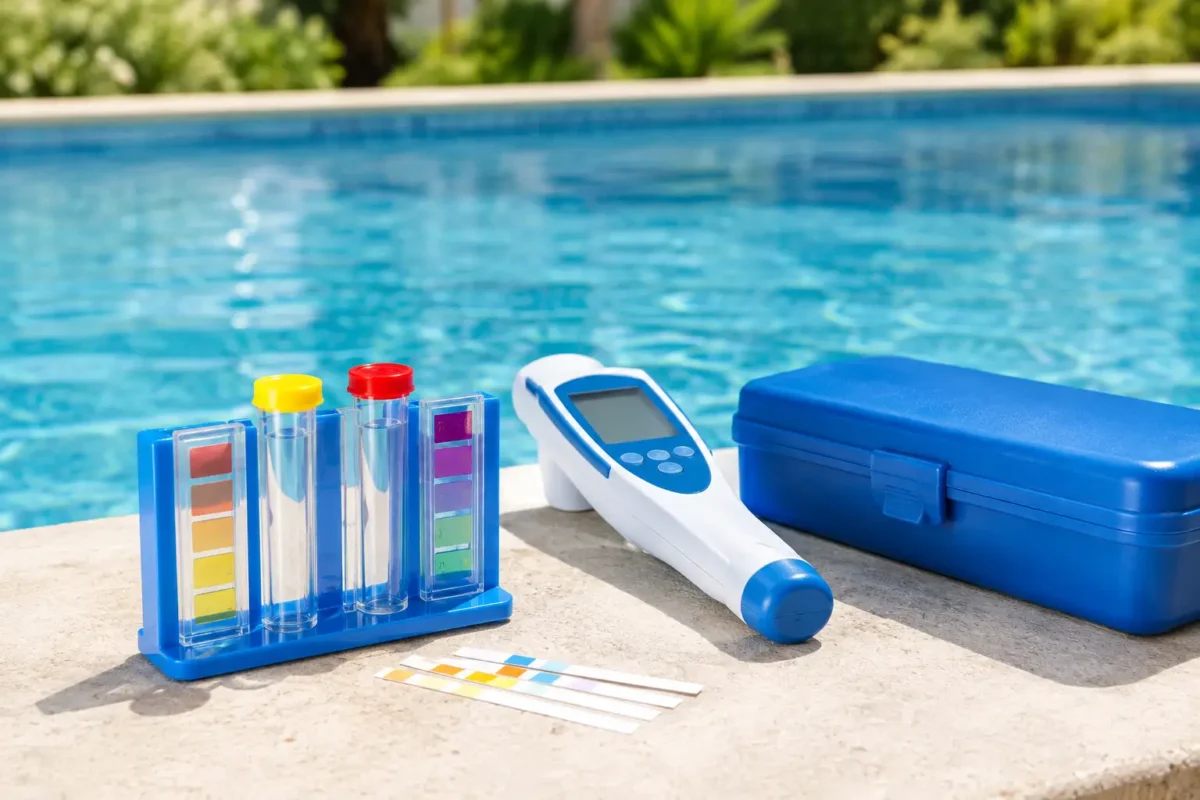
Pool test strips are convenient for a fast daily check, particularly when a maintenance team needs a quick indication of sanitizer and pH. Their trade-off is precision. Lighting, damp hands, expired strips, and subjective color matching can all affect the result.

For more dependable decisions, use a quality liquid reagent kit or a digital photometer. Liquid kits are practical for many residential pools and provide clearer readings for free chlorine, total chlorine, pH, total alkalinity, calcium hardness, and cyanuric acid. Digital photometers are well suited to commercial properties and premium installations where consistent records, accurate dosing, and equipment protection are priorities.

Use a clean sample container and check expiration dates before testing. Old reagents and strips can create a false sense of control, which is more dangerous than recognizing that a reading is unknown.

How to Test Pool Water: Take a Representative Sample

Collecting the sample correctly is the first step. Switch on the circulation system and allow it to run long enough for the water to mix thoroughly. Then take the sample from elbow depth, typically 12 to 18 inches below the surface, and away from return jets, skimmers, chemical feeders, and the pool edge.

Do not test water immediately after adding chlorine, acid, alkalinity increaser, or other treatment products. Give the system time to circulate according to the product instructions. A sample taken beside a feeder or shortly after dosing may show an extreme reading that does not represent the rest of the pool.

If you use test strips, dip one briefly, remove it without shaking it aggressively, and compare the pads to the chart at the exact time specified. With a liquid kit, fill the test cell to the marked line, add the correct number of drops, and read the color against a white background. Digital instruments should be rinsed, calibrated where required, and used with clean cuvettes.

For large pools or facilities with multiple bodies of water, test each pool, spa, fountain, or water feature independently. Shared equipment does not always mean identical chemistry, especially where water temperatures, bather loads, or circulation patterns differ.

The Readings That Matter Most

A complete test can include several measurements, but a few readings determine whether the water is sanitary, comfortable, and compatible with pool finishes and equipment.

Free chlorine and combined chlorine

Free chlorine is the active sanitizer available to control bacteria, organic contaminants, and algae. Most chlorine pools perform well with free chlorine in the 1 to 3 ppm range, though the appropriate level depends on cyanuric acid concentration, bather load, local requirements, and the disinfection system in use.

Total chlorine includes both free chlorine and combined chlorine. Combined chlorine is chlorine that has already reacted with contaminants and is less effective. A noticeable “chlorine smell” often signals chloramines, not excessive free chlorine. If combined chlorine rises above approximately 0.5 ppm, the pool may need oxidation or shock treatment selected for the pool’s equipment and operating conditions.

pH and total alkalinity

pH measures whether pool water is acidic or basic. A target range of 7.2 to 7.6 is commonly recommended. Within that range, chlorine works efficiently, swimmers are more comfortable, and surfaces are less likely to suffer etching or scale formation.

Total alkalinity acts as a buffer that helps prevent pH from moving too quickly. A common target is 80 to 120 ppm, but the ideal number can vary by sanitizer type and water source. Low alkalinity allows pH to swing unpredictably. High alkalinity can make pH difficult to lower and can contribute to cloudy water or scale.

Calcium hardness

Calcium hardness is especially significant for plaster, tile, stone, and other premium finishes. Water with too little calcium may become aggressive and draw minerals from cementitious surfaces or damage metal components. Excessive calcium can create scale on tiles, heaters, salt cells, filters, and plumbing.

Many plaster and concrete pools target roughly 200 to 400 ppm, while vinyl-lined pools may operate at lower levels. The correct range depends on the pool finish, water temperature, total alkalinity, and the broader saturation balance. A professional evaluation is valuable when scale or surface etching appears.

Cyanuric acid

Cyanuric acid, often called stabilizer or conditioner, protects chlorine from rapid sunlight loss in outdoor pools. For many traditionally chlorinated pools, 30 to 50 ppm is a workable range. Saltwater pools may require a higher concentration, commonly 60 to 80 ppm, based on the equipment manufacturer’s guidance.

More stabilizer is not always better. Excess cyanuric acid reduces chlorine’s effectiveness and can make routine sanitation difficult. Because it does not evaporate, lowering an overly high reading often requires partial water replacement.

Adjust Chemistry in the Right Order

A pool is a connected water system. Changing one parameter can influence another, so avoid adding several corrective chemicals at once. Test, make one measured adjustment, circulate, and retest before moving to the next issue.

A sensible order is to address total alkalinity first, then pH, then sanitizer level. After those core readings are stable, review calcium hardness and cyanuric acid. This sequence reduces the risk of chasing numbers and helps prevent unnecessary chemical use.

Always add chemicals according to the manufacturer’s dosing instructions and the actual pool volume. Estimate is not good enough for a large residential or commercial pool. An incorrect volume calculation can lead to under-treatment, wasted chemicals, or aggressive water that damages finishes and mechanical equipment.

Never mix chemicals together, never add water to acid, and never store incompatible products side by side. Apply treatments with the circulation system operating unless the product instructions state otherwise. For premium installations, chemical handling and storage should be part of a controlled maintenance process, not an improvised task.

How Often Should You Test a Pool?

Testing frequency depends on use, weather, water temperature, and the type of disinfection system. A lightly used residential pool may only need a full chemistry check once or twice a week, with free chlorine and pH checked more often. A hotel, community, or high-traffic pool should typically be tested at least daily and may require multiple checks throughout operating hours.

Test after heavy rain, a dust event, a pool party, unusual water loss, equipment service, or an algae treatment. High temperatures and direct sun can consume sanitizer quickly. In hot climates, leaving water unchecked for even a few days can turn a minor imbalance into a filtration, staining, or sanitation issue.

Keep a simple log of dates, readings, chemicals added, water temperature, and any unusual conditions. This record helps identify patterns, such as consistently rising pH, rapidly falling chlorine, or recurring calcium buildup. It also gives facility managers a clear basis for maintenance decisions and service planning.

When Testing Reveals a Bigger Equipment Issue

Balanced chemistry cannot compensate for poor circulation, a blocked filter, a failing pump, or an undersized sanitation system. If chlorine demand remains high despite proper treatment, if water stays dull after balancing, or if pressure and flow are inconsistent, inspect the mechanical side of the installation.

Filter condition, pump run time, valve positions, automated dosing equipment, salt cells, UV systems, and heaters all influence water quality. This is where professional technical support becomes valuable: the correct solution may be a calibration, a circulation adjustment, or a component replacement rather than additional chemicals.

Aquatic Pools and Fountains supports property owners and commercial operators with quality testing systems, treatment products, circulation equipment, and technical maintenance expertise for demanding aquatic environments. A precise test result is only useful when it leads to the right corrective action.

Clear water is the visible result. Consistent testing is the discipline behind it, protecting the comfort, appearance, and long-term performance that a well-designed pool is expected to deliver.

Categories
Uncategorized

LED Pool Lights Comparison for UAE Properties

A pool can look exceptional in daylight and still lose its impact after sunset if the lighting is poorly specified. For villas, hotels, residential towers, and commercial leisure facilities, the right LED system turns water into an architectural feature while supporting safe nighttime use. This LED pool lights comparison focuses on the decisions that affect appearance, operating life, maintenance requirements, and project value in the UAE.

The best choice is rarely the lowest-priced fixture or the brightest one on paper. It is the lighting system that suits the pool finish, installation method, control requirements, water chemistry, and expected service conditions. In a premium property, lighting should feel intentional: even color distribution, reliable performance, and equipment that can be serviced without unnecessary disruption.

LED Pool Lights Comparison: The Main Fixture Types

Most pool-lighting decisions begin with the fixture format. Surface-mounted and niche-mounted lights can both deliver excellent results, but they serve different construction conditions and maintenance priorities.

Niche-mounted LED lights

Niche-mounted lights sit inside a purpose-built housing installed within the pool wall during construction or renovation. The fixture face is generally flush or nearly flush with the finish, creating a clean, integrated appearance that suits luxury pools, tiled spas, and high-visibility hospitality projects.

This is often the preferred option for new builds because the wiring route, niche location, and beam direction can be planned before the pool is finished. It also allows a larger light body, which can support stronger output and more sophisticated optics. For a deep pool, a wide pool, or a pool with dark finishes, this additional performance can be valuable.

The trade-off is installation planning. Retrofitting a niche-mounted light into a completed pool can involve more construction work than a surface-mounted alternative. The niche, conduit, cable length, and waterproof connections must be specified correctly from the start.

Surface-mounted LED lights

Surface-mounted lights attach directly to the pool wall or a suitable mounting plate. They are popular for renovations because they can often be installed without creating a new full-depth niche in the shell. Modern surface-mounted units are compact, refined, and available in white-light and color-changing options.

For property owners upgrading old halogen fittings, a surface-mounted LED can be a practical route to lower energy use and improved visual quality. It can also simplify access for future replacement, depending on the mounting arrangement.

However, not every surface-mounted fixture produces the same visual result. The light body may be more visible than a niche-mounted model, particularly in minimalist mosaic pools. In premium installations, fixture finish, profile, cable routing, and placement must be considered carefully to preserve the overall design.

Retrofit LED lamps

A retrofit LED lamp is designed to replace an existing halogen lamp in a compatible housing. This can be the fastest and most economical upgrade where the old niche, lens, and electrical arrangement remain in good condition.

Retrofit solutions can significantly reduce power consumption and eliminate the frequent lamp changes associated with older halogen systems. Yet compatibility must be confirmed before ordering. An older fixture may have a degraded gasket, unsuitable lens, damaged niche, or transformer that does not work correctly with the selected LED lamp. Replacing only the lamp may save money initially while leaving the weakest parts of the original system in place.

White Light or RGB Color Changing?

White light remains the strongest choice for many premium pools. It shows the true tone of water and tile, improves visibility for swimmers, and delivers a calm, elegant look. Warm white can complement beige stone, timber decking, and residential landscaping. Cool white creates a crisp contemporary effect, especially around pale tile, stainless steel details, and modern architecture.

Color-changing RGB and RGBW lights offer greater flexibility. They are well suited to hotel pools, rooftop lounges, entertainment areas, fountains, and properties that use lighting to create different moods for events. RGBW fixtures add a dedicated white channel, which usually provides a more convincing everyday white than RGB mixing alone.

The decision depends on how the pool is used. A family villa may benefit more from high-quality white illumination that is easy to operate every evening. A resort or commercial venue may gain more value from programmable colors, synchronized scenes, and seasonal displays. Color capability should be chosen as a design feature, not simply because it is available.

Output, Beam Angle, and Pool Finish Matter More Than Wattage

Wattage is an incomplete way to compare LED pool lights. LEDs use far less power than halogen lamps, so a lower-wattage fixture can still provide strong, effective illumination. The more useful considerations are light output, beam spread, fixture placement, and the pool surface itself.

A narrow beam can create bright highlights but leave darker areas across the pool floor. A wider beam generally delivers more even coverage, which is often preferable for swimming pools. Deep pools, pools with unusual shapes, and large commercial basins may need several carefully positioned lights rather than a small number of high-output fixtures.

Finish changes the result dramatically. Light-colored plaster, white tile, and pale mosaic reflect light efficiently and make water appear brighter. Dark blue, charcoal, black, and richly patterned finishes absorb more light, requiring higher output or additional fittings to avoid a flat appearance. A lighting plan should be based on actual dimensions, depth changes, steps, ledges, and finish samples, not just a generic fixture count.

Control Systems: Simple Switching Versus Smart Scenes

The control method determines how easy the system is to use after installation. Basic white lights may operate from a standard switch and timer. This remains a dependable option for residences where the goal is straightforward nighttime illumination.

Color-changing systems can be controlled through power cycling, remote controls, wall-mounted controllers, or integrated automation platforms. Power-cycling is simple but less precise, as users must switch the fixture on and off in a sequence to reach a chosen color or program. It may be adequate for small residential pools but is less suitable for larger sites where consistent scenes matter.

Dedicated controllers provide better control of colors, brightness, timing, and synchronization. For villas with integrated landscape lighting, hotel facilities, and multi-pool developments, automation compatibility is worth considering early. A coordinated system can operate pool lights, fountain lighting, garden zones, and schedules from one platform.

The practical question is not whether smart control is impressive. It is whether the property team or homeowner will use it. The best system is intuitive, reliable, and properly commissioned with clear operating instructions.

Material Quality and UAE Service Conditions

Pool lighting works in a demanding environment: continuous moisture, chemical exposure, heat, and regular operating cycles. In Dubai and across the UAE, outdoor installations also face high ambient temperatures, strong UV exposure, and long periods of intensive use.

Quality housings, sealed cable entries, suitable lenses, and corrosion-resistant components are essential. The fixture should be designed for submerged use and installed according to its specified ingress protection, voltage, and grounding requirements. For saltwater pools or pools with aggressive chemical conditions, material selection becomes even more critical.

Low-voltage LED systems are widely used because they support safer poolside operation when correctly installed. The transformer, junction box, cable sizing, and electrical protection must be treated as part of the lighting system, not as secondary accessories. A premium fixture can still perform poorly if paired with an unsuitable transformer or an improperly sealed connection.

For commercial facilities, serviceability should be part of procurement. Ask whether replacement parts, compatible controllers, transformers, and matching fixtures can be sourced locally. Selecting equipment with dependable stock support reduces downtime and helps maintain a consistent visual standard across the property.

Installation and Placement Define the Final Result

Even the best LED fixture cannot compensate for poor placement. Lights are typically positioned to illuminate across the pool rather than directly toward common viewing areas. This reduces glare from terraces, lounges, and interior spaces while making the water feel evenly lit.

Steps, tanning ledges, swim-out areas, and spa benches deserve separate attention. These features improve the pool experience, but they can create shadows if the main lights are aimed only at the open basin. In a commercial environment, well-lit entry points also support safer guest movement after dark.

Professional installation also protects the long-term integrity of the pool shell and waterproofing system. Cable conduits need correct routing, niches must be securely installed, and every connection must remain accessible where required. For renovations, a site inspection can identify whether an existing niche can be reused or whether a new lighting approach will provide a more dependable result.

Choosing the Right LED Pool Lighting System

For a new luxury villa, niche-mounted white or RGBW lights with a properly planned control system often provide the most refined result. For a renovation, surface-mounted fixtures or compatible LED retrofits may deliver a substantial upgrade with less construction work. For hotels, residential communities, and commercial leisure facilities, the priority should be consistent output, controller reliability, local service support, and a lighting layout built for the full operating environment.

Aquatic Pools and Fountains helps property owners, developers, and facility teams select premium pool and fountain lighting that matches the installation, visual objective, and maintenance strategy. The right recommendation considers more than a catalog specification. It accounts for the pool’s finish, electrical infrastructure, operating schedule, and the standard the property needs to maintain.

A well-designed LED lighting system should disappear into the experience: clear water, confident visibility, elegant reflections, and a pool that remains one of the property’s strongest features long after sunset.

Categories
Uncategorized

Commercial Pool Maintenance Guide for UAE Sites

A hotel pool can lose guest confidence long before the water looks visibly unclean. A slight chemical odor, cloudy edges, a noisy pump room, or uneven circulation signals that standards are slipping. This commercial pool maintenance guide is designed for facility managers, hospitality operators, developers, and property owners who need their aquatic assets to perform safely, efficiently, and at a premium level in the UAE.

Commercial pools carry a heavier operational burden than private pools. High bather loads, intense sun, airborne dust, elevated water temperatures, and long operating hours all place pressure on water balance and equipment. The correct approach is not occasional cleaning. It is a disciplined maintenance program supported by quality pumps, filters, disinfection systems, testing equipment, and trained technical oversight.

Start With Water Quality, Not Appearances

Clear water is only one measure of a well-maintained pool. Water can appear clean while its sanitizer level, pH, alkalinity, or calcium balance is outside the acceptable operating range. In a commercial environment, that creates avoidable risks for swimmers, surfaces, and equipment.

Testing should be performed at defined intervals throughout the day, particularly for pools with heavy guest or resident use. At a minimum, operators should monitor disinfectant residual, pH, total alkalinity, calcium hardness, cyanuric acid where applicable, total dissolved solids, and water temperature. Testing records should be documented, not treated as informal notes. A consistent log gives facility teams evidence of control and helps technicians identify recurring issues before they become expensive repairs.

The ideal chemical program depends on the pool type, bather load, filtration design, source water, and chosen disinfection method. Chlorine remains widely used because it is effective and familiar, while salt chlorination, UV systems, and ozone can reduce chloramine formation and improve the swimmer experience when correctly specified. These systems complement a complete sanitation program; they do not remove the need for measured chemical control.

Balance Protects the Entire Installation

Poor pH control is one of the most common causes of discomfort and premature equipment wear. Water that is too acidic may corrode metal components, damage finishes, and shorten the life of heaters and pumps. Water that is too alkaline can cause scaling, cloudy water, and reduced sanitizer effectiveness.

In Dubai and across the UAE, high temperatures and mineral content in source water make balance especially significant. Calcium scale can form on tile lines, heat-exchange surfaces, salt cells, and internal pipework. Treating scale after it develops is more disruptive than preventing it through regular testing, appropriate dosing, and professionally selected chemical products.

Build a Commercial Pool Maintenance Schedule

A commercial pool needs a schedule that reflects how it is actually used. A residential tower pool open for limited hours requires a different service level than a resort pool operating from morning through late evening. Still, every commercial site should separate daily operating tasks from weekly inspections and planned preventive maintenance.

Daily work should include visual water checks, testing and adjustment, skimming, vacuuming as needed, emptying skimmer and pump baskets, checking water level, and inspecting deck conditions. Staff should also listen for unusual pump noise, watch for leaks, and confirm that safety equipment is present and accessible.

Weekly attention should move deeper into the system. This includes inspecting filter pressure, backwashing or cleaning filters according to manufacturer guidance, brushing walls and steps, checking return fittings, examining grates and covers, and reviewing chemical consumption. Sudden increases in chemical demand often point to a circulation, contamination, or water-balance problem.

Monthly and quarterly visits should focus on planned technical inspections. Pumps, valves, electrical connections, timers, control panels, heat-cool pumps, automatic dosing systems, lights, and disinfection equipment all require professional review. A premium installation deserves more than reactive repair after a failure occurs.

Keep Circulation and Filtration at Full Performance

Water treatment begins in the plant room. If the circulation system is undersized, poorly configured, clogged, or running for too few hours, chemical treatment cannot compensate for it. Every part of the pool should receive properly filtered and disinfected water, with no stagnant areas around steps, corners, spas, or shallow ledges.

Facility teams should understand the pool’s turnover requirement – the time needed to circulate the full water volume through the filtration system. The correct runtime depends on pool volume, occupancy, local requirements, and hydraulic design. Reducing pump hours to save energy may look attractive on a utility report, but it can lead to cloudiness, algae growth, extra chemical use, and guest complaints. Variable-speed pumps can provide an efficient alternative when selected and programmed around the actual hydraulic demand.

Filter pressure is a useful operational indicator, but it should not be read in isolation. High pressure may signal that the filter needs cleaning, while unusually low pressure can indicate a blockage, air leak, or pump issue. Sand, glass media, cartridge, and diatomaceous earth filters each have distinct cleaning and service needs. The filter manufacturer’s operating parameters should guide decisions rather than a fixed calendar routine.

Do Not Neglect the Pump Room

A clean, organized pump room makes maintenance safer and faster. Chemical containers should be correctly stored and clearly labeled. Pipework, valves, dosing lines, and electrical panels should remain accessible. Water leaks, corrosion, vibration, and poor ventilation should be addressed immediately.

The pump room also benefits from clear labeling. When isolation valves, suction lines, return lines, and equipment controls are identified, staff can respond more confidently during an incident and technicians can complete service work without unnecessary downtime.

Protect Surfaces, Decks, and Guest-Facing Details

Commercial pool maintenance is not limited to the water. Guests judge the entire environment: tile lines, coping, drainage channels, handrails, ladders, lights, grilles, and surrounding deck surfaces. A technically sound pool can still undermine a luxury property if finishes look stained, worn, or poorly maintained.

Brush pool walls and waterlines regularly to prevent biofilm, scale, and cosmetic buildup. Use cleaning products suited to the finish. Aggressive chemicals or unsuitable tools can damage mosaics, natural stone, grouting, stainless steel, and coated fixtures. The right method depends on whether the pool has porcelain tile, glass mosaic, plaster, exposed aggregate, or a specialty finish.

Drain covers, grates, and handrails need close inspection because they directly affect safety. Loose fittings, sharp edges, cracked covers, and slippery deck areas should trigger immediate corrective action. Lighting should also be checked for water ingress, failed seals, and inconsistent illumination. For hotels and high-visibility developments, well-maintained LED lighting supports both safety and the visual impact of the property after dark.

Plan for Heat, Dust, and Heavy Usage

UAE conditions require a maintenance plan that is responsive, not static. Fine dust can enter the pool and place additional load on skimmers and filters. Intense sunlight accelerates chlorine consumption. Warm water encourages algae growth and can make water balance more difficult to control.

During periods of high occupancy, increase testing frequency and inspect baskets, filters, and water level more often. After events, storms, landscaping work, or unusually high bather loads, assess the pool before returning to normal operation. A timely shock treatment, extended filtration cycle, or filter clean may prevent a larger water-quality issue the following day.

Seasonality still matters, even in a warm climate. Outdoor pools may see changing use patterns, while temperature-controlled pools and spas need particular attention to heating, cooling, circulation, and evaporation. The most efficient plan adapts to operating data rather than relying on assumptions.

Use Professionals for Technical and Compliance-Critical Work

On-site teams can perform routine checks effectively when trained and equipped, but commercial assets also require specialist support. Electrical faults, pump and filter repairs, automation programming, leak detection, media replacement, chemical-system calibration, and major water corrections should be handled by qualified pool technicians.

This is where a full-scope service partner adds value. The right provider can supply compatible replacement parts, diagnose the underlying cause of recurring failures, and recommend upgrades that improve reliability instead of repeatedly repairing an aging component. Aquatic Pools and Fountains supports commercial clients with premium equipment, technical guidance, and maintenance solutions selected for demanding aquatic environments.

A preventive service agreement is often more cost-effective than emergency callouts. It creates predictable inspection intervals, reduces unplanned closures, and helps protect capital equipment such as pumps, filters, heat-cool pumps, automatic dosing units, and disinfection systems. For facilities with multiple pools, fountains, or water features, centralized maintenance planning also improves consistency across the portfolio.

A Commercial Pool Maintenance Guide for Better Asset Value

The strongest commercial pool maintenance programs treat the pool as a valuable operating asset, not a decorative amenity that only needs attention when something goes wrong. Consistent testing, disciplined circulation, clean finishes, reliable equipment, and documented preventive service protect guest safety and preserve the polished appearance expected from premium properties.

When maintenance decisions are based on water data, equipment condition, and actual usage, facility teams can avoid many of the failures that lead to downtime. The result is a pool environment that remains inviting for guests, dependable for operators, and worthy of the property it represents.